
On This Page6 sections
APPLE LUCE · RELIGHTABLE 3D ASSET GENERATION
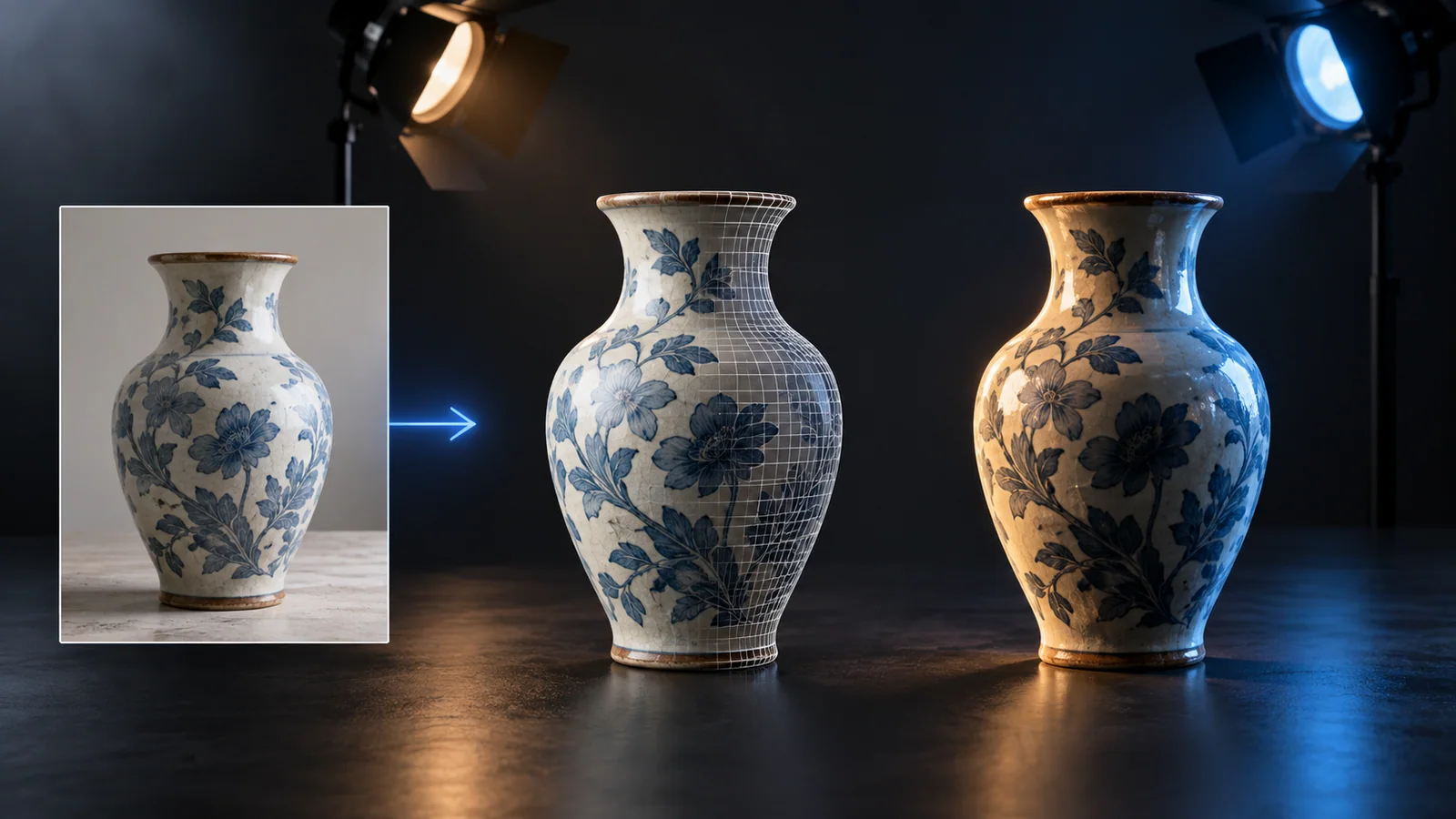
Luce is Apple Machine Learning Research’s August 2026 method for image-to-3D asset generation. Instead of a baked-in lighting look, it predicts geometry and physically based materials inside a voxelised multimodal Gaussian cloud, so the result can be relit and exported as a textured mesh.
Apple Research pageCompare Luce vs SHARPRun SHARP locally
What “relightable” buys you
Most single-image 3D methods bake the photo’s lighting into colour, so the asset looks wrong under a new light. Luce separates albedo from metallic, roughness and surface normals, which is what game engines and renderers expect from a PBR material. The paper also reports that fine details such as text and logos survive the reconstruction.
Luce vs SHARP
SHARP turns a photo of a scene into 3D Gaussians for nearby-view synthesis in under a second, and its code is public. Luce targets objects and produces editable, relightable assets. If you want a 3D-photo effect, use SHARP today; if you want a product or game asset, watch Luce.
Questions
Can I run Luce today?
As of the check date we could not confirm a public code or weight release. This page tracks the research; SHARP is the Apple image-to-3D model you can run now.
What is a Gaussian “cloud” or splat?
3D Gaussian splatting represents a scene as many small, soft ellipsoids with colour and opacity that render in real time. Luce adds material channels to each Gaussian so lighting can be computed instead of baked.
At a glance
Input
One object image, conditioned on multi-layer features from a pretrained encoder
Output
Relightable PBR Gaussians (albedo, metallic-roughness, normals) + optional textured mesh with tangent-space normal maps
Reported results
28% lower FID than the strongest baseline on Toys4K; CLIP image alignment 0.8519 vs 0.8299
Published
August 2026 · arXiv 2608.23943
Code & weights
Not confirmed as released at the time of checking; follow the research page
Checked 2026-09-17
Official sources
Related
Continue Reading
More articles connected to the same themes, protocols, and tools.



Referenced Tools
Browse entries that are adjacent to the topics covered in this article.