
On This Page8 sections
SHARP · IMAGE TO 3D
See Apple’s single-image view synthesis examples, then generate a 3D Gaussian representation from your own photograph locally.
Explore the official comparison gallery
This gallery contains pre-rendered research examples with interactive scene and method comparisons. It does not upload your photo or run SHARP inference in your browser.
Generate a scene from your own image
Install SHARP
Python 3.13 · official SHARP CLI
conda create -n sharp python=3.13 -y
conda activate sharp
git clone https://github.com/apple-aiml-research/ml-sharp.git
cd ml-sharp
python -m pip install -r requirements.txt
sharp --help
Put one or more photos in an input directory, then run prediction. The checkpoint downloads automatically on the first run.
Predict
sharp predict -i ./input -o ./outputSuccessful prediction writes 3D Gaussian .ply files to the output directory. Open them in a compatible Gaussian-splat viewer. The result supports nearby viewpoints; it is not a complete reconstruction of unseen parts of a scene.
Choose the right device
Gaussian prediction
CPU, CUDA or Apple MPS
Render a camera-path video
CUDA GPU required by the official renderer
Optional: render a video on CUDA
CUDA
sharp predict -i ./input -o ./output --render
# Or render previously generated Gaussians:
sharp render -i ./output -o ./renderings
If something goes wrong
- First run appears slow: allow time for checkpoint download and initialization; inspect the terminal output.
- Video rendering fails on Mac: prediction supports MPS, but the official --render path requires CUDA.
- Scene orientation looks wrong in another viewer: SHARP uses OpenCV coordinates; check scale and rotation in that viewer.
Official code and examples · checked September 12, 2026
Apple GitHub ↗ · Official examples ↗ · Paper ↗
Image to 3D: one photo, a 3D Gaussian splat
IMAGE TO 3D · GAUSSIAN SPLATS
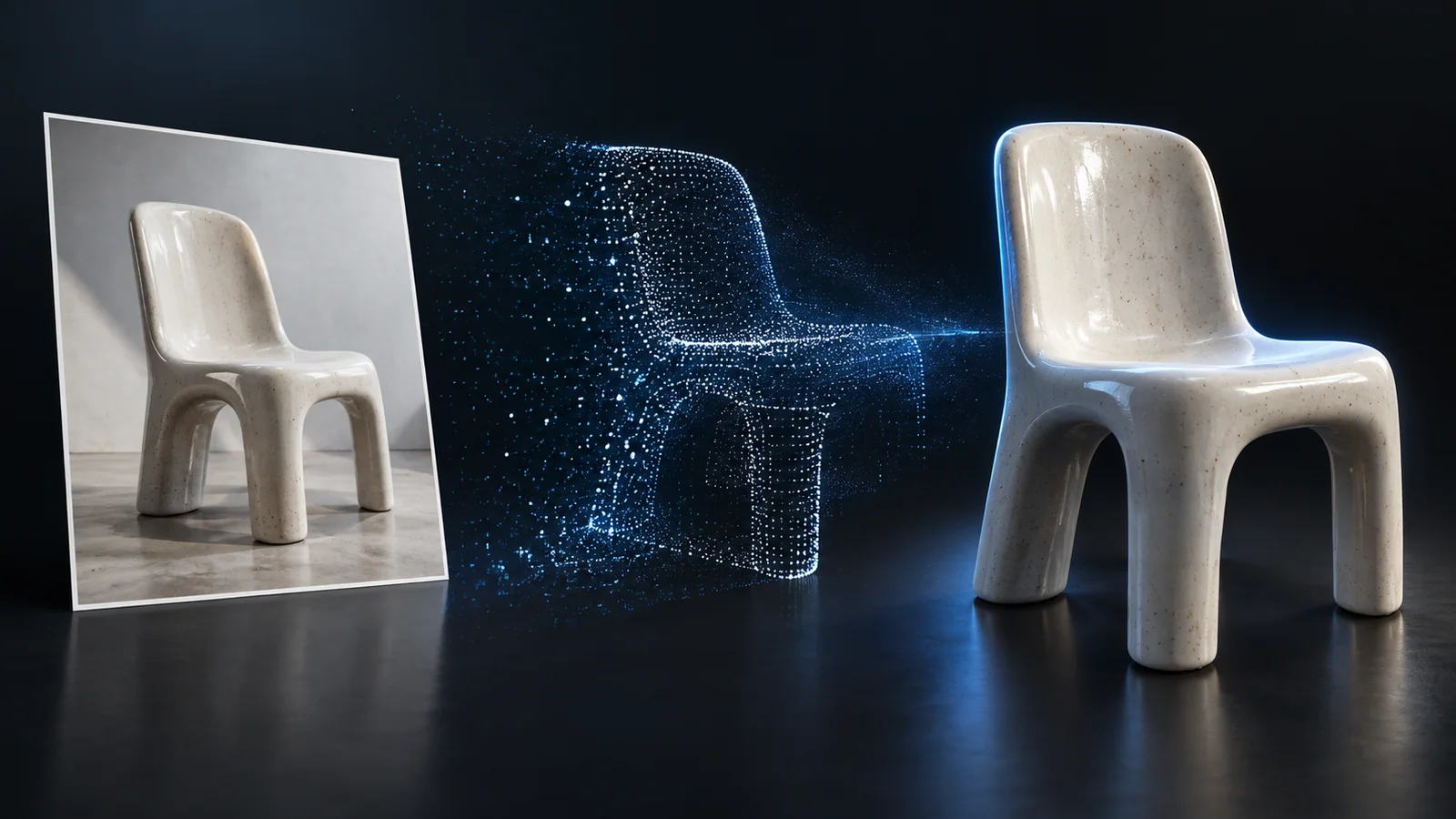
Apple SHARP predicts a 3D Gaussian representation from a single photograph in under a second on a GPU and renders nearby viewpoints in real time. This page is the task-first guide: what you get, how to run it locally on Mac or CUDA, and how to view the result.
See official SHARP examples · GitHub
What you get
- A .ply file of 3D Gaussians with metric scale, ready for splat viewers.
- Real-time parallax around the original viewpoint—think 3D photos, not a full model.
- Optional rendered camera-path videos on CUDA GPUs.
Run SHARP locally
- Create a Python 3.13 environment and install the official repository.
- Put one or more photos in an input folder.
- Run sharp predict; the checkpoint downloads on first use.
- Open the output .ply in a Gaussian-splat viewer.
Python 3.13 · official SHARP CLI
conda create -n sharp python=3.13 -y
conda activate sharp
git clone https://github.com/apple-aiml-research/ml-sharp.git
cd ml-sharp
python -m pip install -r requirements.txt
sharp predict -i ./input -o ./output        # CPU, CUDA or MPS
sharp predict -i ./input -o ./output --render   # video rendering needs CUDA
Viewing the result
SHARP writes standard 3D Gaussian .ply files. Web-based splat viewers open them directly; SHARP uses OpenCV camera conventions, so check scale and orientation if a viewer shows the scene flipped.
Need a relightable asset instead?
Luce (Apple, August 2026) targets objects rather than scenes and predicts PBR materials—albedo, metallic-roughness and normals—so the asset can be relit and exported as a mesh. Code was not confirmed as public at the time of checking.
Questions
Is this the same as photogrammetry?
No. Photogrammetry needs many photos and reconstructs the full object. SHARP infers a plausible 3D scene from one photo and is designed for nearby views only.
Can it run in the browser?
Generation runs locally with the official CLI; there is no in-browser inference. Viewing the .ply output in a web splat viewer works fine.
Does it work on iPhone?
Not as shipped; the reference implementation is a Python package for Mac and Linux. Render the result on a computer, then share the video or splat file.
Hardware
-
Prediction: CPU, CUDA or Apple Silicon (MPS).
-
Video rendering (--render): CUDA GPU required by the official renderer.
-
A recent Mac produces a scene in seconds; unseen regions stay unreconstructed.
Continue Reading
More articles connected to the same themes, protocols, and tools.
Referenced Tools
Browse entries that are adjacent to the topics covered in this article.