
 ConductorA standalone macOS orchestration layer for coordinating multiple coding-agent runtimes across isolated workspaces, testing environments, and pull request workflows.

Unstoppable
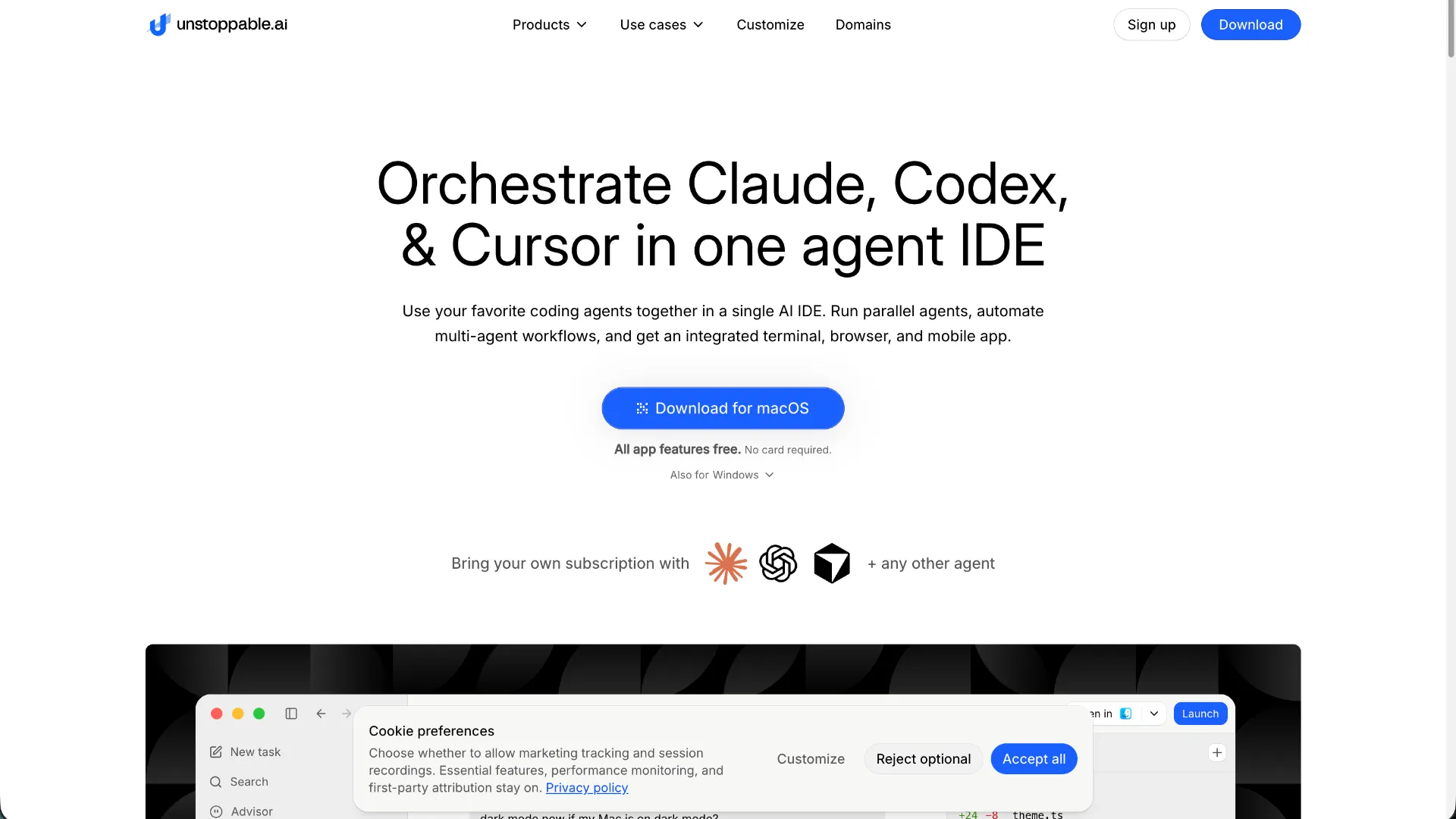
Unstoppable is a standalone agentic development environment focused on orchestrating multiple coding agents, isolated development tasks, and repeatable software delivery workflows.
Information checked: Oct 22, 2026 ·View sources
Tool details
- Type
- AI editors
- Platforms
- macOS (Apple Silicon), macOS (Intel), Windows, iOS (companion app), Android (companion app), Web (remote control and hosted agents)
- Free plan
- Yes
- Open source
- No
- Bring your own key
- No
- Local models
- Yes
Overview
Best for
- Developers coordinating Claude Code and Codex
- Running independent coding tasks in parallel
- Multi-repository engineering workflows
- Teams adopting agent-based development processes
- Automating bug triage, testing, and pull-request reviews
- Developers seeking an integrated agent orchestration workspace
Strengths
- Coordinates multiple coding agents in one environment
- Git worktrees isolate simultaneous development tasks
- Supports existing Claude Code and Codex subscriptions
- Combines agent execution, code review, and automation
- Offers local execution and optional remote access
- Desktop app features currently advertised as free
Limitations & trade-offs
- Developers primarily seeking lightweight inline autocomplete
- Users who prefer traditional manual editing without agents
- Teams unwilling to review agent-generated changes
- Users who need a fully documented first-party BYOK billing workflow
- Users who require a browser-only replacement for a full local development environment
- Less focused on inline autocomplete than editor-first alternatives
- External provider subscriptions or AI credits may still be required
- Parallel branches can create integration and review overhead
- Remote control of local sessions requires the desktop computer to remain online
- Cloud and connected-provider workflows introduce additional privacy considerations
- First-class API-key billing support is not clearly documented
Get started
Pricing & usage limits
Free tier available
Free Workspace$0 / free
All app features are advertised as free with sign-in. Includes an option to enable 25 free AI credits daily, subject to usage limits.
Additional AI CreditsVariable / usage-based
Additional credits can be purchased. Public credit unit prices were not verified.
Existing Agent SubscriptionsVaries
Use eligible Claude Code or Codex subscriptions. Provider subscriptions and their usage limits remain separate from Unstoppable.
Pricing checked: Oct 22, 2026 · Subscription, usage limits, and model costs may be billed separately.
Features & details
Multi-Agent Development
- First-class Claude Code and Codex integration
- Run additional CLI coding agents
- Parallel execution in isolated Git worktrees
- Multi-repository development workflows
- Per-task agent selection and execution
Integrated Development Environment
- Built-in terminal, code editor, and browser
- Git changes, diffs, and pull-request tracking
- GitHub and Linear integrations
- Persistent task context and agent history
- Desktop applications for macOS and Windows
Automation and Quality Control
- Multi-step agent pipelines
- Scheduled, webhook, and event-triggered workflows
- Human approval and testing gates
- Cross-agent code reviews
- Repeatable development and review processes
Remote Access and Team Management
- iOS and Android companion applications
- Browser-based remote control of local sessions
- Hosted web-agent execution
- Team model and plugin permissions
- Token usage and cost dashboards
- Activity visibility and administration controls
Why Choose Unstoppable.ai?
Unstoppable addresses a problem that becomes more noticeable as developers adopt multiple AI coding agents: generating code is increasingly easy, but coordinating, reviewing, and integrating that code remains difficult.
A developer using Claude Code and OpenAI Codex independently can already delegate refactors, bug fixes, and test creation. However, distributing work across separate terminals and repositories creates operational overhead. Developers must remember which agent owns each task, monitor progress, inspect changes, and bring the results back into a coherent codebase.
Unstoppable approaches this as an orchestration problem rather than primarily an autocomplete problem. Its purpose is to give developers a shared operating environment for supervising independent AI-generated work.
This distinction matters because more concurrent agents do not automatically produce more completed software. Throughput improves when tasks have clear boundaries, agents can work without blocking one another, and completed changes move through reliable verification. Otherwise, faster generation simply moves the bottleneck to code review and integration.
The strongest reason to consider Unstoppable is therefore not access to a particular model. It is the possibility of making a multi-agent development process more repeatable and easier to supervise.
Core Workflow: From Task to Verified Pull Request
A useful way to evaluate Unstoppable is to follow a realistic engineering task from assignment to integration.
Consider a web application with three pending changes: improving an authentication flow, correcting an API validation bug, and extending the test suite. Instead of asking one agent to perform everything sequentially, a developer can separate the work into independently scoped tasks.
Each task should begin with a clear acceptance criterion. The authentication change might require preserving the existing session format; the API fix must maintain backward compatibility; and the tests must cover specific failure conditions.
Separate Git worktrees allow the tasks to proceed without agents editing the same working directory. The developer can then inspect each proposed approach, review generated changes, run appropriate checks, and decide which branches are ready for integration.
The important distinction is between filesystem isolation and integration safety. Worktrees prevent simultaneous agents from directly overwriting files in a shared checkout, but they do not prevent logical conflicts. Two branches may independently change the same API contract or introduce incompatible assumptions.
For this reason, a sound workflow should retain automated tests, explicit approval points, and human responsibility for merging. Cross-agent reviews can provide additional scrutiny, but agreement between two models is not a substitute for passing tests or understanding the implementation.
Unstoppable becomes most valuable when these verification practices are repeated across many tasks rather than recreated for every new agent conversation.
Use Cases That Benefit From Agent Orchestration
Parallel feature development. A full-stack team may have frontend, backend, and testing changes that can begin independently. Agents can make progress concurrently when the interfaces between those tasks are already defined. The developer still needs to reconcile cross-layer assumptions before delivery.
Continuous bug triage. Repeated reports can be classified and investigated through structured workflows. The useful outcome is not merely an automatically generated patch, but a reproducible path from issue description to diagnosis, verification, and review.
Pull-request quality assurance. One agent can implement a change while another examines the resulting diff for regressions, missing edge cases, or architectural concerns. Independent review is particularly useful when reviewers receive the original requirements rather than relying exclusively on the implementing agent's summary.
Multi-repository maintenance. Applications split across frontend, backend, and shared packages require coordinated changes. A workspace that keeps related tasks visible can make it easier to follow several pull requests through their separate review cycles. Shared interfaces and dependency versions still need explicit coordination.
Long-running development work. Developers may need to respond to agent questions while away from their primary computer. Remote control is useful for that supervisory role, but it should not be confused with hosted execution: a locally running desktop session still requires its host computer to remain online. Hosted web agents use a separate cloud execution environment.
These workflows are less compelling for developers who mostly make small manual edits and only occasionally ask an assistant to explain a function.
Comparison to Alternatives
Unstoppable vs Cursor
Cursor centers the developer experience on an AI-native editor. That makes it a natural choice for interactive coding, navigation, inline changes, and closely supervised implementation.
Unstoppable emphasizes the coordination of separate agent tasks and the movement of those tasks through a broader development process. Its advantage is potentially greater when a developer supervises several concurrent workstreams rather than spending most of the day directly editing one active file.
This is a workflow distinction, not evidence that one product generates better code. Output quality depends heavily on the selected models, repository context, and task specification.
Unstoppable vs Conductor
Conductor is a closer comparison because it also coordinates coding agents in isolated workspaces. Both products target developers who want to supervise Claude Code, Codex, and other agent runtimes without manually maintaining many independent sessions.
The practical comparison should focus on execution environments, workflow automation, review ergonomics, remote supervision, and team governance. Conductor's local and cloud workspace options may appeal to developers who prioritize agent execution infrastructure. Unstoppable places particular emphasis on repeatable cross-agent pipelines and organization-level coordination.
Both products are evolving, so feature availability should be checked directly rather than inferred from older comparison tables.
Unstoppable vs Orca
The Orca agent development environment at onorca.dev is another close substitute. It also focuses on running multiple CLI agents, managing worktrees, and combining developer tools into a single interface.
Orca is particularly relevant for developers who value an open-source-oriented development environment and extensive support for different CLI agents. Unstoppable may be more attractive to teams evaluating its integrated automation, activity reporting, and administrative workflows.
The name Orca is used by several unrelated developer projects, so comparisons should identify the specific product rather than combining their capabilities.
Unstoppable vs Windsurf
Windsurf is more strongly associated with an editor-native AI development experience. Developers who want interactive code assistance closely integrated with everyday editing may prefer that approach.
Unstoppable is better evaluated as a coordination environment for autonomous work. A fair comparison should ask how frequently the developer needs inline editing versus parallel task management, rather than treating both products as interchangeable autocomplete tools.
Claude Code and Codex themselves are also important workflow components, but their terminal-first runtimes are not direct replacements for an entire multi-agent IDE.
Best Configuration for Reliable Development
A sensible adoption process begins with one familiar Git repository and a small number of independent tasks. Launching many agents immediately makes it difficult to determine whether the orchestration layer is improving productivity or merely increasing work in progress.
Start with two distinct changes that have clearly defined acceptance criteria. Use separate worktrees and preserve a stable integration branch. Choose one supported coding agent for each task, then compare completion time, test results, review effort, and the amount of correction required.
The initial goal should be to establish a reliable baseline rather than maximize parallel sessions.
For repositories with mature testing infrastructure, require relevant unit tests, linting, type checks, or integration tests before accepting generated changes. Projects with weaker tests should receive additional manual scrutiny, particularly around authentication, payments, database migrations, and deployment configuration.
Keep durable project rules in version-controlled instruction files such as AGENTS.md or CLAUDE.md where supported by the selected agent. The exact discovery behavior depends on the runtime, so verify that every agent receives the intended guidance.
Limit external connectors to the minimum permissions each task needs. Read-only repository or issue access can be useful during investigation, while production changes and sensitive write operations should remain behind explicit approval gates.
For longer workflows, separate implementation, verification, and review into distinct stages with clear success conditions. A failed test should block delivery rather than become an instruction for another agent to declare the change acceptable.
This configuration makes the orchestration process more auditable and reduces the chance that errors from an early stage silently propagate into later stages.
Cost, Privacy, and Operational Boundaries
Unstoppable's billing model requires distinguishing the application workspace from the agents performing inference.
The current official website advertises free application features, while supported external agent subscriptions retain their own conditions and limits. Optional AI credits provide another usage path. Older indexed pages under the app subdomain still describe trial-based and paid-tier arrangements, so the current official site should be checked before relying on a particular commercial assumption.
For teams already subscribing to Claude Code or Codex, the relevant question is whether orchestration improves the value received from those subscriptions. Running more agents can increase aggregate model usage, even when the workspace itself has no subscription fee.
There is also an important distinction between bring-your-own-subscription and bring-your-own-key. The former uses an existing agent subscription; the latter connects a provider-issued API key with its own billing arrangement. Unstoppable's first-party documentation emphasizes the subscription approach, so general API-key support should not be assumed from that alone.
Privacy requires equally careful interpretation. Local repository execution does not imply that every model interaction remains on the device. When a hosted model is selected, its provider may receive the prompts and relevant source context needed to perform the task.
Official materials also describe local inference through Ollama, but developers should verify the exact agent and model configuration before assuming an entirely local workflow.
The privacy policy describes configurable activity synchronization and organizational visibility. Developers working on sensitive repositories should inspect those settings before enabling cloud history, team sharing, remote access, or third-party connectors. Local execution, remote mirroring, and hosted agents have different exposure boundaries.
Migration Notes for Existing AI Coding Workflows
Moving from separate Claude Code or Codex terminals does not require abandoning the underlying tools. Unstoppable is intended to coordinate supported agent runtimes rather than replace their model capabilities.
A gradual migration is preferable to moving an entire development organization at once.
Begin with a repository whose build and test procedures are well understood. Connect the existing supported subscriptions, verify authentication, and confirm that agents can access only the intended working directories.
If previous workflows depend on custom instructions, skills, MCP servers, or reusable prompts, inventory those assets before importing or synchronizing them. Even when a tool can import configuration and history, developers should verify that permission boundaries, environment variables, and runtime-specific instructions still behave as expected.
Avoid treating automatically recovered conversation history as the sole source of project knowledge. Important architectural decisions and acceptance criteria should remain accessible in durable documentation or the repository itself.
Teams migrating from Cursor or Windsurf should also plan for a change in interaction style. Editor-first development emphasizes working directly with code while an assistant helps. Agent orchestration emphasizes defining outcomes, supervising execution, and reviewing completed changes. The latter requires more attention to task decomposition and integration discipline.
A useful success measure is the amount of verified, maintainable work delivered per developer hour, not the number of active agents or lines of generated code.
Final Assessment
Unstoppable represents an increasingly important direction in AI development tooling: moving beyond individual coding assistants toward environments that coordinate software delivery across multiple agents.
Its value depends on whether parallel execution, repeated verification, and task-level visibility solve real problems in a developer's existing workflow. Developers already comfortable with Claude Code and Codex have a particularly relevant reason to evaluate it, because the product is designed to build an orchestration layer around familiar tools.
For teams that need only fast inline suggestions and occasional conversational editing, a conventional AI-native editor may remain simpler. For teams managing independent AI coding tasks every day, Unstoppable offers a framework worth testing against their current process.
The most meaningful evaluation is a controlled trial using representative repository tasks, measured by correctness, review burden, integration effort, and total model consumption rather than vendor marketing claims.
Model support & data privacy
Supported models
- Claude
- DeepSeek
- Ollama
Privacy & data handling
Local coding agents operate in selected local folders and Git worktrees. Official documentation also discusses Ollama-based local inference, but hosted models receive the prompts and code context sent to them. The October 8, 2026 privacy policy states that activity-sharing categories default to Off, although organization administrators may impose minimum visibility settings. Hosted agents and connected plugins have separate data-access implications. Review provider permissions, organization settings, and activity synchronization before processing sensitive repositories.
Guides, reviews & fixes
No published guides yet. Start with the official documentation above.
Product updates
No verified product updates listed yet. Follow this tool to see new relevant content in Saved.
See the content timelineAlternatives
ConductorA standalone macOS orchestration layer for coordinating multiple coding-agent runtimes across isolated workspaces, testing environments, and pull request workflows. OrcaOrca is a standalone, local-first agent IDE for coordinating multiple CLI coding agents across isolated git worktrees.
 CursorCursor is an AI coding and cloud development platform that combines a VS Code-based editor, local and cloud agents, CLI workflows, Origin code hosting, repository collaboration, and prompt-to-app creation.
 WindsurfWindsurf, now transitioning under the Devin Desktop brand, is an AI-native IDE for developers who want coding agents, codebase context, and editor workflows in one desktop environment.
Sources & verification
Verification dates record when this directory checked the information. Product release dates appear separately above.
Official websiteUnstoppable CodeOfficial DownloadsAgent Development WorkflowsBring Your Own SubscriptionMulti-Agent PipelinesTeam AdministrationOfficial Privacy PolicyIntroducing Unstoppable.aiLocal Ollama and Agent OrchestrationBYOK and BYOS Explanation
Directory revision history
Official pages checked. The current website advertises all application features as free. The download page lists desktop version 1.13.0; this is an observed version, not a verified release date.
The current privacy policy took effect, describing activity-sharing controls, provider processing, and agent-cloud synchronization.
The official Why Choose Unstoppable Code article was updated with discussion of coordinated coding, verification, and review workflows.
Unstoppable.ai was publicly introduced as a new home for AI products, including its developer-focused desktop environment.