

On This Page7 sections
LUCE VS SHARP · APPLE IMAGE-TO-3D
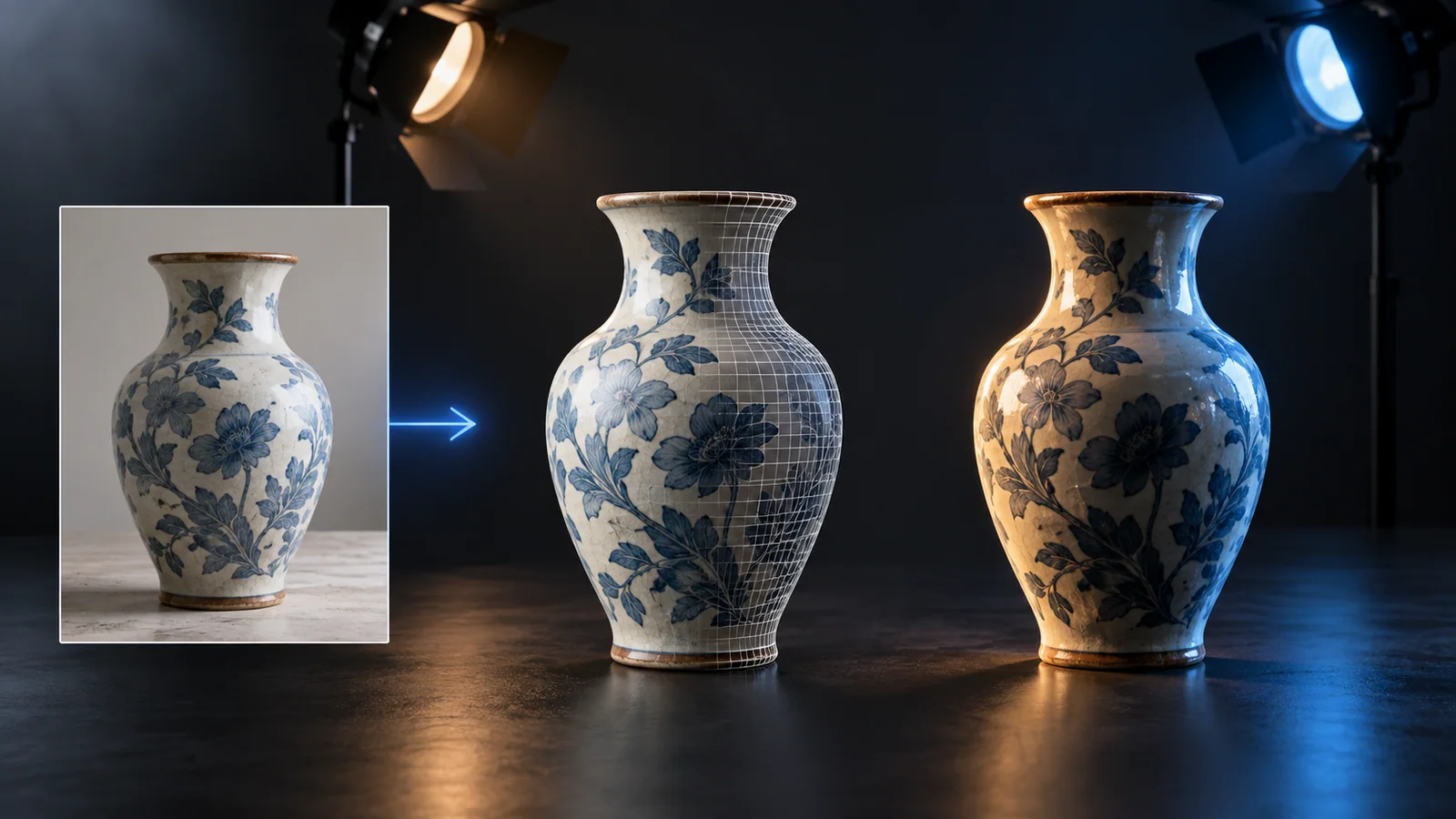
Two Apple papers, one phrase—“image to 3D”—and very different goals. SHARP answers “what does this photo look like from slightly to the left?”; Luce answers “give me this object as an asset I can light in a game engine.”
| Feature | SHARP | Luce |
|---|---|---|
| Input | One photo of a scene | One image of an object |
| Output | Metric 3D Gaussian scene (.ply) for real-time nearby views | Relightable PBR Gaussians (albedo, metallic-roughness, normals) + optional textured mesh |
| Relighting | No — lighting is baked into the photo | Yes |
| Viewpoint range | Nearby viewpoints; unseen regions are not reconstructed | Full object asset intended for arbitrary views |
| Reported speed | Under 1 s on a standard GPU (Apple) | Not the headline metric; quality results on Toys4K |
| Code and weights | Public: apple/ml-sharp (predict on CPU, CUDA or MPS; render needs CUDA) | Not confirmed as released at the time of checking |
| Paper | arXiv 2512.10685 (Dec 2025) | arXiv 2608.23943 (Aug 2026) |
Checked 2026-09-17
Decision summary
- Use SHARP today for 3D-photo and parallax effects from ordinary photos; the CLI is on this site.
- Watch Luce for product, AR and game assets that must respond to new lighting.
- They are complementary, not competitors: scene reconstruction versus asset generation.
Choose SHARP when
- You have a photo of a place, not an isolated object
- You need results now on a Mac (MPS) or CUDA GPU
- Nearby-view parallax is enough
Choose Luce when
- You need PBR materials for a renderer or game engine
- The asset will be seen from many angles under new lights
- You can wait for an official release
How to read this table
SHARP’s speed and Luce’s quality numbers come from different papers and tasks; they are listed to describe each model, not to rank one above the other.
Questions
Can I view SHARP output in the browser?
Yes—SHARP writes standard 3D Gaussian .ply files that open in web-based Gaussian splat viewers. Generation itself runs locally with the official CLI.
Sources
Continue
Share this article
Continue Reading
More articles connected to the same themes, protocols, and tools.
Referenced Tools
Browse entries that are adjacent to the topics covered in this article.