

ManyAgents
A Mac orchestration layer for existing coding agents.
Information checked: Oct 31, 2026 ·View sources
Tool details
- Type
- Developer workflows
- Platforms
- macOS 14 or later
- Free plan
- No
- Open source
- Not verified
- Bring your own key
- Yes
- Local models
- Not verified
Overview
Best for
- Developers supervising parallel repository tasks
- Mac users already using Claude Code
Strengths
- Combines delegation, review and testing in one project workflow.
- Collects agent questions for human decisions.
Limitations & trade-offs
- Windows- or Linux-only development
- Users seeking a standalone model or unlimited included inference
- Requires macOS 14+ and Claude Code; Codex is optional.
- The app license does not include the underlying AI service.
- Public source-code availability was not verified.
Get started
Pricing & usage limits
From $49 · one-time
No account or card required.
Purchase by email. After the trial, existing work remains readable but new work requires a license. Agent subscriptions or API usage are separate.
Pricing checked: Oct 31, 2026 · Subscription, usage limits, and model costs may be billed separately.
Features & details
Project coordination
- Orchestrator, worker, thinker and reviewer roles
- Workers use separate Git worktrees
- Project cards and a shared queue for questions
Review and previews
- Read-only reviewers; a different provider when Codex is configured
- Embedded browser interaction
- Integrated iOS Simulator preview
What is ManyAgents?
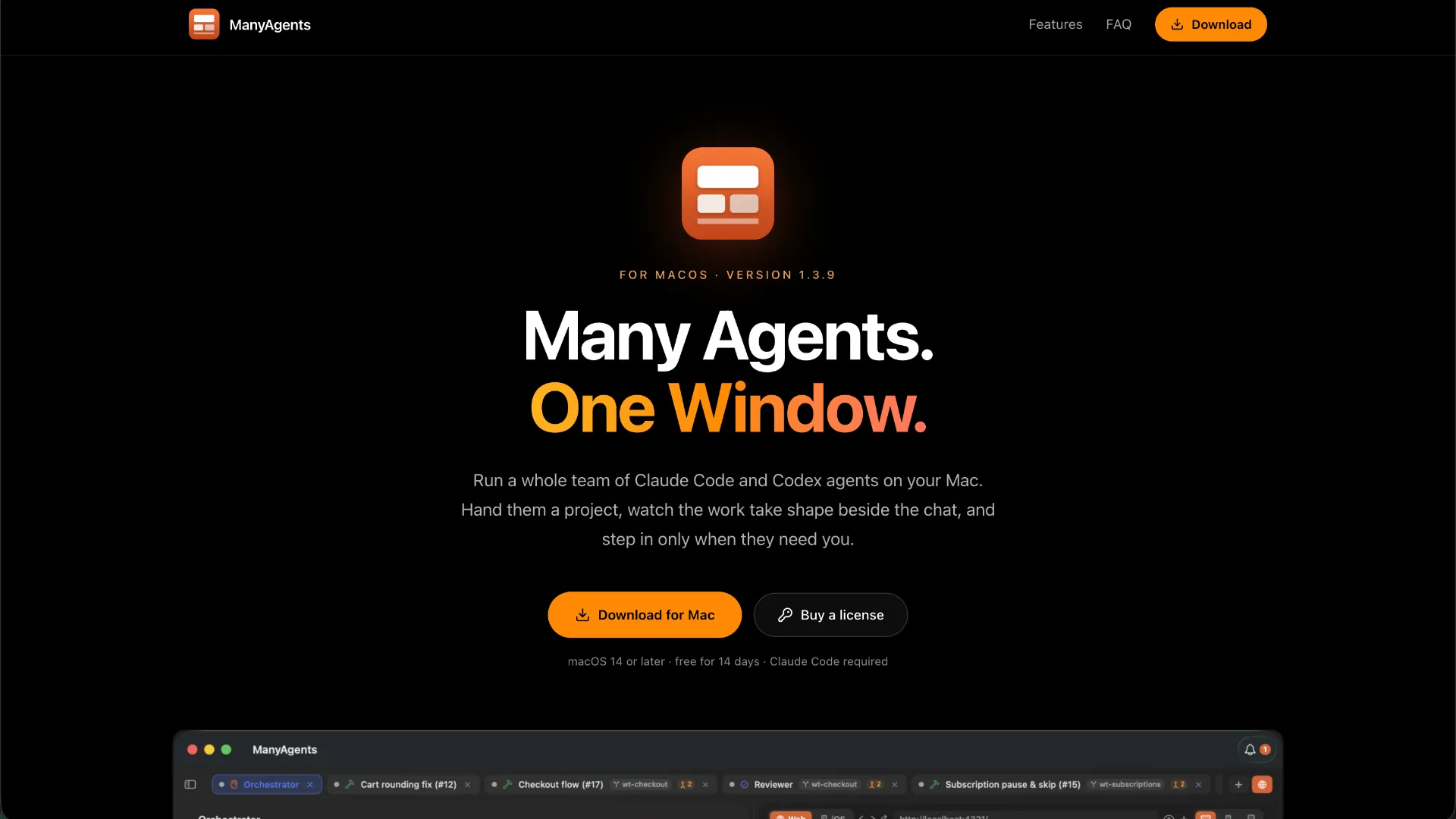
ManyAgents organizes a project around an orchestrator that delegates implementation to workers, collects results and routes questions to one place. The published workflow combines separate Git worktrees, code review and an embedded browser for testing. Product Hunt
Who is it for?
Recommended for developers whose bottleneck is supervising several coding tasks or repositories. For a single small edit, running an existing agent directly may require less coordination. These are editorial fit assessments, not measured productivity claims.
ManyAgents vs MAO and tabsh
ManyAgents emphasizes a predefined project team. MAO emphasizes a canvas with explicit agent connections and supports more CLI providers, Windows and Linux, plus remote workspaces. Both support isolated Git worktrees and browser interaction; those capabilities are not unique to ManyAgents. MAO's layers combine a worktree with canvas state. MAO · Layer documentation
By contrast, tabsh primarily organizes browser-based terminal sessions and explicitly leaves agents in their selected checkout without automatic worktree isolation. tabsh
Limits and verification
An orchestrator's review brief cannot establish unwritten project requirements. The maker describes reviewers receiving a brief from the orchestrator; this is not evidence of guaranteed correctness. Worktree isolation also does not prove that integrated changes pass tests. Maker discussion
No official public source-code repository was verified in this research. This listing is based on published materials checked on October 31, 2026; no installed-app benchmark was performed.
Model support & data privacy
Privacy & data handling
AILOGY LLC says the Mac app has no telemetry and stores workspace data locally. Claude Code and Codex still send prompts and relevant files to their providers. Optional iPhone pairing uses an encrypted relay; local execution does not mean offline inference.
Guides, reviews & fixes
No published guides yet. Start with the official documentation above.
Product updates
No verified product updates listed yet. Follow this tool to see new relevant content in Saved.
See the content timelineSources & verification
Verification dates record when this directory checked the information. Product release dates appear separately above.
Directory revision history
Researched public documentation; homepage displayed v1.3.9. Current $49 license supersedes the launch discussion's undecided pricing.