
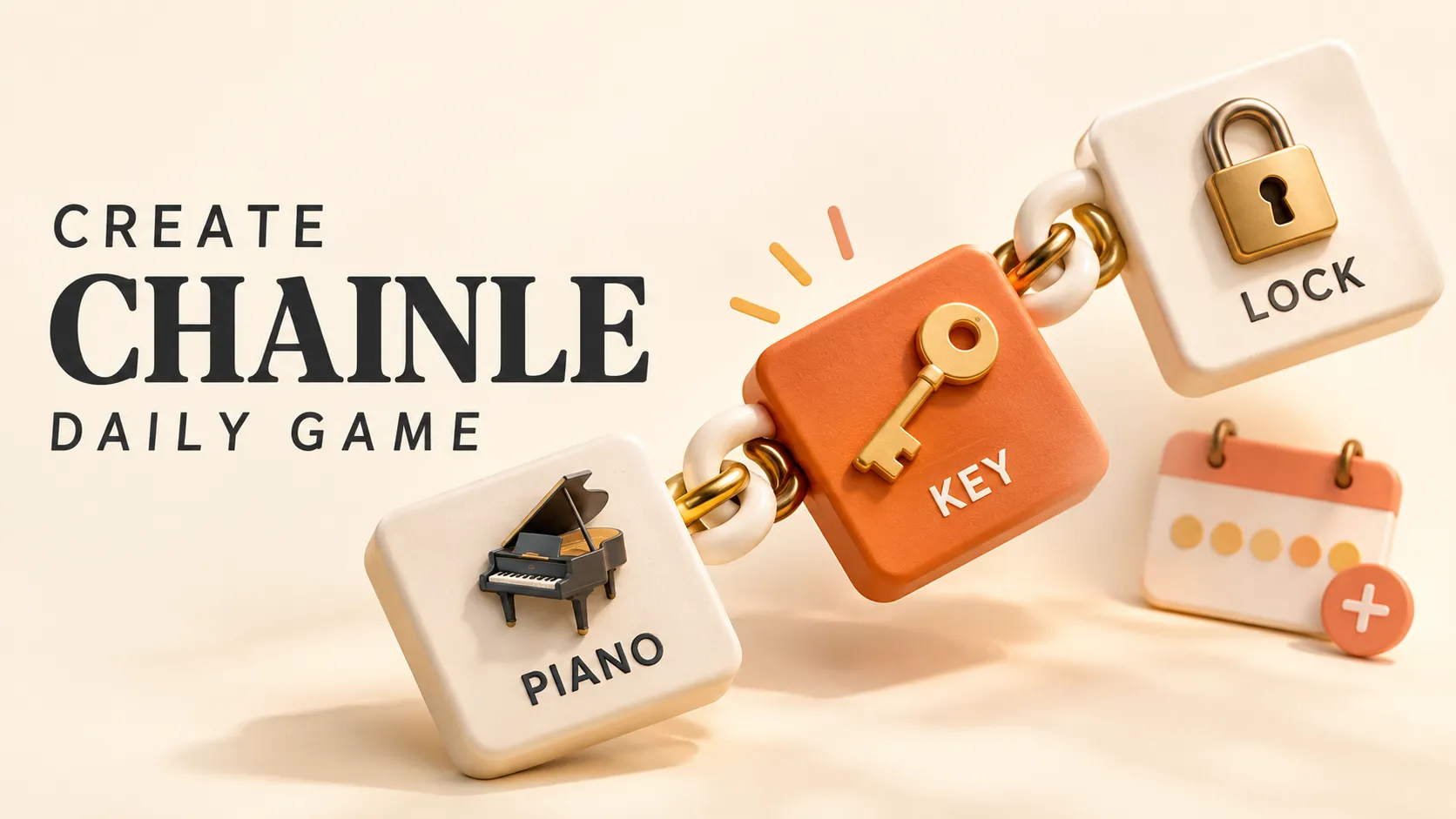
On This Page8 sections
Key Takeaways
- Creating one custom puzzle and launching a daily game are different tasks. An existing puzzle creator handles individual challenges; a standalone game needs scheduling, scoring, progress storage, and a complete player interface.
- Define the word-connection rules before writing code. Semantic bridges, compound-word chains, and word ladders require different answer-checking systems.
- Start with reviewed puzzles and explicit alternative answers. Add semantic scoring when the game can explain its results consistently.
- Keep each published daily challenge stable. Its clues, dictionary, accepted answers, and scoring version should remain consistent for everyone playing that edition.
To create a Chainle daily game, begin with a small collection of word-association puzzles, arrange them into five-round challenges, and assign each challenge to a specific calendar date. Then add answer validation, scoring, saved progress, and a result players can share without revealing the answers.
For someone who only wants to make a custom puzzle, a public creator offers a shorter route. The distinction matters because publishing a community puzzle does not automatically create a recurring daily game.
Understand Which Chainle Experience You Want to Create
Chainle at chainle.io describes a five-round semantic word game. Players submit one answer per round, connecting the clues through meaning. Each round awards up to 1,000 points, for a maximum daily total of 5,000.
Its round structure provides a useful reference:
| Rounds | Challenge | Player input |
|---|---|---|
| 1–3 | Connect two clue words | One connecting word |
| 4 | Connect three clue words | One word linking all three |
| 5 | Find a close meaning | One closely related word |
A three-clue semantic bridge still asks for one answer. It is different from a phrase chain with two missing words, or a word ladder that changes one letter at a time.
There are also independent sites using the Chainle name. Chainle.net identifies itself as an independent project, with its own puzzles, interface, and scoring implementation, and states that it is not affiliated with chainle.io.
Choose the route that matches the intended outcome:
| Goal | Practical route | Main responsibility |
|---|---|---|
| Make an individual custom challenge | Use an existing community puzzle creator | Clues, answers, and explanations |
| Publish a recurring daily experience | Build an independently branded game | Scheduling, gameplay, scoring, and maintenance |
| Explore whether the mechanic is enjoyable | Build a small curated prototype | Puzzle quality and clear feedback |
As of October 23, 2026, the two sites also document different reset times: chainle.io specifies midnight in New York, while chainle.net specifies 00:00 UTC. A tutorial should not treat those schedules as interchangeable.
Create a Custom Chainle Puzzle Without Coding
The public Chainle.net puzzle creator provides a form for individual word-connection challenges:
- Choose two or three clues. Select the matching puzzle type.
- Enter the clue words and intended answer. The answer should connect with every clue.
- Add alternatives under Also accept. These are additional answers that receive full marks.
- Explain each connection. The form provides a separate explanation field for each clue, with a displayed limit of 120 characters.
- Review the checks and preview. The interface includes Suggest answers, Draft with AI, and Try it controls.
- Publish after reviewing the result. Test plays are not counted as ordinary plays.
According to the community documentation, making and publishing puzzles is free, but publishing requires signing in. Community play does not change daily streaks or statistics. Published puzzles are revised by publishing a replacement version through My puzzles.
This creates an individual community puzzle. The documented workflow does not establish a personal five-round daily schedule. A standalone daily game needs the additional systems below.
Design Five Rounds That Feel Fair
Start with the answer, then select clues that lead to it through recognizable relationships. This makes it easier to explain why the puzzle works and to identify reasonable alternatives before publication.
The following is an illustrative, independently authored set. These answers are design examples, not verified top-scoring answers in either existing Chainle implementation.
| Round | Clues | Intended answer | Connection |
|---|---|---|---|
| 1 | Fish + music | Scale | Fish have scales; musical notes form scales |
| 2 | Tennis + judge | Court | Tennis is played on a court; a judge presides in court |
| 3 | Mail + rubber | Stamp | Mail can carry a postage stamp; a rubber stamp makes an impression |
| 4 | Violin + guitar + harp | String | All three instruments use strings |
| 5 | Rapid, in the sense of speed | Swift | Both can describe something moving quickly |
Vary the kind of reasoning across the day. A sequence made entirely of homonyms becomes predictable, while five obscure cultural references can feel inaccessible.
Useful connection types include:
- Multiple meanings: one word connects to different senses of the clues.
- Shared components: several objects contain the same part or material.
- Shared functions: different objects perform a related action.
- Common expressions: the answer participates in familiar phrases with each clue.
- Close meanings: a final round focuses on a specific sense of a word.
For each round, prepare four things before implementation: the intended answer, acceptable alternatives, a short explanation for every clue, and a plausible answer that fits only part of the puzzle.
That last item is especially useful. It reveals whether the scoring system rewards a strong connection to one clue while overlooking a weak connection to another.
Avoid confusing unfamiliar vocabulary with difficulty. A satisfying hard puzzle usually makes familiar words interact in an unexpected way.
Choose a Scoring System You Can Explain
There are three practical approaches:
| Approach | How it works | Advantage | Main limitation |
|---|---|---|---|
| Curated answers | Scores come from reviewed answer lists | Predictable and easy to explain | Unlisted sensible answers need review |
| Semantic scoring | Word vectors estimate relationships | Supports a broader answer space | Estimates can disagree with human judgment |
| Hybrid scoring | Reviewed answers receive explicit credit; other words receive estimates | Combines editorial control with flexibility | Requires versioning and ongoing review |
For an initial prototype, curated answers are sufficient to test the interface and puzzle quality. Describe that version accurately as a curated connection game. It does not reproduce an open-ended semantic scoring system.
A hybrid model is a stronger fit when players should be able to submit unexpected but meaningful answers. Chainle.net documents recognized full-credit answers alongside estimates for unlisted words; its scoring guide also explains that estimates can miss legitimate connections.
For the semantic component, a model such as Stanford GloVe supplies word vectors learned from word co-occurrence patterns. GloVe is one implementation option, not evidence of which model every Chainle-branded site uses.
A practical scoring pipeline is:
- Validate and normalize the submitted word.
- Check reviewed full-credit answers and spelling aliases.
- Compare the candidate with each clue separately.
- Convert those similarities into calibrated connection strengths.
- Combine the strengths into a round score.
- Return an explanation and identify whether the result was curated or estimated.
Raw cosine similarity is not a player-facing percentage. A value of 0.6 does not mean that an answer is 60% correct. The scale needs calibration against reviewed examples.
One possible calibration maps a weak-link baseline to zero and a strong reference connection to one, with values outside that range clamped. Reject configurations where the reference is no stronger than the baseline. Test the resulting scale against human-reviewed answers before using it publicly.
The following JavaScript function is an independent scoring example. It accepts already calibrated strengths between zero and one and uses their harmonic mean. It is not a reproduction of either site's complete scoring implementation.
function scoreConnections(strengths) {
  if (
    !Array.isArray(strengths) ||
    strengths.length < 1 ||
    strengths.length > 3 ||
    strengths.some(value =>
      !Number.isFinite(value) || value < 0 || value > 1
    )
  ) {
    throw new RangeError(
      'Provide one to three strengths between 0 and 1.'
    );
  }

  if (strengths.some(value => value === 0)) return 0;

  const harmonicMean = strengths.length /
    strengths.reduce((sum, value) => sum + 1 / value, 0);

  return Math.round(1000 * harmonicMean);
}

scoreConnections([1, 0.2]);   // 333
scoreConnections([0.6, 0.6]); // 600
scoreConnections([1, 1, 1]); // 1000
scoreConnections([1, 0]);    // 0
The first two examples show the intended behavior: a balanced answer earns more than an answer with one excellent connection and one weak connection.
The final close-meaning round needs additional care. Words with opposite meanings can appear in similar contexts, so distributional similarity alone is insufficient. Add a meaning cue, review synonyms and antonyms, and test ambiguous words separately.
Build a Small, Complete Game Architecture
A standalone daily game can start with a browser interface, a puzzle store, and a small scoring service. A particular frontend framework is less important than keeping those responsibilities clear.
| Component | Responsibility |
|---|---|
| Game interface | Display clues, accept input, show results, and advance rounds |
| Daily resolver | Select the published challenge using the server's date policy |
| Puzzle store | Hold schedules, clues, explanations, answers, and versions |
| Scoring service | Validate guesses and return consistent results |
| Progress storage | Save unfinished games and completed receipts |
| Authoring workflow | Draft, review, preview, and schedule content |
Use a public puzzle response that contains only information players should see before answering. For example:
{
  "puzzleId": "daily-en-2026-10-23",
  "date": "2026-10-23",
  "timeZone": "UTC",
  "contentVersion": 1,
  "scoringVersion": "hybrid-v1",
  "lexiconVersion": "english-v1",
  "rounds": [
    { "id": "r1", "type": "bridge", "clues": ["fish", "music"] },
    { "id": "r2", "type": "bridge", "clues": ["tennis", "judge"] },
    { "id": "r3", "type": "bridge", "clues": ["mail", "rubber"] },
    { "id": "r4", "type": "bridge", "clues": ["violin", "guitar", "harp"] },
    { "id": "r5", "type": "meaning", "clues": ["rapid"], "senseHint": "Speed" }
  ]
}
Keep accepted answers, explanations, and scoring data in a separate server-side record if protecting unrevealed answers matters.
A fully client-side prototype is also possible. However, anything delivered to the browser—including answer tables—can be inspected. Decide whether that tradeoff is acceptable before adding competitive rankings.
Make the Daily Reset Consistent
A daily game needs a precise definition of today. Choose either a fixed UTC boundary or a named regional timezone, then use it consistently in scheduling, countdowns, archives, and streak calculations.
JavaScript's Intl.DateTimeFormat supports explicit timezone formatting. Extracting date parts avoids depending on the ordering or punctuation of a localized date string.
function puzzleDate(now = new Date(), timeZone = 'UTC') {
  const parts = new Intl.DateTimeFormat('en-US', {
    timeZone,
    calendar: 'gregory',
    numberingSystem: 'latn',
    year: 'numeric',
    month: '2-digit',
    day: '2-digit'
  }).formatToParts(now);

  const get = type =>
    parts.find(part => part.type === type).value;

  return `${get('year')}-${get('month')}-${get('day')}`;
}

puzzleDate(new Date('2026-10-23T03:30:00Z'), 'UTC');
// 2026-10-23

puzzleDate(
  new Date('2026-10-23T03:30:00Z'),
  'America/New_York'
);
// 2026-10-22
Run the authoritative date calculation on the server. Return the selected puzzle ID and next reset timestamp so the interface can display the same schedule.
For a regional timezone, calculate the next local midnight with timezone-aware logic. Do not assume that every interval between local midnights lasts exactly 24 hours.
Store an explicit date-to-puzzle mapping. Selecting a puzzle with a day number modulo the current collection length can change historical assignments when the collection grows.
Also define what happens at midnight during an unfinished game. A reasonable policy is to let the player finish the already loaded edition, then offer the new one. Preserve its original date and scoring version throughout.
Validate Answers Before Consuming a Guess
An invalid entry and a low-scoring valid answer should produce different outcomes.
| Entry | Recommended handling |
|---|---|
| Empty input | Ask for a word; keep the round open |
| A phrase in a single-word game | Explain the format; keep the round open |
| A repeated clue or blocked related form | Explain the restriction; keep the round open |
| A word outside the supported vocabulary | Explain that it is unsupported; keep the round open |
| A valid word with a weak connection | Record the score and complete the round |
Normalize case and surrounding whitespace, then apply explicit spelling aliases. Decide how the game handles plurals, hyphens, apostrophes, and derived forms before launch.
Do not strip endings blindly. Removing a final letter is not reliable lemmatization and can corrupt valid words. Likewise, broad substring checks can reject unrelated words that happen to contain a clue's letters.
For a server-scored game, each submission should identify the puzzle, round, and play session. Enforce one accepted submission per round atomically, and support an idempotency key so a network retry returns the original result.
A timeout after submission should trigger a status check or safe retry. It should not silently grant another answer or discard a completed round.
Keep Semantic Scoring Lightweight
Shipping an entire embedding model is not always necessary.
For an illustrative vocabulary of 25,000 words, 300-dimensional vectors stored as 32-bit floats require:
25,000 words × 300 dimensions × 4 bytes
= 30,000,000 bytes
≈ 28.6 MiB
That calculation excludes vocabulary strings, indexes, application code, and runtime overhead.
For a fixed daily challenge, final scores can instead be precomputed for every valid word. Five scores per word, stored as unsigned 16-bit integers, require:
25,000 words × 5 rounds × 2 bytes
= 250,000 bytes
≈ 244 KiB
These are storage calculations, not measured download or performance benchmarks. Per-clue feedback and explanatory metadata require additional space.
Precomputation provides a useful design option: run the heavier semantic analysis during puzzle preparation, then use simple lookups during play. Keep the tables on the server when answer discovery or score manipulation matters.
Whichever approach is chosen, pin the model, calibration, dictionary, and editorial overrides to a scoring version. Updating a model should not silently change the score of an archived submission.
Save Progress and Create Useful Share Results
For an account-free prototype, browser storage can preserve unfinished games and completed results. MDN documents that localStorage persists across browser sessions, but it can be unavailable under browser policies, and private-session data is cleared when the last private tab closes.
Use separate storage keys for daily, practice, and archive play. Include the puzzle ID and schema version so changes to the application do not confuse old saves with new ones.
Save enough information to recover the actual state:
- Current round and confirmed submissions.
- Per-round scores and completion status.
- Puzzle, content, and scoring versions.
- A pending submission identifier when a request is unresolved.
Wrap storage access and JSON parsing in error handling. If persistence fails, keep the game playable and explain that progress may not be saved.
For streaks, compare distinct completed puzzle dates in the game's calendar. Replaying an archive should not extend the daily streak, and completing the same edition twice should not count twice.
A spoiler-free share result can include the date, total score, and one symbol per round:
Daily Bridge Demo · 2026-10-23
3,850 / 5,000
🟩🟨🟩🟧🟨
Add the game's real URL when implementing sharing. Offer a visible text fallback if clipboard access fails.
Keep scores and rankings separate. A connection score does not establish a percentile. A claim such as beating 90% of players requires actual comparable player results and a defined comparison group.
Use AI to Draft Puzzles, Then Review Them
An AI model can help generate candidate connections and alternative explanations. It should feed an editorial queue rather than publish directly into the daily schedule.
A focused drafting prompt is more useful than a request for random word pairs:
Draft 10 English word-association puzzles for adult casual players.
Each puzzle needs two clue words and one connecting answer.
Use familiar vocabulary and vary the relationship types.
For each puzzle, provide:
- One sentence explaining the answer's link to each clue.
- Two plausible alternative answers.
- One tempting answer that fits only one clue.
- Any ambiguity, regional usage, or specialist knowledge involved.
Do not claim that any answer is uniquely correct.
Review every candidate for forced associations, duplicate concepts, obscure vocabulary, and alternatives that are stronger than the intended answer.
Use a fixed scoring process during play. A live generated judgment can introduce variation unless its behavior is constrained and versioned. Reviewed content and deterministic scoring make it easier to explain disputed results and preserve historical games.
Test the Failure Cases Before Launch
The most valuable tests cover situations that can damage player trust:
| Test | Expected behavior |
|---|---|
| Two devices open the game at the same moment | Both receive the same edition for the selected language |
| A player refreshes after round three | Confirmed progress is restored |
| A submission times out and is retried | The same accepted result is returned |
| An unsupported word is entered | The player retains the round |
| A recognized alternative is submitted | Its reviewed credit is applied |
| One clue has a strong match and another a weak match | The score reflects the imbalance |
| Midnight occurs during play | The loaded edition follows the documented completion policy |
| A dictionary or model is updated | Old editions retain their assigned scoring behavior |
| Browser storage is blocked | Play continues with a clear persistence notice |
Also test the interface with a keyboard, a narrow mobile viewport, and a screen reader. Give the answer field a visible label, announce validation errors and results, and communicate connection strength through text as well as color.
Keep advertisements and layout changes away from the input and submit button. A daily puzzle depends on a short, predictable interaction.
Launch With Searchable Rules and a Reliable Content Schedule
Publish a complete playable loop before adding social profiles, leaderboards, or a large archive. A useful first release includes the daily challenge, rules, scoring explanation, saved progress, sharing, and a feedback route.
Prepare a buffer of reviewed content. For example, a two-week launch buffer for five-round days requires 70 reviewed rounds. That is a planning calculation, not a universal production target.
For search visibility, make the game's description, rules, and navigation available in rendered HTML. Google's JavaScript SEO documentation explains the additional rendering step JavaScript content can require and recommends considering server-side rendering or prerendering.
Give archive pages a genuine purpose: a playable past challenge, useful explanation, or both. Avoid generating large numbers of nearly identical date pages before there is meaningful content behind them.
Use a distinct product name, original visual assets, and an independently authored puzzle collection. Explain any inspiration accurately without implying an affiliation that does not exist.
Frequently Asked Questions
Can a Chainle-style daily game work without AI?
Yes. A reviewed answer list can power a complete daily connection game. Semantic models become useful when the design needs to score a much wider range of valid words.
Does a custom puzzle creator provide a complete daily website?
Not necessarily. The documented Chainle.net creator publishes individual community puzzles. A recurring game also needs a schedule, a multi-round session, progress management, and daily result handling.
Does the game need a database?
A small static prototype can use versioned puzzle files and browser storage. A server-side store becomes useful for private answer data, shared results, publishing workflows, and synchronized progress.
How can multiple answers receive full marks?
Store reviewed alternatives alongside the intended answer. Explain why each qualifies, and distinguish those explicit decisions from automatic semantic estimates.
Should every language use translated versions of the same puzzle?
Not by default. Puns, compounds, and word senses often change across languages. Review each language edition independently and give it its own schedule and vocabulary version.
Conclusion
Creating a successful Chainle-style daily game starts with fair word connections and understandable feedback. The interface, reset schedule, and saved progress should reinforce that consistency.
For a single custom challenge, begin with the available community creator. For an independent daily game, build one complete five-round session, validate its alternatives and scoring, and test the midnight and recovery cases before expanding the collection. Launch when players can understand both the connection and the result.
Continue Reading
More articles connected to the same themes, protocols, and tools.
Referenced Tools
Browse entries that are adjacent to the topics covered in this article.