
On This Page8 sections
Key Takeaways
- Krillion is a daily browser-based trivia game where players earn more points for giving uncommon but valid answers rather than obvious responses.
- Every Daily Dive includes seven prompts, with 25 seconds to answer each question. All players receive the same daily challenge.
- Six rarity tiers determine scoring, ranging from Plankton (10 points) to One in a Krillion (100 points).
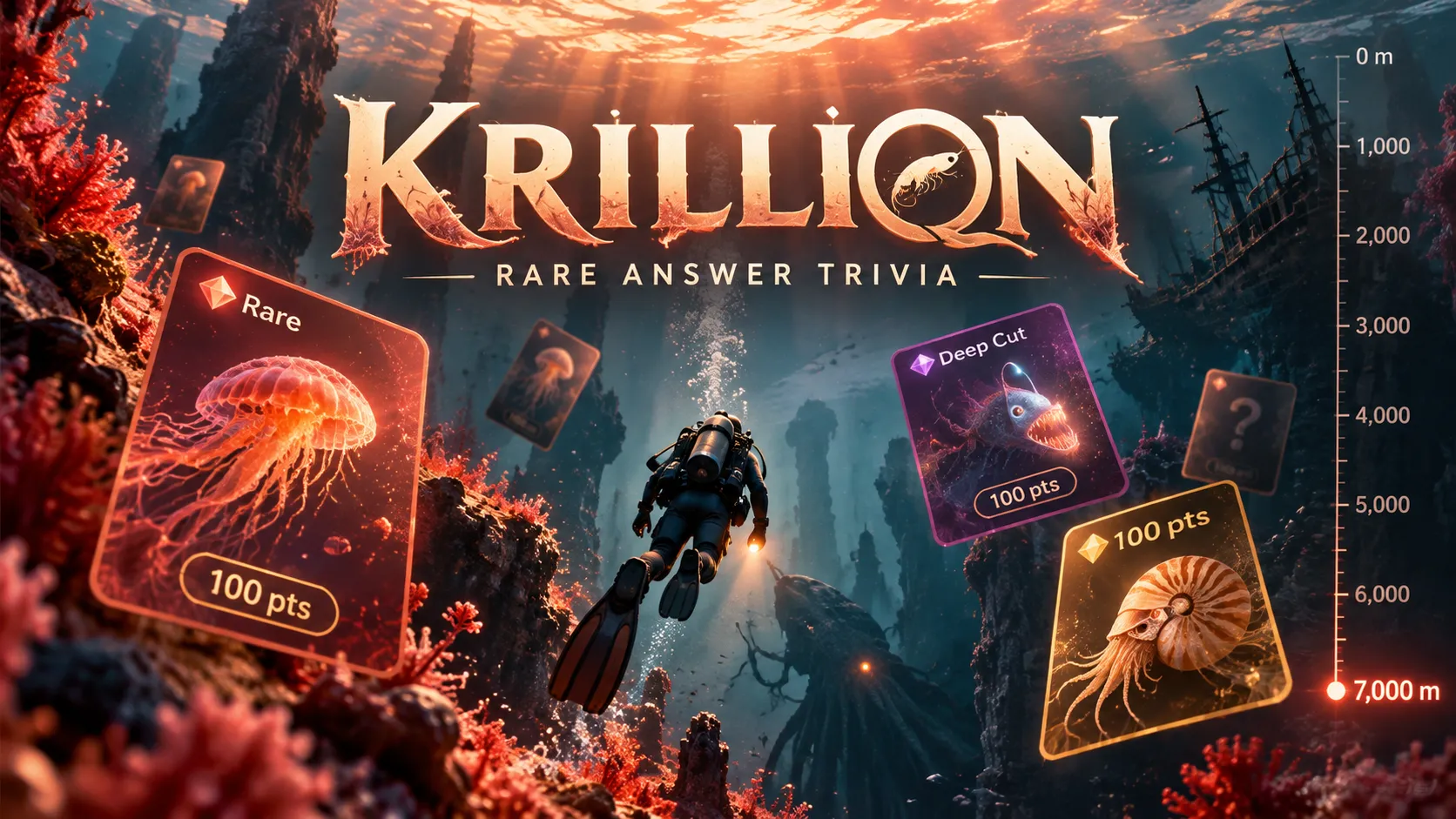
- Every point equals 10 meters of diving depth. A perfect 700-point game reaches 7,000 meters.
- Rarity is not simply calculated from live player votes. The original developer uses familiarity data, curated answer sets, automated assistance, and manual judgment.
- The best strategy combines accuracy, category knowledge, and uncommon recall. A reliable Rare answer is frequently more valuable than gambling on an extremely obscure response.
- The official game is available at Krillion.io, while independent practice resources provide additional questions, hints, and answer explanations.
What Is Krillion?
Krillion is a free-to-play daily trivia game that rewards players for knowing answers other people are less likely to remember. Instead of asking players to identify one predetermined correct answer, the game presents open-ended categories containing multiple acceptable responses.
A question might ask players to name a farm animal, a web browser, a country, or a particular type of food. Several answers may be factually correct, but they do not necessarily earn the same number of points.
For example, imagine a question asking players to name a web browser.
- Google Chrome is an obvious and widely recognized answer.
- Opera is a less automatic response for many people.
- Lynx is a text-based browser that requires more specialized knowledge.
- WorldWideWeb, the original web browser created by Tim Berners-Lee, is a historical example that fewer casual players may recall.
All four names are relevant examples of web browsers, but their actual Krillion scores depend on the specific published question and its curated answer bank. These examples illustrate the reasoning process rather than promising particular point values.
The defining challenge is to find an answer that is both valid and surprisingly uncommon.
Krillion combines trivia, word association, general knowledge, and an underwater progression system. Successful answers send the player deeper into a virtual ocean, while predictable answers produce smaller increases in depth.
The original game is hosted at krillion.io. Its developer identifies themselves publicly as kp, a solo creator, in the game's official FAQ.
The game has inspired independent guides, answer archives, and practice editions. These websites should not be confused with the original publisher because their questions, scoring systems, and validation rules may differ.
How to Play Krillion: Step-by-Step Instructions
Krillion has straightforward mechanics, but achieving a high score requires more than answering questions correctly.
Step 1: Open the official game
Visit Krillion.io using a desktop or mobile browser. The standard Daily Dive can be played without creating an account.
Step 2: Start the Daily Dive
Select the option to begin the dive. The game presents seven prompts in sequence, with everyone receiving the same daily set.
Step 3: Read the complete question
Each prompt defines a category of acceptable answers. Pay attention to restrictions involving geography, dates, names, or membership.
For example, an EU member state is not interchangeable with any country located in Europe. Switzerland is geographically European but is not an EU member.
Step 4: Think beyond the first obvious response
The most recognizable answer may still be correct, but it will often earn fewer points. Consider a less familiar alternative that clearly satisfies the question.
Step 5: Submit within 25 seconds
Type one answer before the countdown expires. Accurate spelling and recognizable names are important, although the game supports many aliases and spelling corrections.
Step 6: Review your rarity result
An accepted answer receives a rarity classification and point value. Your diving depth increases by 10 meters for every point earned.
Step 7: Complete all seven prompts
After the final question, review your accumulated points and diving depth. The standard daily challenge provides one scored attempt per day.
The central rule is simple: correctness qualifies an answer, while its assigned rarity determines the reward.
Krillion Scoring Explained: All Six Rarity Tiers
Krillion uses six scoring tiers. Understanding their values makes it easier to evaluate the trade-off between common, reliable answers and uncommon, potentially risky answers.
| Rarity Tier | Points | Added Depth | Meaning |
|---|---|---|---|
| Plankton | 10 | 100 m | An obvious or highly familiar answer |
| Too Clever | 15 | 150 m | An answer that feels unusual but is a predictable clever choice |
| Schooler | 30 | 300 m | A reasonable answer beyond the most obvious examples |
| Rare | 60 | 600 m | An uncommon but recognizable answer |
| Deep Cut | 85 | 850 m | A highly specialized or obscure accepted answer |
| One in a Krillion | 100 | 1,000 m | The highest-scoring, specially selected answer |
Maximum possible daily score: 700 points.
Maximum possible diving depth: 7,000 meters.
The calculation is:
Total Depth = Total Points × 10
For example, consider a seven-question game with the following results:
| Question | Points | Depth Added |
|---|---|---|
| 1 | 10 | 100 m |
| 2 | 30 | 300 m |
| 3 | 60 | 600 m |
| 4 | 85 | 850 m |
| 5 | 15 | 150 m |
| 6 | 100 | 1,000 m |
| 7 | 60 | 600 m |
| Total | 360 | 3,600 m |
This hypothetical dive reaches 3,600 meters, slightly beyond half the maximum possible depth.
A useful benchmark is seven Rare answers. At 60 points each, they produce 420 points and 4,200 meters.
Seven Deep Cut answers would earn 595 points and 5,950 meters.
However, players should not assume a particular total score corresponds to a fixed percentile of all players. Actual rankings depend on the game's recorded results and should be taken from its own statistics rather than inferred from point totals.
How Does Krillion Decide Which Answers Are Rare?
One of the biggest misconceptions about Krillion is that every rarity score represents the percentage of players who submitted a particular answer.
The original game's scoring process is more nuanced.
According to the developer's official explanation of answer curation, accepted-answer lists are assembled using sources such as dictionaries, encyclopedias, reference material, and other datasets relevant to each question.
The resulting lists are merged, cleaned, and reviewed.
Rarity evaluation then depends on the question. Some answers can be assessed using a familiarity database measuring how frequently words or names appear in written material. Other questions require a combination of language-model assistance and manual judgment.
This distinction matters for three reasons.
1. Real-world popularity and game rarity are different concepts.
An answer can be obscure in everyday conversation but familiar to trivia enthusiasts. Conversely, something widely known within a small professional field may be unfamiliar to most players.
2. Rarity does not necessarily change with every submission.
Players should not assume that an answer loses points immediately when another person types it. The published rarity classification is not described as a continuously recalculated live voting percentage.
3. The top answer includes an editorial element.
The developer explains that the One in a Krillion selection is not determined by numerical obscurity alone. An answer's entertainment value also matters because an impossibly obscure name would not always create a satisfying challenge.
As a result, the highest-scoring answer is better understood as a curated discovery rather than a mathematical guarantee that it is the least frequently known fact.
This approach makes Krillion different from traditional survey-based guessing games.
What Does Too Clever Mean in Krillion?
Too Clever is a valid answer worth 15 points, not an incorrect answer.
The label describes a response that seems inventive or obscure but is itself a common choice among people trying to avoid the obvious.
For example, when a question asks for an unusual animal, many players may instinctively choose the same famous oddities rather than genuinely exploring less familiar species.
The developer describes the category as the standard obscure choice that is not actually obscure.
This creates an interesting psychological problem: players are not simply competing against ordinary recall. They are also trying to anticipate which unusual examples other trivia players will remember.
A useful way to avoid the Too Clever trap is to move beyond the most famous unusual example and search another branch of the category.
For animal questions, consider moving from well-known exotic mammals into birds, marine invertebrates, or regional domesticated breeds—provided the prompt permits those answers.
The objective is not to choose something strange at random. It is to find a defensible answer that is less likely to be the group's shared second thought.
Seven Strategies to Score Higher in Krillion
1. Identify the exact answer boundary
Before thinking about rarity, establish what qualifies as correct.
Questions about countries, sports titles, historical dates, and scientific classifications often contain restrictions that eliminate otherwise plausible responses.
For example, a prompt about Olympic host cities during the 1990s is not equivalent to one about cities that hosted any Olympic Games.
Practical tip: Extract the category, qualifying condition, and date limit before choosing an answer.
2. Build a reliable answer before pursuing a rare one
The safest strategy is to recall a clearly valid answer immediately and then search for a better alternative.
This prevents the final seconds from becoming a desperate attempt to remember an obscure name.
A common answer is worth points. An unanswered question is worth zero.
3. Search within the category, not randomly across it
When asked to name a food, do not simply think of increasingly unfamiliar words.
Instead, navigate distinct subcategories:
- Regional dishes rather than internationally popular meals.
- Traditional preparations rather than generic ingredients.
- Historical or lesser-known varieties rather than globally dominant examples.
- Specific named foods rather than vague descriptive phrases.
The same method works for countries, movies, music, animals, sports, and science.
4. Practice retrieving complete names
Recognizing an answer is easier than producing it without hints.
Krillion requires active recall. Knowing that an obscure film exists is not enough if its exact title cannot be remembered before the timer expires.
Useful practice involves seeing a category and retrieving several specific names without looking at a reference list.
5. Avoid unnecessarily ambiguous answers
Some categories contain borderline cases involving unofficial names, alternate spellings, regional terminology, or changing classifications.
An obscure answer that depends on a controversial definition can be a worse choice than a slightly more familiar answer with an unambiguous fit.
6. Learn from the answer reveal
After completing a question, review accepted responses and identify why certain alternatives are more distinctive.
Building familiarity with categories and naming patterns is more useful over time than memorizing isolated answers without understanding them.
7. Measure improvement across multiple games
A single exceptional dive can reflect favorable categories rather than a repeatable improvement in skill.
Track your results over time using metrics such as:
- Average points per answered prompt.
- Number of unanswered or rejected prompts.
- Frequency of Rare and Deep Cut results.
- Categories that consistently produce lower scores.
- Overall depth across comparable Daily Dives.
The goal is not merely to achieve one high score. It is to reduce avoidable zero-point rounds while steadily improving recall.
The 25-Second Krillion Strategy
Time management plays a major role because each question provides only a brief answer window.
The following is a practical training routine, not a claim about the game's internal timer phases.
| Time Remaining | Recommended Action |
|---|---|
| 25–20 seconds | Read the rule and establish its boundaries |
| 20–14 seconds | Recall one safe accepted candidate |
| 14–8 seconds | Search for a less obvious candidate within the same category |
| 8–4 seconds | Compare certainty and potential rarity |
| Final 4 seconds | Submit a reliable answer before the deadline |
One useful principle is to stop chasing obscurity when the risk of a rejected answer becomes too high.
Consider two hypothetical choices:
- A reliable Rare answer worth 60 points.
- A possible Deep Cut answer worth 85 points.
If a rejected answer would score zero, the Deep Cut candidate needs an acceptance probability greater than approximately 70.6% to outperform the certain 60-point choice in expected points.
The calculation is:
60 ÷ 85 = 0.706
This does not mean players can accurately estimate their probabilities in real time. It demonstrates why uncertain obscure answers are not automatically the strongest strategic choice.
Similarly, a hypothetical 100-point candidate must have better than a 60% chance of being accepted to outperform a guaranteed 60-point answer when failure produces zero.
These comparisons assume no further retries are available and do not represent measured acceptance rates.
Why Krillion Sometimes Rejects Correct Answers
A rejection does not necessarily mean the underlying fact is wrong.
The original developer acknowledges that valid responses can occasionally be absent from curated answer sets.
Several explanations are possible.
Missing answer coverage: A legitimate category member may not have been included during data collection or review.
Question boundaries: The response may be related to the category without satisfying the exact condition.
Ambiguous terminology: A colloquial term, regional name, or alternate classification may differ from the canonical entry.
Spelling and alias matching: The validator recognizes numerous spelling variants and alternate names, but approximate matching is not perfect.
An especially interesting edge case involves autocorrect.
The official FAQ describes how an answer's alias can accidentally resemble an unrelated phrase. Because the validator checks aliases, a small spelling difference can occasionally produce an unexpected accepted match.
This is an inherent challenge of matching thousands of possible answers against imperfect human input.
If an answer is rejected while the round remains open, try a clearer spelling or a safer category member before the timer expires.
For recurring issues, retain the exact prompt and rejected term so the answer can be reviewed or reported accurately.
Krillion Daily Dive vs Unlimited, Archive, and Themed Packs
The Daily Dive is the central experience, but the original Krillion website also provides additional ways to play.
| Mode | Main Purpose | Distinguishing Feature |
|---|---|---|
| Daily Dive | Daily competition | Seven shared prompts and one scored daily attempt |
| Unlimited | Additional practice | Play beyond the single daily challenge |
| Archive | Revisit earlier games | Explore previous Daily Dives |
| Themed Packs | Focused category play | Dedicated challenges organized around specific subjects |
| Puffer Party | Social category gameplay | Separate multiplayer-oriented experience |
The official themed pack directory lists Words & Language, Movies, Sports, and Geography, with Music shown as a planned addition.
These modes serve different purposes.
The Daily Dive tests broad recall under consistent shared conditions. Themed packs provide concentrated experience within selected subjects, while repeatable modes support additional practice.
Availability, purchase requirements, and pack unlock conditions can change. Check the original website before assuming that every archive entry or themed chapter is free.
Krillion also exposes Friends and My Krillion features. Optional account linking supports saved history and progress across devices, according to the publisher's privacy documentation.
Krillion Answers Today: Should Players Use Hints?
Searching for Krillion answers is understandable, especially when a player encounters a difficult category or wants to improve future performance.
However, looking up a complete answer list before submitting a response changes the nature of the challenge.
For players who want to preserve the experience, a three-stage approach is more useful:
Before playing: Review general category knowledge without searching for the current day's exact answers.
During the game: Rely primarily on personal recall, using only the assistance available under the rules of the mode being played.
After completing the dive: Explore the accepted answers, rarity tiers, and explanations to understand which alternatives were available.
Progressive hints are particularly useful in independent practice modes because they can guide recall without immediately giving away an entire answer.
It is also important to distinguish between the original publisher's daily answer set and questions published by another website. A correct response in one game is not proof that a different game's validator accepts it or assigns the same score.
Where to Practice Krillion for Free
Players looking for more questions can start with the original game's Unlimited option and explore independent practice tools.
One example is Krillionio.com, an independent rare-answer trivia companion with its own question library, sourced answer explanations, progressive hints, and repeatable practice.
Its daily practice format currently contains six questions with 20 seconds per question, rather than the original Krillion's seven-question, 25-second Daily Dive.
The companion also provides:
- A searchable practice-question library.
- An answer checker for its published question sets.
- A rare-answer comparison tool.
- Subject-focused practice sessions.
- Previous practice editions and answer explanations.
- Player-choice statistics shown separately from fixed knowledge scores.
Importantly, Krillionio's fixed practice scores are independent editorial ratings, not the original publisher's point values. Its observed player-choice data likewise should not be interpreted as official Krillion popularity or scoring information.
These distinctions make independent tools more useful as educational resources than as guarantees about the official game.
For productive practice, choose a weak subject, attempt several questions without hints, then review the explanations and accepted alternatives.
This creates a repeatable learning process that can improve general knowledge as well as speed of recall.
Krillion vs Wordle, Connections, Scattergories, and Family Feud
Krillion belongs to the broader family of short-form word and knowledge games, but its answer-selection system offers a different challenge.
| Game | Core Mechanic | What Determines Success |
|---|---|---|
| Krillion | Open-ended rare-answer trivia | Validity and curated answer rarity |
| Wordle | Hidden five-letter word guessing | Deduction from letter feedback |
| Connections | Grouping related words | Identifying four coherent categories |
| Scattergories | Category answers constrained by a letter | Valid responses and distinctiveness under the game's rules |
| Family Feud | Survey-based answer guessing | Matching answers supplied by surveyed people |
Krillion is particularly interesting because the obvious correct answer may be strategically weak.
In Wordle, players are trying to identify a specific target. In Krillion, there may be hundreds or thousands of valid answers, each with a different assigned value.
Scattergories is a closer comparison because unusual category answers can be beneficial. However, Scattergories generally emphasizes distinctiveness among participants and often imposes a starting-letter restriction.
Family Feud uses surveyed responses as the basis for popular answers. Krillion's publisher instead describes a curated scoring system that can combine familiarity data, automated assistance, and human review.
That difference is essential: Krillion should not be presented as a live crowd-voting game simply because its rarity system evokes other players' likely choices.
Is Krillion Free and Safe to Play?
The original Krillion Daily Dive is available without requiring a paid account. Players can open the browser game and complete the standard daily challenge as guests.
The website also offers optional account features and paid content unlocks.
According to the official Krillion FAQ, purchasing an unlock for any pack removes advertising across the site. The publisher also provides ways to restore eligible purchases across devices.
From a privacy perspective, the Krillion privacy policy, effective September 23, 2026, explains that guest progress, preferences, and certain game data are stored in the browser.
It also describes several important distinctions:
- Submitted answers are sent to the server for validation.
- Completed dive scores and randomly generated player identifiers are used for game statistics.
- Optional Google sign-in supports account-linked progress and history.
- Purchases use a third-party payment processor.
- Analytics and advertising services have their own data-processing practices.
Players should be aware that clearing browser storage may remove locally saved guest progress or preferences.
An optional account may help preserve eligible completed game history across devices, although in-progress sessions and device settings do not necessarily sync.
For the original game, the safest starting point is the publisher's domain, krillion.io. Many similarly named websites host independent versions or guides and are not affiliated with the original creator.
Common Krillion Mistakes to Avoid
Mistake 1: Giving the first correct answer immediately.
The first name that comes to mind is often the most recognizable example. Spending a few additional seconds on recall may reveal a higher-value candidate.
Mistake 2: Choosing obscurity over correctness.
A rare-sounding response outside the category cannot earn points merely because it is unusual.
Mistake 3: Treating Too Clever as a rejected answer.
Too Clever still earns 15 points. It reflects a particular scoring judgment rather than complete failure.
Mistake 4: Assuming player votes directly determine all tiers.
The official rarity method includes curated reference data and editorial review, not simply a live count of submitted answers.
Mistake 5: Confusing independent scores with official scores.
A companion game may use different questions, accepted spellings, time limits, or rarity ratings.
Mistake 6: Forgetting the timer.
An imperfect but valid response before the deadline can be more valuable than an ambitious answer left unsubmitted.
Mistake 7: Memorizing rare words without their context.
Category boundaries change which answers qualify. Learning why a name belongs to a group is more reliable than memorizing unusual names in isolation.
Frequently Asked Questions About Krillion
What is the official Krillion website?
The original daily game is available at https://krillion.io/. Other similarly named domains may operate independent games, answer archives, or guides.
How many questions are in Krillion?
The official Daily Dive contains seven prompts, with 25 seconds available for each answer.
What is the highest Krillion score?
The maximum Daily Dive score is 700 points, corresponding to 7,000 meters of diving depth. This requires seven 100-point answers.
What is the rarest tier in Krillion?
One in a Krillion is the highest tier, worth 100 points. The developer explains that this selection considers both rarity and how satisfying an answer is to discover.
What does Too Clever mean?
Too Clever describes an accepted answer that seems obscure but represents a predictable unconventional choice. It earns 15 points.
Can you play Krillion more than once a day?
The standard Daily Dive provides one scored daily attempt. Other official modes, including Unlimited and themed content, offer additional play opportunities. Independent practice editions may also permit repeatable games.
When does Krillion reset?
The original Daily Dive refreshes once per day. Check the official game's countdown for the current reset time rather than assuming an independent site's midnight UTC schedule applies to the original game.
Are Krillion scores based on the number of players who choose an answer?
Not exclusively. The official developer describes a system involving curated answer sets, familiarity measurements, language-model assistance, and manual review, depending on the prompt.
Can Krillion reject a factually correct answer?
Yes. The publisher acknowledges that some legitimate answers may be absent from its curated database. Ambiguous wording, aliases, spelling, and category restrictions can also affect recognition.
Who created Krillion?
According to the official FAQ, the game was created by an independent solo developer using the pseudonym kp. The creator has explicitly warned about other websites incorrectly claiming to be the original publisher.
Is there an official Krillion mobile app?
The original browser game works on mobile devices. The developer's FAQ describes a standalone app as a future plan, rather than confirming a released official app. Players should verify any app claiming official status directly through the publisher.
What is the best way to improve a Krillion score?
Focus first on factual accuracy, then improve recall of less familiar category members. Practice across subjects, review rejected responses, and learn which types of answers consistently earn higher tiers.
Where to Practice Krillion for Free
One example is Krillionio.com, an independent rare-answer trivia companion with its own question library, sourced answer explanations, progressive hints, and repeatable practice.
For players who want to practice beyond the daily challenge, Krillion Unlimited offers a dedicated entry point for additional rare-answer trivia practice. It is an independent practice resource, separate from the original game's official Unlimited mode.
Its daily practice format currently contains six questions with 20 seconds per question, rather than the original Krillion's seven-question, 25-second Daily Dive.
Conclusion
Krillion turns traditional trivia into a challenge of knowledge, memory, and originality. Rather than rewarding the first correct response, it encourages players to search beyond obvious examples and discover unexpected connections within familiar categories.
The scoring system adds meaningful strategy. Six rarity tiers, a strict 25-second timer, and a 7,000-meter maximum depth create a balance between certainty and ambition.
The most effective approach is to understand the question, secure a reliable answer, and search for a rarer alternative only while there is enough time to submit it confidently.
Players can start today's official Krillion Daily Dive or develop their skills using the independent practice questions and explanations at Krillionio.
Whether the goal is to improve a daily score, discover unusual facts, or reach the trench floor, each dive offers another opportunity to turn general knowledge into a more surprising answer.
Continue Reading
More articles connected to the same themes, protocols, and tools.


Referenced Tools
Browse entries that are adjacent to the topics covered in this article.