
On This Page8 sections
Key Takeaways
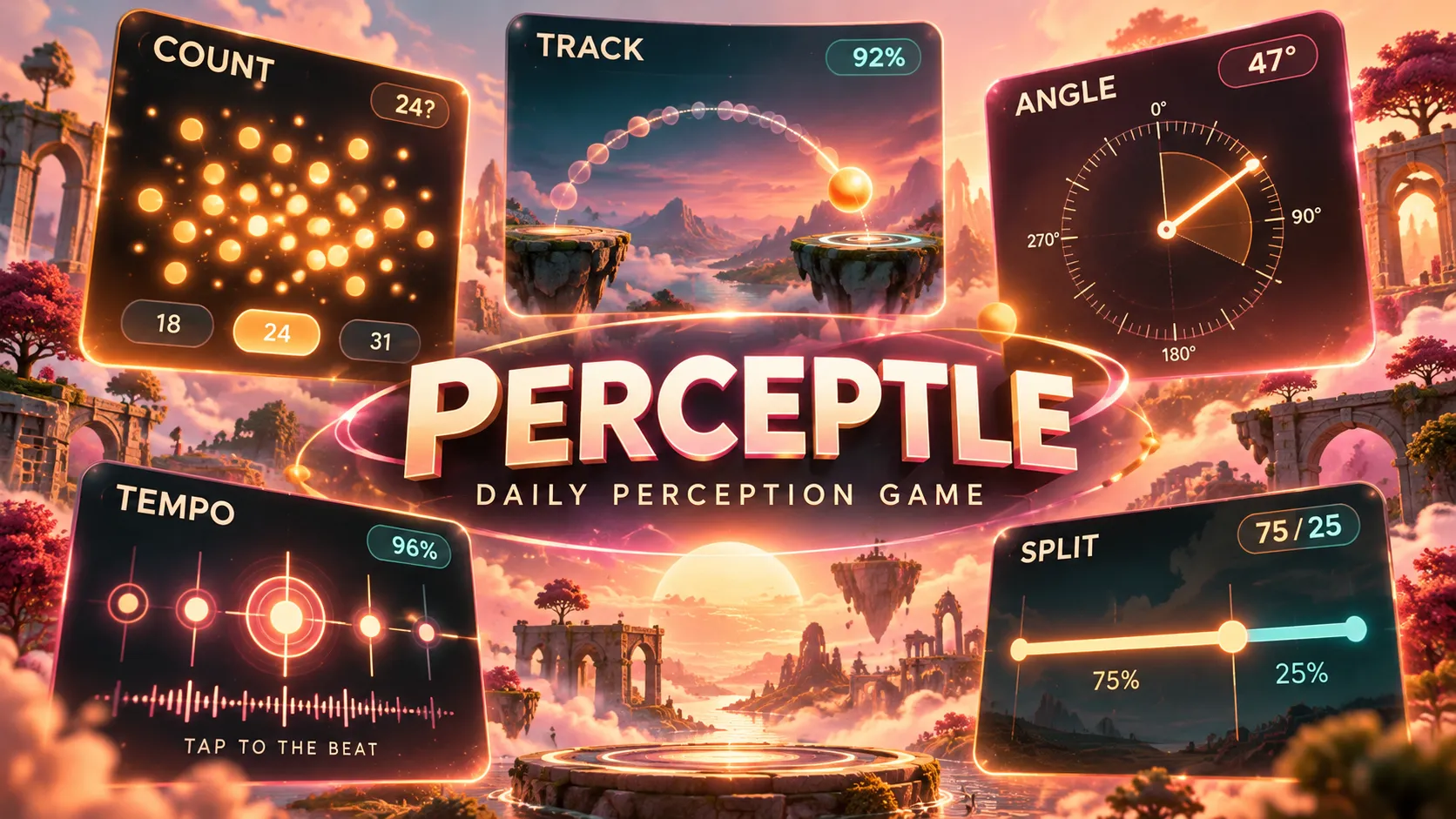
- Perceptle is a free daily browser game that challenges visual perception, numerical estimation, motion prediction, rhythm, and spatial reasoning rather than vocabulary or trivia knowledge.
- The original game features five tests: Count, Track, Angle, Tempo, and Split. Each measures a different aspect of perceptual accuracy.
- Every test awards up to 100 points. The final score is the rounded average of all five results, producing an overall score from 0 to 100.
- An A grade starts at 85 points, while an S grade requires at least 95. High scores depend on consistent accuracy across multiple perceptual skills.
- Friday challenges introduce five special variations, including moving dots, bouncing trajectories, multi-turn angles, offbeat rhythms, and fractions extending beyond a line.
- Players can access previous puzzles through Archive and generate additional unrecorded rounds through Keep playing.
- Perceptle is not a medical vision or cognitive assessment. Results are influenced by concentration, screen conditions, input devices, and familiarity with the tasks.
- The original game is available at Perceptle.com. Several similarly named websites provide independent games, practice tools, and guides with potentially different mechanics.
What Is Perceptle?
Perceptle is a daily perception-based puzzle game that measures how accurately players can estimate quantities, predict movement, judge angles, maintain rhythms, and identify proportions.
Unlike Wordle, which challenges vocabulary and logical deduction, Perceptle focuses on the relationship between sensory information and human judgment.
Each daily challenge consists of five short interactive tests. Players must perform tasks such as estimating the number of briefly displayed dots, predicting the landing position of a moving ball, and reproducing a rhythm after its audible reference disappears.
The game does not generally require researching facts or remembering specialized information. Instead, success depends on interpreting limited visual or auditory information and producing an accurate response.
This creates an important distinction between Perceptle and conventional puzzle games.
In many traditional puzzles, an answer is either correct or incorrect. In Perceptle, accuracy exists on a continuous scale. A slightly inaccurate estimate can still receive a strong score, while a larger error earns fewer points.
For example, when asked to estimate an angle of 120 degrees, a response of 122 degrees is much closer than 150 degrees. Both represent measurable errors, and the game's scoring system rewards the smaller difference.
The original Perceptle game contains five fixed categories played in the same order. Each day provides a new set of targets, allowing players to compare their accuracy over time.
The game is playable directly in a modern browser without installing software or creating an account.
Why Is Perceptle Different From Other Daily Games?
Perceptle combines several characteristics that are uncommon in traditional word and trivia games:
- Multisensory gameplay: Visual observation, spatial judgment, and auditory timing contribute to the final score.
- Error-based scoring: Players receive points according to how close their response is to the target.
- Short daily sessions: Five compact challenges make the game suitable for brief daily play.
- Skill-specific feedback: Individual scores identify which categories were easier or harder during a particular attempt.
- Special Friday rules: Weekly variations change the underlying tasks rather than simply increasing the number of questions.
- Repeatable practice: Additional rounds allow players to explore their weaker skills without waiting for the next daily challenge.
The appeal comes from discovering the difference between how accurately something feels and how accurately it was actually perceived.
How to Play Perceptle: Step-by-Step Instructions
Getting started requires only a web browser, although enabling sound is important for the rhythm challenge.
Step 1: Open the original game
Visit Perceptle.com on a desktop computer, tablet, or smartphone.
Step 2: Start the daily challenge
Select Play and read the instructions before each event. Some tests involve information that appears briefly and cannot be inspected again after it disappears.
Step 3: Complete the five perception tests
The original game presents these challenges in a fixed sequence:
| Order | Test | Objective | Input Method |
|---|---|---|---|
| 1 | Count | Estimate briefly displayed dots | Enter a number |
| 2 | Track | Predict where a moving ball lands | Click or tap |
| 3 | Angle | Rotate a line to the requested angle | Drag and release |
| 4 | Tempo | Continue a rhythm after the reference stops | Tap or press Space |
| 5 | Split | Mark a requested fraction of a line | Drag and release |
Step 4: Review each result
After submitting an answer, the game reveals the target and evaluates the difference between the correct value and the player's estimate.
Each challenge receives a score between 0 and 100.
Step 5: Check the final grade
Once all five tests are completed, Perceptle calculates the rounded average of the event scores.
The game assigns an overall letter grade ranging from F to S.
Step 6: Practice or return tomorrow
The daily result represents the recorded attempt for that date. Players can also explore historical puzzles through Archive or select Keep playing for additional unrecorded practice rounds.
The essential strategy is to understand exactly what each test measures before trying to optimize the response.
Perceptle Count: How to Estimate Dots Accurately
Count is the first challenge in the original Perceptle sequence.
A collection of dots appears briefly on the screen. After the dots disappear, the player must estimate how many were displayed.
In normal mode, the field contains approximately 45 to 85 dots, displayed for two seconds.
This duration makes individual counting impractical for most players.
The challenge therefore measures approximate numerosity judgment rather than ordinary counting speed.
The Best Count Strategy
1. Divide the field into regions.
Mentally separate the display into four approximately equal sections. Estimate the dots within each section rather than trying to count the entire field sequentially.
2. Recognize smaller groups.
Look for recognizable clusters of approximately five or ten dots. These groups provide a useful reference for estimating the total.
3. Adjust for uneven density.
A field containing dense clusters and large empty areas should not be treated as uniformly distributed.
4. Avoid false precision.
A stable estimate derived from visual grouping is generally more practical than attempting to count every individual dot before the display disappears.
For example, suppose the field appears to contain four sections with approximately 12, 16, 14, and 15 dots.
The resulting estimate is:
12 + 16 + 14 + 15 = 57 dots
This is an illustrative estimation method, not an actual daily puzzle answer.
Why Relative Error Matters
Perceptle's Count scoring evaluates error relative to the true number of dots.
The error calculation is:
Relative Error = |Estimated Count - Actual Count| / Actual Count
If the actual count is 60 and the player enters 66, the relative error is 10%.
If the actual count is 45 and the player also misses by six dots, the relative error is approximately 13.3%.
Therefore, two guesses with the same absolute difference can produce different scores.
Advanced tip: Review whether estimates consistently fall above or below the correct count. Repeated directional errors provide more useful feedback than a single unusually accurate guess.
Perceptle Track: How to Predict the Ball's Landing
Track challenges players to predict the landing position of a moving ball.
The ball follows a visible trajectory before disappearing. Players must mentally continue its movement and mark the horizontal position where it will reach the ground.
The main difficulty is that the final visible position is not necessarily close to the eventual landing point.
A ball traveling sideways continues moving horizontally after disappearing.
Understanding the Trajectory
Successful Track estimates depend on three observations:
- Horizontal movement: How quickly is the ball traveling sideways?
- Vertical position: Is the ball still rising, approaching its highest point, or descending?
- Remaining flight: How much time is likely to pass before the ball reaches the ground?
A common mistake is clicking directly underneath the last visible position.
That ignores the remaining horizontal displacement.
A Practical Prediction Method
First, identify the general shape of the visible arc.
Second, estimate where the ball reaches its highest point.
Third, mentally extend the descending trajectory toward the ground.
Finally, mark the expected horizontal landing location.
For an ideal symmetrical projectile arc with equal launch and landing heights, the highest point lies near the horizontal midpoint of the full flight. This can provide a useful reference.
However, that approximation should not be applied blindly when the game introduces different launch heights, gravity settings, or wall reflections.
Advanced tip: Use the revealed landing position to identify systematic errors. Consistently choosing positions too close to the disappearance point suggests that the remaining horizontal travel is being underestimated.
The original game's Track measurements use an internal coordinate system. Physical touchscreen pixels should not be confused with those game coordinates when comparing numerical errors across devices.
Perceptle Angle: How to Estimate Degrees Precisely
Angle tests spatial judgment and mental rotation.
The game displays a target angle, and the player must rotate a line counterclockwise from a reference direction until it matches that value.
The response is submitted when the handle is released.
Use Familiar Angular Landmarks
| Angle | Reference Position |
|---|---|
| 0° | Starting direction |
| 45° | Halfway between 0° and 90° |
| 90° | Quarter turn |
| 135° | Halfway between 90° and 180° |
| 180° | Half turn |
| 225° | Halfway between 180° and 270° |
| 270° | Three-quarter turn |
| 360° | Complete revolution |
Instead of estimating an unfamiliar angle from scratch, identify the nearest familiar landmark and adjust from it.
For example, a target of 110 degrees can be understood as:
110° = 90° + 20°
The player first reaches a quarter turn, then rotates approximately 20 degrees farther.
This anchoring method reduces the number of independent judgments required.
Watch the Reference Line
The game uses a dashed reference line to establish the starting direction.
Surrounding visual elements may make the frame appear tilted. Measuring relative to the wrong reference produces systematic errors, even when the rotated line looks visually reasonable.
Advanced tip: In normal mode, angles wrap around a full circle. The shortest angular separation between 359° and 1° is 2°, not 358°.
Friday challenges behave differently because they require tracking complete revolutions.
Perceptle Tempo: How to Keep a Perfect Rhythm
Tempo introduces an auditory timing challenge.
Players hear four reference beats and tap along with them. After the audible reference ends, they must maintain the same rhythm for eight additional taps.
The objective is to reproduce a consistent interval without relying on continuing audio feedback.
Understanding BPM
Tempo is commonly expressed in beats per minute, or BPM.
The interval between beats can be calculated as:
Beat Interval (ms) = 60000 / BPM
For example:
| Tempo | Interval Between Beats |
|---|---|
| 80 BPM | 750 ms |
| 100 BPM | 600 ms |
| 120 BPM | 500 ms |
| 150 BPM | 400 ms |
At 120 BPM, a steady rhythm requires one beat every half second.
The challenge is not simply remembering the first beat. Players must continue reproducing approximately the same interval across all eight silent taps.
Timing Drift vs Timing Jitter
Two types of error are particularly important.
Timing drift describes a consistent tendency to tap earlier or later than the intended reference.
Timing jitter describes inconsistency between taps.
A player might maintain relatively even spacing while tapping consistently late. Another player might have little overall timing bias but alternate unpredictably between early and late taps.
Both patterns can reduce the score.
The original game's timing evaluation combines average timing displacement and variation. Its reference is calibrated using the player's warm-up taps, which means fixed-reference practice tools may produce different results.
Practical Tempo Strategies
- Maintain a gentle physical motion while listening to the reference.
- Continue that motion after the audible beats disappear.
- Avoid accelerating simply because the audio stops.
- Use the same input method throughout the test.
- Consider wired headphones or the device speaker when Bluetooth latency creates noticeable timing problems.
- Avoid switching tabs or receiving interruptions during the rhythm sequence.
Advanced tip: Analyze whether timing errors accumulate throughout the eight silent beats. Increasing lateness suggests the reproduced interval may be too long; increasing earliness suggests the interval may be too short.
Perceptle Split: How to Master Fractions and Proportions
Split is the fifth and final test.
The player must identify a requested fraction or percentage of a line and mark the corresponding position.
Although the task involves simple mathematical relationships, its difficulty comes from visual placement and directional interpretation.
Understand the Starting Endpoint
Suppose a line extends from left to right.
If the instruction requests one-quarter from the left, the answer lies 25% of the way across the line.
If it requests one-quarter from the right, the correct position lies 75% of the way across when measured from the left.
| Requested Position | Equivalent Position From Left |
|---|---|
| 1/4 from left | 25% |
| 1/4 from right | 75% |
| 1/3 from left | 33.3% |
| 1/3 from right | 66.7% |
| 3/4 from left | 75% |
| 3/4 from right | 25% |
The arithmetic is straightforward, but a player who ignores the specified endpoint can produce a large error.
How to Improve Split Accuracy
Start by identifying the halfway point.
Use that midpoint to estimate quarters, thirds, or other requested proportions.
For example, seven-thirteenths of a line represents approximately 53.85% of its length.
That position is slightly beyond halfway when measured from the left.
When the prompt measures from the right, reverse the direction before placing the marker.
Advanced tip: Convert difficult fractions into decimal proportions mentally when useful, but avoid performing unnecessary long division during the actual test. Approximate reference points are often sufficient for a strong score.
How Perceptle Scoring Works
Perceptle uses an error-based scoring system rather than conventional correct-or-incorrect evaluation.
Each event awards an integer score between 0 and 100 according to the magnitude of the player's error.
The original game's scoring approach can be expressed as:
Score = round(100 × exp(-0.5 × (error / tolerance)^2))
Here, error represents the measured difference between the player's response and the correct target.
Tolerance represents the scale of error used for that particular test.
The scoring curve is nonlinear. Points do not decrease by a fixed amount for every additional unit of error.
Understanding the Error Curve
| Error Relative to Tolerance | Approximate Score |
|---|---|
| 0 × tolerance | 100 |
| 0.5 × tolerance | 88 |
| 1 × tolerance | 61 |
| 1.5 × tolerance | 32 |
| 2 × tolerance | 14 |
| 3 × tolerance | 1 |
This structure rewards precision while allowing small errors without immediately destroying a score.
It also means that reducing an already small error may have a different point impact from reducing a much larger error.
Normal-Mode Scoring Tolerances
The original game's published and independently examined scoring behavior uses different tolerances for each test.
| Test | Error Measurement | Normal Tolerance |
|---|---|---|
| Count | Relative number of dots | 20% |
| Track | Horizontal landing position | 60 internal units |
| Angle | Angular difference | 8° |
| Tempo | Timing displacement and variation | 60 ms |
| Split | Relative distance along line | 5% of line length |
For example, a normal-mode Angle error of 8 degrees corresponds to one full tolerance and produces approximately 61 points.
An error of 4 degrees corresponds to half a tolerance and produces approximately 88 points.
These values explain why relatively small differences in precise spatial tasks can meaningfully affect the final result.
For additional mathematical examples, the independent Perceptle scoring guide documents the score curve and test-specific error units.
Perceptle Grades Explained: What Is a Good Score?
After all five events, Perceptle calculates the rounded average of the individual results.
The calculation is:
Final Score = round((Count + Track + Angle + Tempo + Split) / 5)
Perceptle Grade Chart
| Grade | Final Score | Interpretation |
|---|---|---|
| S | 95–100 | Exceptional accuracy across the five tests |
| A | 85–94 | Strong overall accuracy |
| B | 70–84 | Solid performance with room to improve |
| C | 55–69 | Moderate accuracy |
| D | 40–54 | Substantial errors across one or more tests |
| F | 0–39 | Low accuracy in the current challenge |
These interpretations describe the scoring levels, not validated psychological or medical categories.
Example of a Complete Perceptle Score
Consider this hypothetical result:
| Test | Score |
|---|---|
| Count | 80 |
| Track | 90 |
| Angle | 70 |
| Tempo | 85 |
| Split | 95 |
| Total of Event Scores | 420 |
The calculation is:
420 / 5 = 84
The final result is 84 points, earning a B grade.
Now suppose the Angle result increases from 70 to 73 while everything else stays unchanged.
The sum becomes 423.
423 / 5 = 84.6
After rounding, the final score becomes 85, crossing the threshold into an A grade.
This reveals an important strategic principle: a small improvement in one weak event can sometimes change the final grade.
Is 90 a Good Perceptle Score?
Yes. A score of 90 is within the game's A-grade range.
However, it does not automatically mean the player performed better than 90% of other participants.
An absolute score and a percentile ranking represent different measurements.
Population rankings require real comparative player data from the same puzzle or a clearly defined comparison group.
The game's letter grades alone cannot establish a global percentile.
Does a Score of 100 Mean Perfect Accuracy?
Not necessarily in every individual measurement.
Because event scores are rounded to whole numbers, a sufficiently small nonzero error can still produce a displayed score of 100.
Therefore, a perfect displayed score does not always prove that every underlying estimate was mathematically exact.
Perceptle Friday Mode: All Five Special Challenges Explained
One of Perceptle's most distinctive features is its special Friday variation.
Rather than presenting the same tasks with slightly different numerical targets, Friday challenges modify the mechanics of all five tests.
In the original game's reviewed puzzle calendar, the first Friday variation appears on July 31, 2026, as puzzle #14.
Players can identify Friday variations using the joker marker in Archive.
Normal vs Friday Rules
| Test | Normal Mode | Friday Variation |
|---|---|---|
| Count | Stationary dots | Moving and bouncing dots |
| Track | Standard projectile arc | Weaker gravity and wall ricochets |
| Angle | Angle within one complete turn | Multiple revolutions totaling more than 360° |
| Tempo | Continue the main beat | Tap halfway between the beats |
| Split | Fraction within the line | Improper fraction extending beyond the line |
Friday Count: The displayed dots move during the observation period. Players must estimate the number of individual dots rather than counting every successive position occupied by a moving dot.
Friday Track: The ball can reflect from the side boundaries. Predicting the final landing requires accounting for the reflected trajectory instead of extending a single uninterrupted arc.
Friday Angle: Targets may require more than one complete rotation. A target of 810 degrees requires two full revolutions plus another 90 degrees.
Stopping at 90 degrees would produce the same final direction but miss 720 degrees of accumulated rotation.
Friday Tempo: Players continue tapping at the midpoint between reference beats rather than directly on the original pulse.
At 100 BPM, consecutive beats are separated by 600 milliseconds. The offbeat occurs approximately 300 milliseconds after a beat, followed by another offbeat 600 milliseconds later.
The goal is to shift the rhythm's phase, not double its tempo.
Friday Split: Players must place a point beyond an endpoint when the requested fraction exceeds one.
For example, eight-fifths of a line measured from the left equals 1.6 times the original length.
The target therefore lies 60% of one line length beyond the right endpoint.
Friday Scoring Is Adjusted
Friday mode uses different scoring tolerances to accompany its harder mechanics.
| Test | Normal Tolerance | Friday Tolerance |
|---|---|---|
| Count | 20% | 32% |
| Track | 60 units | 90 units |
| Angle | 8° | 14° |
| Tempo | 60 ms | 85 ms |
| Split | 5% | 10% |
The final grade thresholds remain unchanged.
This means a Friday score and a normal-mode score should not be compared without considering their different tasks and tolerances.
Players seeking additional examples can review the independent Perceptle Friday rules guide.
Perceptle Unlimited and Archive: Can You Play More Than Once?
The original Perceptle game includes additional gameplay options beyond the recorded daily challenge.
Perceptle Archive
Archive provides access to historical daily puzzles.
To use it:
- Open Perceptle.com.
- Select Archive from the main menu or results screen.
- Find the desired puzzle number and date.
- Choose an unfinished puzzle to play its five events.
- Review the saved result if that date was already completed in the same browser storage context.
Historical puzzles preserve their original date-specific targets and Friday rules.
The archive displays dates and puzzle numbers rather than requiring players to guess hidden URLs.
For reference, October 21, 2026 corresponds to original Perceptle puzzle #96 in the independently documented puzzle calendar.
That example is historical information and should not be mistaken for a permanently current puzzle number.
Keep Playing
The original game's Keep playing option generates additional random five-event practice sets.
These runs are marked as unrecorded practice rather than new official daily results.
The mode follows the current local day's rule variation, meaning a random set played on a normal day does not necessarily recreate Friday's special mechanics.
Independent Unlimited Practice
Perceptle Unlimited provides an independent practice experience with repeated rounds, skill selection, and additional configuration options.
Its generated puzzles and saved practice results are separate from those of the original game.
Another independent companion, Perceptle Game, offers individual practice exercises for the five original-style skills.
These resources can help players target weaknesses, but their generated rounds and scores should not be treated as official historical Perceptle results.
Seven Strategies to Improve Your Perceptle Score
A high Perceptle score requires more than repeatedly attempting random challenges.
A useful training approach focuses on identifying specific errors and improving the underlying judgment process.
1. Train the Weakest Skill First
Because all five tests carry equal weight, weak performance in a single category can substantially lower the final average.
For example, consider a player scoring 95 in four events but only 45 in Tempo.
The total is:
(95 + 95 + 95 + 95 + 45) / 5 = 85
Despite strong results in four categories, the final score is only 85.
Improving Tempo from 45 to 75 would raise the final average to 91.
The most useful next practice task is often the one with the greatest realistic potential for improvement.
2. Separate Systematic Errors From Random Errors
Systematic errors repeat in a recognizable direction.
Examples include consistently underestimating dot counts or repeatedly placing a ball's landing too far to the left.
Random errors fluctuate without a clear pattern.
Different problems require different adjustments.
A systematic bias may respond to a small deliberate correction. Highly variable responses may require a more stable reference method or better testing conditions.
3. Use Anchors for Spatial Tasks
Spatial reasoning becomes easier when unfamiliar positions are compared with familiar reference points.
For Angle, use quarter turns and diagonal directions.
For Split, use the midpoint, quarters, and thirds.
For Track, use the visible apex and horizontal position of the ball.
Anchoring reduces reliance on isolated visual intuition.
4. Practice Under Consistent Conditions
Perceptle performance can vary with device and environment.
Useful consistency measures include:
- Using the same display size for repeated comparisons.
- Avoiding unnecessary browser zoom changes.
- Keeping sound output consistent during Tempo.
- Reducing interruptions and notifications.
- Using the same tapping method when practicing timing.
These steps do not guarantee higher scores, but they make comparisons between attempts more meaningful.
5. Review the Actual Error, Not Just the Grade
A grade summarizes overall performance but hides important differences.
Two players can receive the same total score while showing completely different strengths and weaknesses.
One may perform consistently across all five categories. Another may achieve excellent results in three categories but struggle with the remaining two.
The individual error measurements reveal which skills deserve attention.
6. Learn Friday Mechanics Separately
Friday mode is not merely a faster version of the standard game.
It introduces genuinely different tasks.
For example, Friday Angle requires accumulated rotation, while Friday Tempo requires an offset rhythm.
A player who has mastered ordinary one-turn angles or regular on-beat tapping can still struggle with those variations.
Practicing the specific Friday rules is therefore more effective than relying entirely on normal-mode repetition.
7. Track Improvement Across Multiple Attempts
One unusually high score may reflect favorable targets or normal variation.
A more useful training record includes:
- Average score per skill.
- Typical absolute or relative error.
- Frequency of overestimation and underestimation.
- Normal-mode versus Friday-mode results.
- Device and audio conditions.
- Number of practice attempts.
Repeated improvements under comparable conditions provide stronger evidence of learning than a single perfect round.
A Seven-Day Perceptle Practice Plan
Players who want a structured improvement routine can use the following schedule.
| Day | Focus | Suggested Exercise |
|---|---|---|
| 1 | Baseline | Complete one full game and identify the weakest event |
| 2 | Count | Practice grouping and density estimation |
| 3 | Track | Predict trajectories and inspect landing errors |
| 4 | Angle | Practice reference angles and incremental adjustments |
| 5 | Tempo | Continue silent rhythms at different beat intervals |
| 6 | Split | Practice fractions from both endpoints |
| 7 | Review | Complete a comparable set and examine error patterns |
The purpose is to develop a more reliable process, not to guarantee a particular score improvement in seven days.
Where possible, use independently generated practice rounds so that improvement does not simply reflect memorization of previously revealed targets.
Perceptle Answers Today: Should You Look Up the Daily Targets?
Searching for Perceptle answers is different from searching for Wordle or traditional trivia solutions.
The game asks players to produce numerical or spatial estimates rather than identify a single hidden word.
A daily answer guide may reveal information such as:
- The actual number of Count dots.
- The ball's landing position in Track.
- The target Angle value.
- The Tempo's BPM.
- The requested Split fraction or percentage.
However, knowing a target does not always reproduce the original gameplay conditions.
For example, a Tempo challenge also involves timing relative to the player's audible warm-up. Knowing the nominal BPM does not automatically determine every calibrated tap timestamp.
Similarly, knowing the final landing coordinate in Track removes the prediction challenge rather than teaching the player how to interpret the trajectory.
A Better Way to Use Daily Hints
Before playing: Review the rules and practice general estimation methods without revealing the day's exact targets.
During the daily game: Attempt the five challenges using personal observation and timing.
After finishing: Compare the revealed values with the original estimates and identify which judgment methods were inaccurate.
For historical explanations, Perceptle Guide provides independently documented date-specific information and practice resources.
Always confirm that the puzzle number and date match the original game before treating a third-party answer page as relevant.
Perceptle vs Wordle, Freehand, and Other Estimation Games
Although Perceptle is often discussed alongside daily word games, its mechanics are more closely related to visual estimation and perception challenges.
| Game | Main Gameplay | Primary Skill |
|---|---|---|
| Perceptle | Five daily perception tests | Visual estimation, timing, spatial judgment |
| Wordle | Guess a hidden five-letter word | Vocabulary and deduction |
| Connections | Group related words | Pattern recognition and semantic reasoning |
| Freehand | Estimate visual quantities, angles, cuts, and motion | Spatial and numerical intuition |
| Estimatle | Answer numerical questions using sliders | Quantitative estimation and general knowledge |
| Estimania | Estimate numerical facts across topics | Magnitude reasoning |
| Packle | Estimate how many circles fit inside a shape | Spatial packing intuition |
Freehand is a particularly relevant alternative for players who enjoy perceptual tasks such as landing predictions and angular judgments.
Estimatle and Estimania are better suited to players who prefer numerical questions involving real-world knowledge.
Packle focuses on estimating spatial capacity rather than completing several different perception tests.
These games are alternatives, not equivalent implementations. Their scoring formulas, daily schedules, and input methods differ.
Perceptle's distinctive advantage is the variety of perceptual judgments combined into a single short daily result.
Important: Different Websites Use the Perceptle Name
Players searching for Perceptle may encounter websites with different game formats.
This distinction matters because instructions for one implementation may be inaccurate for another.
| Website | Game Format | Relationship |
|---|---|---|
| perceptle.com | Original five-test Daily Dive | Original game discussed in this guide |
| perceptle.io | Embedded original plus independent practice modes | Independent companion |
| perceptlegame.com | Embedded original plus individual exercises | Independent companion |
| perceptle.net | Original-game embed, guides, hints, and practice | Independent companion |
| perceptle.org | Separate ten-test perception game | Independently developed game with different mechanics |
| perceptle.app | Independent five-test daily game | Separate puzzle generation and saved results |
The version at Perceptle.org includes a broader collection of perception tasks such as color memory, reaction time, symmetry, and area estimation.
Its daily game uses ten tests and a maximum total of 1,000 points, rather than the original five-test average out of 100.
As a result, instructions describing ten rotating perception tests should not be applied to the original five-event game at Perceptle.com.
Likewise, an independent five-test clone may share category names without sharing the original puzzle dates, target values, scoring calibration, or history.
Always identify the domain before following a guide, comparing scores, or searching for today's answers.
Is Perceptle a Real Vision or Cognitive Test?
Perceptle uses tasks related to numerical estimation, visual processing, motion prediction, temporal judgment, and spatial reasoning.
These are legitimate areas of psychological and perceptual research.
However, the existence of a research-related task does not automatically make a browser game a validated assessment instrument.
The original game should be understood primarily as entertainment and informal skill practice.
Scores can be influenced by variables unrelated to underlying perceptual ability, including:
- Screen dimensions and display scaling.
- Browser rendering and input responsiveness.
- Audio latency and output-device configuration.
- Familiarity with the interface.
- Concentration and environmental distractions.
- Practice effects from repeating similar tasks.
A low Count score does not establish a visual disorder.
A low Tempo score does not establish a neurological or auditory problem.
Likewise, a high overall result does not establish an IQ score or medically validated perceptual ability.
Players seeking formal evaluation of eyesight, hearing, or cognition should use appropriately validated assessments administered by qualified professionals.
Perceptle Not Working? Common Problems and Fixes
Most gameplay problems relate to browser behavior, audio permissions, local storage, or interactions with the game interface.
1. No Sound During Tempo
Possible causes include muted tabs, low media volume, disabled audio output, or browser restrictions on automatic sound playback.
Try the following:
- Confirm that device media volume is enabled.
- Check whether the browser tab is muted.
- Start the test using a deliberate click or tap to authorize audio playback.
- Test the device speaker or wired headphones if Bluetooth timing seems inconsistent.
- Open the original game directly instead of through an embedded frame.
Importantly, the silent continuation after the four audible reference beats is part of the game. It is not necessarily an audio malfunction.
2. Game Appears Blank
An embedded Perceptle game may fail to load because of browser restrictions, connection problems, or blocked third-party content.
Open Perceptle.com directly in another tab to distinguish a problem with the original game from a problem with the embedding website.
Avoid reloading an unfinished challenge unless necessary, because an interrupted attempt may lose unsaved progress.
3. Previous Scores Are Missing
The original game stores completed results in browser storage.
Scores may appear missing when players:
- Switch to another device or browser.
- Use private browsing.
- Clear site data.
- Change browser storage permissions.
- Open the game through a different embedding context.
Historical puzzle availability and locally saved completion results are different things.
An archive date can remain available even when the browser no longer remembers a previously completed score.
4. Today's Puzzle Number Looks Wrong
The original game uses the browser's local calendar date when selecting the daily puzzle.
Two players in different time zones can therefore see different current daily puzzles at the same moment.
If the game shows an unexpected date, verify the device's clock and time-zone settings.
A page left open across midnight may need to be reopened to load the newly current daily puzzle.
5. Touch Controls Are Difficult
On mobile devices, dragging an angle or split marker can conflict with page scrolling.
Begin the drag inside the active game area and release deliberately to submit the response.
For better precision, consider opening the original game in a dedicated browser tab or using a larger screen.
Frequently Asked Questions About Perceptle
What is Perceptle?
Perceptle is a free browser-based perception game featuring five short tests: Count, Track, Angle, Tempo, and Split. Players estimate numerical, spatial, motion, and rhythm targets, receiving scores based on accuracy.
Where can Perceptle be played?
The original game is available at https://perceptle.com/. Independent companion sites provide additional practice modes and guides.
Is Perceptle free?
The original daily browser game is free to play without requiring a download or account registration.
How many tests are in Perceptle?
The original game contains five tests per daily challenge. A separate game at Perceptle.org uses ten daily tests with different mechanics.
What is the maximum Perceptle score?
The original five-test game has a maximum displayed final score of 100. The five event scores are averaged rather than added into a 500-point final total.
What is a good Perceptle score?
A score of 85 or higher earns an A grade, while 95 or higher earns an S. These are game-defined thresholds, not statistical percentile rankings.
How does Perceptle calculate scores?
Each event converts measured error into a score between 0 and 100 using a nonlinear scoring curve. The final result is the rounded average of the five event scores.
What does S mean in Perceptle?
S is the game's highest grade and applies to final scores from 95 through 100.
Does Perceptle reset every day?
Yes. The original game selects its daily puzzle using the browser's local calendar date. Players in different time zones may encounter the date change at different moments.
Can Perceptle be played more than once per day?
Yes. Keep playing offers additional unrecorded sets, while Archive provides access to previous dated puzzles. Independent practice websites may offer further repeatable challenges.
What happens on Perceptle Friday?
Friday variations introduce moving dots, wall-bouncing trajectories, multi-revolution angles, offbeat rhythms, and improper fractions extending beyond a line.
Does Friday Perceptle use different scoring?
The final grade structure remains the same, but individual tests have different error tolerances to accommodate the changed challenges.
How do players improve at Perceptle?
Useful methods include grouping dots, predicting motion using trajectory landmarks, estimating angles from quarter turns, maintaining consistent rhythmic intervals, and locating fractions using familiar proportions.
Can Perceptle be played on a phone?
Yes. The original game runs in mobile browsers, although screen size, touch input, and audio configuration can affect the gameplay experience.
Does Perceptle measure IQ or eyesight?
No validated IQ or eyesight diagnosis should be inferred from its game scores. Perceptle is an entertainment-oriented perception challenge rather than a clinical assessment.
Where can players find Perceptle answers today?
The original game reveals targets after each submitted response. Independent guides such as Perceptle Guide also organize date-specific hints and explanations. Players should match the puzzle number, date, and game version before using third-party answer information.
Conclusion
Perceptle offers a distinctive alternative to conventional daily word and trivia games by turning everyday perceptual judgments into five measurable challenges.
Its combination of numerical estimation, motion prediction, spatial reasoning, rhythm, and proportional thinking makes each daily attempt a compact test of accuracy rather than general knowledge.
The scoring system rewards precision without requiring every answer to be exact. At the same time, Friday variations introduce new mechanics that challenge players to adapt familiar strategies.
The strongest approach is to identify which event produces the largest recurring errors, practice that specific skill, and compare results under consistent conditions.
Players can start the original Perceptle daily game, explore additional rounds through Perceptle Unlimited, or consult the Perceptle rules and practice guide for more detailed instructions.
With five short tests, clear feedback, and a fresh daily puzzle, Perceptle makes perceptual accuracy an engaging skill to explore one challenge at a time.
Continue Reading
More articles connected to the same themes, protocols, and tools.


Referenced Tools
Browse entries that are adjacent to the topics covered in this article.