
On This Page8 sections
Key Takeaways
- Andrew Ambrosino is a member of OpenAI’s technical staff, with a background spanning software engineering, product design, product leadership and entrepreneurship.
- He led development of the Codex desktop app and subsequently described responsibilities extending to desktop experiences and the Space team.
- Before OpenAI, he co-founded Catch and held frontend, design and product leadership roles at Noyo.
- There is no verified public announcement, as of November 4, 2026, that he replaced Thibault “Tibo” Sottiaux as the leader of the entire Codex organization. Their publicly described responsibilities have different scopes.
His personal website, published interviews and project portfolio provide a more useful picture than the shorthand description of him as simply a Codex executive. They show a builder working at the intersection of implementation, interaction design and product decisions.
Who Is Andrew Ambrosino?
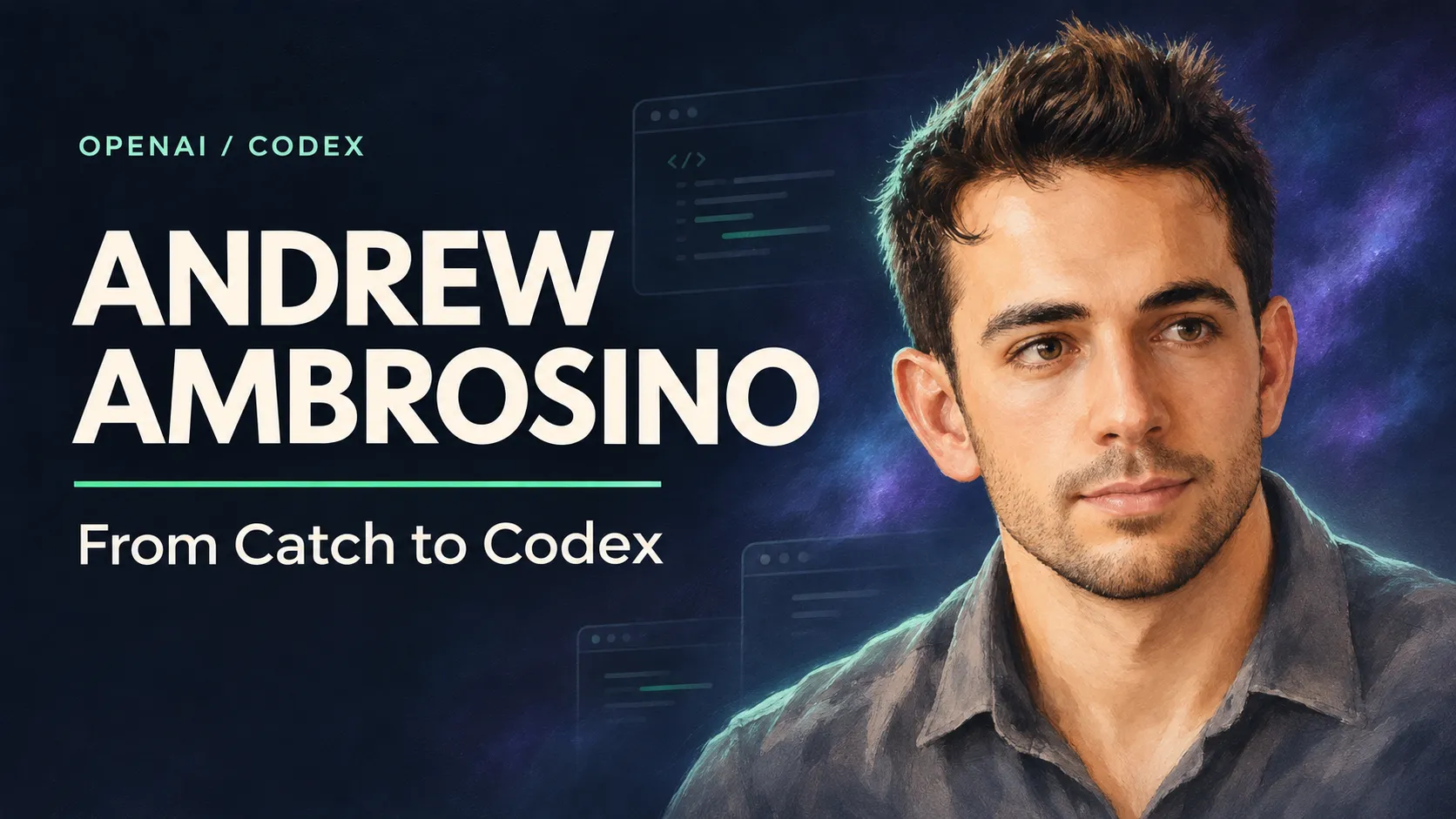
Andrew Ambrosino is an OpenAI technical staff member whose career combines building software with deciding how products should work. His personal website describes him as a founder, design engineer and product leader, and lists his OpenAI tenure as beginning in 2025.
His GitHub profile independently identifies his OpenAI role and previous positions at Noyo and Catch.
Three descriptions help distinguish his formal title from his work:
| Description | What it establishes |
|---|---|
| Member of Technical Staff | His publicly listed OpenAI title |
| Codex desktop development lead | A product responsibility documented in his June 2026 Lenny’s Podcast appearance |
| Desktop and Space team leader | Responsibilities he described during TBPN’s September 2026 DevDay interview |
These labels are compatible. A broad technical staff title can coexist with responsibility for leading a product team. However, none of them, by itself, establishes authority over every Codex product, model or infrastructure team.
Career Timeline: From Design Engineering to OpenAI
Ambrosino’s published career history shows repeated movement between engineering, design and product ownership.
| Period | Organization | Publicly listed role |
|---|---|---|
| 2011–2015 | MITRE | Senior Design Engineer |
| 2013 | Microsoft | Software Engineer |
| 2014 | Upthere | Product Design |
| 2016–2023 | Catch | Founder and CTO/CPO |
| 2023–2025 | Noyo | Head of Frontend and Design |
| 2025 | Noyo | Head of Product |
| 2025 onward | OpenAI | Member of Technical Staff |
The dates above follow his personal website; overlapping entries should not be interpreted as a sequence of mutually exclusive, full-time appointments.
Catch: Building a Product Around Independent Workers
Before joining OpenAI, Ambrosino co-founded Catch, a company focused on benefits for independent workers. Y Combinator’s company profile identifies him as a founder and CTO/CPO, while its company records place Catch in the W19 batch.
His Catch project portfolio describes responsibility for product strategy and the engineering and design organizations. The product combined workflows involving tax withholding, savings, retirement accounts and health insurance, with integrations across banking, brokerage and insurance providers. These are historical descriptions of his work, rather than statements about Catch’s current offerings.
The relevant connection to his later career is experience making complicated systems understandable. A benefits product must help users navigate several underlying services while maintaining a coherent experience.
That provides a useful perspective on AI applications: adding more capabilities does not automatically make a product easier to use. Someone still has to decide how those capabilities fit together, what users need to understand and where the interface should expose complexity. This is an analytical connection between his roles, rather than a claim that Catch directly determined Codex’s design.
Noyo: Evidence of Hands-On Technical Work
Ambrosino’s Noyo portfolio offers concrete evidence of engineering work alongside product leadership.
According to his published Noyo project account, he helped build a customer-facing web application, introduced architecture to consolidate multiple generations of React codebases, and built a GraphQL server that unified API schemas across approximately 15 services. He also describes forming an AI team and building initial generative AI prototypes.
The technologies listed include React, Next.js, TypeScript, GraphQL and Apollo. These details describe his Noyo work; they should not be treated as a disclosure of Codex’s current technology stack.
The architectural significance is straightforward: a unified schema can give frontend developers a more consistent interface to fragmented backend services. The product benefit depends on implementation, but the underlying objective is to reduce the coordination burden involved in shipping a coherent experience.
His portfolio therefore supports a specific characterization: a product leader with direct experience building interfaces and integration layers, rather than someone whose public record consists only of management titles.
What Has Andrew Ambrosino Led at OpenAI?
His public responsibilities are best understood through dated accounts.
June 28, 2026: Codex desktop development. Lenny’s Podcast introduced Ambrosino as leading development of the Codex desktop app. The interview covered product judgment, changing team roles and coordinating work across ChatGPT, Codex and existing tools.
September 29, 2026: desktop and Space. During TBPN’s OpenAI DevDay episode, he said he had led the desktop team since the original Codex app and had also taken on leadership of the Space team. This is stronger evidence of his responsibilities than interpreting a social media biography alone.
Later public writing: collaboration in ChatGPT. His author biography for Every’s essay on computing after automation describes him as leading a team building tools for people to work together in ChatGPT.
Taken together, these accounts support a progression from Codex desktop development toward broader desktop and collaborative work experiences. They do not establish that he personally owns every part of ChatGPT or Codex.
The distinction also matters for readers following Codex CLI: leadership of a desktop application does not automatically establish leadership of the command-line product or the underlying model research organization.
Did Andrew Ambrosino Replace Tibo?
No verified public announcement establishes that replacement as of November 4, 2026.
An October 7, 2026 Masters of Scale interview identifies Thibault “Tibo” Sottiaux as OpenAI’s head of Product & Platform, with a remit spanning ChatGPT, Codex and the API.
The publicly described difference is therefore one of scope:
| Person | Documented responsibilities | What should not be inferred |
|---|---|---|
| Andrew Ambrosino | Codex desktop development; later desktop and Space team responsibilities | That he controls the entire Codex organization or model roadmap |
| Thibault Sottiaux | Product and platform leadership across ChatGPT, Codex and the API | That another team leader collecting feedback means he has left those responsibilities |
This comparison combines their public interviews; it is not a published internal reporting chart.
A team leader becoming more visible to users can reflect increased responsibility for delivery, communication or a particular improvement effort. Establishing a formal succession requires clearer evidence, such as an appointment announcement or an explicit statement from the people involved.
His Product Thinking: Judgment, Adaptability and Clear Ownership
Ambrosino’s public discussions are useful because they address what changes when software becomes faster to build.
Product judgment becomes more consequential. His Lenny’s Podcast appearance emphasizes taste and changing product roles. A practical implication is that producing more implementations increases the need to choose which ones deserve further investment. A working prototype can demonstrate feasibility without demonstrating demand.
Cross-disciplinary work still needs ownership. The interview discusses a “zone defense” approach to product work alongside the risks of eliminating roles entirely. The useful distinction is between allowing people to cross functional boundaries and leaving decisions without an accountable owner.
Software should adapt to how people work. In his Every essay, Ambrosino argues for computing that accommodates different modes of thinking and interaction, rather than requiring users to reorganize their work around application conventions.
For small product teams, these ideas suggest three practical habits:
- Define the user outcome before generating alternatives. For an image tool, a successful outcome might be exporting a usable file with fewer corrections, rather than displaying more editing options.
- Label the maturity of a prototype. Make clear whether it tests an idea, validates a workflow or is ready for release.
- Assign responsibility for the complete experience. Someone should own how errors, interruptions and recovery work across the full task, even when several people contribute features.
These are practical applications of the themes in his interviews, not a claim that they reproduce OpenAI’s internal operating procedures.
Why His Feedback Posts Attracted Attention
On October 29, 2026, Ambrosino announced an intensive effort to improve application simplicity and performance, said he would oversee it, and invited complaints. That establishes responsibility for a particular improvement effort; it does not establish that the work had already been completed.
His November 4 post expanded the invitation to feedback about all apps and included a joke about enjoying a good merge. Tibo’s reply asked him to improve the model because it could not yet do everything.
The tone supports reading the exchange as playful exaggeration. It does not announce responsibility for third-party applications, a leadership replacement or a new product merger.
For users following his account, the useful signals are specific commitments, descriptions of work in progress and subsequent evidence that changes shipped.
Frequently Asked Questions
What is Andrew Ambrosino’s official OpenAI title?
His personal website and GitHub profile list Member of Technical Staff. Product leadership responsibilities should be described separately from that title.
Is he the founder of Codex?
The evidence supports describing him as a leader involved in building the Codex desktop app. Calling him the sole founder or creator of the entire Codex product family would go beyond the available evidence.
What did he do before OpenAI?
He co-founded Catch and later held frontend, design and product leadership positions at Noyo. His earlier career includes MITRE, Microsoft and Upthere.
Where can readers follow his work?
His personal website provides career and project information, GitHub identifies his professional affiliations, and X account contains product commentary and feedback discussions.
Conclusion
Andrew Ambrosino’s career illustrates how engineering, design and product judgment can combine in the development of AI applications. His work spans a benefits startup, software integration challenges at Noyo, Codex desktop development and collaborative experiences in ChatGPT.
For developers and founders, the most useful reason to follow him is the connection between technical capability and everyday usability: how powerful tools become understandable products that people can depend on.
Explore his project portfolio and long-form interviews, then follow his product updates for concrete changes in desktop and collaborative AI workflows. Keep documented responsibilities separate from speculation about executive succession.
Continue Reading
More articles connected to the same themes, protocols, and tools.


Referenced Tools
Browse entries that are adjacent to the topics covered in this article.