
On This Page8 sections
Key Takeaways
- PlayDaily.org is a browser-game platform operating under the Daily brand. Its main attraction is repeatable play across music, trivia, visual and classic puzzle games.
- Official author biographies identify Emma Hamlin and Peter Frank as co-founders. Their published interests emphasize familiar puzzles, shared play and competition.
- The homepage lists 16 distinct games as of October 23, 2026. Older references to additional titles should not be treated as proof of current availability.
- Songless, Songspot, Krillion and Noillirk offer live multiplayer. Friends can join private rooms using a six-digit code.
- Games are free; Daily Pro primarily removes advertising. The plans page currently displays $10.47 per year or $25 for lifetime access.
- Some open-ended answers receive AI-assisted judgments. The resulting rarity or popularity scores are game estimates, not independently verified population statistics.
What Is PlayDaily.org?
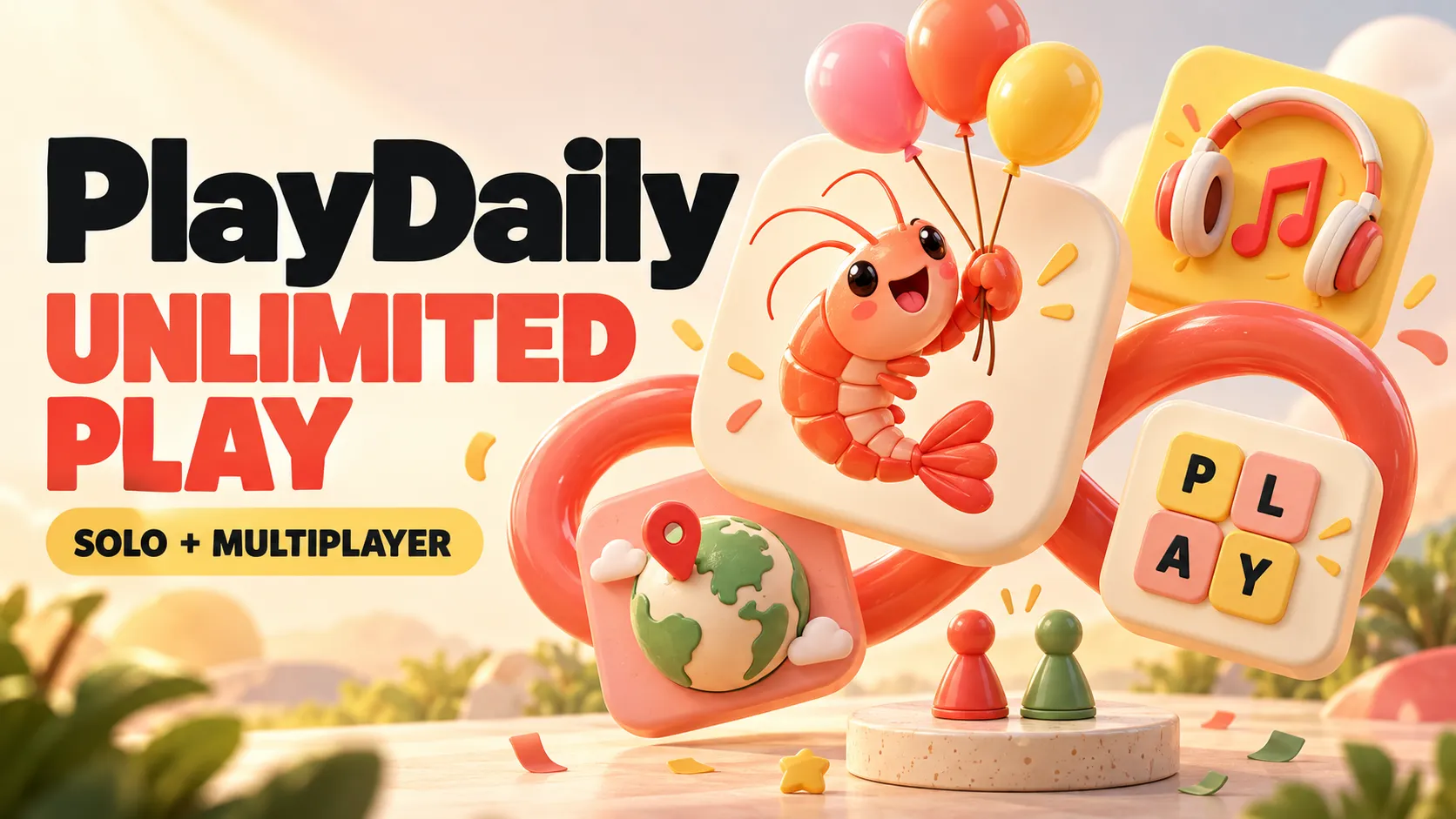
PlayDaily.org brings multiple playable browser games together under one brand. Visitors can choose a game and start without installing software or creating an account.
Its defining proposition is unlimited access to short, familiar game formats. Someone who enjoys a daily guessing game can continue playing new rounds instead of waiting for the next reset. The platform also adds social competition to selected games. Its About page explicitly describes this approach.
The distinction matters: a game directory primarily helps visitors discover other websites, while PlayDaily provides its own game experiences at dedicated URLs. That gives the operator control over rules, scoring, progression and the transition between games.
However, familiar names require careful interpretation. Daily describes several titles as independently developed versions inspired by existing games. A game appearing on PlayDaily does not establish an affiliation with the creator of the original title.
Who Founded PlayDaily?
PlayDaily's official articles identify two co-founders:
| Founder | What the official biography says |
|---|---|
| Emma Hamlin | Co-founded Daily to make childhood puzzle interests into a shared routine, with a particular enthusiasm for word and logic games. |
| Peter Frank | Co-founded Daily from a longstanding interest in puzzle games and focuses on its competitive side and leaderboard experience. |
These descriptions appear in founder-authored material, including Emma Hamlin's music-game guide and Peter Frank's article about competitive browser games. They establish how the company publicly presents its founders; they do not independently verify employment histories or corporate ownership.
The About page describes the creators as two corporate workers who retained an affection for simple games. Their stated motivation was to provide an accessible place to keep playing and share that experience with others.
That motivation is reflected in the product: short instructions, immediate access, repeatable rounds and optional competition. The business interpretation is that familiar mechanics reduce the explanation required before a visitor can enjoy a first session.
What Games Are Currently on PlayDaily?
The homepage lists 16 distinct titles, grouped into music, word and trivia, visual games, and classics. Featured cards repeat some titles and should not be counted as additional games. This is a snapshot of the public homepage on October 23, 2026, rather than a claim that every historical URL remains available.
Music Games: Songless, Bandle and Songspot
| Game | Core mechanic | Important distinction |
|---|---|---|
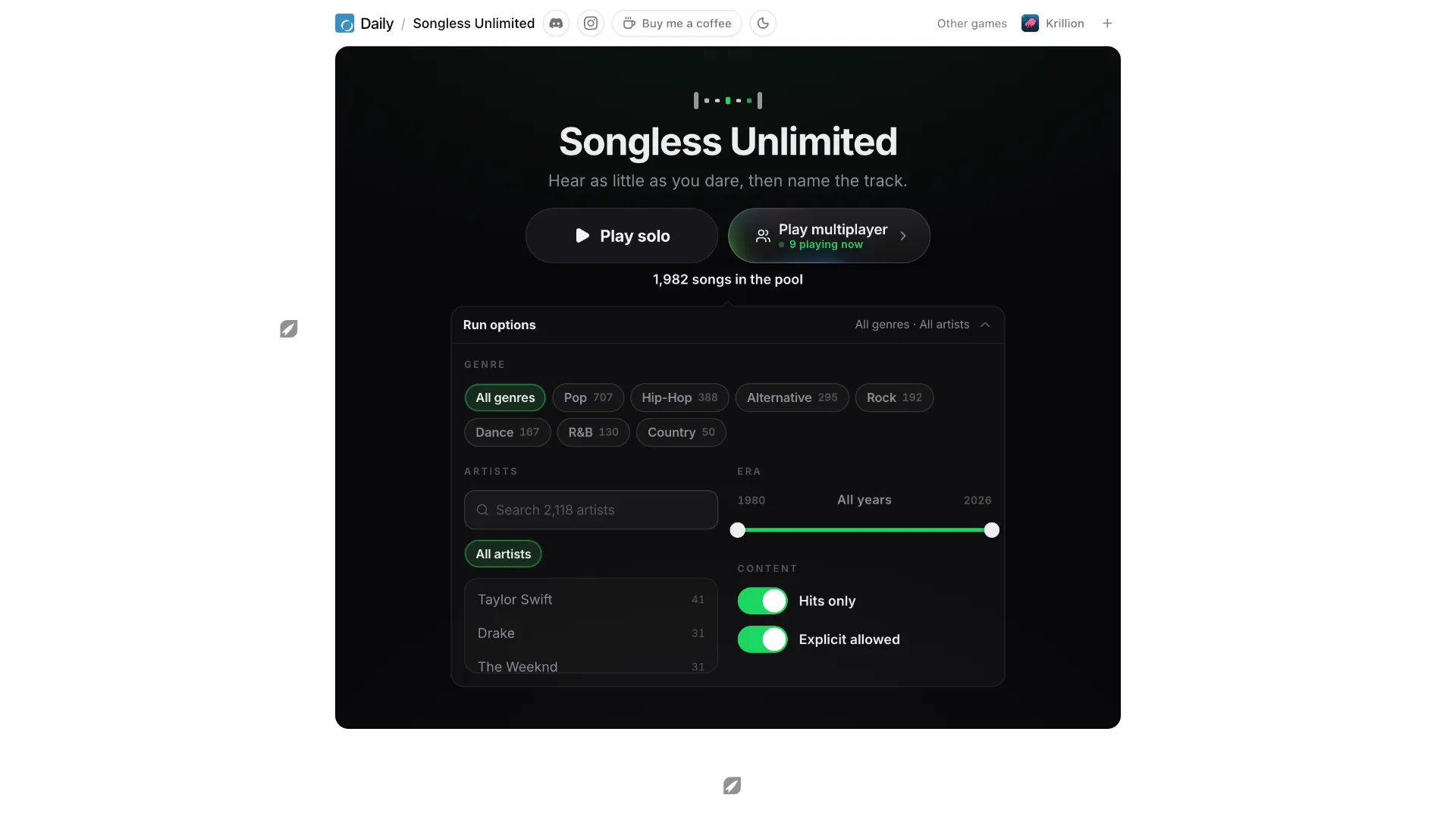
| Songless Unlimited | Identify a song from an initial 0.1-second excerpt, revealing more audio when needed. | A draggable playback control lets players choose how much to hear. |
| Bandle Unlimited | Identify a recording as drums, bass, other instruments and vocals become available. | Difficulty depends on how many musical layers are revealed. |
| Songspot | Identify songs using progressively longer excerpts. | Uses fixed clip lengths: 0.1, 0.5, 2, 5 and 15 seconds. |
The respective game pages describe these three distinct approaches to revealing musical information.
Songless currently reports 6,637 tracks, with filters for genres, artists and release years. A standard run contains five songs. Revealing more audio reduces the available score, creating a trade-off between confidence and points.
Bandle advertises more than 5,000 tracks. Its published scoring awards up to 10,000 points for identifying a song from drums alone; adding each of three further layers reduces that maximum by 2,000 points. Incorrect guesses incur a separate penalty.
Songspot also uses five-song runs, organized from easier to harder selections. Its multiplayer description supports rooms of up to 50 players, with participants racing to identify the same recording.
Which should players choose? Songless suits those who want precise control over hints. Songspot offers clearer, fixed decisions. Bandle is the more distinct listening challenge because it removes parts of the arrangement instead of simply shortening the recording.
Word and Trivia Games: Krillion, Noillirk and Poople
| Game | Objective | Standard structure |
|---|---|---|
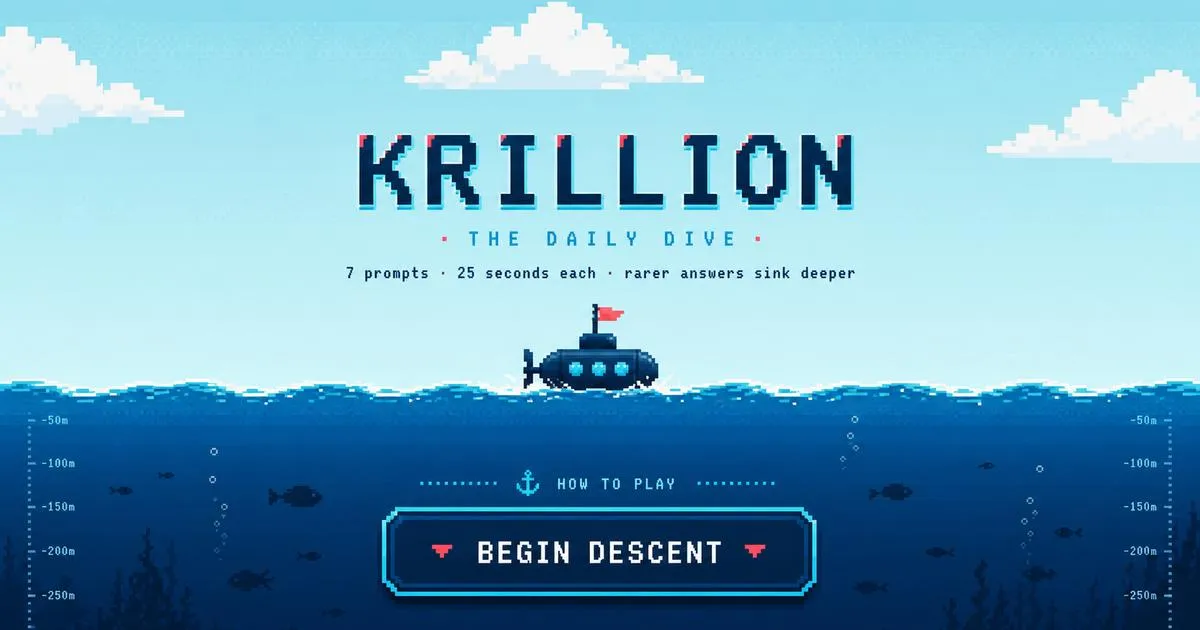
| Krillion Unlimited | Give valid answers that the game considers uncommon. | Seven prompts, with 25 seconds per prompt. |
| Noillirk | Predict the answer the game ranks as most common. | Seven prompts, with 15 seconds per prompt. |
| Poople Unlimited | Transform a starting word into POOP, changing one letter at each step. | Each intermediate step must be an accepted four-letter word. |
The rules reward different kinds of reasoning: unusual recall, anticipation of popular responses, and vocabulary-based pathfinding.
Krillion turns uncommon answers into underwater progress. Its standard run awards up to 700 points, represented as a 7,000-meter dive. The current game page also describes an Endless mode and live multiplayer. These are separate formats; a perfect standard score should not be confused with an Endless-mode distance.
Noillirk reverses the incentive. Its name is Krillion spelled backwards, and its character rises on balloons as players find popular answers. Daily identifies Noillirk as its own game. The current rules describe live rooms for up to 30 players and a maximum standard climb of 14 kilometers.
Poople adds a useful solvability constraint. Its page says starting words come from a connected set of 3,051 four-letter words that can reach the target. Players receive a target move count, and giving up reveals a shortest ladder. That makes the challenge about finding an efficient route rather than discovering whether a route exists.
Visual and Geography Games
| Game | What players do | Published scoring or content detail |
|---|---|---|
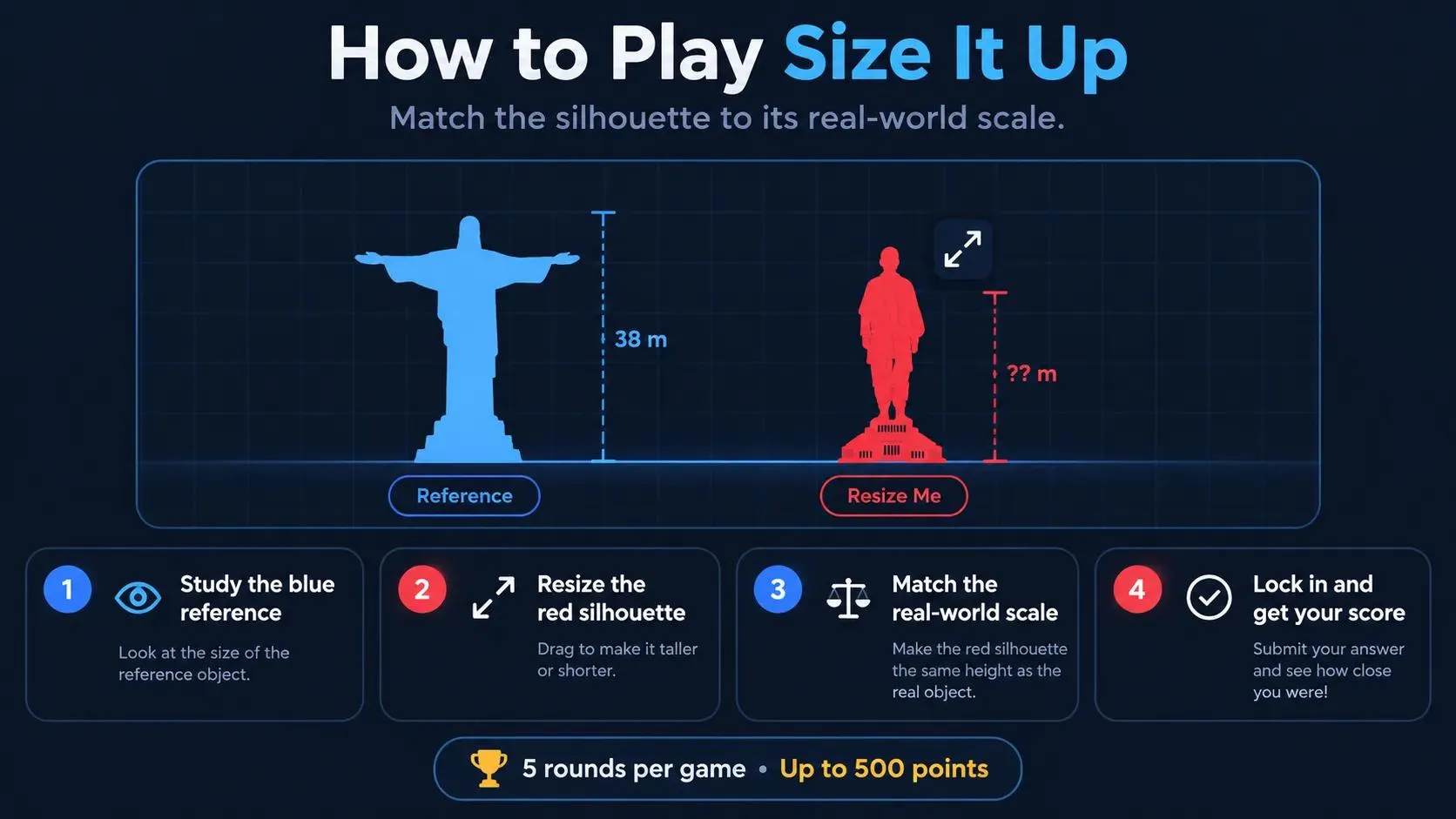
| Size It Up | Resize an outline relative to a reference object. | Five rounds; the page reports 2,010 objects. |
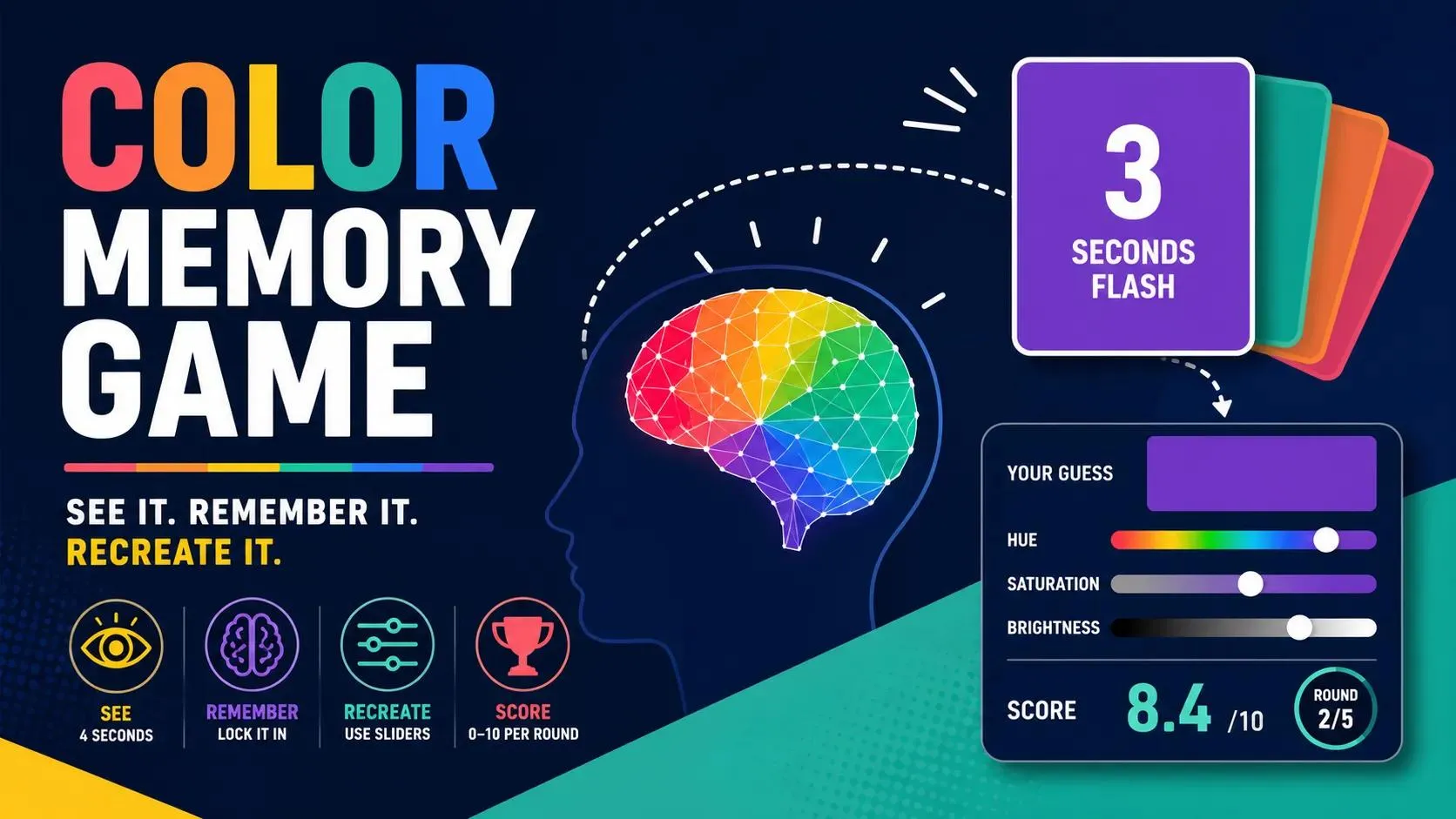
| Color Game | Reconstruct a briefly displayed color using hue, saturation and brightness sliders. | Three colors per round, for a maximum of 30 points. |
| Logo Game | Restore an incorrectly colored part of a brand logo from memory. | Three logos per round; the page reports 977 logos. |
| MapTap | Locate a named city on a rotatable 3D globe. | Five locations per run, for a maximum of 1,000 points. |
These figures are published by the individual game pages and may change as their content pools expand.
Several design details make this group more interesting than a generic picture quiz:
- Size It Up scores proportional error. Guessing double the correct size and guessing half are treated equivalently. The rule makes mistakes comparable across objects of very different scales.
- Color Game describes CIEDE2000-based scoring. Its published method compares perceptual color difference, rather than simply counting how far slider positions moved.
- Logo Game offers themed decks. Players can choose familiar brands or narrower groups such as technology companies and startups.
- MapTap awards partial credit. Its rules give full marks within 25 kilometers and declining scores for more distant guesses.
The common design principle is immediate, visible feedback. A player sees the actual size, correct color or location after committing, making the result understandable without a long explanation.
The Six Classic Games
| Game | Published gameplay description |
|---|---|
| Word Hunt | Find words in a 4×4 letter grid, with three shuffles using the same letters. |
| Traffic Jam | Clear a route for the target car across three timed puzzles. |
| Tile Fit | Place blocks and complete rows, columns or boxes while managing larger pieces. |
| Coin Maze | Gather coins while avoiding a pursuing character. |
| Air Hockey | Collect keys in sequence and slide through the exit. |
| Money Tycoon | Develop passive income and purchase upgrades over 30 timed game days. |
These are the six entries currently presented in the homepage's Classics section. In particular, Air Hockey is described as a key-and-exit sliding challenge, so its name should not be taken as evidence of conventional table-hockey gameplay.
What About Fermi, Silverbrook and Global Gauntlet?
Older indexed pages and navigation references mention additional experiences, including Fermi, Silverbrook and Global Gauntlet. However, the /fermi, /village and /gauntlet routes returned 404 responses during the October 23 availability check. An indexed /gauntlet/play result was also not retrievable.
These references should be treated as historical or currently unconfirmed, rather than added to the active homepage count. A failed retrieval alone does not establish that a game has been permanently discontinued, but an old search listing does not establish that it remains playable either.
How Does PlayDaily Multiplayer Work?
Daily's About page identifies Songless, Songspot, Krillion and Noillirk as games with multiplayer rooms. Players can enter an open room or create a private one and share its six-digit code. Participants face the same round together and can communicate through room chat.
This changes the reason to return. Solo replay is driven by curiosity or improvement; a live room also provides an invitation from friends, shared surprises and an immediate comparison of results.
For a first session:
- Agree on a game and open its multiplayer option.
- Create a private room and share the code with the intended participants.
- Check the current lobby's capacity and settings before inviting a large group.
- Complete one round together before changing games or options.
Room limits are game-specific. A capacity advertised for Songspot should not be assumed to apply to Noillirk or another title.
What Is the Product Strategy Behind PlayDaily?
The visible product supports four strategic interpretations. These are deductions from its features and positioning, not claims about internal financial results.
1. Serve the desire to continue playing.
Several landing pages explicitly address the moment after a daily game ends. Bandle's page positions its version as something to play after the day's Bandle, while Krillion emphasizes additional runs without a daily cap. That is a concrete demand proposition: a visitor already understands the basic activity and wants more of it.
2. Give repeat sessions different motivations.
Unlimited rounds provide practice, while multiplayer provides shared competition. The two can complement each other: a player can learn a format alone and later introduce it to friends. Whether this actually improves retention would require usage data, but the product gives both behaviors a place to happen.
3. Create distinct games by changing the central decision.
Krillion and Noillirk illustrate this clearly. One asks for an unusual valid response; the other rewards anticipating the most common response. Reversing the scoring incentive changes what counts as a good answer even when the interaction remains a short text prompt.
The transferable design lesson is to examine what the player is optimizing, rather than only changing graphics or names.
4. Connect games through relevant recommendations.
Individual game pages link to other Daily titles. That makes a completed session a potential starting point for another game. The likely benefit is more opportunities for discovery within the platform; public evidence does not establish a measured conversion rate.
Does PlayDaily Use AI?
Yes, for some answer judgments in Krillion and Noillirk. The privacy policy describes this sequence:
- Check an answer against the game's existing answer lists.
- Send an uncovered answer and its prompt to an OpenAI model through Microsoft Azure OpenAI Service.
- Potentially retain the normalized answer and judgment for later reuse.
This is a hybrid lookup-and-model system. Reusing judgments can reduce repeated model requests, although no public cost or latency benchmark establishes the size of that benefit.
The disclaimer adds an important qualification: rarity and commonness judgments are estimates that may be wrong or change after reevaluation.
Consequently, a popularity tier should be read as a gameplay result, not a measured percentage of real people. Model-assisted judging also should not be confused with evidence that the entire website was generated by AI. The cited disclosures do not identify the coding tools used to build it.
What Technology Does PlayDaily Use?
Its public policies identify the following service providers:
| Service | Disclosed role |
|---|---|
| Vercel | Hosting |
| Cloudflare | Content delivery and game-file storage |
| Supabase | Database, authentication and multiplayer data |
| Stripe | Payments |
| Sanity | Stories and articles |
| Microsoft Azure OpenAI | Some live answer judgments |
| Google Analytics | Usage analytics |
| Journey by Mediavine | Advertising |
These are disclosed dependencies, not a complete source-code audit. In particular, a hosting provider alone does not establish the exact frontend framework or implementation of every game.
Music processing has a separate technical detail. The copyright policy says preview audio is loaded from third-party services, and Bandle's instrument parts are produced in the player's browser from a short streamed excerpt. The public policy does not identify the precise separation model or runtime.
Is PlayDaily Free? Daily Pro Pricing Explained
All games are advertised as free. Daily Pro removes ads while the player is signed in and allows games to occupy the space previously used by advertising.
The plans page displays these prices as of October 23, 2026:
| Plan | Displayed price | Main benefit |
|---|---|---|
| Free | $0 | Access to games with advertising |
| Daily Pro Yearly | $10.47 per year | Ad removal across the signed-in account |
| Daily Pro Lifetime | $25 once | Ad removal without annual renewal |
The page also shows crossed-out reference prices of $20.94 and $49.99. Treat the listed amounts as a dated pricing snapshot and confirm the currency and total at checkout.
Annual subscriptions renew automatically unless canceled. The terms say cancellation stops future renewals; it does not normally refund the current period. Optional Buy Me a Coffee tips are separate from Pro and do not unlock its benefits.
The commercial structure combines advertising, paid ad removal and voluntary support. Its actual revenue, subscriber count and advertising yield are not established by the public product pages.
How Does PlayDaily Attract Visitors?
The most visible acquisition approach is the combination of playable landing pages and explanatory content.
Pages such as Size It Up include rules, scoring details, frequently asked questions and related reading. The homepage also promotes multiple Noillirk articles covering rules, multiplayer, naming and daily play. These pages address different questions around a game rather than relying on a single launch announcement.
The likely search advantage is relevance: someone looking for a game, an explanation or a way to play with friends can find a page matching that specific intent. Content volume alone does not demonstrate strong rankings or traffic growth.
Daily also issued an October 12, 2026 GlobeNewswire press release, emphasizing unlimited play and live rooms. It claimed millions of monthly players. Because Daily supplied that release, the audience figure should remain attributed to the company rather than presented as independently audited traffic.
Practical Tips and Limitations
Choose a game by the kind of decision you enjoy. Music recognition, visual estimation and open-ended trivia place different demands on a player. Trying one from each group is more informative than judging the platform from a single unfamiliar song.
Compare like-for-like results. Color Game difficulty changes viewing time, Logo Game decks change the brands selected, and music filters change the available tracks. Scores from different settings are not necessarily equivalent measures of improvement.
Preserve progress deliberately. Browser-local records disappear when browser data is cleared. Private rooms are accessible to anyone holding their code, so share codes with the intended group and keep sensitive information out of chat.
Distinguish independent adaptations from original publishers. Daily's own statements separate its versions from other game creators. Similar names do not guarantee identical rules, content or scoring.
Treat music-rights statements as the operator's position. Daily argues that its excerpts qualify as fair use or fair dealing and provides a removal process. That statement is not evidence of endorsement or blanket licensing by artists, labels or music services.
Conclusion
PlayDaily combines familiar puzzle formats, repeatable rounds and selected multiplayer experiences in a single browser platform. Its most distinctive product idea is the connection between those features: visitors can discover a game, practice it repeatedly and bring friends into a shared session.
The current homepage provides 16 clear starting points, while its public policies explain the role of advertising, paid ad removal and AI-assisted answer judging. Founder identities and audience claims should retain their stated provenance, and historical game references should be separated from confirmed current listings.
Continue Reading
More articles connected to the same themes, protocols, and tools.


Referenced Tools
Browse entries that are adjacent to the topics covered in this article.