On This Page8 sections
Key Takeaways
- Tailwind Labs announced on September 9, 2026 that it is joining Shopify. The official announcement uses the language “joining Shopify”; it does not disclose a purchase price, valuation, or detailed legal structure.
- Tailwind CSS is not being shut down or turned into a Shopify-only framework. Tailwind says its open-source projects will remain MIT-licensed and will continue to be led and maintained by the existing team with Shopify's support.
- The commercial Tailwind Labs business is changing dramatically. Existing customers keep access to Tailwind Plus and ui.sh, but new customer sign-ups are closing as the team shifts its focus to Tailwind CSS at Shopify.
- AI is a major part of the backstory. In January 2026, Adam Wathan said Tailwind documentation traffic was down about 40% from early 2023, revenue was down close to 80%, and 75% of the engineering team had lost their jobs even while Tailwind usage was growing.
- For developers, the near-term framework risk appears lower, not higher. Shopify gives Tailwind a large-scale production environment and a long-term financial home, although the community should still watch governance, roadmap priorities, and the future of Tailwind's commercial products.
What Happened: Tailwind Labs Is Joining Shopify
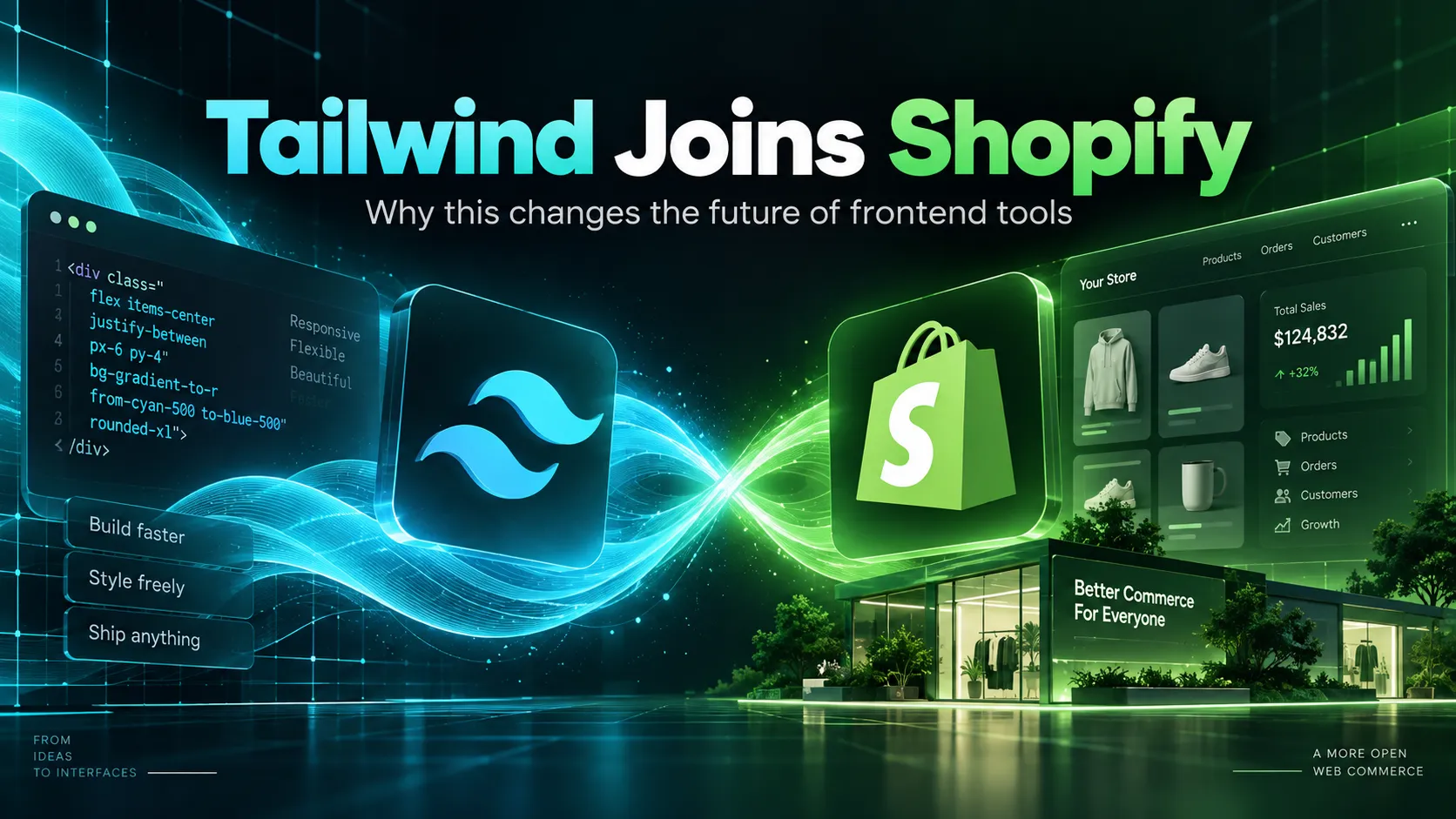
Tailwind Labs founder Adam Wathan announced on September 9, 2026 that the company behind Tailwind CSS is joining Shopify.
The scale of the framework helps explain why this matters. According to the announcement, Tailwind CSS is now installed more than 110 million times per week and is used to style products at companies including ChatGPT, X, Cloudflare, Reddit, and Shopify. Tailwind has moved far beyond being a niche utility-first CSS framework; it has become infrastructure for a significant portion of modern frontend development.
The stated goal of the Shopify move is straightforward: give Tailwind a stable long-term home where the framework can continue to be actively maintained for the millions of developers who depend on it.
That wording is important. The announcement does not present this as the end of Tailwind CSS. It presents Shopify as the organization that can fund and provide a real-world product environment for the next phase of Tailwind's development.
Was Tailwind Acquired by Shopify?
Searches for “Shopify acquires Tailwind” or “Tailwind acquisition” will likely become common, but the official wording deserves precision.
Tailwind Labs says it is joining Shopify. The announcement does not disclose:
- A transaction price
- A valuation
- Whether consideration is cash, stock, or a combination
- A detailed corporate or employment structure
- Whether Tailwind Labs Inc. will remain a separate legal entity
Therefore, describing the event as a confirmed traditional acquisition goes beyond the information currently published. “Tailwind is joining Shopify” is the most accurate formulation until either company provides more transaction details.
For developers, however, the practical consequence is already clear: the Tailwind team will work on Tailwind CSS with Shopify's backing, while Tailwind Labs will stop trying to grow its existing commercial business.
What Changes for Tailwind CSS?
The most important technical commitment in the announcement is that nothing is supposed to change about the open-source status of Tailwind CSS or Tailwind Labs' other open-source projects.
Tailwind says:
- Projects will remain MIT-licensed
- The existing team will continue to lead and maintain them
- Shopify will support that maintenance
- Development will continue for the broader community, not only Shopify users
This substantially reduces the immediate risk that developers will need to rewrite projects, migrate CSS frameworks, or prepare for a proprietary licensing switch.
There is also no announcement of:
- A new package name
- A Shopify-only distribution
- Breaking changes to the Tailwind configuration model
- Removal from npm
- A new commercial runtime requirement
- A change to the MIT license
For production teams, the sensible response is therefore continuity rather than migration. Existing Tailwind projects can continue to pin versions, run normal upgrade testing, and follow release notes as before.
What Happens to Tailwind Plus and ui.sh?
The biggest immediate change is on the commercial side.
Tailwind Labs says it will no longer try to grow the business around Tailwind. Existing customers will maintain access to paid products such as Tailwind Plus and ui.sh, but new sign-ups are being closed so the team can focus on Tailwind CSS at Shopify.
That creates an unusual split:
The open-source framework continues and gains a much larger corporate sponsor, while the standalone commercial funnel stops expanding.
For existing Tailwind Plus or ui.sh customers, several practical questions are still unanswered publicly:
- How long will existing products receive content updates?
- Will existing licenses receive new components or agent skills?
- How will team-seat changes or future upgrades work if new sign-ups are closed?
- Will parts of those products eventually move into Shopify tooling?
- Will any currently commercial assets become open source?
None of those outcomes should be assumed until Tailwind or Shopify publishes more details.
The AI Backstory: Tailwind Was Growing While Its Business Was Shrinking
The Shopify announcement is easier to understand when placed next to what happened in January 2026.
During a GitHub discussion about adding an llms.txt endpoint optimized for large language models, Adam Wathan explained that Tailwind Labs faced a severe mismatch between framework adoption and business sustainability.
He reported that:
- Documentation traffic had fallen about 40% from early 2023
- Tailwind was nevertheless becoming more popular
- Revenue had fallen close to 80%
- 75% of the engineering team had lost their jobs
The critical detail is not simply that “AI hurt Tailwind.” The mechanism was more specific.
Tailwind Labs' commercial products depended heavily on developers discovering them while visiting the documentation. AI coding assistants increasingly let developers generate Tailwind markup, remember utility classes, refactor responsive styles, and answer syntax questions without visiting the Tailwind website first.
The old funnel looked roughly like this:
Developer question
    ↓
Search engine
    ↓
Tailwind documentation
    ↓
Awareness of Tailwind's paid products
    ↓
Commercial purchase
AI-assisted development can compress that journey into:
Developer request
    ↓
Coding agent or AI assistant
    ↓
Generated Tailwind code
Tailwind can therefore become more widely used while the company receives fewer opportunities to convert that usage into revenue.
That is a strategically important distinction: AI did not necessarily reduce demand for Tailwind CSS; it reduced the value of documentation traffic as a distribution channel.
Why the llms.txt Debate Became Symbolic
The January GitHub discussion became a useful case study in the economics of AI-era open source.
A contributor proposed an llms.txt endpoint that would make Tailwind documentation easier for LLMs and agents to consume. Wathan initially closed the work because improving machine access to documentation could further reduce direct visits to the site, which was still the main discovery mechanism for paid products.
The tension was unusual:
- Better machine-readable documentation could improve the developer experience.
- Better AI access could increase Tailwind adoption.
- More adoption no longer guaranteed more Tailwind Labs revenue.
- The engineering work required to improve AI consumption itself still needed funding.
This is the central business-model lesson from the Tailwind story: an open-source project's influence can grow faster than its ability to capture enough value to fund maintainers.
For developer-tool companies, raw usage is therefore becoming a less reliable proxy for commercial health.
Tailwind Already Tried an AI-Native Direction With ui.sh
Tailwind Labs did not simply resist AI distribution. It also experimented with products designed specifically for coding agents.
ui.sh describes itself as a collection of agent skills for interface builders. Its workflows include tasks such as designing interfaces, generating brand directions, componentizing UI, adding dark mode, making layouts responsive, converting images into markup, and canonicalizing Tailwind classes.
The product's June 2026 changelog also shows how quickly the team was adapting its architecture. ui.sh moved away from a single remote MCP-centered workflow toward separate locally installed skills, partly to improve discoverability, customization, model-specific capabilities, and reliability.
That evolution matters because it shows Tailwind Labs had already recognized the new interface for developer education:
The developer may no longer read the documentation directly; the coding agent may become the primary consumer of expert guidance.
The Shopify move does not invalidate that insight. It may actually make it more strategically valuable if Tailwind's design expertise becomes part of Shopify's broader AI-assisted development stack.
Why Shopify Is a Logical Home for Tailwind
Shopify is not a random buyer or sponsor entering the Tailwind ecosystem at the last minute.
Shopify has used Tailwind for years. In its engineering write-up about Hydrogen, Shopify noted that Tailwind was used in the original Hydrogen demo at Shopify Unite 2021 and said the framework proved effective and performant for building and scaling large storefronts.
Tailwind's own partner directory also listed Shopify as a partner before the September announcement and described Tailwind as infrastructure used broadly inside the company.
This creates a strong technical fit.
Shopify operates multiple complex interface surfaces:
- Merchant administration
- Product and inventory management
- Storefronts
- Checkout
- Order tracking
- Shop
- Partner and app experiences
- Emerging agentic-commerce interfaces
Those products expose framework maintainers to problems that a template business cannot reproduce at the same scale: massive design systems, accessibility requirements, internationalization, responsive behavior, performance constraints, component consistency, browser edge cases, and long-lived application codebases.
Tailwind's announcement explicitly says the team wanted the framework to be developed in service of a real product where maintainers encounter the same problems as users. Shopify provides that environment.
Shopify Has Used This Playbook Before
There is an important precedent.
In 2022, the Remix team joined Shopify. Shopify's reasoning emphasized shared web principles, strong developer infrastructure, and using frameworks such as Remix to help developers build on the open web and on Shopify.
Tailwind is different from Remix, but the strategic pattern is similar:
- A developer technology becomes important to Shopify's ecosystem.
- Shopify develops substantial internal dependence on it.
- The maintainers gain access to a large real-world product surface.
- Shopify helps secure the project's long-term development.
For Shopify, funding important developer infrastructure can create value even when that infrastructure is free.
Shopify does not need Tailwind CSS itself to generate subscription revenue. If better Tailwind tooling makes Shopify engineers faster, improves storefront development, helps partners ship better themes, or makes AI-generated commerce interfaces more reliable, Shopify can capture value elsewhere in its platform.
Why This Deal Makes Economic Sense
Tailwind Labs and Shopify have fundamentally different ways to monetize the same framework.
For an independent Tailwind Labs, the economic loop depended on something close to:
Free framework
    ↓
Documentation traffic
    ↓
Paid-product discovery
    ↓
Revenue
    ↓
Framework development
For Shopify, the loop can look more like:
Better Tailwind CSS
    ↓
Faster UI development
    ↓
Better Shopify products and storefront tooling
    ↓
More capable merchants, developers, and partners
    ↓
More commerce on Shopify
This solves a classic open-source monetization problem by moving Tailwind inside an organization that can benefit indirectly from maintaining it.
The framework no longer needs to convert every additional user into a Tailwind Labs customer for continued development to make economic sense.
What Developers Should Do Now
For most frontend teams, there is no evidence that an emergency migration away from Tailwind CSS is warranted.
A practical response is:
- Keep using Tailwind normally. No open-source licensing change has been announced.
- Pin production dependencies. Corporate backing does not remove the need for controlled upgrades.
- Track the roadmap. Watch whether priorities become disproportionately shaped by Shopify's internal requirements.
- Monitor Tailwind Plus and ui.sh communications. Existing users should pay attention to future access, updates, licensing, and support details.
- Do not treat current commercial products as available for future procurement. New sign-ups are closing.
- Avoid assuming Shopify-specific integration. No announcement says Tailwind will become mandatory for Shopify themes, Hydrogen, or Shopify apps.
- Watch contribution governance. MIT licensing protects the ability to fork, but project direction still depends heavily on maintainers and decision-making processes.
For teams considering Tailwind for a new long-lived application, Shopify's backing arguably reduces one of the largest risks visible earlier in 2026: insufficient funding for active maintenance.
What Could Change Under Shopify?
The announcement is reassuring, but corporate stewardship introduces different risks.
Roadmap concentration
A framework can remain open source while its roadmap increasingly reflects the needs of its largest internal user. If Shopify becomes the dominant environment in which Tailwind is developed, features useful to large commerce applications may receive more attention.
That is not automatically negative. Large production systems can surface valuable problems. The risk appears only if broader community needs consistently lose priority.
Governance transparency
MIT licensing guarantees important freedoms over the code, but it does not guarantee community control of roadmap decisions. Developers should distinguish license openness from governance openness.
Commercial-product uncertainty
Tailwind Plus and ui.sh are now in maintenance-like territory from a customer-acquisition perspective. Existing access is promised, but the long-term product roadmap has not been specified.
Deeper Shopify integration
Shopify already has a history of building developer infrastructure around web technologies such as Remix and Hydrogen. Deeper Tailwind integration across Shopify development tools is plausible, but it should remain a hypothesis until specific products or APIs are announced.
What This Says About Open Source in the AI Era
The most important lesson extends beyond Tailwind CSS.
Historically, many developer-tool businesses could subsidize open source through a predictable attention funnel:
Free software creates demand → documentation captures search traffic → the website introduces paid products → commercial revenue funds maintainers.
AI agents weaken the middle of that funnel.
A developer can receive a correct Tailwind solution without knowing which documentation page taught the model or agent how to produce it. The open-source project still creates enormous value, but the value may be captured by:
- AI coding products
- Cloud platforms
- Application builders
- Hosting companies
- Ecommerce platforms
- End users who ship faster
The maintainer may receive less direct traffic and fewer opportunities to monetize.
Tailwind is an unusually visible example because the numbers moved in opposite directions: adoption accelerated while documentation traffic and commercial revenue fell sharply.
That suggests future open-source businesses may rely more heavily on models such as:
- Strategic corporate sponsorship
- Enterprise support
- Hosted infrastructure
- Usage-based cloud services
- Paid data or API access
- Commercial licensing for specific assets
- Deep integration with platforms that capture downstream value
The key question is no longer merely, “How many developers use this project?”
A more useful question is, “Where in the value chain can the maintainer sustainably capture enough value to keep building it?”
Is This Good or Bad for Tailwind CSS?
Based on the information available at announcement time, the move is more positive than negative for the open-source framework itself.
Before Shopify, Tailwind faced a documented sustainability problem: usage was soaring, but the commercial mechanism funding development was deteriorating.
After joining Shopify, Tailwind gains:
- A financially strong long-term sponsor
- A huge real-world product environment
- Existing internal demand for the framework
- A reason to continue investing in framework quality even if Tailwind itself does not directly generate revenue
The tradeoff is concentration: Tailwind becomes more dependent on one large company's priorities.
For most developers, that is a better immediate risk profile than a framework whose independent maintainer has already warned that the existing business model could not reliably sustain development.
Conclusion
Tailwind Labs joining Shopify is not simply another developer-tool deal. It is a case study in how AI is changing the economics of open-source software.
Tailwind CSS became more popular than ever, reaching more than 110 million weekly installs, while the business that funded it saw documentation traffic and revenue fall sharply. Shopify offers a different economic model: Tailwind can be valuable as infrastructure for commerce and product development even if the framework itself remains free.
For developers, the immediate message is reassuring: Tailwind CSS remains MIT-licensed, the existing team continues to maintain it, and no migration is required because of this announcement.
The more important story to follow is what comes next: how Shopify influences Tailwind's roadmap, what happens to Tailwind Plus and ui.sh, and whether Tailwind becomes a model for how critical open-source developer infrastructure survives when AI agents consume more of the documentation layer.
Teams that depend on Tailwind should keep building, but they should also watch those signals closely. The framework's technical future looks more secure; its governance and commercial future are entering a new phase.
Continue Reading
More articles connected to the same themes, protocols, and tools.



Referenced Tools
Browse entries that are adjacent to the topics covered in this article.