On This Page8 sections
Key Takeaways
- SoonPlay is a mobile-first AI game creation and discovery platform developed by Jiyi AI (极逸人工智能), a company incubated by Chinese games publisher Kingnet Network (恺英网络). Its public beta launched on October 20, 2026.
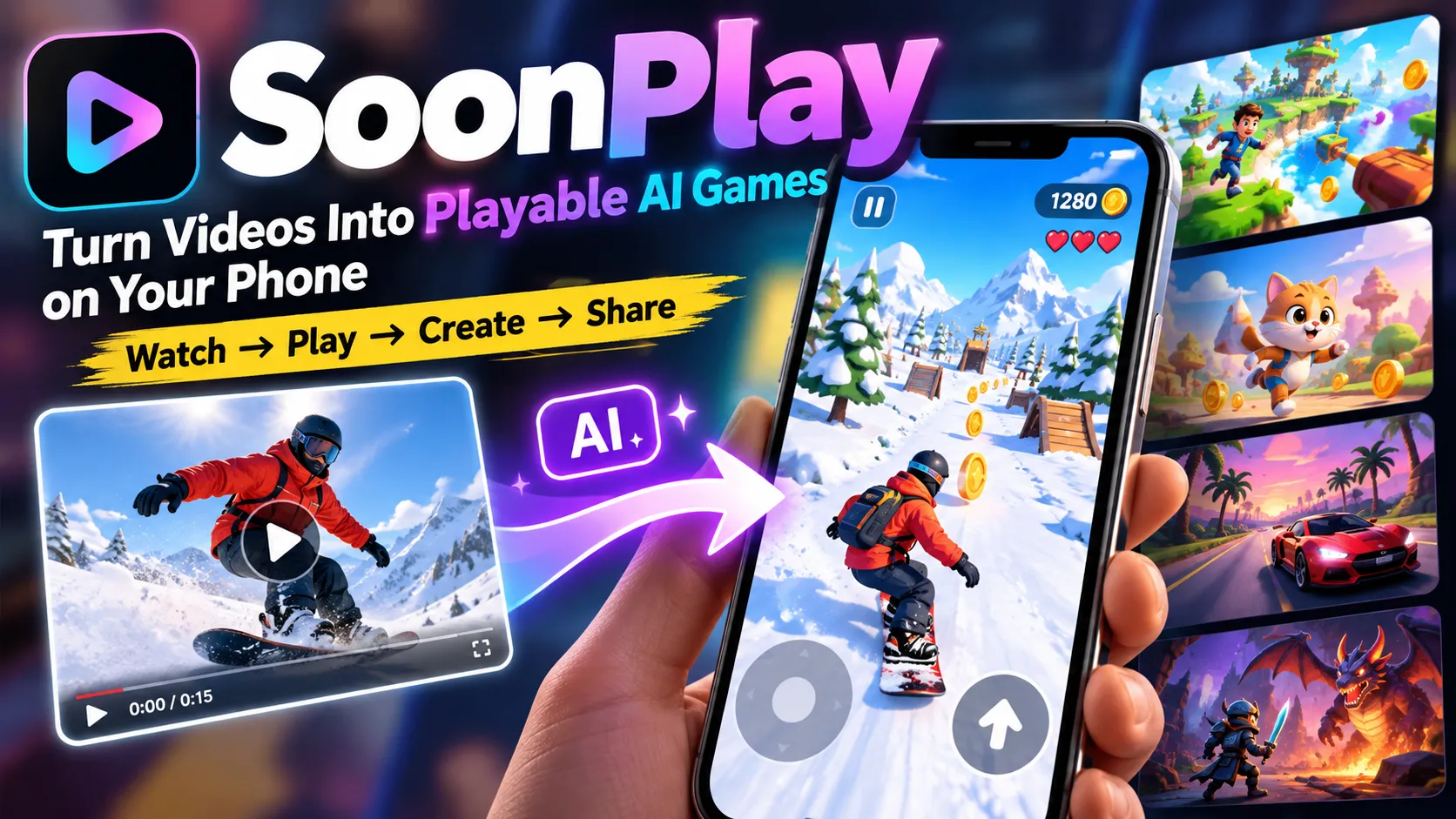
- The headline feature is video-to-game: users supply a short video, image, or idea, and the SOON AI system attempts to turn it into a playable interactive experience. The platform also connects videos with games that viewers can play immediately.
- SoonPlay and SOON are not identical products. SoonPlay emphasizes lightweight mobile creation and community discovery; the broader SOON platform focuses on more involved game production and related assets.
- The official website currently advertises an Android app, version 1.0.0. A verified official iOS download page, complete public creation-pricing schedule, and general-purpose SoonPlay API have not been established as of October 21, 2026.
- The most important question is not whether AI can generate a playable prototype, but whether creators can refine, retain rights to, export, and sustain games that people want to replay.
What Is SoonPlay?
SoonPlay is an AI-powered mini-game platform built around three connected activities: watch, play, and create. Instead of browsing a conventional catalog of finished games, users encounter video-led content and can move from watching a clip to playing an associated AI-generated game. Creators can use text, images, or video as starting material, then edit, preview, publish, and share what they make.
The product entered public beta on October 20, 2026. The launch was announced by Kingnet Network through Sina Finance, while the official Jiyi SOON website lists the release date and mobile download entry. The company describes SoonPlay as a lightweight creation platform, not as a replacement for every professional game engine.
The concept is sometimes described as a TikTok-style feed for playable games. That is a useful analogy for its discovery experience, but it is not evidence of a partnership with TikTok or ByteDance. The distinctive product idea is that a piece of video content can become both a source of gameplay inspiration and a distribution surface for the resulting game.
| At a glance | Verified public information |
|---|---|
| Product | SoonPlay |
| Developer | Jiyi AI (极逸人工智能), incubated by Kingnet Network |
| Public beta launch | October 20, 2026 |
| Website | soonjy.com |
| Official mobile download | Android QR-code entry on the developer's website |
| Listed launch version | V1.0.0 |
| Main creation inputs | Video, images, and text; official website also promotes voice-based ideas |
| Core user journey | Discover a clip → play its game → create or refine a game → share |
| Pricing | Free-to-play positioning announced; complete AI-creation pricing not publicly established |
How Does SoonPlay Turn a Video Into a Game?
A video contains visual evidence of an experience, not an executable game specification. It may show a moving character, falling objects, scoring effects, or an obstacle course, but it typically does not reveal all collision rules, hidden states, controls, difficulty curves, or win conditions.
SoonPlay's advertised video-to-game workflow uses SOON AI to identify gameplay-relevant elements and generate an interactive result. The precise production model architecture and error rates have not been disclosed in sufficient detail for independent technical benchmarking. A sensible way to understand the task is as five stages:
- Interpret the reference. Identify visible characters, motion, scene geometry, recurring actions, and likely player objectives.
- Infer a playable loop. Translate visual cues into possible controls, rules, scoring, challenges, and failure states.
- Construct an initial game. Produce or arrange the necessary game logic, visual assets, interface elements, and interactions.
- Playtest and revise. Adjust the parts that the first generation misinterpreted or implemented poorly.
- Publish the result. Connect the finished playable experience with its presentation inside SoonPlay.
The key limitation: a generated game is an interpretation of a clip, not a frame-perfect conversion of video into a working simulation. Camera cuts, cinematic effects, sophisticated enemy AI, networked multiplayer, and complex physics can all hide rules that no video can fully specify. Creators should judge the result by its playable behavior rather than by visual resemblance alone.
How to Use SoonPlay: A Practical First-Game Workflow
The following process follows the officially described create–preview–edit–publish flow. Individual screen labels may change during public beta.
- Start at the official website. Open soonjy.com and use its Android download instructions rather than an unrelated APK mirror. Verify the app publisher and permissions before installing.
- Choose one small idea. A dodge-the-obstacles game, one-button timing challenge, or simple collection game provides a more testable first project than an open-world RPG.
- Provide an original reference. Upload a short clip or image you own, or begin with a clear text description. Avoid copyrighted game footage unless you have the relevant permissions.
- State the missing rules. Video alone may not specify what counts as success, how the player loses, or how the game resets. Add these requirements explicitly when the editor permits.
- Preview the generated game. Check movement, collisions, scoring, game-over handling, portrait-screen layout, touch input, and audio behavior.
- Request targeted changes. Replace vague instructions such as
make it betterwith a measurable change:Reduce the first 15 seconds of difficulty and make obstacles appear at least one second apart. - Publish only after repeat testing. Play several complete rounds, including failure and restart paths, before sharing it with others.
A narrowly scoped example brief might look like this:
Create a portrait-mode arcade game inspired by my original clip.
Goal: collect 10 falling stars in 45 seconds.
Controls: drag a basket left and right with one finger.
Rules: missing a star costs one of three lives.
Progression: increase falling speed every 15 seconds.
Interface: show score, remaining time, lives, and Restart.
Keep all essential controls visible on a small phone screen.
A brief like this does not guarantee a particular result. It reduces ambiguity and provides an objective checklist for subsequent revisions.
What Can SoonPlay Create—and Where Might It Struggle?
The launch materials emphasize lightweight, quickly accessible games rather than a fixed list of supported genres. The following examples are plausible use cases, not a claim that every genre has been independently demonstrated in the new app.
Promising early projects:
- One-button arcade games: tapping, dodging, jumping, and reaction-time challenges.
- Puzzle concepts: simple mazes, matching, memory, and rule-based challenges.
- Score-chasing games: endless survival, item collection, and increasing-difficulty loops.
- Personalized interactive jokes: small games built around an original character, drawing, or short video.
- Rapid gameplay prototypes: demonstrating a mechanic before investing in a larger production project.
Higher-risk projects:
- Large, interconnected worlds requiring coherent quests and persistent state.
- Physics-heavy games that depend on precisely tuned collisions and simulation.
- Competitive multiplayer requiring matchmaking, synchronization, anti-cheat, and backend services.
- Commercial projects requiring source-code ownership, platform-specific packaging, analytics, or external payment integration.
- Faithful recreation of existing games, whose assets and distinctive protected expression may be copyrighted.
The distinction matters because a working first prototype and a commercially publishable game are different deliverables. A prototype proves that the central interaction can run. A finished game also needs stable progression, accessibility, performance, clear rights, and ongoing maintenance.
SoonPlay vs. SOON: What Is the Difference?
Jiyi AI operates a wider AI game-production ecosystem under the SOON name. The mobile-focused SoonPlay app targets rapid ideation, casual play, and sharing. The SOON web creation platform presents examples of more involved games and asset-generation workflows.
| Dimension | SoonPlay | SOON |
|---|---|---|
| Primary audience | Casual players, first-time creators, social creators | More advanced creators and game developers |
| Core activity | Watch, play, make, and share mini-games | Develop and refine games and production assets |
| Typical workflow | Mobile-first, lightweight creation | More detailed game-production workflow |
| Main value | Rapid feedback and distribution | Broader production depth and iteration |
| Output expectations | Small playable experiences | Potentially more complex game projects |
| Confirmed export/API policies | Not fully documented publicly | Must be checked for the specific SOON plan and workflow |
The two products should not be treated as interchangeable. In particular, a capability visible on SOON's desktop website does not automatically mean that the same feature, file limit, or export option exists inside the SoonPlay app.
What Do the AP1–AP6 Game Levels Mean?
The SOON ecosystem uses AP, short for AI + People, as a platform-defined progression from rough prototypes to highly polished work. Its website lists these six labels:
| Level | Official Chinese label | Practical interpretation |
|---|---|---|
| AP1 | 框架游戏 | Basic game framework |
| AP2 | 微调游戏 | Refined initial prototype |
| AP3 | 简单游戏 | Simple playable game |
| AP4 | 成品游戏 | More complete game |
| AP5 | 精品游戏 | Polished or premium-style production |
| AP6 | 传世佳作 | Aspirational highest tier |
The official site associates mobile SoonPlay with the lighter AP1–AP3 experience and desktop SOON with AP4–AP6. These are the company's own descriptive tiers, not independently standardized performance scores or a guarantee that an AI model can automatically make a blockbuster game.
The useful takeaway is that the company recognizes iteration as a core part of creation: an initial generated artifact should not be confused with a finished product.
What Technology Powers SoonPlay?
SoonPlay is built around the proprietary SOON AI game-creation system. Its public materials describe a coordinated production workflow for game logic, characters, animation, scenes, effects, interfaces, and optimization. Related technologies named in company disclosures include:
- SOON-FX: numeric rules and formula-related game systems.
- SOON-SABER: code and game-runtime-related production capabilities.
- SoonAnix: character and skeletal animation.
- SoonVex: visual effects generation.
- SoonTerrain: environment and scene generation.
- SoonPanel: interface asset generation.
These names describe the wider SOON ecosystem; they should not be interpreted as proof that every subsystem is directly exposed in SoonPlay's first mobile release.
One inspectable component is the open-source SoonFx Runtime, a TypeScript numeric engine published under the Apache 2.0 license. Its documentation describes formula evaluation, character statistics, and battle-simulation utilities. The existence of this repository does not make SoonPlay itself open source, and it does not establish the architecture of the platform's undisclosed generation backend.
An official SOON showcase lists a higher-complexity creation example involving 352 conversation turns, 70 characters, 2,165 images, 52 game systems, and 58 hours of generation time. These are showcase figures, not independently audited averages. They demonstrate why generating a complex project can remain a multi-stage process even when AI handles much of the asset and code work.
Is SoonPlay Free? Pricing, Credits, and Creator Rewards
Launch coverage describes SoonPlay's game-playing experience as free during its initial phase, without gameplay advertising or in-app purchases. That promise concerns playing games and should not be assumed to mean unlimited free AI generation or a permanent ad-free policy.
The official site also describes a creator resource called 鱼饵 (literally bait) and a featured-creator program. Under the published conditions, creators whose individual game receives 100 saves can apply for official selection. If accepted, the creator may receive a return of 50% of the bait consumed by that work, alongside promotional exposure.
The website additionally advertises a creation-incentive pool expressed as 1亿, but the public description does not clearly establish its denomination, payment method, eligibility rules, or cash equivalent. It would be inaccurate to advertise this as a confirmed cash prize worth RMB 100 million.
Before spending money or committing to a production workflow, verify:
- How many generation credits a new account receives.
- Whether video processing, retries, editing, and publishing consume different credit amounts.
- Whether credits expire or can be refunded for failed jobs.
- Whether free and paid creations have different commercial-use rights.
- Whether rewarded resources are withdrawable or usable only inside the platform.
As of October 21, 2026, a complete, independently verifiable public price table for SoonPlay creation was not available from the official landing-page information. Avoid third-party pricing claims that do not link to a current official policy.
How to Download SoonPlay: Android, iOS, and Browser Access
The official download page identifies SoonPlay V1.0.0, dated October 20, 2026, and offers an Android QR-code download route.
- Android: use the official page and verify the app details before installation.
- iOS: a verified official standalone SoonPlay App Store listing was not established in the material reviewed as of October 21, 2026; check the developer's website for updates rather than assuming availability.
- Desktop/browser: SOON has a separate web creation portal, but this should not be mistaken for a confirmed browser edition of the complete SoonPlay mobile app.
- International availability: language support, account requirements, regional distribution, and upload access may vary and should be confirmed during onboarding.
The SOON desktop portal displays a 20-second and 50 MB limit for one video-upload entry. That figure applies to the observed web portal interface; the SoonPlay Android app's current upload limits have not been independently confirmed.
SoonPlay vs. Astrocade, Rosebud AI, and TapTap Maker
AI-assisted game creation was already an active category before SoonPlay's public beta. Its specific differentiation is the video-led mobile loop, not the invention of AI game generation itself.
| Platform | Main entry point | Game creation and sharing emphasis | Best-fit user |
|---|---|---|---|
| SoonPlay | Video, images, and ideas in a mobile app | Watch a clip, play its connected game, create and share | Casual creators and mobile players |
| Astrocade | Prompts and AI-agent workflows | Generate games and distribute them in a playable social feed | Creators who value community and agent integration |
| Rosebud AI | Browser-based prompt and templates | Build, edit, and publish browser games, including 2D and 3D concepts | Web-first creators and learners |
| TapTap Maker | Natural-language creation | AI-assisted creation linked to the TapTap game ecosystem | Creators interested in TapTap distribution |
Astrocade introduced an MCP integration on October 12, 2026, connecting AI agents with its game-building and publishing workflow. Rosebud emphasizes playable browser output and editable JavaScript on its official site. TapTap Maker entered open web testing in August 2026, according to its platform announcement.
No independent, controlled benchmark currently establishes that SoonPlay produces better games than these competitors. A meaningful comparison would use the same reference assets, equivalent genre scope, fixed time and credit budgets, and consistent measures of playability, performance, revision count, and export rights.
Copyright, Privacy, and Commercial Use: What Creators Must Check
Uploading a video does not automatically grant the uploader the right to reproduce its protected elements in a new game. This is especially important for third-party game footage, television clips, music, celebrity likenesses, logos, and user-generated videos featuring other people.
For safer experiments, creators should use original footage, licensed audio, and assets they are entitled to reuse. Before publishing or monetizing a generated game, review the latest SoonPlay terms for:
- Input permissions: what rights the service requires to process uploaded clips, images, and audio.
- Output ownership: whether the creator owns or merely receives a license to generated assets and code.
- Model-training use: whether uploads or finished games can be reused to improve models, and what controls exist.
- Visibility: whether drafts are private by default and whether published works can be remixed.
- Portability: whether playable files, assets, code, or project data can be downloaded.
- Commercialization: whether external publishing, advertising, sponsorship, and resale are permitted.
- Deletion and retention: what happens to source media, account data, and published games when they are removed.
Do not infer that all output is commercially unrestricted simply because the creation process is automated. Commercial rights and technical exportability are separate requirements, and both need explicit confirmation.
How to Evaluate the Quality of an AI-Generated Game
A persuasive demonstration video may hide a weak game loop. A more useful evaluation is to play at least five full sessions, record concrete failures, and improve one problem per revision.
| Test | What to check | Why it matters |
|---|---|---|
| First interaction | Does the player understand the controls within seconds? | Reduces early abandonment |
| Input reliability | Do swipes, taps, and repeated actions register correctly? | Determines basic playability |
| Core rules | Are collisions, lives, scores, and win conditions consistent? | Prevents arbitrary frustration |
| Difficulty | Is the opening manageable, with a clear progression? | Creates a learnable challenge |
| Restart behavior | Can users retry without broken state or long waits? | Supports repeat sessions |
| Mobile performance | Does the game remain usable on an ordinary phone? | Protects the intended mobile experience |
| Replay value | Does another round offer a reason to return? | Distinguishes novelty from an engaging game |
For developers comparing platforms, record time to first playable build, number of successful revisions, total credits used, crash frequency, and whether the output can be exported. This practical scorecard provides more decision value than an unsupported claim that a tool creates professional games instantly.
Who Should Try SoonPlay?
Casual players may enjoy it as a stream of small playable ideas, especially if they prefer immediate interaction over installing separate games. The selection and quality of its public-beta catalog will determine how compelling that discovery experience becomes.
Non-coders and social creators are the clearest target audience. Video and image references lower the burden of explaining every visual detail in technical language. However, creating an enjoyable game still requires choices about challenge, timing, feedback, and rewards.
Students and educators may find value in using short games to explore interactive storytelling and basic game-design principles, provided content policies, age requirements, and privacy settings are suitable for the intended setting.
Professional developers should treat SoonPlay primarily as a rapid-prototyping and audience-testing experiment until source export, integration options, intellectual-property rights, and production reliability are documented. The broader SOON platform may be more relevant for complex projects.
Frequently Asked Questions About SoonPlay
Is SoonPlay an AI game generator or a game platform?
Both. It combines AI-assisted creation with a feed in which users can discover and play games. That creation-to-distribution loop is central to its positioning.
Can SoonPlay really turn a video into a playable game?
Video-to-game is an officially announced capability. The AI aims to infer useful gameplay ideas and create an interactive result; it does not guarantee an exact reproduction of every scene, rule, or animation in the source footage.
Do users need programming experience?
The service is designed for people without coding experience. Clear game rules and active playtesting still substantially improve the chances of a useful result.
Is SoonPlay available on iPhone?
The official launch page clearly lists an Android download. A verified official iOS download destination was not established in the information reviewed on October 21, 2026.
Is SoonPlay completely free?
The initial public messaging promotes free game playing without ads or in-app purchases. AI creation may involve the platform's resource system; its full public pricing and limits should be checked in the current app.
Can SoonPlay games be exported to other websites or app stores?
A general export workflow or public SoonPlay API has not been confirmed from the available official launch information. Creators should verify this before assuming they can host or monetize finished games elsewhere.
Is SoonPlay open source?
No public evidence establishes that the SoonPlay application or its core generation backend is open source. The related SoonFx Runtime has a separate open-source repository.
Who makes SoonPlay?
It is developed by Jiyi AI, which was incubated by Kingnet Network. SOON is the wider AI game-production ecosystem associated with the developer.
Conclusion
SoonPlay's October 2026 launch highlights a meaningful shift in AI game creation: the next competitive advantage may come from connecting discovery, generation, iteration, and sharing—not simply producing more code from a prompt. Its video-to-game concept offers a more visual starting point for people who have ideas but cannot describe them in game-engine terminology.
The promise is credible as a prototype-and-play workflow, but important claims about generation quality, international availability, creator costs, commercial rights, and export options still require independent verification. Anyone considering SoonPlay for serious production should complete a small test project and read the current platform terms before committing valuable assets or significant development time.
Explore the official SoonPlay website, build one original mini-game, and evaluate it against a clear playtesting checklist. The quality of the playable result—not the excitement of the first AI generation—is the best measure of whether the platform fits a creator's goals.
Continue Reading
More articles connected to the same themes, protocols, and tools.

Referenced Tools
Browse entries that are adjacent to the topics covered in this article.