
On This Page8 sections
Key Takeaways
- Getting your SaaS recommended by ChatGPT is not the same as ranking on Google. AI recommendations depend on query relevance, accessible information, external evidence, and the search system's selection process.
- Competitor backlink analysis reveals potential recommendation opportunities. Ahrefs can identify comparison articles and best-of lists that already feature competing products but omit yours.
- Third-party listicles are especially relevant to AI product discovery. A December 2025 Ahrefs study found that best-of blog lists represented 43.8% of cited source links in its sampled ChatGPT recommendation research.
- Prioritize editorial credibility and demonstrated AI citations over backlink quantity. A relevant article that AI systems already cite may offer greater strategic value than an unrelated high-authority website.
- There is no guaranteed placement technique. Getting added to an article creates an opportunity for discovery, not a promise that ChatGPT, Perplexity, Gemini, or Google AI Mode will recommend a product.
- Measure brand mentions, source citations, referral traffic, and conversions separately. Each metric represents a different stage of AI-driven discovery.
What Is the ChatGPT SaaS Recommendation Strategy?
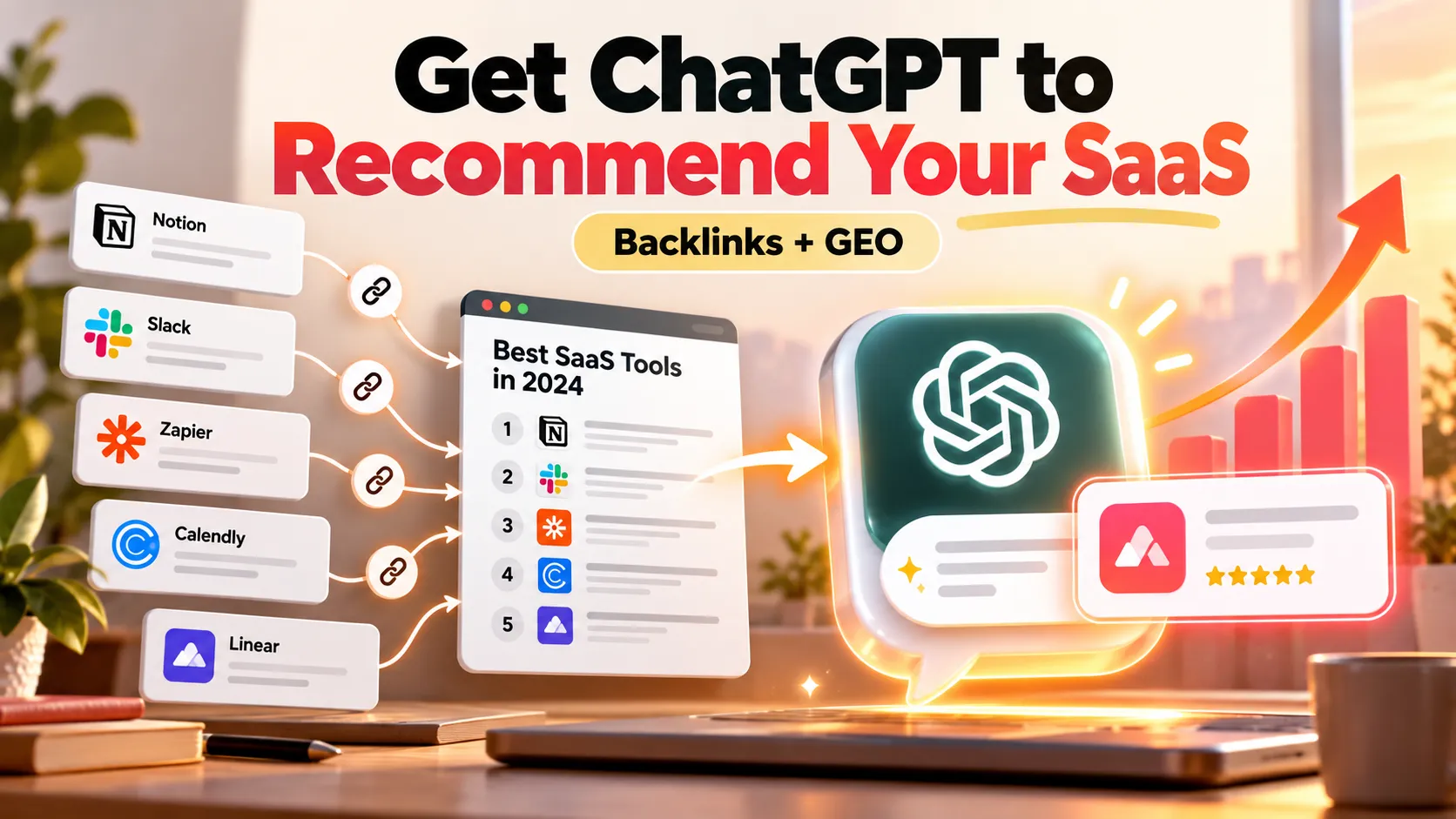
The ChatGPT SaaS recommendation strategy combines three established marketing disciplines: competitor backlink analysis, editorial outreach, and Generative Engine Optimization (GEO).
The objective is to identify independent publications that already recommend competing software, earn legitimate inclusion in their relevant comparison content, and improve the availability of credible information about a product across the web.
A simplified workflow looks like this:
- Ask ChatGPT to recommend the best tools in a specific SaaS category.
- Identify the competitors appearing in those recommendations.
- Analyze their backlinks using Ahrefs Site Explorer.
- Filter referring pages by quality, relevance, and estimated organic traffic.
- Find best-of articles, software roundups, and comparison pages linking to competitors.
- Approach the relevant editors with a credible reason to evaluate the missing product.
- Monitor subsequent brand mentions, AI citations, search visibility, and commercial outcomes.
The method is often described as listicle link building for GEO or AI recommendation optimization through competitor backlink replication.
Its underlying principle is straightforward: if an AI system retrieves a comparison article containing relevant software recommendations, products accurately described within that article may become candidates for inclusion in an answer.
However, the article must first be discovered, selected, and considered relevant. A backlink does not directly insert a company into an AI model's recommendations.
Why Best-of Lists Matter for ChatGPT Recommendations
Software buyers frequently ask AI assistants questions such as:
- What are the best AI image generators for small businesses?
- Which CRM tools are best for startups?
- What is the cheapest AI coding assistant with an API?
- Which project management tools support unlimited guests?
- What are the best alternatives to an expensive SaaS platform?
These questions require comparisons rather than simple factual answers.
A well-maintained software roundup can provide multiple useful signals: product names, categories, features, pricing, advantages, limitations, and recommended use cases.
AI search systems can retrieve this information to help formulate relevant answers. This is particularly important when recommendations need current pricing or product availability that may not be reliably represented in a model's existing knowledge.
What the Research Actually Shows
In December 2025, Ahrefs published a study of 26,283 source URLs examining citations associated with 750 ChatGPT recommendation prompts across software, physical products, and agencies.
Its reported findings included:
- Best-of blog lists accounted for 43.8% of cited source links in the analyzed sample.
- Products appearing higher in third-party comparison lists tended to be associated with more recommendations.
- Recently updated comparison articles were prominent among cited sources.
- Comparison listicles also appeared in source sets from other AI search platforms.
These findings provide a concrete reason to investigate best-of articles rather than treating all backlinks equally.
Nevertheless, the sample was limited to selected recommendation-oriented prompts. The 43.8% figure does not mean that 43.8% of every ChatGPT response relies on listicles.
The observed relationships are also correlational. Popular products may appear prominently in AI recommendations and editorial rankings because they are already widely used, rather than because a particular list placement caused the recommendation.
Additional Ahrefs research covering 75,000 brands found stronger associations between AI visibility and widespread brand mentions than between AI visibility and raw backlink counts.
The practical lesson is to pursue credible, relevant coverage, not the largest possible number of links.
How AI Recommendations Differ From Traditional SEO
Traditional search optimization and AI recommendation optimization overlap, but their outputs are not identical.
| Dimension | Traditional SEO | GEO and AI Recommendations |
|---|---|---|
| Main objective | Improve visibility in search results | Increase relevant brand mentions and source citations |
| Primary unit | Webpage or URL | Brand, product, source, or supporting claim |
| Typical measurement | Rankings, clicks, impressions | Mention frequency, citation frequency, AI impressions, referrals |
| Competitive analysis | Keyword gaps and backlinks | Prompt gaps, cited sources, editorial mentions |
| Important content | Useful indexed pages | Useful pages plus reliable off-site evidence |
| Outcome consistency | Rankings can fluctuate | Recommended brands and cited sources can vary between responses |
Google's 2026 guidance on generative AI search explains that its AI features rely on established search systems alongside techniques such as retrieval-augmented generation and query fan-out.
Retrieval-augmented generation allows AI systems to consult relevant external information when producing an answer. Query fan-out can generate several related searches to address a complex question.
This means a question about affordable image generators might lead to searches for product comparisons, pricing, licensing, and specialized use cases.
Google also emphasizes that its existing SEO fundamentals remain relevant. GEO should therefore complement strong technical SEO, useful content, and genuine product differentiation rather than replace them.
Step 1: Identify the Prompts That Matter to Your SaaS
The first step is not collecting backlinks. It is understanding which buying questions the target audience asks.
Start by defining the product category, ideal customer, core capabilities, and strongest competitive advantage.
For an AI image generation platform, useful queries might include:
- Best AI image generators in 2026
- Best AI image generators for commercial use
- Affordable Midjourney alternatives
- AI image generators with API access
- Best AI image tools for ecommerce product photos
- Free AI image generators without registration
These prompts represent different buyer requirements. A product suited to commercial API usage may not deserve inclusion in a ranking focused on free illustration tools.
Create an initial tracking set of approximately 20 to 40 prompts, grouped into four categories:
- Category discovery: Best tools in a broad market.
- Alternative searches: Competitor alternatives and replacements.
- Feature-specific searches: Tools supporting a required capability.
- Use-case searches: Tools suitable for a particular audience or workflow.
Record the exact prompt, target market, geography, language, intended buyer, and whether the answer uses live web search.
Run each prompt multiple times under comparable conditions. A single response is insufficient to establish a reliable baseline because AI recommendations are variable.
Step 2: Build a Competitor Recommendation Database
Record the products that repeatedly appear in relevant AI recommendations.
For each competitor, capture:
| Field | Example |
|---|---|
| Product | Competitor A |
| Website | competitor-a.example |
| Category | AI image generation |
| Target segment | Designers and marketing teams |
| Main differentiator | Advanced image editing |
| Recommendation frequency | 7 of 10 sampled answers |
| Recurring sources | Comparison blogs and review directories |
The example frequency is illustrative, not a measured industry benchmark.
Collect at least five directly relevant competitors. Larger categories may justify ten or more.
Distinguish genuine alternatives from adjacent platforms. A general-purpose design application may appear in image-generation recommendations without competing directly with a dedicated generation API.
Also separate brand mentions from cited websites. ChatGPT may recommend one SaaS while citing an independent publisher rather than the SaaS company's homepage.
That distinction becomes important when deciding which sites deserve outreach.
Step 3: Reverse-Engineer Competitor Backlinks With Ahrefs
Open Ahrefs Site Explorer and enter a relevant competitor domain.
Navigate to the Backlinks report, which identifies external webpages linking to the target website.
Use the following workflow:
- Enter the competitor's domain and select an appropriate analysis scope.
- Open the Backlinks report.
- Apply the Best links filter.
- Filter for referring pages with meaningful estimated organic traffic where suitable.
- Sort by referring-page traffic when the report offers that column.
- Examine the linking-page titles and surrounding anchor text.
- Export promising results for review.
Ahrefs explains in its Best links documentation that the filter can narrow results using criteria such as Domain Rating, organic traffic, and outgoing links.
It is important to understand that Best links is a configurable screening tool, not an official Google quality rating or an AI citation score.
How to Filter the Results
For an initial prospecting pass, a SaaS marketer could test these illustrative thresholds:
| Metric | Starting Filter | Purpose |
|---|---|---|
| Referring-page traffic | At least 100 estimated visits/month | Find pages with some existing search demand |
| Domain Rating | 20 or higher | Remove some very weak domains |
| Topical relevance | High | Match the target SaaS category |
| Article type | Editorial list or comparison | Identify product discovery opportunities |
| Publication status | Live and accessible | Avoid removed or inaccessible pages |
| Existing competitor inclusion | Yes | Confirm the publisher covers the market |
These are adjustable prospecting rules, not proven AI ranking thresholds.
Niche B2B software publications can be valuable even with fewer than 100 estimated visits per month. Conversely, a high-traffic article about an unrelated topic may provide little value.
Referring-page traffic is generally more informative for this workflow than domain-wide traffic alone. A popular publisher may have an outdated software comparison page that receives almost no readers.
Check whether the backlink appears inside meaningful editorial content, rather than a footer, automatically generated directory, or unrelated sponsored placement.
Finally, deduplicate prospects by canonical article URL. A single publisher may link to several competitors from the same roundup, and counting these as separate outreach opportunities inflates the pipeline.
Step 4: Find Listicles That Already Recommend Your Competitors
The objective is to identify comparison articles where the target SaaS would be a legitimate addition.
Look for titles resembling:
- Best AI Image Generators for Designers
- Top CRM Software for Small Businesses
- Best AI Video Creation Tools
- Project Management Software Compared
- Best Alternatives to Competitor A
- Affordable Marketing Automation Platforms
Use Ahrefs referring-page titles, search engines, and content discovery platforms to identify these pages.
Useful search patterns include:
best ai image generators 2026
intitle:best ai image tools
best alternatives to competitor-a
ai image generator tools compared
best ai image generators for ecommerce
For each article, review five factors.
1. Topical relevance: Does the article answer a question that the SaaS can genuinely solve?
2. Editorial independence: Does the publication provide meaningful comparisons and acknowledge product limitations?
3. Current relevance: Are prices, features, screenshots, and links reasonably up to date?
4. Existing demand: Does the page receive organic traffic, relevant referrals, or measurable engagement?
5. Inclusion opportunity: Does the product offer something missing from the current recommendations?
Record the article URL, publication, editor or contact page, competing products featured, article update date, estimated traffic, and specific reason your SaaS deserves consideration.
A generic request to add another product is much weaker than offering a verified capability that addresses an obvious gap in the article.
Step 5: Prioritize Pages Already Cited by AI Systems
Competitor backlink analysis is only the first layer of opportunity discovery.
A more targeted strategy combines backlink data with observed AI citations.
For example, Ahrefs Brand Radar can help investigate the websites and pages appearing as sources in AI-generated responses, alongside brand mention patterns.
Where available, use cited-page reports and competitor mention-gap analysis to identify independent publications that:
- Are already associated with relevant AI recommendation prompts.
- Mention or recommend direct competitors.
- Have not yet included the target SaaS.
- Publish credible content about the same buying problem.
- Maintain accessible, reasonably current comparison pages.
This creates a more useful prospecting category: AI-cited competitor mention gaps.
Suppose a page is cited in an AI response about AI image tools, features several competing products, and omits a platform with a distinctive commercial licensing capability.
That is a stronger editorial opportunity than an unrelated article with a high Domain Rating.
However, an AI citation on an unrelated query does not establish that the article influences recommendations in the desired category.
Always inspect the original prompt, cited passage, and surrounding context when possible.
An Advanced GEO Opportunity Scoring System
A structured scoring model helps teams avoid spending outreach resources on weak prospects.
The following is a proposed operational framework, not a ranking algorithm used by Google, OpenAI, or Ahrefs.
| Evaluation Factor | Maximum Points |
|---|---|
| Match with target buying intent | 30 |
| Evidence of relevant AI citations | 25 |
| Referring-page traffic and audience | 15 |
| Editorial credibility and independence | 15 |
| Content freshness | 10 |
| Clear product differentiation opportunity | 5 |
| Total | 100 |
Consider the following hypothetical examples:
| Prospect | Score | Suggested Action |
|---|---|---|
| Frequently AI-cited niche comparison article | 92 | Priority outreach |
| Relevant independent SaaS review with organic traffic | 78 | High-priority outreach |
| Relevant but aging comparison article | 59 | Suggest a substantive update |
| Generic directory with little editorial oversight | 31 | Low priority |
| Paid-link network with artificial recommendations | Not eligible | Exclude |
A simple operational rule is to prioritize candidates scoring 75 or above, evaluate those scoring 50 to 74 manually, and defer weaker opportunities.
These thresholds should be calibrated against actual campaign results rather than treated as universal benchmarks.
The most important safeguard is that editorial legitimacy should be a qualification requirement, not something a high numerical score can override.
Step 6: Create Product Evidence That Editors Can Verify
Outreach succeeds more consistently when a product offers a useful addition to an existing article.
Before contacting publishers, prepare an accessible evidence package.
It should include:
- Clear product positioning: Explain the primary use case and target customer.
- Current features: Distinguish shipped capabilities from planned functionality.
- Transparent pricing: Provide plan limits, free-tier restrictions, and relevant usage costs.
- Comparison evidence: Describe specific differences from products already listed.
- Demonstrable results: Provide public demos, screenshots, or reproducible examples.
- Trust signals: Include company information, support policies, security details, and relevant documentation.
- Freshness information: Show when specifications and comparisons were last reviewed.
For example, a video-generation SaaS might provide an actual sample output, supported resolutions, generation duration, licensing information, and published API documentation.
A claim that the product is better than every competitor is much less useful than a verifiable feature comparison.
Original data can also support earned coverage. Examples include benchmark methodologies, pricing datasets, compatibility matrices, or measured performance under disclosed testing conditions.
Any benchmark must distinguish directly observed results from vendor claims, identify the test environment, and explain important limitations.
This supports both editorial review and the broader E-E-A-T principles of demonstrating experience, expertise, authority, and trustworthiness.
Step 7: Contact Publishers With an Editorially Useful Pitch
Once promising listicles have been identified, contact their authors or editorial teams through appropriate public contact channels.
The outreach should explain why the SaaS is relevant to the publication's audience, not merely ask for a backlink.
A practical editorial pitch can follow this structure:
Subject: A potential addition to your AI image generator comparison
Your comparison of AI image generation platforms covers several strong options for designers and creative teams. One potentially useful addition is Product X, which focuses on commercial image generation with transparent usage-based pricing.
Its public product documentation includes supported features, current pricing, and examples that readers can evaluate directly.
The product may be relevant to your section covering tools for commercial workflows. A comparison against your existing recommendations could help readers understand where it fits and where alternatives remain stronger.
A public demo and supporting specifications are available on the product website.
The most effective pitch is specific, factual, and respectful of editorial independence.
Avoid demanding a particular ranking position, requiring favorable language, or offering compensation for an undisclosed endorsement.
If a publisher offers sponsored inclusion, distinguish advertising from independent editorial evaluation. Paid relationships should be appropriately disclosed, and paid links should use suitable attributes under Google's outbound-link guidance.
The goal is earned, credible product coverage rather than manufactured consensus.
Step 8: Make Your SaaS Website Accessible to AI Search
Third-party mentions are more useful when the product's own website provides reliable, accessible information.
OpenAI's official crawler documentation identifies OAI-SearchBot as the crawler used to help surface sites in ChatGPT search.
It distinguishes OAI-SearchBot from GPTBot, which is associated with content that may be used for model training.
A site that permits search discovery but opts out of GPTBot training access can configure its robots.txt rules accordingly.
For example:
User-agent: OAI-SearchBot
Allow: /

User-agent: GPTBot
Disallow: /
This is an illustrative configuration. Existing robots.txt groups, hosting rules, security controls, and organizational policies should be reviewed before deployment.
Blocking model-training crawling is not the same as blocking ChatGPT search discovery.
Also verify that:
- Public product pages return successful HTTP responses.
- Important information is available in readable page content.
- Canonical URLs identify the preferred versions of pages.
- Relevant pages are linked from normal website navigation.
- Search crawlers are not accidentally blocked by authentication or bot challenges.
- CDN and WAF rules permit legitimate crawler access.
- Pricing and feature information matches the actual product.
- Important comparisons are updated when functionality changes.
A robots.txt allowance does not bypass a Cloudflare challenge, a server-level 403 response, or a login wall.
For Google AI Overviews and AI Mode, check the site's indexing status and the Search generative AI inclusion control in Search Console.
Google's 2026 guidance also states that there is no special schema markup or additional AI-specific text file required for inclusion in its generative search experiences.
Step 9: Build First-Party Comparison Content Without Misleading Readers
Editorial outreach should be supported by useful content on the SaaS company's own website.
Potential pages include:
- A category-specific product overview.
- A detailed comparison against a leading competitor.
- A guide explaining a specialized workflow.
- An independently useful pricing calculator.
- A reproducible benchmark or compatibility matrix.
- A detailed product documentation hub.
For example, an AI image generation SaaS could publish a comparison of supported image sizes, commercial licensing, editing capabilities, API availability, and pricing models.
A strong comparison explains which tool is most suitable for different users rather than automatically declaring the publisher's own product the winner.
Disclose commercial relationships and acknowledge situations where competitors perform better.
This matters because AI-generated answers may draw from both first-party documentation and independent publications. Accurate agreement between these sources can help users verify claims.
Avoid creating hundreds of nearly identical comparison pages or thin directories that merely repeat competitor descriptions.
Google's generative AI optimization guidance specifically emphasizes unique, valuable content over artificial GEO tactics and inauthentic mentions.
How to Measure Whether the Strategy Works
A complete measurement framework should distinguish four outcomes.
1. Editorial Placement Rate
Track how many legitimate publications add, update, or substantively review the product.
Editorial Placement Rate = Qualified Placements / Qualified Outreach Prospects × 100For example, six placements from 60 qualified opportunities produce a 10% placement rate. This is a hypothetical calculation, not an industry benchmark.
2. AI Brand Mention Rate
Measure the proportion of relevant, controlled prompt runs in which the brand appears.
AI Mention Rate = Prompt Runs Mentioning the Brand / Total Relevant Prompt Runs × 100If a brand appears in 24 of 100 comparable prompt runs, its observed mention rate is 24% for that sample.
Keep the test prompts, countries, languages, and evaluation conditions consistent when comparing periods.
3. Citation and Referral Visibility
Track whether the product's domain is cited directly, whether new third-party articles appear as sources, and whether identifiable visits arrive from AI platforms.
Use separate fields for:
- Brand mentioned in an answer.
- Product website directly linked.
- Third-party editorial page cited.
- User visit referred from an AI platform.
- Trial, signup, or purchase attributed to that visit.
These events should not be combined into one generic AI ranking metric.
4. Google Generative AI Impressions
In June 2026, Google introduced dedicated Generative AI performance reports in Search Console. According to Google's reporting documentation, these insights were rolled out globally by August 31, 2026.
The report includes impressions associated with AI Overviews and AI Mode, with breakdowns such as pages, dates, countries, and devices.
An important limitation is that this reporting measures Google generative search visibility, not ChatGPT recommendations or the precise influence of a particular third-party article.
Some properties may not display the report when there is insufficient eligible impression data.
Measure Commercial Impact, Not Just Mentions
AI referral analytics can underestimate how often AI recommendations influence discovery.
For example, a user may see a SaaS recommendation in ChatGPT, later search the brand on Google, and convert through a different channel.
An October 2026 Ahrefs analysis explains why AI referral traffic alone can understate this kind of indirect influence.
A more complete dashboard should combine AI referral sessions, brand-search trends, trial conversions, direct traffic, and voluntary customer acquisition surveys.
None of these measurements alone proves that a specific listicle placement caused an increase in AI recommendations.
A Practical 30-Day GEO Execution Plan
A small SaaS team can implement this process without building a large marketing department.
| Period | Core Activities | Deliverable |
|---|---|---|
| Days 1–5 | Define target prompts and record competitor recommendations | Baseline AI visibility dataset |
| Days 6–10 | Export competitor backlinks and deduplicate editorial pages | Qualified prospect inventory |
| Days 11–15 | Investigate AI-cited sources and score opportunities | Prioritized outreach shortlist |
| Days 16–23 | Prepare product evidence and approach relevant publishers | Editorial evaluation pipeline |
| Days 24–30 | Monitor placement changes, sources, and analytics | First performance review |
A reasonable initial operational target is to identify 50 relevant prospects, manually qualify the strongest 20, and begin with approximately ten tailored editorial approaches.
These numbers are planning examples, not guaranteed campaign outcomes.
Follow-up analysis should continue after the initial month because editorial updates, crawling, and AI recommendations may change at different times.
Rather than interpreting a single response as proof of success, compare repeated observations over consistent periods and investigate which prompts and sources changed.
Common Mistakes That Undermine GEO Campaigns
Mistake 1: Treating every backlink as an AI recommendation signal.
Backlinks can support conventional discoverability and SEO, but a link does not guarantee a brand mention or citation in an AI response.
Mistake 2: Prioritizing Domain Rating without examining the article.
A high-authority domain may host a weak, irrelevant, or outdated page. The referring page itself matters.
Mistake 3: Buying undisclosed placements.
Google's spam policies prohibit link schemes designed to manipulate rankings. Sponsored placements must be handled transparently and should not be presented as independent endorsements.
Mistake 4: Claiming that a product is best without supporting evidence.
Unsupported superlatives weaken editorial credibility. Specific advantages, limitations, and demonstrations are more useful.
Mistake 5: Publishing self-serving best-of lists at scale.
A company-controlled comparison can be helpful when it is transparent and substantive. Repetitive promotional lists with little independent value introduce credibility and search-quality risks.
Mistake 6: Confusing citation frequency with customer acquisition.
A brand can appear frequently in AI responses without receiving meaningful traffic or qualified leads.
Mistake 7: Testing only one prompt once.
AI responses vary by query wording, user context, location, model configuration, and retrieval conditions. Repeatable measurement is essential.
Mistake 8: Assuming AI can access every website.
Robots rules, indexing problems, authentication, JavaScript rendering limitations, and anti-bot systems can prevent content discovery.
Mistake 9: Ignoring editorial maintenance.
An article published several years ago may continue attracting backlinks while containing obsolete pricing and discontinued software.
Mistake 10: Confusing correlation with causation.
Even if AI mentions increase after a publisher adds a product, concurrent product launches, new reviews, or increased brand awareness may explain some of the change.
Advanced Strategy: Combine Source Gaps, Brand Gaps, and Product Gaps
The strongest GEO prospecting programs examine three different gaps simultaneously.
Source gap: Which relevant webpages do AI systems cite when discussing competitors but not the target brand?
Brand gap: Which credible publications repeatedly mention competing software but omit the target SaaS?
Product gap: Which user requirements are poorly addressed by the products already recommended?
The intersection of these gaps is particularly useful.
For example, suppose a SaaS product offers an accessible API and transparent usage-based pricing, while a frequently cited article concentrates on expensive subscription-only alternatives.
The opportunity is not simply to request another link. It is to help the publication answer an underserved buying question more completely.
The same reasoning can inform product development. If relevant prompts repeatedly ask for capabilities that no existing recommendation fully provides, those requirements may reveal an actual market gap.
This transforms GEO research into a combined process for distribution, competitive intelligence, and product positioning.
Can This Workflow Be Automated?
Much of the discovery and monitoring process can be automated, while editorial assessment still benefits from human judgment.
A practical internal GEO opportunity system might include these modules:
| Module | Function |
|---|---|
| Prompt Tracker | Stores representative buying questions and observed recommendations |
| Competitor Resolver | Associates brand names with verified official domains |
| Backlink Collector | Imports referring-page information from authorized SEO data sources |
| Citation Analyzer | Identifies relevant AI-cited domains and pages where supported |
| Opportunity Deduplicator | Normalizes URLs and groups repeated mentions by article |
| Prospect Scorer | Applies transparent relevance and quality criteria |
| Outreach Pipeline | Records editorial contacts, evaluation status, and placements |
| Visibility Dashboard | Tracks mentions, citations, impressions, referrals, and conversions |
Automated collection must follow applicable platform access rules and data provider terms.
A useful minimum dataset includes the target brand, competitors, prompt cluster, source URL, article title, publication date, observed AI citation, estimated traffic, relevance score, and outreach status.
The system should preserve evidence and collection timestamps. A citation observed months ago should not automatically be treated as proof that the same page is still cited today.
Automating mass promotional messages or manufacturing reviews is not a substitute for genuine editorial relationships.
Frequently Asked Questions
Can a new SaaS get recommended by ChatGPT without many backlinks?
Yes, it is possible. A product may be discovered through accessible first-party documentation, relevant independent coverage, or other information sources. Backlink volume is not a published prerequisite for ChatGPT recommendations, and no specific number guarantees inclusion.
Does getting listed on a popular software blog guarantee ChatGPT visibility?
No. The AI system must encounter relevant information and select it for the user's question. Editorial placement improves the availability of evidence but does not control the generated answer.
Should SaaS companies target backlinks or unlinked brand mentions?
Both can be valuable. Backlinks can support referral discovery and conventional SEO, while accurate unlinked mentions may increase the availability of third-party brand information. The stronger goal is credible coverage that helps prospective customers evaluate the product.
Are G2, Capterra, and software directories useful for GEO?
They can be useful when their pages are relevant, trusted by buyers, and actually surfaced in the target AI search experience. Inclusion alone does not guarantee a recommendation, and different directories have different editorial, ranking, and commercial models.
How long does it take for new editorial coverage to affect AI recommendations?
There is no universal timeline. Discovery, indexing, article updates, query selection, and AI retrieval behavior vary. Track the change over several measurement periods rather than promising results within a fixed number of days.
Is paid inclusion in a best-of list effective?
Sponsored exposure may produce direct traffic or awareness, but it should be disclosed and assessed separately from independent editorial coverage. Payment does not guarantee AI citations, and link qualification rules still apply.
Do companies need an llms.txt file to appear in AI recommendations?
There is no universal requirement for an llms.txt file to appear in AI search. Google's official guidance states that such additional AI-specific files are not required for its generative search features. Normal crawlability, useful content, and search eligibility remain important.
What is the difference between being mentioned and being cited by ChatGPT?
A mention occurs when the brand appears in the answer. A citation is a reference or link to supporting source material. A SaaS can be mentioned without a direct link to its own website, while a third-party comparison article may be cited as evidence.
Conclusion
Getting a SaaS recommended by ChatGPT is not a matter of buying a backlink or finding a secret AI ranking factor.
A more defensible approach is to understand what buyers ask, identify which competing products are recommended, determine which credible sources support those recommendations, and earn editorial coverage that contributes genuine value.
Ahrefs competitor backlink analysis provides the initial map. AI citation analysis identifies higher-relevance opportunities. Strong product evidence and ethical editorial outreach turn those opportunities into credible coverage.
The results should be judged through repeated recommendation measurements, source citations, qualified traffic, and actual business outcomes rather than screenshots of individual AI responses.
For a SaaS preparing its next growth campaign, the clearest starting point is to select one commercially important product category, establish a baseline of relevant AI prompts, identify ten credible comparison articles missing the product, and prepare a verifiable case for editorial inclusion.
That process builds a repeatable foundation for both traditional search visibility and AI-driven product discovery.
Continue Reading
More articles connected to the same themes, protocols, and tools.



Referenced Tools
Browse entries that are adjacent to the topics covered in this article.