
Jev: an AI decision model for agents
TypeSafe’s Jev selects from predefined options, scores text against a rubric, and returns yes/no probabilities. Use it to route tools, select agent skills, and check results.
Sources checked September 19, 2026 · View sources
Example inputs and outputs
“Find why our checkout API started returning 502 after the last deployment.”
Available specialists: backend, infrastructure, frontend, database.Which specialist should handle this?
backend72% option probabilityDoes this need investigation?
0.98probability of yesHow urgent is the issue?
3.6 / 4Urgency · 0–4 rubricApplication actionRoute to the backend agent. Let it investigate and write the fix.
Illustrative outputs · No live API call · No actions are executed
Jev videos & use cases
From asset selection to ad creatives
Jev is really good at content filtering and asset selection.
DeepSeek + Higgsfield turn the selected assets into ad creatives.
End-to-end testing with Jev and agents
Oskar demonstrates Jev in e2e, a framework for running end-to-end tests with agents across web and mobile.
The announcement describes an open-source framework in development, with availability coming soon.
How Jev turns text into decisions
Send relevant text and a specific question. Jev returns a value that your application can use in a conditional, ranking, or review rule.
if (amount > 1000) {
 requireApproval()
}
Ordinary code handles exact rules.
“Did this tool result
actually solve the task?”
→ probability of yes: 0.94
Jev handles a narrow judgment. Your code chooses the next step.
When a decision depends on text meaning
Handwritten rules struggle with fuzzy language. A full LLM can make the call, but you may only need a category or a yes/no estimate.
Define the possible decisions, give Jev relevant state, and keep policy in your application.
TypeSafe · What Jev doesJev’s role in an agent workflow

Choice, Noul, and Score outputs
You define the question and its meaning. Jev returns values you can branch on, rank, or check against a threshold.
Illustrative outputs below, not measured API responses.
ChoiceSelect one option
“Who should investigate this checkout API failure?”
NoulEstimate the probability of yes
“Did the previous tool call solve the task?”
ScoreScore against a defined rubric
“How risky is this code change?”
- 0 Safe
- 1 Low
- 2 Medium
- 3 High
- 4 Critical
How to interpret these values. Choice and Score include a separate confidence statistic derived from their distributions. Noul returns the probability of yes. None guarantees a correct judgment.
Evaluate multiple questions in one request
Ask about relevance, risk, and completion in a single request. Each question reads the same state, not the other answers. Combine the results in code.
TypeSafe · Parallel questions- Is this relevant?Noul
- How risky is it?Score
- What next?Choice
Jev use cases and published results
Examples of browser action selection, skill routing, context filtering, and output evaluation, with sources and test limitations.
WindTunnel: WebMCP vs. DOM task completion
Third-party benchmark
Jev selects a WebMCP tool. Mercury 2.5 generates its arguments. The website executes it.
In WindTunnel, this setup solved all 49 tasks across three attempts each. The DOM setup solved 25. Our reading: clear, bounded tools make the decision problem easier.
- Attempt success
- 141/147
- Median time
- 3.2s
- Median cost
- $0.0011
WebMCP results · 49 tasks, 8 websites, 3 attempts per task. “Solved” does not mean every attempt succeeded. Snapshot: September 18, 2026.
Browser Use: select browser actions
Project-author measurements
Jev chooses the browser operation and target element from DOM state. Mercury generates text only when TYPE_TEXT is selected.
Test scope and limitations
Project-author measurement. Three matched pairs on one task and browser profile; not a general reliability benchmark. Initial navigation and independent verification are outside the timer.
Hermes: select from 182 agent skills
Vendor cookbook
One pass ranks the catalog and asks whether a skill is needed. A second reads the top three in detail, then suggests one skill—or none.
Test scope and limitations
Vendor cookbook: Jev 1.12 with Claude Haiku 4.5, 488 requests. Wrong loads are measured on 315 covered requests; unnecessary loads on 173 uncovered requests fell from 9.8% to 4.0%. Partly synthetic data.
Claude Code: filter tool history
Community project
This Claude Code plugin asks which tool calls and results still matter. It keeps, truncates, or drops them instead of rewriting everything as a summary.
Test scope and limitations
Community implementation, not a measured accuracy guarantee. Selection can discard useful evidence; evaluate it on your own sessions.
Every: check text against writing criteria
Third-party experiment
Every’s head of evals checked 37 texts against 21 writing patterns: 777 judgments in under 0.7 seconds, at an estimated cost of $0.0025.
Test scope and limitations
Small third-party experiment, not a production accuracy study. In a separate 12-passage test, Jev caught 6 of 7 planted defects; Fable 5.1 caught all 7.
Document re-ranking. A TypeSafe legal retrieval cookbook uses Jev to re-rank a BM25 shortlist by relevance to a query.
See the cookbookJev in a coding agent workflow
A coding agent can call Jev before selecting a tool, when filtering context, or after receiving a result. These integrations require setup.
Model, skill, and tool selection
- Route to the right model or specialist
- Shortlist relevant agent skills
- Select an available MCP tool
Context filtering and action checks
- Filter old context and tool results
- Check whether evidence is relevant
- Flag actions for a policy check
Result verification and retry decisions
- Check results against narrow criteria
- Decide whether to retry or escalate
- Send uncertain decisions to review
Integration patterns, not built-in features of every coding agent. Tool permissions, tests, and approval rules stay in your application.
Jev vs. GPT and Claude structured outputs
Both can return structured decisions. Compare their output types, confidence signals, supported tasks, and costs.
| What changes | GPT / Claude structured output | Jev |
|---|---|---|
| Core job | Generate text, code, or a structured answer | Make a bounded semantic decision |
| Output | Generated tokens constrained to a schema | A choice, rubric score, or yes/no probability |
| Schema guarantees | Strict output modes can enforce a supported schema | The interface returns predefined typed decisions |
| Confidence | A requested confidence number is usually self-reported | Choice / Score confidence is derived from the distribution |
| Several checks | Batching and parallel requests depend on the API | Independent questions share state in one request |
| Reasoning & writing | Use for explanations, code, and multi-step reasoning | Use for routing, filtering, scoring, and checks |
| Cost | Depends on model, input, output, and caching | $0.042 / 1M input tokens; output is not charged |
Schema guarantees are not unique to Jev. Evaluate the accuracy and total cost of the complete workflow.
OpenAI · Structured output guaranteesPublished Jev benchmarks
TypeSafe reports speed and cost for its System One workflows. PrimeLine separately tested classification accuracy on 800 commit messages and 450 knowledge-base notes.
TypeSafe’s speed and cost comparison
View vendor methodology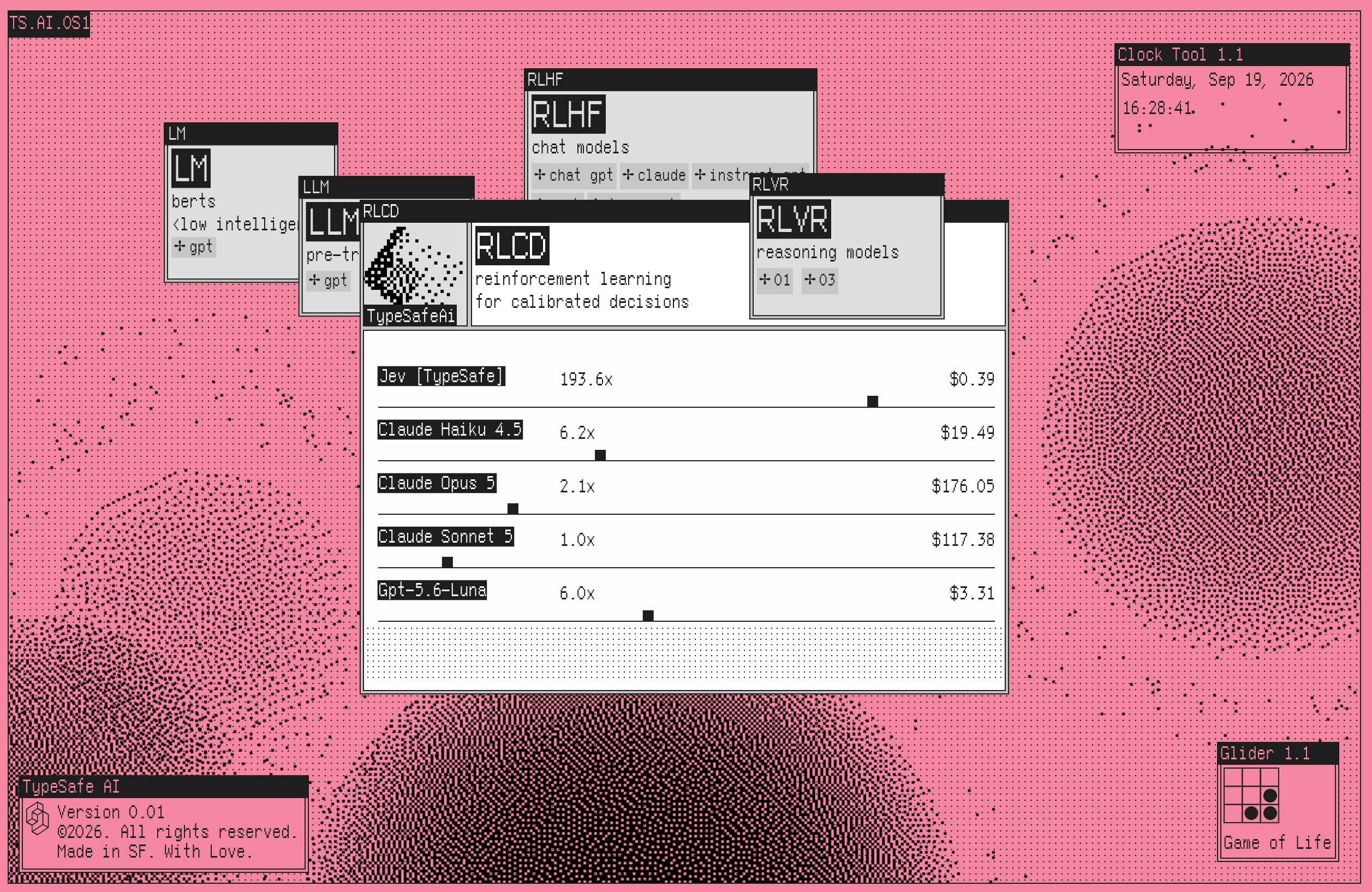
PrimeLine: four models, two classification jobs
Reported September 18, 2026. Unanswered items count as incorrect. Jev’s numerical lead over Opus on commits was not statistically distinguishable in this sample. Dataset provenance and task-specific labels limit generalization; these are not universal model rankings.
A schema-valid answer can still be the wrong judgment.
“Zero hallucinations” refers to the constrained output shape. A valid approve can still be an incorrect decision. Evaluate accuracy, calibrate thresholds, and keep a fallback.
Jev 1.13 limitations
TypeSafe reports weaknesses in exact calculation, multi-hop reasoning, and noisy context. The alternatives below address each case.
Math, counting & exact dates
Use deterministic codeExtract values, then calculate or compare them in code.
Deep, multi-hop reasoning
Use a reasoning modelBreak a broad question into small checks, or hand it to an LLM.
Writing, coding & explanations
Use a generative modelJev can judge a proposed output. It does not create it.
Huge, noisy or adversarial context
Retrieve, clarify & validateFilter irrelevant text, resolve conflicting criteria, and treat inputs as untrusted.
Jev 1.13 pricing and API limits
Published Jev 1.13 pricing, checked September 19, 2026. Confirm current terms with TypeSafe.
- Model ID
jev-1.13.0- Input
- Text, including JSON text state
- Context
- 64K tokens per request
State + longest question: up to 32K - Published rate limits
- 250K tokens/s · 1,200 requests/min
TypeSafe says these limits can change. - Access
- HTTP API · TypeScript / JavaScript · Python
Call Jev with TypeScript or Python
Pick a judgment you already make repeatedly. Define the options. Evaluate against known answers before automating it.
- 1Get an API key
Create a key in the TypeSafe console. Keep it server-side.
- 2Define the question and options
Supply relevant state and clear categories. Include a review path when information is missing.
- 3Evaluate on labeled examples
Check accuracy, confidence thresholds, latency, and total cost on your actual workload.
npm install @typesafe-ai/sdkimport { choice, TypeSafeClient } from "@typesafe-ai/sdk";
// Server-side only. Set TYPESAFE_API_KEY in the environment.
const client = new TypeSafeClient();
const response = await client.systemOne({
model: "jev-1.13.0",
state: { task: "Investigate checkout API 502 errors." },
questions: {
specialist: choice("Which specialist should investigate?", {
backend: "Application code and API behavior",
infrastructure: "Networking, deployment, or runtime failures",
review: "Insufficient information to choose a specialist",
}),
},
});
const decision = response.answers.specialist;
// Illustrative threshold: evaluate it on your own labeled tasks.
const next = decision.confidence >= 0.9 ? decision.choice : "review";
console.log({ next, probabilities: decision.probabilities });Run on your server with TYPESAFE_API_KEY set. Your actual response will vary.
Frequently asked questions
What is Jev, in plain English?
Jev is TypeSafe’s AI decision model. Give it relevant text and a specific question; it returns a choice, a score, or a yes/no probability that your code can use. It does not write the reply, generate code, or explain its reasoning.
TypeSafe · What Jev doesWhy not just ask GPT or Claude for JSON?
You can, and a strict structured-output mode can also guarantee a supported schema. Jev’s difference is a decision-focused interface, distributions rather than a generated confidence claim, and a low published input price. Whether it is better depends on your task’s accuracy, latency, and cost requirements.
TypeSafe · Choice, Score & NoulIsn’t this just classification?
Classification is one of its jobs. The useful part is that you define different categories, rubrics, and yes/no questions at runtime. TypeSafe says it does not fine-tune or LoRA-adapt Jev for each customer; domain knowledge and rules go into the request.
TypeSafe · Models, pricing & limitsWhat does a probability or confidence of 0.9 mean?
For Noul, 0.9 is the model’s estimated probability that the answer is yes. For Choice, each option has its own probability. Choice and Score also return a separate confidence statistic derived from the distribution; it is not simply the winning option’s probability or a guarantee of 90% accuracy on your task. Validate thresholds with representative labeled examples.
TypeSafe · Probability vs. confidenceWhat does a score such as 2.14 mean?
It is the probability-weighted mean of the rubric’s level numbers. On our illustrative 0–4 risk scale, 3%, 11%, 59%, 23%, and 4% produce 2.14. That is a position on your chosen scale, not a 2.14% risk or a universal quality score. Inspect the full distribution as well.
TypeSafe · Reading a ScoreDoes “zero hallucinations” mean Jev is always right?
No. A constrained output shape prevents an answer outside the interface, but a valid choice can still be the wrong decision. Test its judgments, keep deterministic checks, and define fallback or review paths. Schema validity and decision accuracy are different properties.
TypeSafe · Introducing JevCan I use Jev with Claude Code or Codex?
Yes, through an integration you build or a compatible community project. Jev can select skills, filter context, choose tools, and check results around a coding agent. The fast-jev-compaction project specifically targets Claude Code. These examples are integration patterns, not a claim that either coding agent includes Jev by default.
fast-jev-compaction · Source codeCan Jev see screenshots or run locally?
Jev 1.13 accepts text, including structured text state. It does not accept image, audio, or video input. It is offered as a hosted API; the open-source example projects are integrations, not downloadable Jev model weights.
TypeSafe · Models, pricing & limitsCan one question depend on another in the same request?
Questions in a request are evaluated independently against shared state. They do not read each other’s answers. Combine the outputs in your application; if a later question needs an earlier answer, make a subsequent request.
TypeSafe · Choice, Score & NoulSources & editorial notes
This is an independent AI IDE List explainer. Official specifications, vendor tests, community projects, and third-party experiments are labeled separately. Numbers are dated snapshots, not guarantees. Interactive outputs and custom diagrams are explanatory illustrations.
View all 18 references
- TypeSafe · What Jev doesOfficial documentation
- TypeSafe · Choice, Score & NoulOfficial documentation
- TypeSafe · Reading a ScoreOfficial documentation
- TypeSafe · Probability vs. confidenceOfficial documentation
- TypeSafe · Models, pricing & limitsOfficial documentation
- TypeSafe · Jev 1.13 limitationsOfficial documentation
- TypeSafe · Introducing JevVendor report
- WindTunnel · Results & methodologyThird-party benchmark
- Browser Use · Measurements & limitsProject-author measurements
- TypeSafe · Hermes skill suggestionVendor cookbook
- fast-jev-compaction · Source codeCommunity project
- Every · Mike Taylor’s hands-on evaluationThird-party experiment
- PrimeLine · Four models, two real jobsThird-party benchmark
- TypeSafe · Parallel questionsVendor cookbook
- TypeSafe · Legal document re-rankingVendor cookbook
- TypeSafe · JavaScript SDKOfficial SDK reference
- TypeSafe · Python SDKOfficial SDK reference
- OpenAI · Structured output guaranteesOfficial documentation