On This Page8 sections
Key Takeaways
- Skyto.ai is a flight discovery and fare-search tool built around an interactive 3D globe. Instead of requiring travelers to know exactly where they want to go, it emphasizes exploring destinations and routes visually.
- Skyto is not an airline or online travel agency. It does not sell tickets, hold seats, process travel payments, or issue bookings. Users are redirected to external airlines or travel providers to complete purchases.
- The service is currently free. Its terms leave open the possibility of future paid features, while booking links can contain affiliate tracking that may generate referral revenue for Skyto.
- Its most interesting feature is the combination of route discovery and fare discovery. The globe can expose destinations connected to an airport while the fare layer highlights comparatively attractive prices.
- A displayed round-trip price may actually combine two separately observed one-way fares. Travelers therefore need to check whether an itinerary involves separate tickets before booking.
- Skyto should not be treated as a definitive source of flight availability. Route data can include seasonal, cargo, charter, suspended, or otherwise non-bookable services, and its search does not cover every airline, seller, fare, or seat.
- Despite the
.aidomain, the publicly documented product is primarily a flight-search and visualization service rather than an obvious generative-AI travel assistant.
What Is Skyto.ai?
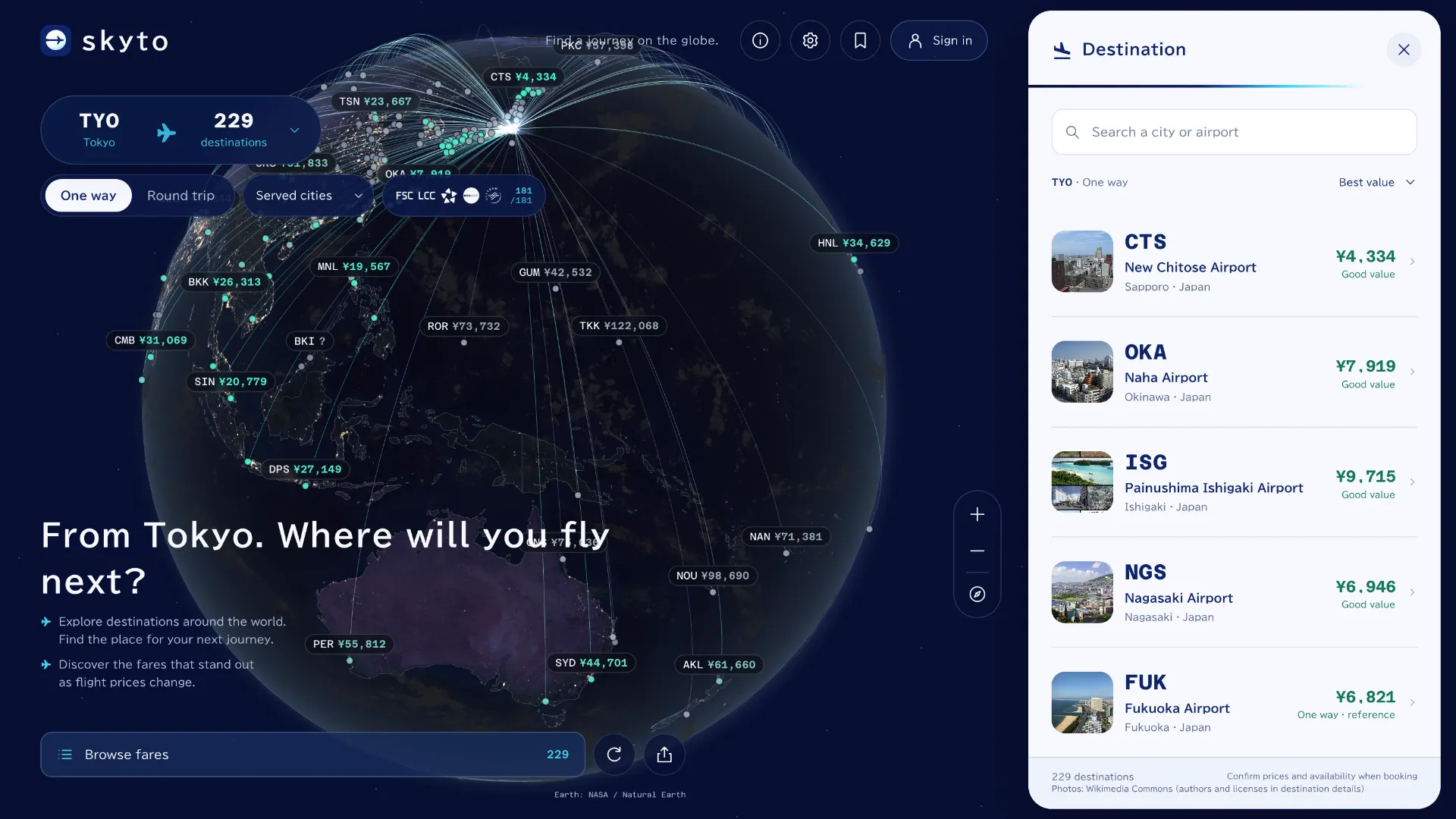
Skyto.ai is a travel discovery application designed to help people explore flight routes by moving around a 3D representation of the Earth. Its official support page describes Skyto simply as an app for exploring flights on a 3D globe, while the homepage emphasizes visualizing destinations served by airports around the world and discovering comparatively inexpensive tickets created by dynamic airfare pricing.
That positioning matters because Skyto approaches flight search differently from the familiar origin-destination-date form used by most booking sites.
A traditional flight search starts with a decision:
Origin → Destination → Dates → Search → Compare flightsSkyto is better understood as:
Origin → Explore reachable destinations → Discover fares → Choose a trip → Book elsewhereThe distinction makes Skyto particularly relevant to flexible travelers who know where they are departing from but have not yet decided where to go.
The service is operated by Taniii合同会社 in Tokyo, Japan. Skyto's Terms of Service were issued on October 3, 2026, and its Privacy Policy was also last updated on October 3, 2026, making the publicly available documentation unusually recent as of October 2026.
How Skyto.ai Works
The homepage opens around an origin such as Tokyo and uses a globe-based interface to expose possible destinations. Users can switch between one-way and return searches and filter the route visualization using airline categories and major alliances. The visible interface includes categories for full-service carriers, low-cost carriers, Star Alliance, oneworld, and SkyTeam.
Conceptually, Skyto appears to combine two layers that are often separated in travel products.
1. Route discovery
The first layer answers questions such as:
- Where can this airport connect me?
- Which cities are served from my departure point?
- What destinations become available if airline or alliance filters change?
This is closer to the experience offered by a route database such as FlightConnections, which maps scheduled routes, airports, airlines, direct flights, and connecting possibilities worldwide.
2. Fare discovery
The second layer attaches airfare information to travel possibilities and attempts to surface comparatively attractive prices.
Skyto explicitly states that its deal labels, colors, and rankings are comparative indicators based on the information available to the service. They are not guarantees that a fare is the absolute cheapest price in the market or that it will become cheaper later.
This is an important distinction. Skyto is not merely drawing airline routes on a globe; it is attempting to help users answer a more commercially valuable question:
Which of the places that can be reached from here look unusually affordable right now?
What Makes Skyto.ai Different?
The strongest part of Skyto is not any individual capability. Route maps, flexible-destination searches, cheap-fare tools, and flight comparison engines already exist.
The differentiation comes from combining these ideas into a highly visual discovery workflow.
A traveler might normally use several products:
- FlightConnections to understand route networks.
- Google Flights Explore to browse destinations and flexible fares.
- Skyscanner Explore Everywhere to discover low-cost destinations.
- An airline or OTA to make the final booking.
Skyto attempts to compress more of that exploration phase into one interface.
This makes the globe more than a cosmetic feature. It turns airfare search from a database-like task into something closer to browsing a map for travel opportunities.
Skyto.ai vs Google Flights vs Skyscanner vs FlightConnections
| Feature | Skyto.ai | Google Flights | Skyscanner | FlightConnections |
|---|---|---|---|---|
| Destination discovery | Yes | Yes | Yes | Yes |
| Interactive map/globe | 3D globe | Map | Primarily search/list discovery | Route map |
| Search destination as flexible | Core experience | Yes | Yes | Route focused |
| Flight fare search | Yes | Yes | Yes | More route/schedule focused |
| Price tracking | Not currently provided by route bookmarks | Yes | Yes | Not the core product |
| Route-network visualization | Strong focus | Limited compared with dedicated route maps | Limited | Core feature |
| Direct ticket issuance | No | No | Generally redirects to providers | No |
| Saved routes | Yes with account | Saved/tracked travel features | Saved lists/alerts | Product dependent |
Google Flights already has a powerful Explore workflow. It allows travelers to select Anywhere, use flexible dates, browse results on a map, filter by price and stops, view price insights, and set fare tracking alerts. Google also currently promotes AI-assisted deal discovery in Flights.
Skyscanner's Explore Everywhere addresses almost exactly the same high-level intent: enter a departure airport, choose Everywhere as the destination, and browse destinations ordered by price. Skyscanner also supports flexible dates and Price Alerts.
FlightConnections approaches the problem from another direction. Its core strength is a detailed worldwide route map showing airports, airlines, scheduled routes, direct flights, and possible connections.
Skyto's niche sits between these categories: make the airline network visually explorable, then layer fare discovery on top of it.
Skyto's Round-Trip Pricing Has an Important Detail
One of the most useful disclosures in Skyto's terms concerns return fares.
Some displayed return estimates can be created by adding two separately obtained one-way fares rather than showing one conventional round-trip ticket.
For example, a discovery engine could theoretically surface something like:
Tokyo → Taipei
Airline A
One-way fare: ¥12,000

Taipei → Tokyo
Airline B
One-way fare: ¥10,500

Approximate return total: ¥22,500
This technique can uncover useful combinations because the lowest outbound fare and lowest inbound fare do not necessarily come from the same airline or ticket.
However, separate tickets introduce risks that travelers should understand:
- The fares may disappear independently.
- Baggage allowances can differ.
- Cancellation rules can differ.
- One ticket usually does not protect the other.
- A schedule change affecting one flight may not create refund rights for the other ticket.
- Self-transfer itineraries may require baggage collection, immigration, or another check-in.
Skyto explicitly tells users to verify separate-ticket notices, connection conditions, airport changes, baggage re-check requirements, transit rules, and final booking details before purchasing.
Are Skyto.ai Prices Live and Guaranteed?
No flight-search product should be treated as a contractual price quote until the booking provider confirms the fare, and Skyto is particularly explicit about this limitation.
According to its terms, Skyto can use:
- third-party information,
- previously collected and stored information,
- calculated information,
- estimated information.
As a result, prices, availability, schedules, airline details, and routes can change between discovery and booking.
The price displayed by Skyto may also exclude costs such as:
- checked baggage,
- seat selection,
- payment charges,
- currency conversion fees,
- other provider-specific extras.
Travelers should therefore use Skyto as a discovery and comparison layer, then confirm the total directly with the booking provider.
A Route on the Globe Does Not Always Mean a Bookable Passenger Flight
This is one of the most important edge cases for new users.
Skyto states that its route information can contain seasonal routes, cargo services, charter flights, and suspended routes. A displayed arc or destination should therefore not automatically be interpreted as proof that a nonstop passenger flight can be purchased for the selected date.
The service also notes that its destination classification can rely on all-airline route information independently from the airline filter currently selected by the user.
In practical terms:
Use the globe for exploration, not as an operational flight schedule.
Always confirm the exact flight, operating carrier, airport, departure date, local time, and availability before building a trip around a route.
Does Skyto.ai Actually Sell Airline Tickets?
No.
Skyto's terms clearly state that the company does not:
- sell airline tickets,
- accept booking orders,
- reserve seats,
- issue tickets,
- collect travel payments,
- enter into the airline or travel contract on the traveler's behalf.
The final transaction occurs with an external airline, travel company, or booking provider.
Clicking a booking button is therefore not the same as making a reservation. Skyto even notes that an outbound link may sometimes lead to a search result for the same route and dates rather than directly to the exact flight originally shown.
Is Skyto.ai Free?
Yes, Skyto is currently free to use.
The Terms of Service say that paid functionality could be introduced later, but any price, subscription duration, renewal terms, and cancellation conditions would need to be disclosed separately before purchase.
Skyto also uses an affiliate model. Booking links can contain affiliate advertising, and the operator may receive referral payments when users follow those links or complete bookings.
That makes its current business model similar to many travel metasearch products:
Traveler discovers flight
        ↓
Skyto sends traveler to booking provider
        ↓
Airline or OTA processes booking
        ↓
Skyto may receive referral revenue
Do You Need an Account?
No account is required for ordinary flight searching.
Skyto's Privacy Policy says travelers can search for flights without registering. Web users can optionally sign in when they want to save routes.
The web application uses Firebase Authentication, with Google, Apple, and X supported as authentication providers.
A saved route contains the origin and destination relationship, but Skyto makes an important distinction: the bookmark does not save or guarantee a fare, seat, or travel date, and it does not create a price alert.
That means users looking specifically for automatic fare-drop notifications will currently find stronger functionality in Google Flights or Skyscanner, both of which support price tracking.
Skyto.ai Privacy and Analytics
Skyto's Privacy Policy provides an unusually specific description of its web analytics setup.
The web version uses Google Analytics 4 to measure aggregate usage. According to the policy, information such as viewed screens and device or browser information may be sent to Google, but Skyto says it does not include authentication user IDs, display names, email addresses, searched travel dates, itineraries, or booking-provider URLs in its analytics data.
The company also says it does not use that analytics data for personalized advertising and that the web application respects supported browser Do Not Track and Global Privacy Control signals.
For a travel discovery service, this level of disclosure is useful because flight searches can reveal potentially sensitive information about intended destinations and travel dates.
Is Skyto.ai Really an AI Travel Tool?
The .ai domain may suggest an artificial-intelligence product, but users should distinguish the domain name from the documented feature set.
As of October 2026, Skyto's public homepage, support documentation, Terms of Service, and Privacy Policy primarily describe:
- airline-route visualization,
- flight and fare search,
- fare comparison,
- route bookmarks,
- external booking referrals.
There is no clearly documented conversational AI trip planner, large-language-model assistant, autonomous booking agent, or generative itinerary system in the core public product documentation reviewed for this article.
For that reason, Skyto is more accurately described today as a modern flight discovery application than as an AI travel agent.
That could change as the product evolves.
Where Skyto.ai Is Strongest
Visual destination discovery
The globe is immediately understandable. It encourages users to browse places instead of treating flight search as a form-filling exercise.
Useful for travelers without a fixed destination
Skyto is particularly well suited to questions such as:
- Where can I fly from Tokyo?
- What destinations can I reach from Taipei?
- Which routes from my airport look cheap right now?
- Which low-cost-carrier destinations are available?
- Where can members of a particular airline alliance travel?
Route and price information live together
Traditional route-map products are excellent for network exploration but often require a second service for meaningful fare discovery. Skyto attempts to reduce that friction.
Low commitment
Searching does not require an account, and the core service is currently free.
Where Skyto.ai Still Falls Short
No built-in price alerts for saved routes
A saved route is a bookmark, not a fare tracker. This is currently one of the clearest gaps compared with mature competitors such as Google Flights and Skyscanner.
Search coverage is not exhaustive
Skyto explicitly says its results do not cover every airline, seller, fare, or available seat.
Users should therefore cross-check important trips with an airline directly or another major flight search engine.
Route visualization can be misunderstood
Seeing a destination on the globe does not guarantee a currently bookable nonstop passenger flight.
Separate-ticket combinations require more care
Combining one-way fares can expose attractive prices, but it can also remove protections normally associated with a single through-ticket.
It is currently narrower than full travel platforms
Skyto is primarily focused on flight discovery. Skyscanner also covers hotels and car rentals, while Google's travel ecosystem integrates flights with broader destination and accommodation discovery.
Who Should Use Skyto.ai?
Skyto makes the most sense for flexible and exploratory travelers rather than travelers who already have a completely fixed itinerary.
It is especially useful for:
- travelers who know their departure airport but not their destination,
- people hunting for spontaneous weekend trips,
- aviation enthusiasts exploring airport connectivity,
- travelers comparing low-cost-carrier possibilities,
- frequent flyers interested in airline-alliance networks,
- users who prefer map-based exploration over traditional search forms.
A business traveler who already needs a specific flight from New York to London at 9 a.m. on a particular day may gain less from the globe interface. Google Flights, an airline website, or a corporate booking platform may provide a faster path for that use case.
How to Use Skyto.ai Effectively
A sensible workflow is:
- Choose your departure city or airport.
- Explore the globe before deciding on a destination. This is where Skyto offers the most value.
- Apply airline or alliance filters when route preferences matter.
- Compare one-way and return pricing.
- Look carefully for approximate or separate-ticket pricing.
- Open the external booking provider.
- Verify the exact airport, operating airline, times, baggage allowance, currency, and final price.
- Cross-check expensive or complicated itineraries elsewhere before paying.
For simple direct flights, this process can be fast. For self-transfers, separate tickets, multiple airports, or international connections involving visa requirements, additional verification is essential.
Skyto.ai vs Traditional Flight Search: The Bigger Idea
Skyto illustrates a broader shift in online travel search.
Most flight engines historically assumed that users already knew three variables:
FROM + TO + DATEBut a large class of travelers actually starts with only one:
FROMThe remaining questions are exploratory:
Where can I go?
What is cheap?
What can I reach nonstop?
What looks interesting?
Google Flights Explore and Skyscanner Everywhere already validate this behavior at enormous scale. Google lets travelers choose Anywhere, flexible dates, trip duration, price limits, stops, airlines, and interests, while Skyscanner explicitly positions Everywhere search for users who have not chosen a destination.
Skyto's contribution is to make this discovery process more visually centered around the global route network.
That makes it less like a traditional booking form and more like a flight opportunity browser.
Frequently Asked Questions
What is Skyto.ai?
Skyto.ai is a flight discovery application that lets users explore routes on a 3D globe, search and compare fares, save routes, and continue to external providers for booking.
Is Skyto.ai free?
Yes. The service is currently free, although its terms allow for paid features to be introduced in the future.
Can you book flights directly on Skyto.ai?
No. Skyto does not sell or issue tickets. Purchases take place with external airlines or travel providers.
Does Skyto always show the cheapest airfare?
No. Its own terms state that deal labels and rankings are comparative indicators and do not guarantee the lowest fare across the entire market.
Does every route shown on the globe have a bookable flight?
No. Route data may include seasonal, cargo, charter, suspended, or otherwise unavailable services. Travelers should confirm availability before making plans.
Does Skyto offer flight price alerts?
Not through its current route-bookmark feature. Saved routes do not store fares or travel dates and do not generate price alerts.
Is Skyto better than Google Flights?
The products emphasize different experiences. Skyto provides a distinctive 3D route-discovery interface, while Google Flights currently offers a more mature fare toolset including flexible-date exploration, price history, price insights, and price tracking.
Is Skyto similar to Skyscanner Everywhere?
Yes in terms of user intent. Both can help travelers discover destinations when they know where they are leaving from but do not have a fixed destination. Skyto differentiates itself through its globe and route-network visualization, while Skyscanner has a more mature metasearch ecosystem and price-alert system.
Conclusion
Skyto.ai takes a familiar problem—finding affordable flights—and redesigns the starting point around exploration rather than destination entry.
Its 3D globe, airline-route visualization, fare discovery, one-way and return search, and external booking workflow make it particularly appealing to flexible travelers asking where they could go rather than searching for one predetermined trip.
The product still has important limitations. Prices are references rather than guarantees, route data can include services that are not currently bookable, search coverage is not exhaustive, return estimates can involve separately ticketed one-way fares, and route bookmarks currently do not function as price alerts.
That means Skyto is best used as a discovery layer, not the final authority before payment.
For travelers who enjoy letting airfare and route availability influence where they travel next, however, Skyto presents an unusually visual alternative to the conventional flight-search box. The most effective approach is to explore destinations in Skyto, identify interesting fares, then verify the complete itinerary and final price with the airline or booking provider before purchasing.
Continue Reading
More articles connected to the same themes, protocols, and tools.



Referenced Tools
Browse entries that are adjacent to the topics covered in this article.