
On This Page8 sections
Key Takeaways
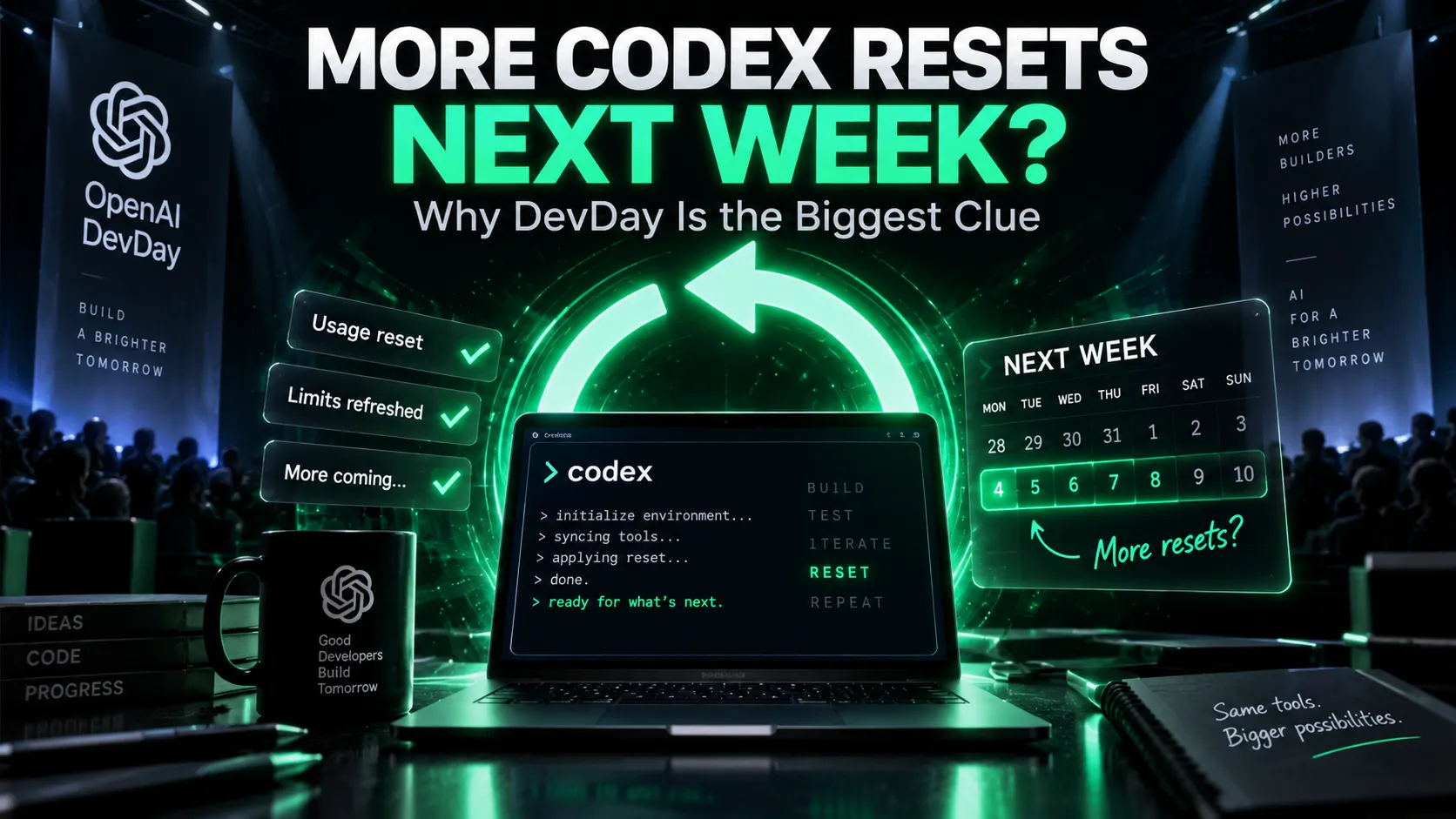
- OpenAI's Tibo has explicitly said that more Codex resets are coming next week. The wording is important, but it does not yet reveal the exact dates, number of resets, or whether they will be banked or automatic.
- The September 26 reset appears to have been a separate outage-recovery event. OpenAI's status page recorded a Codex outage on September 25 affecting Codex Web, the Codex API, CLI, and the VS Code extension, followed by recovery later that evening.
- OpenAI DevDay 2026 is the strongest clue for why additional resets are planned. DevDay takes place on September 29 in San Francisco.
- OpenAI has already used resets as a launch-management tool. During the GPT-6 Astra rollout, eligible Plus, Pro, and Business users received banked resets followed by a global reset.
- A reset is not the same as a permanent limit increase. Banked resets are one-time promotional benefits, while automatic or global resets are applied immediately to eligible usage limits.
The most likely interpretation is not that OpenAI is simply extending compensation for one outage. The timing suggests that resets have become a deliberate way to give Codex and ChatGPT Work users more room to experiment during major launches, rapid product changes, and periods of unusually high demand.
What Tibo Actually Confirmed
The immediate signal came from a short public exchange after the latest Codex reset.
After announcing that the latest reset had propagated, Tibo was told by Gia that the timing was unfortunate because it arrived just after her own usage had reset. His reply was direct:
"More resets coming next week."
That sentence confirms the broad direction but leaves several details unresolved.
It does not yet tell users:
- how many resets will happen;
- which day or days they will arrive;
- whether every paid plan will qualify;
- whether the resets will cover both Codex and ChatGPT Work;
- whether they will be saved as banked resets or applied automatically;
- whether they are tied to a launch, compensation event, usage-policy change, or a combination of those factors.
The plural word "resets" is notable, but it should not be treated as a contractual promise of a specific number. Public product posts are often informal, and future promotional resets can vary by plan, region, workspace, availability, and the terms of each offer.
The September 26 Reset Was Already Explained by the Outage
The first reason to separate next week's resets from the current one is chronology.
OpenAI recorded a Codex outage on September 25, 2026. The incident affected Codex Web, the Codex API, CLI, and the VS Code extension. OpenAI identified the issue, applied mitigation, and later marked the incident resolved.
Soon afterward, Tibo announced that usage limits would be reset for paid users across Codex and ChatGPT Work.
That makes the weekend reset easy to explain: it followed a service disruption.
The important part is that "more resets coming next week" came after that reset was already complete. In other words, the additional resets appear to be a separate future event rather than merely the unfinished propagation of the September 26 compensation.
Why DevDay 2026 Is the Biggest Clue
The calendar is unusually suggestive.
OpenAI DevDay 2026 is scheduled for Tuesday, September 29 in San Francisco.
Tibo's public posts immediately before the reset announcement repeatedly pointed to DevDay. He described the upcoming sprint as unusually ambitious and said it included many things that could change how people work. He also said the team was fully focused on DevDay.
That sequence matters:
- September 24: strong DevDay product tease;
- September 25: team is focused on DevDay;
- September 25: Codex outage;
- September 26: outage recovery and paid-user reset;
- September 26: Tibo says more resets are coming next week;
- September 29: OpenAI DevDay.
No official announcement currently says, "The resets are for DevDay." That distinction matters for accuracy. But DevDay is the clearest public event sitting directly inside the promised reset window.
OpenAI Has Already Used Resets During Major Launches
The strongest precedent is the GPT-6 Astra rollout.
OpenAI documented multiple reset events during the launch period, including banked resets for eligible Plus, Pro, and Business users and a later global reset.
This matters because it demonstrates that resets are not limited to outage compensation.
They can also be used during launches.
A reset can serve several product goals at once:
- compensate users for disruption or delayed access;
- encourage users to test a newly released model or workflow;
- reduce friction when a launch changes usage behavior;
- give OpenAI more real-world usage data during rollout;
- soften the impact of temporary inefficiencies while usage accounting or model behavior is being tuned.
A major developer event is exactly the kind of environment in which those goals overlap.
The Sol and Luna Launch Adds Another Signal
There is also a more recent example.
The GPT-6 Sol and Luna launch was accompanied by a banked reset for Plus, Pro, and Business users.
That launch happened only about one week before DevDay.
The pattern is therefore becoming difficult to dismiss as random:
major model or workflow launch → additional usage headroom → users experiment more aggressively.
This does not prove that every future launch will include resets. But it does establish a recent operational pattern.
Why OpenAI Would Want Users to Have More Usage During DevDay
The product logic is straightforward.
Codex is no longer just a single prompt followed by a single completion. Modern agentic coding workflows can involve long-running sessions, tool calls, repository exploration, repeated edits, verification, background work, and multiple model interactions.
When a company launches new agentic capabilities, usage behavior can change dramatically.
A feature that looks efficient in internal testing can produce very different consumption patterns when users apply it to:
- large repositories;
- multi-step refactors;
- parallel coding tasks;
- browser or computer-use workflows;
- plugin-connected tasks;
- long context histories;
- repeated review and verification loops.
Extra reset capacity lowers the cost of experimentation for users during the period when OpenAI most needs real-world feedback.
This creates a useful feedback loop:
new capability → more user experimentation → more telemetry and feedback → faster tuning of reliability and efficiency.
That is one reason a reset can be strategically useful even when there has been no outage.
Resets Also Work as a Safety Valve for Rapid Rollouts
There is another practical reason.
Usage limits can become controversial when product behavior changes faster than the published plan structure.
Suppose a new Codex workflow performs more autonomous steps than the old workflow. Even if it completes more useful work, users may perceive it as consuming allowance faster.
A temporary reset gives OpenAI time to observe:
- whether the new feature is consuming more allowance than expected;
- whether some workloads are disproportionately expensive;
- whether usage accounting is behaving consistently;
- whether capacity needs adjustment;
- whether model routing or context handling needs optimization.
From the user's perspective, the reset reduces the downside of testing something new.
From OpenAI's perspective, it creates room to launch aggressively without immediately turning every early inefficiency into a subscription-value dispute.
Banked Reset vs. Global Reset: Why the Difference Matters
Users should not treat every reset as the same thing.
OpenAI uses at least two different mechanisms.
Banked reset
- saved to the account;
- manually applied;
- can be held until needed or until it expires;
- refreshes eligible usage windows when used.
Automatic or global reset
- applies directly to eligible usage limits;
- cannot be saved for later;
- does not appear as a banked reset.
This distinction becomes especially important around DevDay.
If OpenAI wants everyone to test a feature immediately, a global reset is more effective because it restores headroom at once.
If OpenAI wants to give users flexible extra capacity over several days, a banked reset is more useful.
A launch week could also use both mechanisms.
Using a Banked Reset Can Change Your Weekly Reset Date
There is one detail heavy Codex users should understand before pressing the reset button.
Using a full banked reset can refresh the relevant usage windows. After the reset is used and activity resumes, the weekly reset schedule may shift to the new cycle rather than preserving the previous reset date.
For example, a user whose weekly allowance normally renews on Friday could use a banked reset on Tuesday and begin a new weekly cycle from around that point.
That means a banked reset has timing value.
If a user still has substantial allowance available immediately before DevDay, it may be more useful to preserve a banked reset until the new features are actually available. By contrast, an automatic reset requires no timing decision because OpenAI applies it directly.
What "More Resets" Could Mean Next Week
There are several plausible scenarios, and they should be separated from confirmed facts.
Scenario 1: A DevDay Launch Reset
OpenAI could apply a reset around the September 29 keynote so existing Codex and ChatGPT Work users can immediately test new capabilities.
This would fit the recent launch pattern.
Scenario 2: One Banked Reset Plus One Automatic Reset
The wording "more resets" could refer to different reset types rather than multiple identical global resets.
A banked reset could provide flexible extra usage, while a later automatic reset could refresh everyone during a broader rollout.
Scenario 3: A Launch Reset Followed by a Reliability Reset
Large launches can generate unexpected load or usage-accounting problems.
If DevDay produces a major spike in Codex or ChatGPT Work traffic, OpenAI could first issue a planned promotional reset and later issue another reset if users experience disruption.
This would combine two established uses of resets: launch promotion and service recovery.
Scenario 4: Multiple Resets Across a Staged Rollout
OpenAI may release several features over multiple days instead of shipping everything during the keynote.
In that case, multiple resets could be aligned with different rollout stages.
None of these scenarios is confirmed yet. The only confirmed forward-looking statement is that more resets are expected next week.
What Users Should Watch
The most useful signals are not rumors but changes in official or account-level surfaces.
Watch for:
- Settings → Usage showing a new banked reset;
- a sudden return to full eligible usage without manual action, indicating an automatic reset;
- an official OpenAI Help Center update explaining eligibility;
- Tibo specifying whether the reset covers Codex, ChatGPT Work, or both;
- DevDay launch announcements that materially change agent workflows or model availability;
- OpenAI Status incidents that might trigger a separate compensation event.
The account's Usage page remains the most important source for whether a particular user actually received a promotional reset.
Common Misunderstandings About Codex Resets
A reset does not permanently raise the plan limit. It replenishes an allowance; it does not rewrite the subscription's long-term entitlement.
A banked reset is not API credit. It is not cash, API credit, or a transferable balance.
A global reset and a banked reset are not interchangeable. One is applied automatically; the other is stored for later use.
The word "resets" does not guarantee a specific count. Until OpenAI publishes exact terms, it is safer to interpret Tibo's wording as a clear promise of additional reset activity rather than a precise numerical commitment.
The next reset is not necessarily compensation for the September outage. The outage-related reset had already propagated before Tibo said more were coming.
What This Says About OpenAI's Codex Strategy
The bigger story is not the free usage itself.
Resets increasingly look like a product-operations mechanism for Codex and ChatGPT Work.
OpenAI can use them to manage the transition between:
- new models;
- new agent behaviors;
- changing efficiency characteristics;
- sudden traffic growth;
- reliability incidents;
- evolving subscription limits.
That is particularly useful for an agentic product because the amount of compute behind a user-visible task can vary far more than in a simple chat interaction.
A temporary reset lets OpenAI move quickly while keeping early adopters engaged instead of forcing them to ration usage during the exact period when the company wants experimentation.
Conclusion
The clearest fact is simple: Tibo says more Codex resets are coming next week.
The exact reason has not been formally announced, but the timing strongly points toward OpenAI DevDay 2026 on September 29 as the main context. OpenAI has already used banked and global resets during major launches, while the September 25 Codex outage had its own separate recovery reset.
For heavy Codex users, the practical move is to watch the Usage page and distinguish carefully between a banked reset and an automatic reset. If a banked reset is already available, its timing can matter because using it may shift the weekly usage cycle.
The next key date is September 29. If DevDay introduces the scale of workflow changes Tibo has been teasing, the additional resets may be less of a giveaway and more of an intentional part of how OpenAI rolls those changes out.
Continue Reading
More articles connected to the same themes, protocols, and tools.

Referenced Tools
Browse entries that are adjacent to the topics covered in this article.