
On This Page8 sections
Manus has resumed operating as an independent AI company as of September 1, 2026, with founders Red Xiao, Tao Zhang, and Peak Ji continuing to lead the business. The corporate change closes one chapter, but the more important story is what Manus plans to build next.
The company's new direction can be summarized in three ideas: become more deeply embedded in everyday workflows, interact more directly with external tools and services, and act more proactively on the user's behalf.
Together, those ideas describe something larger than a better chatbot. Manus is moving from an agent that waits for an assignment toward an operating layer that can remain present, understand what is happening, and keep work moving with less supervision.
From One-Off Tasks to Continuous Work
The first generation of general AI agents followed a familiar loop:
Open the agent
      ↓
Describe a task
      ↓
Wait for execution
      ↓
Receive the result
That model is useful, but it is still fundamentally reactive. Every new task begins with a person opening an interface and explaining what should happen.
The next model looks different:
Set a goal and permissions
          ↓
The agent monitors relevant systems
          ↓
It recognizes when action is needed
          ↓
It executes across connected tools
          ↓
It reports results and exceptions
This is the product transition Manus is signaling. The agent becomes less like a destination and more like infrastructure: available in the background, connected to the places where work already happens, and capable of carrying a process across multiple steps.
The Product Stack Behind the Strategy
Manus has already introduced several products that point toward this always-on model. Each one solves a different part of the same problem.
Manus Cloud Computer: A Place Where the Agent Can Act
An AI agent needs more than reasoning. It needs an execution environment.
Manus Cloud Computer gives the agent a remote workspace where it can use a browser, work with files, access web applications, and continue multi-step tasks without depending entirely on the user's local machine. That makes it a foundation for jobs that take time or require interaction with several services.
The important shift is from generating instructions to carrying them out. Instead of explaining how to collect information, organize files, update a dashboard, or complete a web workflow, the agent can perform those actions inside a controlled computer environment.
Scheduled Tasks 2.0: Giving the Agent a Sense of Time
Cloud access answers the question, “Where can the agent work?” Scheduled Tasks 2.0 addresses, “When should it work?”
Scheduling turns an AI agent from an on-demand tool into a recurring operator. A user can define work that needs to happen every morning, every week, after a deadline, or at another meaningful interval. That can include monitoring a source, preparing a report, checking for changes, or starting a repeatable workflow.
The deeper value is continuity. When scheduled execution is combined with context from earlier runs, an agent can compare what changed, identify exceptions, and focus the user's attention on what matters instead of simply repeating the same output.
Manus for Small Businesses: Packaging Automation Around Outcomes
Small companies rarely need another blank AI interface. They need concrete results: qualified leads, updated records, customer follow-ups, market research, published content, and operational reports.
A product designed for small businesses suggests that Manus is packaging its general agent capabilities around these recurring outcomes. The opportunity is significant because smaller teams have many cross-functional processes but limited capacity to build and maintain custom automation.
For this audience, the winning experience will not be measured by the sophistication of a prompt. It will be measured by how much dependable work the system completes across the tools a business already uses.
The Upcoming Work Product: The Likely Integration Point
Manus has also teased what it describes as its most ambitious Work product to date. Details remain limited, but the direction is clear when viewed alongside Cloud Computer and Scheduled Tasks 2.0.
Cloud Computer provides an execution surface. Scheduled Tasks adds persistence and timing. Business-focused products add repeatable use cases. A broader Work product could bring those layers together into a single environment for assigning goals, connecting services, reviewing progress, and managing approvals.
That would make the product less like a collection of agent features and more like a system for delegating digital work.
Three Capabilities That Define the New Manus
1. Embedded in Everyday Workflows
Today, most AI products live in a separate tab. Users leave their work, open the AI tool, provide context, copy the result, and then return to the original application.
An embedded agent reduces that friction by connecting directly to the workflow:
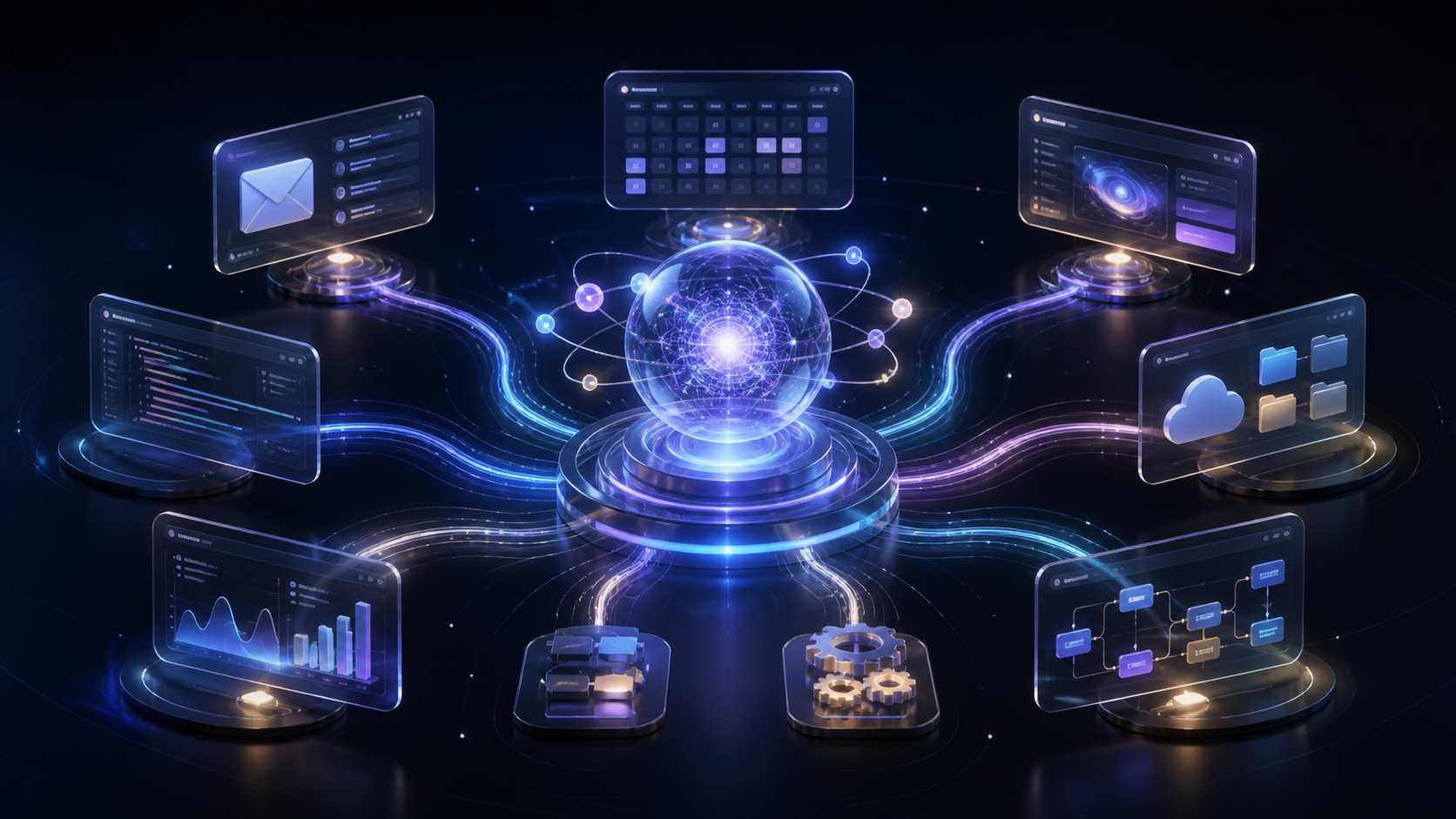
Email · Calendar · Browser · Slack · GitHub · Drive · CRM
                              ↓
                            Manus
                              ↓
                  Monitor · Decide · Execute
The more deeply the agent understands the state of these systems, the less often a user has to reconstruct context manually. A meeting can become a list of tasks. A new customer request can trigger research. A code change can lead to tests, documentation, and a deployment checklist.
This is where an agent starts to feel like a coworker rather than a prompt box.
2. Direct Interaction With the Outside World
Research and content generation are only the beginning. Real work requires state changes.
That may mean navigating a browser, editing a file, submitting a form, calling an API, updating a database, sending an email, deploying code, or completing a transaction. Computer use and tool use allow the agent to cross the boundary between describing an action and performing it.
The distinction matters. A system that writes a launch plan is helpful. A system that creates the project, prepares the pages, deploys the site, checks the result, and reports any failures is operational.
3. Proactive Action on the User's Behalf
Proactivity is the most consequential part of the strategy. It changes who starts the work.
A proactive agent does not need a new prompt for every step. It works from a standing goal, watches for relevant changes, and acts when predefined conditions are met. Routine work can happen automatically, while unusual or high-risk decisions are escalated to the user.
That creates a much more powerful loop:
Observe → Understand → Decide → Act → Verify → ReportThe final two steps are essential. An agent should not only perform an action; it should confirm the outcome and make its work visible. Proactivity without verification becomes fragile automation. Proactivity with clear reporting becomes delegated work.
What an End-to-End Manus Workflow Could Look Like
Consider a solo builder looking for a promising AI product opportunity. The complete process might involve far more than a single research prompt.
| Stage | Agent responsibility | Typical tools |
|---|---|---|
| Discover | Find emerging AI products and recurring user problems | Browser, search, feeds |
| Validate | Review search trends, keywords, competitors, and demand signals | Analytics tools, spreadsheets |
| Decide | Rank opportunities against the builder's criteria | Saved preferences, scoring rules |
| Plan | Create the site structure, positioning, and content plan | Documents, project workspace |
| Build | Generate pages, write code, and prepare assets | Code environment, file system |
| Launch | Deploy the project and verify production behavior | GitHub, hosting platform, browser |
| Monitor | Track search performance, errors, and market changes | Search Console, analytics, scheduled tasks |
| Improve | Recommend and execute the next iteration | Reports, code, content systems |
Most of these capabilities already exist as separate tools. The hard product problem is coordinating them reliably under one goal.
This is why the combination of Cloud Computer, scheduled execution, workflow connections, and proactive behavior is more important than any individual feature. It creates the possibility of a continuous loop from discovery to delivery to improvement.
The Hard Part Is Trust, Not Intelligence
The more an agent can do, the more carefully it must be controlled. An always-on agent needs a clear operating model for permissions, approvals, and accountability.
Users will need to know:
- Which systems the agent can access
- Which actions it can take automatically
- Which actions require approval
- What information it remembers between runs
- How to inspect its activity and reverse a mistake
- What happens when a tool fails or a workflow becomes ambiguous
The strongest version of a proactive agent will not ask for approval at every trivial step. That would remove the benefit of delegation. But it also should not treat every connected service as an unrestricted playground.
A practical design is risk-based autonomy: routine, reversible actions can run automatically; consequential or irreversible actions pause for confirmation. Detailed activity logs, checkpoints, spending limits, and scoped credentials will be as important as model quality.
A Different Competitive Category
This strategy moves Manus beyond the traditional chatbot market. Its closer competitors are agentic products that can use computers, write and deploy code, operate inside workspaces, and automate multi-application processes.
That includes products in the orbit of ChatGPT Agent, Codex, Claude Code, computer-use systems, and workflow automation platforms. The competition will not be decided by which assistant produces the most polished chat response. It will be decided by which system can complete real work with the best combination of capability, reliability, control, and integration depth.
For Manus, independence may also make product focus more visible. The founding team can now define the roadmap around the company's original general-agent ambition: not simply answering users, but acting for them.
What to Watch Next
The upcoming Work product will be the clearest test of this strategy. Four questions matter most:
- How persistent is the agent? Can it retain useful project context and continue work over days or weeks?
- How broad are the integrations? Can it move smoothly across communication, development, data, and business tools?
- How much can it do without supervision? Does it reduce operational overhead while preserving meaningful user control?
- How reliably does it recover? Can it detect failed steps, retry safely, and ask for help when a situation falls outside its instructions?
If Manus solves those problems well, the result will not feel like a smarter chat application. It will feel like a new interface for work itself.
The Bigger Product Bet
Manus's renewed independence is the headline, but its product roadmap is the story.
Cloud Computer gives the agent somewhere to work. Scheduled Tasks 2.0 gives it continuity. Deeper integrations give it context. Proactive execution gives it agency. The forthcoming Work product may be where those pieces become one coherent system.
The ambition is straightforward to describe and difficult to deliver: move from “tell the AI what to do” to “tell the AI what outcome you want.”
That is the next frontier for Manus—and for the broader agent market. The company is no longer trying only to build an AI that can finish a task. It is trying to build an AI that can keep work moving.
Continue Reading
More articles connected to the same themes, protocols, and tools.
Referenced Tools
Browse entries that are adjacent to the topics covered in this article.