On This Page8 sections
Key Takeaways
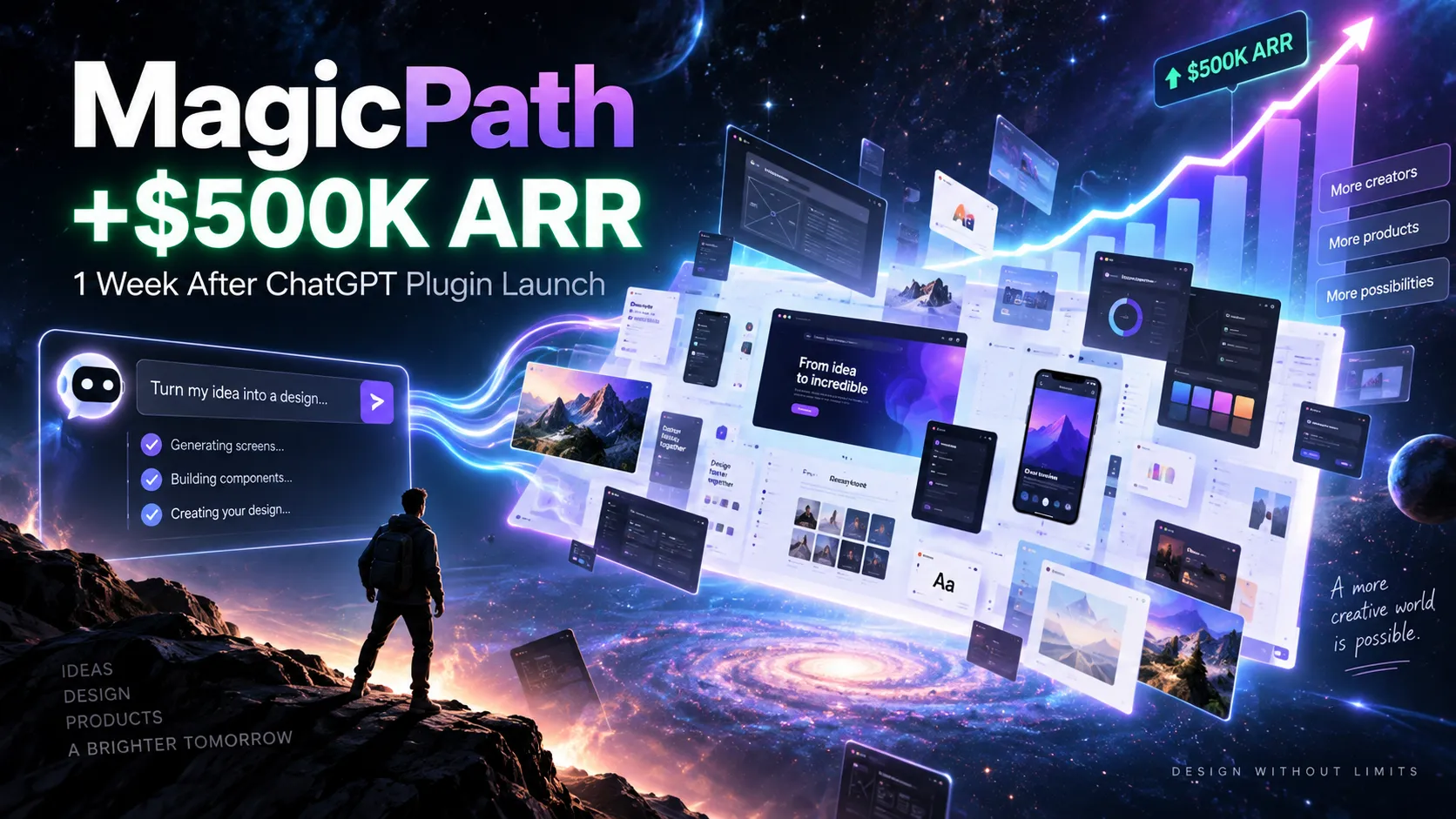
- MagicPath founder Pietro Schirano says the company added $500,000 in ARR in a single week after launching its ChatGPT plugin. The figure is founder-reported and has not been independently audited.
- $500K ARR does not mean $500K of cash was collected in seven days. It corresponds to roughly $41,667 in additional monthly recurring revenue at the same run rate.
- MagicPath is an AI-native visual design canvas that connects prompts, working UI, React code, Figma, and coding agents such as Codex, Claude Code, and Cursor.
- The most important part of the story may be distribution: ChatGPT can surface a specialized tool at the exact moment a user expresses design intent.
- MagicPath is therefore an early example of a broader shift from search-driven SaaS acquisition to intent-level AI distribution.
Did MagicPath Really Add $500K in ARR in One Week?
The core claim is credible, but it needs precise wording.
On October 6, 2026, MagicPath founder Pietro Schirano said the company had added $500K in ARR during the week following the launch of its ChatGPT plugin.
That should not be rewritten as “MagicPath made $500K in one week.”
ARR means Annual Recurring Revenue. It annualizes the current recurring subscription run rate.
$500,000 / 12 = $41,666.67 per monthSo the more accurate interpretation is:
MagicPath says the new subscriptions added during that week represented roughly $41.7K in additional monthly recurring revenue, or $500K when annualized.
The number remains a founder-reported metric. No public Stripe dashboard, audited statement, or independent SaaS analytics source currently verifies the exact amount.
What Is MagicPath?
MagicPath is an AI design product built around a shared visual canvas for humans and AI agents.
Instead of generating only a static image or a single website preview, MagicPath connects several parts of the product-design workflow:
- Natural-language prompts
- Multi-screen interface generation
- Editable visual layouts
- React-based working interfaces
- Figma import and export
- Existing website elements
- Design systems
- External coding agents
- Production code workflows
The result is closer to a combination of Figma, an AI UI generator, an infinite canvas, and an agent workspace than a conventional no-code website builder.
One Prompt Can Become a Multi-Agent Design Workflow
One of MagicPath's most distinctive ideas is parallel agent execution.
A user can request an entire product flow such as:
- Onboarding
- Dashboard
- Billing
- Settings
- Profile
- Empty states
Instead of generating every screen sequentially, multiple agents can work across the same canvas.
That changes the mental model from:
“Generate one screen for me.”
to:
“Assign a design brief to an AI design team.”
This matters because real product design is rarely a single-screen task. Teams need consistency across states, screens, responsive layouts, and reusable components.
MagicPath Connects Design and Real Code
The canvas is not intended to end as a flattened mockup.
MagicPath can produce working interfaces using technologies such as React, TypeScript, and Tailwind CSS. This makes the output more useful to developers and coding agents than a screenshot-only workflow.
A traditional process often looks like this:
Designer
→ Figma mockup
→ developer rebuilds the interface
→ review
→ revisions
MagicPath is trying to compress that into:
Prompt / Figma / existing code
→ MagicPath canvas
→ working interface
→ coding agent or developer
→ production repository
The important idea is not merely faster code generation. It is reducing the gap between what a designer sees and what a developer eventually ships.
Figma Can Remain Part of the Workflow
MagicPath does not need to replace Figma completely to be useful.
Designs can move from Figma into MagicPath, where AI agents can create new screens, variants, or functional prototypes. Work can also move back toward editable design workflows rather than being trapped as a static screenshot.
A practical workflow can look like:
Figma
→ MagicPath
→ AI-generated variants
→ working prototype
→ coding agent
→ production implementation
This is strategically important because many companies already have established Figma libraries, design systems, and review processes.
A tool that integrates with those workflows has a lower adoption barrier than one requiring an entirely new design stack.
Why Codex, Cursor, and Claude Code Matter
MagicPath becomes significantly more valuable when paired with coding agents.
A repository-aware agent can understand:
- Existing components
- Route structure
- Design tokens
- Naming conventions
- Dependencies
- Import paths
- Product context
MagicPath can then provide the visual surface where that context becomes an interface.
A future-oriented workflow looks like:
Repository
→ coding agent reads the project
→ MagicPath creates or edits the visual design
→ human reviews visually
→ coding agent implements the approved result
That creates a genuine code → design → code loop.
For product teams, this is potentially more valuable than another standalone prompt-to-website generator because the generated design can stay connected to the real software project.
Why the ChatGPT Integration Changed the Growth Curve
MagicPath existed before the ChatGPT plugin.
The major change was distribution.
A traditional SaaS funnel might look like:
Google or social discovery
→ MagicPath website
→ understand the product
→ sign up
→ learn the interface
→ create first design
→ upgrade
A ChatGPT-native funnel can be much shorter:
User asks ChatGPT to design something
→ MagicPath becomes relevant
→ plugin is invoked or installed
→ useful visual result appears
→ user continues into the paid product
The second funnel begins after the user has already expressed purchase-adjacent intent.
That is the key reason this kind of distribution can convert unusually well.
The user does not first need to search for “AI design software.” The conversational request itself reveals the need.
From SEO Traffic to Intent-Level Distribution
Traditional SEO is based on queries such as:
- AI UI generator
- Figma to React
- AI wireframe tool
- design website with AI
Conversational AI exposes richer intent:
- “Design a dashboard for this SaaS.”
- “Turn this PRD into an onboarding flow.”
- “Create three pricing-page alternatives.”
- “Visualize the interface for this repository.”
Those users may never search Google for a design tool.
An AI assistant can identify the task and route it toward a specialized execution layer.
That creates a new acquisition model:
User intent
→ AI reasoning
→ tool selection
→ execution
→ persistent SaaS workflow
→ paid conversion
This is fundamentally different from a search engine sending a click to a landing page.
Why MagicPath Is Well Suited to ChatGPT Distribution
Not every SaaS product is equally suited to an AI assistant ecosystem.
MagicPath has several advantages.
1. The user intent is easy to recognize.
Requests such as “design this,” “visualize this,” and “turn this into an interface” naturally map to the product.
2. The product adds a capability the assistant itself does not fully replace.
A specialized visual canvas is different from generic text generation.
3. Value can appear quickly.
Users can see a concrete interface rather than reading a description of what a design tool might create.
4. There is a clear monetization path.
Free usage can lead to paid design credits, heavier workflows, collaboration, or team usage.
5. The product remains useful after the original ChatGPT interaction.
Projects, canvases, design systems, Figma assets, repositories, and team collaboration create reasons to return.
How Many Customers Could $500K of ARR Represent?
The exact number cannot be calculated without MagicPath's billing data, but simple scenarios show why the growth does not require hundreds of thousands of new paid customers.
At $84 per year:
$500,000 / $84 ≈ 5,952 subscriptionsAt $252 per year:
$500,000 / $252 ≈ 1,984 subscriptionsThe real mix will be more complicated because SaaS businesses can have monthly plans, annual plans, team contracts, upgrades, usage-based expansion, and different customer tiers.
The useful takeaway is that a few thousand high-intent conversions can create hundreds of thousands of dollars in incremental ARR.
MagicPath vs. Figma, v0, Lovable, and Coding Agents
| Product category | Primary strength | MagicPath's position |
|---|---|---|
| Figma | Human-first visual design | Human + agent collaboration on a shared canvas |
| v0-style tools | Fast prompt-to-UI generation | Multi-screen spatial workflow and design iteration |
| Lovable-style builders | Prompt-to-app development | More design-centric, with visual canvas workflows |
| Cursor / Codex / Claude Code | Repository-aware coding | Gives coding agents a visual design surface |
| Infinite canvas tools | Spatial organization | Combines spatial work with executable interface generation |
MagicPath's strongest strategic position may be between these categories rather than directly replacing one of them.
It can become the visual coordination layer connecting designers, coding agents, design systems, and production repositories.
Common Mistakes When Interpreting the $500K ARR Claim
“MagicPath made $500K in one week.”
Incorrect. The reported figure is $500K in added ARR, not necessarily $500K of cash collected.
“Every ChatGPT plugin can achieve the same growth.”
There is no evidence for that. MagicPath already had a mature product, clear monetization, strong differentiation, and a use case that maps naturally to conversational intent.
“The plugin proves ChatGPT caused every dollar of growth.”
The timing strongly links the growth acceleration to the launch, but public information does not provide a complete attribution model.
“ARR is guaranteed future revenue.”
It is not. Churn, cancellations, downgrades, failed payments, and customer contraction can reduce realized revenue.
Why This Matters for AI Startups
The deeper lesson is that distribution architecture is becoming part of product architecture.
AI startups traditionally ask:
- Can this rank in Google?
- Can it spread on X or Reddit?
- Can it acquire users through paid search?
- Can affiliates distribute it?
A new question is becoming equally important:
Can this product become an executable capability inside the AI assistant where users already express the problem?
That is the strategic significance of the MagicPath story.
ChatGPT can function as the intent and reasoning layer.
MagicPath functions as the specialized visual execution layer.
If this pattern continues, AI companies may increasingly compete not just for keywords, backlinks, or app-store rankings, but for the moment when an AI assistant decides which external capability is best suited to complete a user's request.
Conclusion
MagicPath's reported $500K increase in ARR in one week is a notable example of how quickly distribution can change when an AI product becomes available inside a major assistant ecosystem.
The number should be interpreted carefully. It is founder-reported, not independently audited, and it represents annualized recurring revenue rather than $500K of cash earned during seven days.
But the broader signal is important.
MagicPath combines a specialized visual canvas, real interface generation, Figma workflows, and coding-agent integration with a new distribution surface inside ChatGPT.
That creates a powerful combination:
high-intent discovery + immediate execution + persistent SaaS workflow + monetization.
For AI founders, the lesson is larger than MagicPath itself.
The next generation of SaaS products may not win only by ranking first in search. They may also win by becoming the default specialized tool an AI assistant chooses when a user asks for a valuable task to be completed.
Continue Reading
More articles connected to the same themes, protocols, and tools.
Referenced Tools
Browse entries that are adjacent to the topics covered in this article.