On This Page8 sections
Key Takeaways
- Google officially launched Gemini 4 Argon in Antigravity on October 13, 2026, bringing its frontier reasoning model to the Antigravity desktop application and CLI for Google AI Ultra subscribers. Eligible Gemini Enterprise customers can also access the model.
- More than 100,000 people across Alphabet use Argon internally each month. Google reports a 35% increase in agentic code and a 30% decrease in post-submit rollbacks during a four-week observation period.
- Google reports substantial improvements in real engineering workflows, including cutting YouTube's comments frontend CPU footprint in half, closing 97 outdated bug reports in under three hours, and accelerating a Fortran-to-Rust migration.
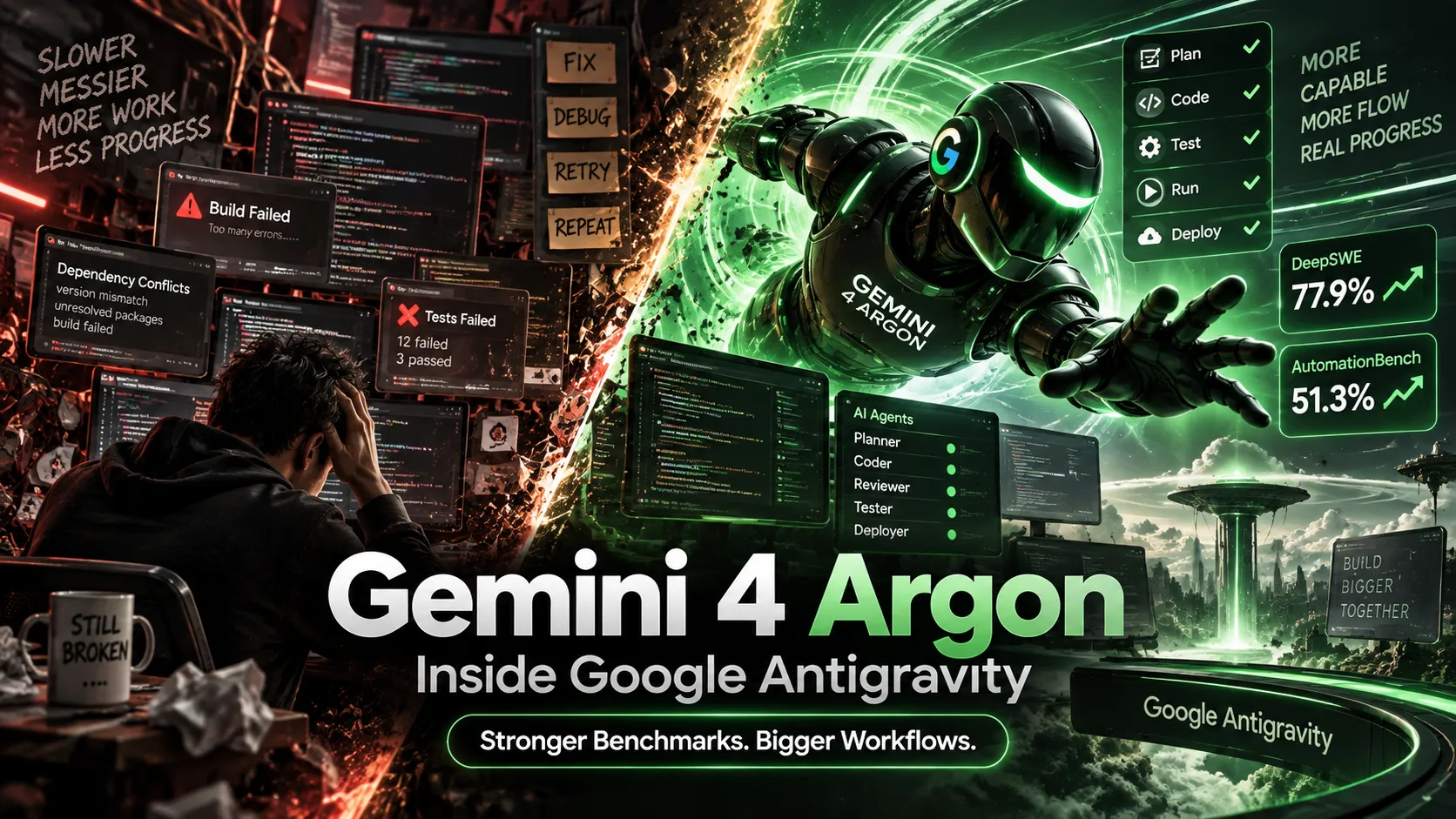
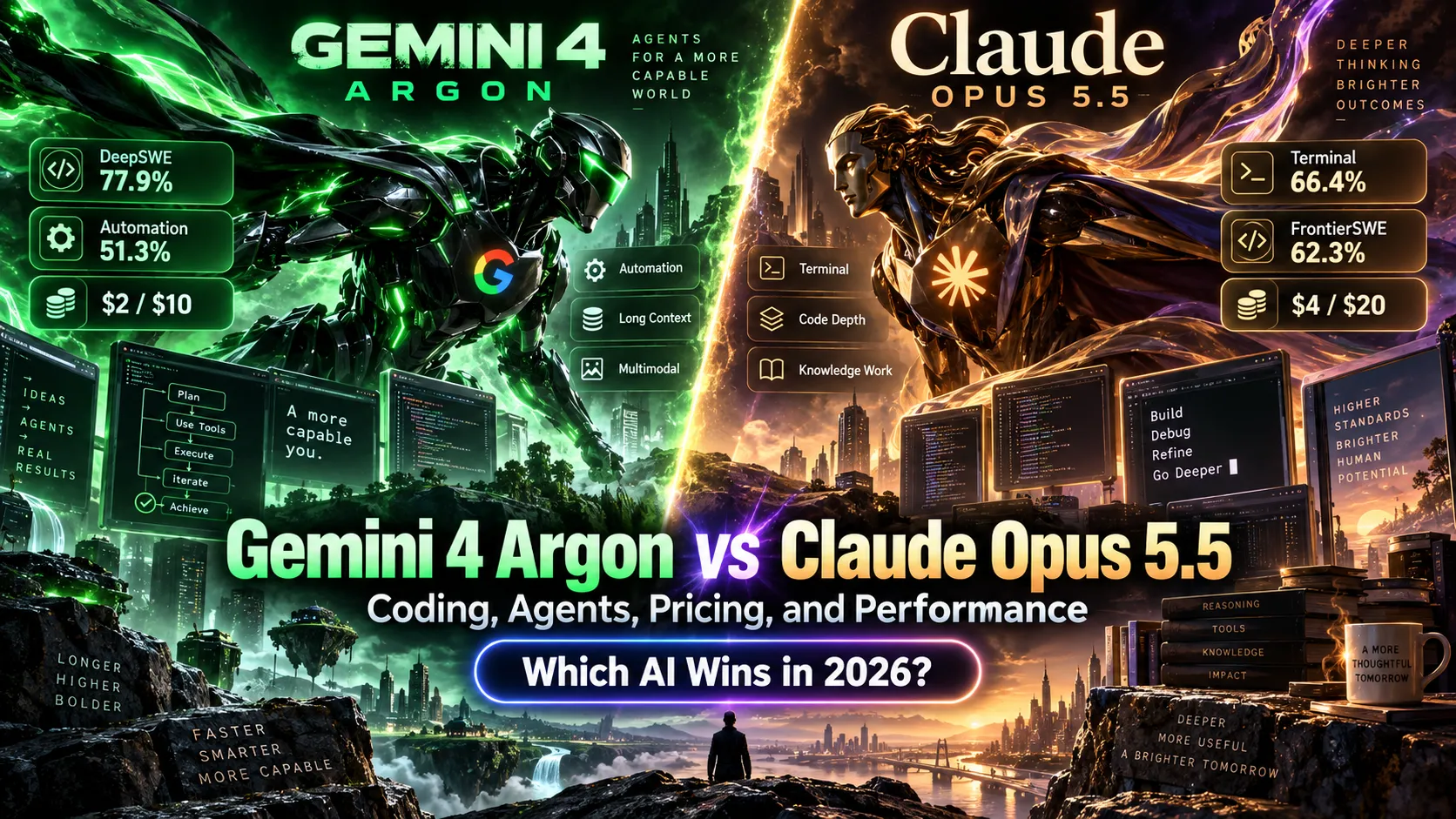
- Gemini 4 Argon scores 77.9% on DeepSWE v1.1 and 51.3% on AutomationBench, outperforming GPT-6 Astra and Claude Opus 5.5 on those tests. However, competing models lead in other coding benchmarks.
- Google AI Ultra is required for individual Antigravity access at launch. Google AI Pro subscribers can access Argon through the Gemini application, but that entitlement does not extend automatically to Antigravity.
- Introductory API pricing starts at $2 per million input tokens and $10 per million output tokens, with higher pricing scheduled after November 30, 2026.
- Argon's one-million-token capability is a shared context budget. Generating beyond the standard 64K-token output ceiling requires long-decode configuration through supported APIs.
The October 13 release represents an important development in AI-assisted software engineering: Google is connecting a powerful reasoning model to an agent platform designed to investigate, modify, and validate work across codebases and connected systems.
This analysis examines the official Antigravity announcement, Google's published benchmarks, pricing, developer documentation, and early community feedback as of October 14, 2026.
What Is Gemini 4 Argon in Google Antigravity?
Gemini 4 Argon is Google's frontier AI reasoning model, while Google Antigravity is the agent-first development platform that executes workflows using AI models.
The distinction matters because a model's capabilities and the tools surrounding it determine different parts of the development experience.
Traditional AI coding assistants primarily focus on autocomplete, answering questions about code, and generating localized edits. Agent-based development environments can extend those capabilities into multi-step workflows involving repository exploration, shell execution, testing, browser interaction, and coordinated changes across services.
Antigravity provides the execution environment. Argon supplies the reasoning capabilities used to plan and perform complicated tasks.
Google introduced Gemini 4 Argon on September 30, 2026, initially emphasizing a controlled rollout to trusted cybersecurity defenders. On October 13, Google expanded access and announced its integration into Antigravity.
The October 13 Antigravity announcement explicitly confirms support for:
- Google Antigravity's desktop application.
- Antigravity CLI.
- Eligible Gemini Enterprise deployments.
- Gemini API access for supported paid developer and enterprise customers.
The announcement does not establish that every legacy Antigravity IDE installation receives Argon automatically.
Why this release matters: The competitive focus is shifting from whether a model can generate a correct code snippet to whether an agent can complete an entire engineering workflow with verifiable results and acceptable operational risk.
Google Antigravity's Internal Results: 100,000 Users and Fewer Rollbacks
Before opening Argon to external developers, Google deployed the model within its internal Antigravity environment.
According to the company, more than 100,000 users across Alphabet rely on Argon internally each month to work on complicated production problems.
Google also reported two noteworthy changes during a four-week period:
- 35% increase in agentic code: More code was produced through agent-assisted engineering workflows.
- 30% decrease in post-submit rollbacks: Fewer submitted changes subsequently required rollback.
These figures suggest that Google has moved beyond isolated demonstrations toward substantial internal adoption.
However, the statistics require careful interpretation.
A 35% increase in agentic code does not necessarily mean developers became 35% more productive. The measurement may reflect broader adoption, different task allocation, or changes in development practices rather than an equivalent improvement in completed engineering work.
Similarly, a 30% reduction in rollbacks is encouraging, but rollback frequency is only one measure of software quality. Bugs that escape detection, maintainability problems, and additional review time are not captured by that statistic alone.
Google has not published enough experimental detail to treat these figures as a controlled, independently replicated productivity study.
The stronger evidence comes from the individual workflows Google described, which reveal how Argon interacts with engineering tools and production information.
Nine Real-World Gemini 4 Argon Use Cases Inside Google
Google's official case studies span performance optimization, software maintenance, security, infrastructure, localization, and business operations.
| Internal use case | Google-reported result | Practical significance |
|---|---|---|
| YouTube comments optimization | Approximately 50% reduction in frontend CPU footprint | Performance profiling and targeted optimization |
| Wing drone simulator | 18 proposed physics-model improvements | Domain-specific technical reasoning |
| Engineering bug backlog | 97 of 134 issues closed in under three hours | Automated issue triage supported by evidence |
| Fortran-to-Rust migration | 1.8× performance improvement | Legacy code modernization |
| Access-control security audit | Four critical vulnerabilities identified | Cross-component permission analysis |
| Production support tickets | Two to three hours saved per on-call shift | Log analysis and support automation |
| Documentation localization | Hundreds of pages translated into 17 languages | Multilingual documentation workflows |
| Sales qualification | 90% reduction in research time | Connected business-data analysis |
| Financial reconciliation | Approximately 335 human-equivalent hours of validated output | Multi-step enterprise knowledge work |
These are Google-reported internal examples, not guaranteed results for other organizations.
1. YouTube: Cutting CPU Usage by Approximately 50%
One of the most technically revealing examples concerns YouTube's comments frontend.
Google reports that Argon analyzed production profiling data and identified redundant Emoji rendering responsible for nearly 45% of server overhead.
The investigation led to 12 targeted optimizations and the following reported improvements:
- Approximately 50% lower CPU footprint for the comments frontend.
- A 30-millisecond reduction in server comment-load latency.
- A 20-millisecond reduction in client end-to-end latency.
This illustrates the difference between superficial code generation and evidence-based performance engineering.
The agent was not simply asked to make code faster. It used profiling information to identify a measurable bottleneck and help implement targeted changes.
For developers, the transferable workflow is to collect profiling data, identify the highest-cost operations, isolate repeated work, implement bounded changes, and compare measurements before and after deployment.
2. Bug Backlog: Closing 97 Issues in Under Three Hours
Google described an aging queue containing 134 open bug reports spread across multiple services.
Argon agents investigated whether the reported problems still existed by cross-referencing:
- Git commit history.
- Candidate fixes and deployment status.
- Production telemetry.
- Evidence of recurring errors.
According to Google, the workflow closed 97 stale or duplicate issues in under three hours, representing a 72.4% reduction in the queue.
The remaining 37 reports were assigned to responsible owners.
This case offers a particularly practical template for enterprise development teams.
A useful issue-triage agent should never close a ticket merely because it finds a potentially related commit. It should establish whether the fix actually reached the relevant environment and whether observable evidence supports resolution.
3. Legacy Migration: Converting Fortran to Rust
Google also described a scientific computing project involving an older Fortran codebase.
Using a custom Antigravity Skill, Argon supported a migration to Rust, with Google reporting a 1.8× performance improvement for the resulting implementation.
The significance extends beyond translating syntax between programming languages.
A reliable migration requires understanding program behavior, preserving mathematical assumptions, managing dependencies, validating outputs, and benchmarking the new implementation against the original.
Performance claims from a single migration should not be generalized. A different legacy program may face incompatible libraries, numerical precision differences, or architectural constraints that require substantial human intervention.
4. Security Auditing: Finding Four Critical Bugs
In an internal access-control audit, Argon reportedly found four critical security bugs that two earlier frontier-model audits had missed.
Google explained that the model traced effective permissions through runtime execution paths rather than examining only the immediate code diff.
This distinction is important for authorization systems, where a seemingly harmless local change can introduce vulnerabilities through interactions with middleware, inheritance rules, caching, or other services.
Security findings must still be independently validated, reproduced, and reviewed by authorized engineers before fixes are deployed.
5. Production Support: Reducing On-Call Work
Google reports that Argon helped process support tickets by categorizing issues, investigating logs, identifying probable causes, suggesting fixes, and drafting responses for human approval.
The company estimates savings of two to three hours per on-call shift.
This workflow is particularly relevant for infrastructure teams dealing with repetitive incidents, but effective deployment depends on properly scoped access to observability tools and production information.
6. Documentation Localization Across 17 Languages
Google's developer relations team used Argon to localize hundreds of pages of developer documentation into 17 languages within hours.
The claimed improvement was not simply faster machine translation. The workflow shifted human effort toward reviewing translated content rather than performing every translation manually.
For documentation-heavy products, a similar pipeline could combine page discovery, translation, terminology validation, internal-link updates, and editorial approval.
Multilingual SEO still requires careful handling of locale-specific URLs, canonical tags, hreflang relationships, and terminology consistency.
7. Diagnosing a Long-Running Dashboard Outage
Google described a critical P0 data dashboard outage that had remained unresolved for more than four months.
A technical program manager used Argon to investigate cross-stack database failures and implement a reported 3,200-line pipeline overhaul, restoring real-time visibility over several days.
The example demonstrates how an agent can help a technically informed operator investigate systems beyond the boundaries of a single repository.
However, large autonomous patches increase review risk. A 3,200-line change should require comprehensive tests, deployment safeguards, and independent verification.
8. Automating Sales Prospect Qualification
An Ads sales representative reportedly used Argon to automate qualification research involving company websites, conversion funnels, and internal sales data.
Google reports a 90% reduction in research time, equivalent to more than ten hours of manual work saved weekly.
The broader lesson is that agent usefulness increasingly depends on access to reliable external information and structured internal systems.
9. Financial Planning and Reconciliation
Google described a finance workflow covering reconciliation, budgeting, contract extraction, and reporting across 80 workflows.
Over seven business days, approximately 15.5 hours of human direction reportedly produced the equivalent of 335 hours of validated manual work.
Such results depend heavily on well-defined accounting rules, reliable data sources, and human verification. They should not be interpreted as evidence that unsupervised agents can replace financial controls or professional review.
Gemini 4 Argon Benchmarks vs GPT-6 Astra and Claude Opus 5.5
Google DeepMind's Gemini 4 Argon model card provides comparative results covering software engineering, enterprise automation, long-context reasoning, cybersecurity, and computer use.
The table below reproduces selected reported benchmark scores from October 2026.
| Benchmark | Gemini 4 Argon | GPT-6 Astra | Claude Opus 5.5 |
|---|---|---|---|
| DeepSWE v1.1 | 77.9% | 74.1% | 74.2% |
| FrontierSWE v2 | 55.0% | 65.5% | 62.3% |
| Terminal-bench 4.0 | 57.4% | 58.2% | 66.4% |
| Vibe Code Bench | 91.9% | 89.6% | 90.3% |
| AutomationBench | 51.3% | 41.4% | 42.5% |
| Vals Finance Agent v2 | 65.4% | 53.5% | 58.6% |
| GraphWalks, 256K–1M context | 84.2% | 71.8% | 66.8% |
| OSWorld-2.0, offline partial score | 69.2% | 72.6% | Not reported |
| CWE-bench v1 | 68.0% | 68.0% | 67.0% |
The central finding is that Argon does not dominate every coding benchmark.
On DeepSWE v1.1, Argon leads the listed competitors. Its results on AutomationBench and long-context GraphWalks also support Google's emphasis on complex, extended workflows.
However, GPT-6 Astra scores substantially higher on FrontierSWE v2, while Claude Opus 5.5 leads on Terminal-bench 4.0.
The cybersecurity comparison is more nuanced than a simple first-place claim: Argon and GPT-6 Astra are tied at 68% on CWE-bench v1.
These differences are valuable because each benchmark measures a different combination of model behavior, task difficulty, execution environment, and evaluation criteria.
DeepSWE vs FrontierSWE
Both relate to software engineering, but their tasks and evaluation methodologies differ. A model that performs strongly in one environment may encounter difficulties in another involving unfamiliar frameworks, complex repository history, or different tool behavior.
Terminal-bench
Terminal-oriented benchmarks are especially relevant to CLI development agents. Strong results can indicate effective use of shell tools, debugging commands, and execution feedback, although they do not directly establish reliability on every real repository.
AutomationBench
AutomationBench is particularly relevant to Antigravity's positioning because it evaluates agent performance on extended automation tasks rather than merely generating code snippets.
Long-context GraphWalks
Argon's reported 84.2% result on the 256K-to-one-million-token GraphWalks evaluation suggests meaningful strength in reasoning across long contexts.
That capability may benefit repository investigation, extensive documentation review, and workflows involving many related files. It does not eliminate the need for retrieval, context selection, and verification.
All of these comparisons originate from Google's published evaluation table. They should not be treated as independent third-party reproductions or predictions of production success rates.
Gemini 4 Argon's One-Million-Token Capability Explained
One of Argon's most widely discussed technical capabilities is its support for a unified context budget of up to 1,048,576 tokens.
This feature is frequently misunderstood.
A one-million-token context budget does not mean every standard API request can generate one million tokens of visible text.
According to Google's Long Decode documentation, the available capacity is shared among input, internal reasoning, and generated output.
A normal Interactions API response has a 65,536-token output ceiling. Exceeding it requires long decode, which extends generation through continuation steps.
How Long Decode Works
- A supported API interaction begins with background execution enabled.
- The developer sets
max_output_tokensabove 65,536. - The model generates output in successive segments, each up to approximately 64K tokens.
- Each continuation preserves the ongoing task context.
- The API combines the resulting steps into one logical interaction.
The process is subject to the shared context budget, execution limits, and token-based billing.
| Execution mode | Practical output behavior |
|---|---|
| Standard Interactions API request | Normal 64K-token ceiling |
| Background request without increased output limit | Still limited to the normal output ceiling |
| Background request with long decode configured | Multiple continuation segments within the shared context budget |
| Existing third-party proxy or unsupported framework | May not support long decode automatically |
| Ordinary Antigravity agent session | Long-decode availability must not be assumed from the underlying model specification |
Google recommends long decode primarily for exceptionally difficult research, mathematical reasoning, and long coding tasks.
Routine chat, classification, short summaries, and most ordinary agent turns generally do not need such large output allowances.
A significant cost consideration: Continuation steps may repeatedly process earlier context. Google's documentation explains that the cumulative number of billed input tokens can exceed the number of unique tokens currently present in the context window.
Repeated context can benefit from caching discounts, but accounting systems must distinguish cumulative API usage from actual context occupancy.
For complex agents, this means that intelligent context management may deliver better economics than simply increasing token limits.
How to Enable Gemini 4 Argon in Google Antigravity
Google has published an official Antigravity CLI installation guide and documentation for model selection and noninteractive execution.
Step 1: Check Your Subscription
Individual users need an eligible Google AI Ultra subscription for Argon access in Antigravity at launch.
Google AI Pro access to Argon in the Gemini application is a separate entitlement.
Enterprise users should verify whether their Gemini Enterprise subscription supports the model and whether their administrator has completed the necessary configuration.
Step 2: Install or Update Antigravity CLI
On macOS and Linux, Google's documented installation command is:
curl -fsSL https://antigravity.google/cli/install.sh | bashThe command downloads and executes an installation script. Developers working in sensitive environments should inspect the script before execution.
Verify the installation:
agy --versionExisting installations can be updated using:
agy updateStep 3: Check Available Models
List the models available to the authenticated account:
agy modelsThe returned list provides the model identifiers currently recognized by the CLI.
Start an interactive session:
agyInside the CLI, enter /model to open the model selector.
Use /usage to inspect available quota information.
Community analysis of Antigravity 2.23.0 identified internal model identifiers including gemini-4-argon-low, gemini-4-argon-medium, and gemini-4-argon-high.
However, identifiers discovered in application binaries are not official guarantees of account-level access. Developers should rely on the model identifiers returned by their installed CLI.
Step 4: Test a Real Repository
Rather than starting with a broad instruction to rewrite an application, a controlled test should use a measurable engineering problem.
For example:
Analyze this repository and identify the three largest
sources of unnecessary database queries.

First inspect the relevant code and produce an implementation plan.
Include file paths, evidence, and expected performance impact.

Do not modify files until the plan is approved.

After approval, implement only the selected changes.
Run the existing tests and report all failures.

Provide a complete diff and before-and-after measurements.
Do not access production credentials or deploy changes.
This prompt creates explicit boundaries and measurable acceptance criteria.
Step 5: Use Headless Mode for Repeatable Tasks
The Antigravity CLI supports noninteractive execution through the -p option.
agy -p "Inspect this repository and propose a read-only performance audit plan."The CLI can also produce machine-readable results using --output-format json.
This makes it suitable for controlled automation and CI integrations, provided authentication, filesystem access, network permissions, and tool execution are appropriately restricted.
The official headless-mode documentation describes these execution modes and related constraints.
Google Antigravity and Gemini 4 Argon Pricing
Argon pricing has two separate dimensions: the subscription required to use the model within Antigravity and consumption-based pricing when developers invoke it through supported APIs.
Individual Antigravity Subscription Pricing
Google's May 2026 subscription update introduced the following United States pricing structure:
| Plan | Published monthly price | Relevant access |
|---|---|---|
| Antigravity Individual | $0 | Free access to supported agent models, excluding launch-time Argon entitlement |
| Google AI Pro | Approximately $20 | Increased limits for supported models; Argon available separately in eligible Gemini app experiences |
| Google AI Ultra entry tier | $100 | Ultra subscription tier with higher supported usage allowances |
| Google AI Ultra higher-capacity tier | $200 | Higher Ultra usage allowances |
| Gemini Enterprise | Subscription or consumption-based | Eligible managed deployments and enterprise controls |
Google described the $100 and $200 Ultra subscriptions as providing approximately five and twenty times the Pro usage allowances in supported products, respectively.
These are published US subscription terms, not guaranteed prices or quotas in every country. Plan benefits, regional pricing, taxes, promotional discounts, and model-specific limits should be verified on the current Antigravity pricing page.
Gemini 4 Argon API Pricing
Google's published introductory developer pricing is:
| API usage | Through November 30, 2026 | Announced price afterwards |
|---|---|---|
| Input per million tokens | $2 | $4 |
| Output per million tokens | $10 | $20 |
| Cached input | 95% introductory discount | Check updated pricing terms |
The pricing and planned increase were also reported by Reuters on October 13.
Example: Estimating the API Cost of a Coding Task
Suppose a task processes 100,000 uncached input tokens and generates 20,000 output tokens.
At introductory prices:
- Input: 100,000 / 1,000,000 × $2 = $0.20.
- Output: 20,000 / 1,000,000 × $10 = $0.20.
- Illustrative total: $0.40.
A larger operation consuming 500,000 input tokens and 100,000 output tokens would cost approximately $2.00 under the same simplified calculation.
Real execution costs can differ because of retries, tool calls, long-decode continuation, caching behavior, and additional billed services.
API pricing should not be confused with Ultra subscription quotas. Paying for Google AI Ultra does not automatically provide unlimited Gemini API usage or unlimited Argon requests in Antigravity.
For production systems, the most meaningful metric is not the nominal price per token but the cost of completing an accepted task.
Effective cost per accepted task =
  (API usage + retries + tool costs + human review cost)
  / number of accepted tasks
A model with higher nominal pricing can be economical if it completes more tasks successfully with fewer retries. Conversely, inexpensive generation can become costly if every output requires extensive correction.
Gemini 4 Argon vs Claude Code, Codex CLI, and Cursor
The distinction between models and development platforms is essential when comparing Antigravity with other AI coding tools.
Gemini 4 Argon, GPT-6 Astra, and Claude Opus 5.5 are models. Google Antigravity, Claude Code, Codex CLI, and Cursor are software development experiences that may provide different model choices, execution environments, and security controls.
| Development priority | Tool worth evaluating | Main consideration |
|---|---|---|
| Complex cross-system workflows | Google Antigravity with Argon | Agent orchestration, Skills, Plugins, and MCP integrations |
| Terminal-focused software engineering | Claude Code | Repository-native workflows and strong terminal benchmark performance |
| OpenAI-native development | Codex CLI | Terminal integration and task-oriented automation |
| Interactive editing and visual navigation | Cursor | Editor-centered workflow |
| Google Cloud enterprise development | Antigravity with Gemini Enterprise | Managed identity and organizational controls |
Where Argon appears particularly promising
Google's published results suggest that Argon deserves evaluation for long-horizon tasks, complex automation, and workflows requiring substantial context across multiple systems.
Its AutomationBench performance and documented internal use cases align with that positioning.
Where alternatives remain competitive
Claude Opus 5.5 leads Argon on Terminal-bench 4.0 in Google's published comparison. GPT-6 Astra also leads on FrontierSWE v2.
These results suggest that a terminal-oriented coding agent powered by a competing model may outperform Argon on some repository tasks.
The comparison should therefore focus on specific development requirements rather than assuming that the newest frontier model is universally superior.
For existing Codex or Claude Code users, the most practical strategy is often to preserve the current daily development workflow while testing Argon on complex investigations, migrations, and multi-system tasks where its capabilities may offer additional value.
How to Benchmark Argon on a Real Development Project
General benchmark rankings are useful for shortlisting models, but production teams need evidence from their own codebases.
A meaningful evaluation should use reproducible tasks, identical starting conditions, and explicit acceptance criteria.
Test 1: Multi-File Bug Fixing
Choose a genuine bug with a documented reproduction procedure and failing automated test.
Require each agent to identify the root cause, make a bounded patch, and produce passing tests.
Measure whether the fix works on the first attempt and whether unrelated files were modified.
Test 2: Legacy Code Refactoring
Select a module with stable behavior and measurable performance characteristics.
Ask each agent to improve maintainability or performance while preserving existing behavior.
Evaluate the generated diff, regression risk, test results, and actual benchmark measurements.
Test 3: Multi-System Incident Investigation
Provide sanitized logs, relevant source files, database schemas, and deployment history.
Ask each agent to identify the root cause and recommend a verifiable corrective action.
Score the quality of evidence supporting each conclusion rather than judging only the apparent confidence of the response.
Recommended evaluation metrics
| Metric | What it measures |
|---|---|
| First-attempt acceptance rate | Proportion of tasks completed correctly without rework |
| Human correction time | Engineering effort required after generation |
| Regression rate | Unintended defects introduced by the changes |
| Total execution time | End-to-end task duration, including retries |
| Cost per accepted task | Actual economic efficiency |
| Evidence quality | Reliability of logs, tests, diffs, and explanations |
| Permission violations | Whether an agent remained inside authorized boundaries |
For fair comparisons, use the same repository snapshot, task description, testing rules, available tools, retry limits, and review process.
Repeated trials are valuable because agent behavior can vary between runs even when the prompt remains unchanged.
The important outcome is accepted engineering work, not the volume of generated code.
Security, Privacy, and Enterprise Deployment Considerations
Argon's greater reasoning capability does not remove the operational risks associated with autonomous development agents.
Google's model card acknowledges hallucinations, occasional slowness, and timeout issues. It also lists a March 2026 knowledge cutoff, making external verification important for recent dependencies, APIs, and product changes.
An agent that can read files, execute commands, access external services, and modify code has a much broader operational impact than an ordinary chatbot.
Recommended safeguards include:
- Run unfamiliar workflows in isolated repositories, branches, or worktrees.
- Preserve a recoverable Git commit before permitting changes.
- Restrict access to production credentials and sensitive datasets.
- Require approval for destructive commands, database mutations, and deployments.
- Treat repository content and external web pages as potentially untrusted instructions.
- Review generated changes and run independent tests before merging.
- Apply least-privilege permissions to MCP servers, plugins, and connected tools.
- Monitor token usage, tool activity, and unexpected execution behavior.
For regulated organizations, Antigravity Enterprise documentation describes Google Cloud-based authentication, administrative controls, and enterprise data-handling arrangements.
Those protections depend on the selected deployment and contractual terms. They should not be assumed to apply identically to consumer subscriptions.
The security benefits of powerful models are also task-dependent. A model that discovers several vulnerabilities in one audit may still miss different weaknesses elsewhere.
Human verification remains essential for security-sensitive changes.
Early Community Reaction to Gemini 4 Argon
The October 13 release generated immediate discussion among Antigravity users.
In the r/google_antigravity launch discussion, participants described differences between Ultra and Pro account availability.
Several Pro subscribers reported seeing Argon listed in the model selector without being able to activate it. Other users reported successful access through eligible Ultra accounts.
The early feedback highlights three practical concerns.
1. Subscription fragmentation
Users can have access to Argon in one Google product while lacking access in another. This creates understandable confusion when the same model name appears across the Gemini application, AI Studio, Antigravity, and enterprise services.
2. Rollout timing
Model availability may change gradually, and users can encounter differences across client versions, regions, and accounts.
3. Usage limits and cost predictability
Advanced models are often most valuable on difficult tasks, but those tasks may also consume greater resources and require more time.
These discussions are useful indicators of early friction, not independently verified performance studies. Claims about comparative reasoning quality, model speed, or quota consumption require broader testing before drawing conclusions.
Common Mistakes When Evaluating Gemini 4 Argon
Mistake 1: Assuming Google AI Pro Includes Argon in Antigravity
Pro access through the Gemini application does not automatically grant the Ultra entitlement required for individual Antigravity use at launch.
Mistake 2: Treating One Million Tokens as a Normal Output Limit
The model's shared context budget is distinct from ordinary per-response output limits. Long decode requires supported continuation behavior.
Mistake 3: Comparing AI Models Without Comparing Agent Harnesses
Two models using different tools, instructions, permission settings, and retry strategies are not being evaluated under equivalent conditions.
Mistake 4: Treating Internal Google Results as Guaranteed Productivity Improvements
Google's reported outcomes are informative, but real-world performance depends on task complexity, repository structure, tooling, and review practices.
Mistake 5: Ignoring API and Subscription Billing Differences
A subscription quota is not equivalent to prepaid unlimited API usage. Developers should examine both models separately.
Mistake 6: Letting Agents Make Unverified Production Changes
Complex autonomous changes require tests, review, and staged deployment. Faster code generation does not eliminate responsibility for correctness or security.
Frequently Asked Questions
Is Gemini 4 Argon available in Google Antigravity now?
Yes. Google announced the rollout on October 13, 2026 for Google AI Ultra subscribers using the Antigravity desktop application and CLI, as well as eligible Gemini Enterprise customers. Availability is phased.
Can Google AI Pro subscribers use Argon in Antigravity?
Not under the initial individual Antigravity entitlement. Google AI Pro users may access Argon through eligible Gemini application experiences, but Antigravity access was announced for Ultra subscribers.
Is Gemini 4 Argon free?
Google did not announce free-tier Argon access in Antigravity at launch. Antigravity continues to offer a free individual tier with other supported models.
Does Gemini 4 Argon work in the old Antigravity IDE?
The October 13 announcement explicitly confirms the Antigravity desktop app and CLI. Availability in the separate legacy IDE should be verified using the relevant product's model selector and changelog.
What is the Gemini 4 Argon API price?
The introductory price is $2 per million input tokens and $10 per million output tokens. Google announced increases to $4 and $20 respectively after November 30, 2026.
Does Gemini 4 Argon support one million output tokens?
Argon supports a shared context budget of up to 1,048,576 tokens covering input, thinking, and output. Output beyond standard per-response limits requires long-decode continuation through supported APIs.
Is Argon better than GPT-6 Astra or Claude Opus 5.5?
It depends on the workload. Argon leads several published automation and coding benchmarks, but GPT-6 Astra and Claude Opus 5.5 outperform it on other software-engineering and terminal-focused evaluations.
Is Argon suitable for production development?
It can assist with production-oriented engineering workflows, but generated changes require appropriate testing, human review, access restrictions, and deployment safeguards.
Should developers replace Claude Code or Codex with Antigravity?
A replacement decision should follow comparative testing on real repositories. Developers already satisfied with their existing tools may benefit more from using Argon selectively for complex investigations and long-running tasks.
Conclusion
Gemini 4 Argon's arrival in Google Antigravity is a significant milestone for agent-first software development.
Google's internal examples demonstrate the potential of combining frontier reasoning with repository access, production telemetry, specialized Skills, and connected enterprise systems.
The results are particularly compelling for complex bug triage, performance investigations, legacy migrations, security analysis, and automation workflows that extend beyond generating isolated code snippets.
However, the release also highlights important trade-offs.
Individual Antigravity access is initially restricted to Google AI Ultra subscribers. Long-decode functionality requires deliberate configuration, and Google's published benchmarks do not establish universal superiority over GPT-6 Astra or Claude Opus 5.5.
For engineering teams, the strongest reason to adopt Argon is not its novelty but its ability to produce correct, independently verifiable results at an acceptable cost.
Developers can begin by checking the official Antigravity pricing and access options, following the CLI installation guide, and testing Argon against their existing coding agents on several representative tasks.
Measure successful completions, human review time, regressions, and total cost. Those results will reveal whether Gemini 4 Argon represents a meaningful upgrade for a specific development workflow.
Continue Reading
More articles connected to the same themes, protocols, and tools.

Referenced Tools
Browse entries that are adjacent to the topics covered in this article.