On This Page8 sections
Key Takeaways
- GLM-5.3 Highspeed is a reported high-throughput serving option in Z.ai's GLM-5.3 family, not a separately documented new foundation model.
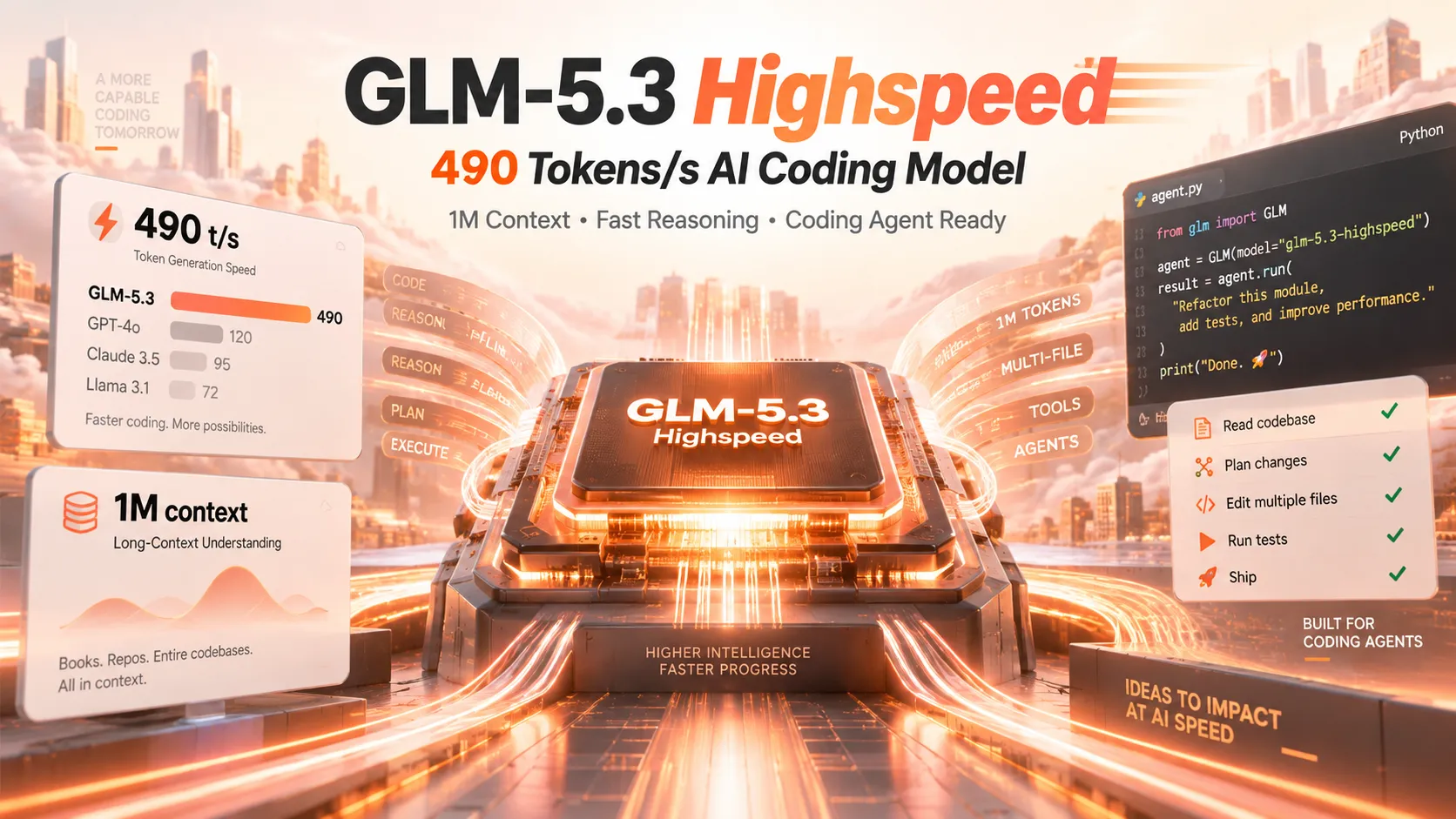
- An October 12, 2026 report described a 490 tokens/second observation from an early ZCode user. That is a community-reported result, not a guaranteed or independently reproduced throughput figure.
- Third-party model catalogs list
glm-5.3-highspeed, a 1,000,000-token context window, up to 131,072 output tokens, text input, andlow,high, andmaxreasoning efforts. Official Highspeed documentation has not independently confirmed all of these fields. - Highspeed appears to be undergoing limited access testing. General availability, eligibility by subscription tier, dedicated pricing, and production service guarantees remain unconfirmed.
- GLM-5.3 Highspeed and GLM-5.3-FlashX are distinct options. FlashX is a high-speed variant of the smaller, multimodal Flash family; Highspeed is associated with the flagship GLM-5.3 family.
- For coding agents, successful tasks per hour, P95 latency, and cost per completed task are more useful than headline tokens per second.
What Is GLM-5.3 Highspeed?
GLM-5.3 Highspeed, identified in model catalogs as glm-5.3-highspeed, is an emerging model-serving option associated with Z.ai (Zhipu AI). It is attracting attention because of a report that it generated text at 490 tokens per second (TPS) during an early user session.
On October 12, 2026, a QbitAI report reproduced by HSTong described access in ZCode 3.15.1 for selected users. The report attributed the speed observation to user @leo114119 and noted that other users could not necessarily enable the same model.
The identifier is also present in the Pi model catalog. However, a catalog entry does not itself prove that an API key is entitled to invoke a model. Entries can precede a rollout or remain after provider access changes.
Unlike a conventional model release, a high-speed serving option might use the same underlying weights with different infrastructure or inference optimizations. Z.ai has not publicly established whether Highspeed uses identical weights to standard GLM-5.3 or any specific acceleration technique. It should not be presented as a newly trained architecture without evidence.
GLM-5.3 Highspeed Specifications
The following information comes from developer-model catalog metadata and early availability reports, rather than a dedicated official Highspeed specification sheet.
| Field | Reported or cataloged value | Confidence |
|---|---|---|
| Model ID | glm-5.3-highspeed | Listed in third-party catalog |
| Provider | Z.ai / Zhipu AI | Listed in catalog |
| Model family | GLM-5.3 | Listed in catalog |
| Context window | 1,000,000 tokens | Cataloged, not independently verified for every account |
| Maximum output | 131,072 tokens | Cataloged |
| Input / output | Text / text | Cataloged |
| Reasoning effort | low, high, max | Cataloged |
| Tool calling | Supported | Cataloged |
| Structured outputs | Supported | Cataloged |
| Reported throughput | Up to 490 tokens/s | Single early user report |
| Full public availability | Not confirmed | Unannounced |
| Highspeed-specific price | Not confirmed | Unannounced |
A long context window may help an agent examine multiple source files, test output, product requirements, and prior interactions. It does not guarantee that a model will reliably retrieve every detail from an extremely long prompt. Real-world utility also depends on input processing time, context compaction, attention quality, and tool orchestration.
Release Timeline: From GLM-5.3 to Highspeed
| Date | Development | Evidence |
|---|---|---|
| August 14, 2026 | Standard GLM-5.3 announced | Official Z.ai release |
| September 2026 | Highspeed identifier appears in developer catalogs and discussions | Community/catalog evidence |
| September 15, 2026 | Pi users raise questions about which Coding Plan model IDs actually work | Pi issue discussion |
| October 12, 2026 | Media report describes ZCode 3.15.1 preview and 490 TPS observation | User report reproduced by media |
| General availability | No verified date | Pending official announcement |
The distinction between a visible model name and an authorized, working model is especially important during previews. Manually creating an entry in a coding client cannot bypass provider-side access controls.
How Fast Is 490 Tokens per Second?
If output decoding genuinely remains at 490 tokens/s, theoretical decode-only durations are:
| Output size | Theoretical generation time |
|---|---|
| 1,000 tokens | 2.0 seconds |
| 5,000 tokens | 10.2 seconds |
| 10,000 tokens | 20.4 seconds |
| 30,000 tokens | 61.2 seconds |
| 50,000 tokens | 102.0 seconds |
These numbers are calculations from the reported rate, not measured Highspeed end-to-end timings. They exclude initial network delay, queueing, prefill, tool execution, application overhead, and retries.
TTFT versus sustained throughput
Time to first token (TTFT) matters for short, interactive tasks. Sustained output throughput matters more for long generations. A server can have fast decoding but a slow TTFT, or produce a short burst at peak speed without sustaining that rate across a long response.
When a coding agent edits a repository, total duration can be represented conceptually as:
Total time = network + queue + prefill + decoding
           + tool executions + tests + retries
A coding model that generates code quickly but fails more often can finish later than a slower model that solves the task on the first attempt. Therefore, a speed comparison must report task accuracy alongside TPS.
Can the reported 490 TPS be independently verified?
Not yet from the publicly documented information. The original observation does not supply a comprehensive, repeated test protocol with prompt sizes, token accounting, reasoning settings, load conditions, and latency distributions. It is appropriate to say 'reported peak of 490 TPS', not 'guaranteed 490 TPS'.
GLM-5.3 Highspeed vs GLM-5.3, Flash, and FlashX
| Model | Intended positioning | Speed evidence | Official standard API input/output price per 1M tokens |
|---|---|---|---|
| GLM-5.3 | Flagship coding and reasoning | Workload-dependent | $1.40 / $4.40 |
| GLM-5.3 Highspeed | High-speed flagship-family serving option | 490 TPS early report | Not announced |
| GLM-5.3-Flash | Efficient, multimodal GLM variant | Workload-dependent | $0.15 / $0.50 |
| GLM-5.3-FlashX | Faster Flash serving option | Approximately 200 TPS advertised | $0.37 / $1.25 |
Published standard API prices are from Z.ai's pricing documentation. The Highspeed price has not been officially specified. A Coding Plan subscription is a different billing arrangement from pay-as-you-go API calls.
Is Highspeed simply FlashX with a different name?
No evidence supports that conclusion. The underlying flagship GLM-5.3 and the smaller GLM-5.3-Flash are distinct model families with different reported parameter scales and capability-cost trade-offs.
Standard GLM-5.3 uses a large mixture-of-experts architecture, with roughly 744B total parameters and 40B active parameters. GLM-5.3-Flash has roughly 320B total and 18B active parameters, according to vendor disclosures. Flash offers multimodal capabilities, while the cataloged Highspeed entry specifies text input.
The 490 TPS early report is approximately 2.45 times a 200 TPS headline figure, but that ratio does not establish that Highspeed is 2.45 times faster under matched conditions. Different prompts, hardware, server loads, token definitions, and measurement protocols can dramatically change observed throughput.
GLM-5.3 Benchmarks: What Can Be Inferred About Highspeed?
Z.ai has released evaluations for standard GLM-5.3, including improvements on coding and agent benchmarks. These results should not be copied into a Highspeed performance chart as though they were independently measured.
| Evaluation | GLM-5.2 | GLM-5.3 | What it evaluates |
|---|---|---|---|
| Terminal-Bench 3.0 | 4.6 | 28.3 | Terminal-based tasks |
| DeepSWE v1.1 | 46.2 | 66.9 | Extended software engineering |
| Agents' Last Exam | 23.8 | 28.5 | Agentic tool and reasoning tasks |
| CyberGym | 77.2 | 84.5 | Vulnerability-oriented tasks |
The figures are vendor-reported results from GLM-5.3 release materials, not independent Highspeed tests. Scores use different methodologies and should not be compared directly across benchmark rows.
Even if Highspeed shares the flagship model's weights, changes to serving configuration, reasoning settings, sampling behavior, and context handling may affect observed task success. Controlled equivalence tests remain necessary.
GLM-5.3 Highspeed Pricing and Coding Plan Access
There is no verified Highspeed-specific token price or credit multiplier as of October 12, 2026. Some third-party catalogs display $0 token pricing for subscription-based Coding Plan model entries. That should not be misinterpreted as a promise of unlimited free access.
The documented Z.ai Coding Plan currently includes the following credit allowances:
| Plan | Five-hour credits | Weekly credits |
|---|---|---|
| Lite | 2,000 | 10,000 |
| Pro | 12,000 | 60,000 |
| Max | 28,000 | 140,000 |
The documented regular GLM-5.3 credit multipliers are 6.9 for uncached input, 1.7 for cached input, and 24 for output, with lower off-peak rates specified by Z.ai. These values must not be assumed to apply to Highspeed until the provider confirms that they do.
For current allowances and eligibility, review the Z.ai Coding Plan documentation. Preview models can be restricted by account, client version, subscription tier, or provider-side flags.
How to Check GLM-5.3 Highspeed in ZCode
The October 12 report describes limited access through ZCode, Z.ai's coding-agent application.
- Install the latest ZCode build from its official distribution channel.
- Sign in with the appropriate Z.ai or BigModel account.
- Connect a supported Coding Plan subscription if required.
- Inspect the model selector and model-management screen.
- Look for an explicitly offered Highspeed model rather than assuming a custom identifier will work.
- Test a small, reversible coding task before attempting a large repository operation.
A model appearing in a user-configurable list is not sufficient proof of permission. The provider must authorize the request and return a response from the intended model.
If unavailable, use standard glm-5.3, which is documented in the broader GLM Coding Plan. Avoid repeatedly upgrading subscriptions solely on the assumption that an undocumented model will become available.
GLM-5.3 Highspeed API: Endpoint and Example
The Pi model directory associates Highspeed with the Z.ai Coding Plan endpoint:
https://api.z.ai/api/coding/paas/v4This differs from Z.ai's standard metered API base URL:
https://api.z.ai/api/paas/v4The mainland BigModel Coding Plan commonly uses https://open.bigmodel.cn/api/coding/paas/v4. These services have different entitlements and policies; do not assume that a model exposed by one endpoint is available through another.
Conditional access test with cURL
The following request tests the cataloged model identifier. It is an illustrative access test, not a universally verified Highspeed API example. It will fail if the key lacks permission or the server has not enabled the identifier.
export ZAI_API_KEY='YOUR_ZAI_API_KEY'

curl -sS 'https://api.z.ai/api/coding/paas/v4/chat/completions' \
  -H "Authorization: Bearer $ZAI_API_KEY" \
  -H 'Content-Type: application/json' \
  -d '{
    "model": "glm-5.3-highspeed",
    "messages": [
      {"role": "user", "content": "Write a typed TypeScript debounce function and tests."}
    ],
    "max_tokens": 2048,
    "thinking": {"type": "enabled"},
    "reasoning_effort": "low",
    "stream": false
  }'
The standard GLM-5.3 API documents enabled reasoning and effort controls. Support for those exact parameters on the Highspeed preview is subject to the deployed tool schema.
Typical errors
- Model not found: The identifier is not recognized on the chosen endpoint, or the account is not authorized.
- Permission denied: The account, plan, region, or preview flag does not allow access.
- Rate or quota exceeded: The subscription or API allowance has been reached.
- Invalid parameter: The endpoint or model does not accept the submitted parameter structure.
- Unexpectedly slow generation: Queue time, long prefill, reasoning output, or load may dominate total latency.
For production services, use a properly licensed metered API rather than assuming a Coding Plan can serve arbitrary public applications. Follow Z.ai's current usage policies.
Can GLM-5.3 Highspeed Work with Claude Code, OpenCode, and Codex?
The wider GLM Coding Plan ecosystem provides integrations for coding clients such as Claude Code, OpenCode, and Codex. That does not prove that each client supports Highspeed or that every subscriber is entitled to use it.
A practical setup sequence is to first connect the documented standard GLM-5.3 model, verify authentication and tool calling, then check whether Highspeed is exposed by the provider. Ensure the client uses the appropriate protocol: a Chat Completions-compatible endpoint should not automatically be substituted for a client requiring a different API protocol.
When benchmarking, record the exact model identifier sent and confirm the provider's returned model metadata when available. Otherwise a fallback or alias could invalidate the claimed Highspeed result.
Best Real-World Tests for AI Coding Agents
Highspeed could be useful for operations that repeatedly generate substantial code or explanations, including:
- React and TypeScript feature work: Generate components, integrate existing utilities, and repair type errors.
- Large-repository refactoring: Update interfaces consistently across many files.
- Terminal-driven development: Diagnose failures and propose corrective commands.
- Test-driven agents: Write implementations, run tests, interpret failures, and iterate.
- Long-context code review: Review interdependent files, although large-prompt latency must be measured separately.
A reliable benchmark should compare standard GLM-5.3 with Highspeed under equivalent prompts and tool permissions. Repeat each test at least five times and collect TTFT, median and P95 latency, sustained output TPS, successful task completions, tool calls, retries, and total cost.
An especially useful operational metric is:
Successful tasks per hour = completed correct tasks / elapsed hoursA second is cost per successful task, which accounts for repeated attempts and failed runs. Together, these provide more useful evidence than a single peak TPS screenshot.
Is GLM-5.3 Highspeed a New Architecture or a Self-Hosted Model?
Z.ai has not published a distinct Highspeed model card explaining its weights, architecture, training procedure, or accelerator configuration. Techniques such as optimized kernels, scheduling, speculative decoding, and parallel serving could theoretically improve throughput, but none should be asserted as Highspeed's confirmed implementation.
The standard GLM-5.3 weights are available for developers to inspect and deploy under the applicable model license. However, those weights do not automatically reproduce the performance of a proprietary high-speed serving tier. Running a very large MoE model also requires substantial accelerator resources and careful inference-engine configuration.
There is no verified independent GLM-5.3-Highspeed downloadable checkpoint as of this article's publication date.
Is GLM-5.3 Highspeed the Same as Omen Alpha?
Some community discussions have speculated about a relationship between Highspeed and anonymous coding-model tests such as Omen Alpha. No verified disclosure establishes that they are the same model. Similarity in response style or speed is insufficient to prove shared weights or provider identity.
Model-directory pages and media summaries should not convert anonymous-model theories into factual model specifications.
Frequently Asked Questions
Is GLM-5.3 Highspeed publicly available?
A limited ZCode preview was reported on October 12, 2026. General availability and universal API access have not been confirmed.
Does GLM-5.3 Highspeed really generate 490 tokens per second?
An early user observation reported 490 TPS. Sustained throughput, standardized test conditions, and independent replication remain unverified.
What is the GLM-5.3 Highspeed model ID?
The third-party catalog identifier is glm-5.3-highspeed. Actual invocation depends on provider authorization.
Does Highspeed have a 1M-token context window?
The Pi model catalog lists 1,000,000 context tokens and up to 131,072 output tokens. These figures are not yet backed by a dedicated public Highspeed specification.
How much does GLM-5.3 Highspeed cost?
No separate official per-token price or subscription credit multiplier has been published. Zero-dollar catalog entries for subscription offerings are not proof of unlimited free usage.
Does GLM-5.3 Highspeed support images?
The currently cataloged configuration lists text input. Multimodal support should not be assumed; GLM-5.3-Flash and FlashX are documented alternatives for multimodal tasks.
Is it more intelligent than GLM-5.3?
There is no independent benchmark showing greater reasoning or coding accuracy. The distinguishing early claim concerns serving speed.
Can it be downloaded and hosted locally?
Standard GLM-5.3 weights are available, but no separate Highspeed checkpoint or reproducible high-speed deployment recipe has been confirmed.
When will it launch for everyone?
An official general-availability date has not been established as of October 12, 2026.
Conclusion
GLM-5.3 Highspeed is worth watching because a reported 490 tokens/s output rate could materially improve lengthy AI coding-agent workflows. A million-token cataloged context window and flagship-family positioning add to its potential appeal.
But the available evidence supports a cautious conclusion: early catalog and user-report visibility do not yet establish universal access, stable production throughput, equivalent flagship-model accuracy, or predictable pricing.
Developers should check ZCode and Z.ai's official documentation for updates, use standard GLM-5.3 as the documented fallback, and compare successful coding tasks per hour rather than relying only on peak tokens-per-second figures.
Continue Reading
More articles connected to the same themes, protocols, and tools.


Referenced Tools
Browse entries that are adjacent to the topics covered in this article.