On This Page8 sections
Key Takeaways
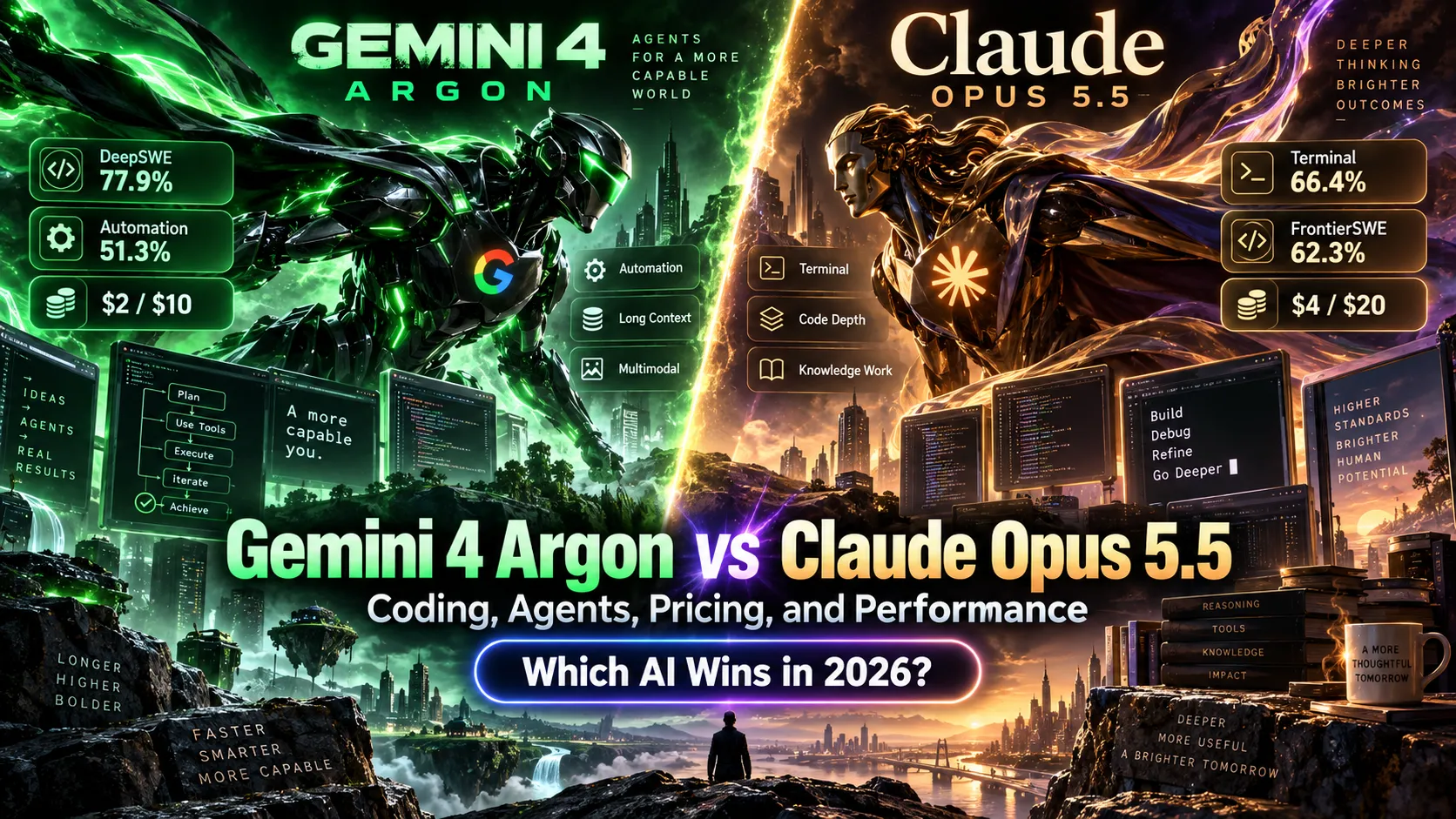
- Gemini 4 Argon wins several Google-reported software engineering and automation benchmarks, including DeepSWE v1.1 (77.9% vs 74.2%) and AutomationBench (51.3% vs 42.5%).
- Claude Opus 5.5 leads in terminal-intensive engineering tasks. It scores 66.4% on Terminal-Bench 4.0 against Argon's 57.4%, and 62.3% on FrontierSWE v2 against Argon's 55.0%.
- Independent evaluations also favor Opus 5.5 at maximum reasoning effort. Artificial Analysis reports an Intelligence Index of 58 for Opus 5.5 Max versus 53 for Gemini 4 Argon High. However, the difference narrows substantially when comparing both models at High settings.
- Gemini 4 Argon is 50% cheaper per standard API input and output token during its introductory period. It costs $2 per million input tokens and $10 per million output tokens, compared with $4 and $20 for Opus 5.5.
- Google's pricing advantage is temporary. Argon's announced standard rates increase to $4 input and $20 output on December 1, 2026, matching Opus 5.5's current published prices.
- Both models support approximately one million tokens of context. Argon offers long-decode continuation beyond its normal 64K output ceiling, while Opus 5.5 supports 128K output tokens in standard requests and up to 300K through a beta Batch API feature.
- Argon looks particularly promising for multi-step business automation, long-context reasoning, and multimodal research. Opus 5.5 remains highly competitive for terminal development, extensive codebase modifications, and professional knowledge work.
- The best choice depends on workload, reasoning settings, tools, and total task cost, not a single benchmark percentage.
Google's release of Gemini 4 Argon on October 13, 2026, created a direct challenge to Anthropic's Claude Opus 5.5, released on September 22.
Both models target demanding tasks that require reasoning, tool use, software engineering, and extended autonomous execution. However, their strengths, pricing models, and development environments differ in meaningful ways.
This comparison uses Google's Gemini 4 Argon model card, Anthropic's Claude Opus 5.5 announcement, official API documentation, and independent results from Artificial Analysis.
Last updated: October 14, 2026. Benchmark rankings and model availability may change as providers update their systems.
Gemini 4 Argon vs Claude Opus 5.5: Quick Comparison
| Feature | Gemini 4 Argon | Claude Opus 5.5 |
|---|---|---|
| Developer | Google DeepMind | Anthropic |
| Public release | October 13, 2026 | September 22, 2026 |
| Primary focus | Complex reasoning, automation, engineering, multimodal workflows | Agentic coding, knowledge work, long-running engineering tasks |
| Context capacity | 1,048,576 shared input, thinking, and output tokens | 1M-token context window |
| Standard output limit | 65,536 tokens through supported synchronous interfaces | 128K tokens |
| Extended generation | Long decode up to remaining unified context budget | Up to 300K output tokens through Batch API beta |
| API input price | $2 / 1M tokens, promotional | $4 / 1M tokens |
| API output price | $10 / 1M tokens, promotional | $20 / 1M tokens |
| API model ID | gemini-4-argon | claude-opus-5-5 |
| Reasoning controls | Low, medium, high | Low, medium, high, xhigh, max |
| Native model inputs | Text, images, audio, video, PDF | Text and images; PDF workflows supported through platform features |
| Primary coding environment | Google Antigravity | Claude Code |
| Independent Intelligence Index | 53, High configuration | 58, Max configuration |
| Model weights | Proprietary | Proprietary |
The most important distinction is that these models compete across several different dimensions rather than one universal measure of intelligence.
Argon's strengths in automation and long-context processing are substantial. Opus 5.5's strengths in terminal development and complex professional tasks are equally relevant.
The published results also reveal why evaluation settings matter: changing Opus 5.5 from Medium to Max effort can materially change benchmark outcomes, latency, and resource consumption.
Coding Benchmarks: Gemini 4 Argon vs Opus 5.5
Google DeepMind published detailed comparisons between Gemini 4 Argon, Claude Opus 5.5, GPT-6 Astra, and Claude Fable 5.1.
The following results are taken from Google's October 2026 model card.
| Coding benchmark | Gemini 4 Argon | Claude Opus 5.5 | Winner |
|---|---|---|---|
| DeepSWE v1.1 | 77.9% | 74.2% | Argon |
| FrontierSWE v2 | 55.0% | 62.3% | Opus 5.5 |
| Terminal-Bench 4.0 | 57.4% | 66.4% | Opus 5.5 |
| Vibe Code Bench | 91.9% | 90.3% | Argon |
| PostTrainBench | 45.3% | 49.3% | Opus 5.5 |
Result: Opus 5.5 wins three of these five coding-related evaluations, while Argon wins two.
However, counting benchmark wins is less informative than understanding what those benchmarks measure.
DeepSWE v1.1: Argon Leads by 3.7 Percentage Points
Gemini 4 Argon scores 77.9%, compared with 74.2% for Opus 5.5.
DeepSWE evaluates agentic software engineering capabilities. The result suggests Argon performs strongly on the benchmark's particular collection of implementation and repair tasks.
This is useful evidence for developers considering Argon for repository investigations, code changes, and multi-step engineering work.
It does not demonstrate that Argon is superior on every real-world codebase.
FrontierSWE v2: Opus Leads by 7.3 Points
Claude Opus 5.5 scores 62.3%, compared with Argon's 55.0%.
This is a substantial difference on an evaluation focused on complex software engineering problems.
A model's ability to understand unfamiliar code, identify dependencies, and produce changes that satisfy hidden requirements is often more valuable than generating large volumes of code quickly.
For developers maintaining established repositories, this result makes Opus 5.5 a strong candidate for difficult debugging and implementation tasks.
Terminal-Bench 4.0: Opus Leads by 9 Points
The terminal benchmark presents one of the clearest advantages for Claude Opus 5.5.
- Gemini 4 Argon: 57.4%.
- Claude Opus 5.5: 66.4%.
- Absolute difference: 9.0 percentage points.
Terminal-oriented evaluations measure whether AI agents can complete tasks involving command-line tools and execution feedback.
These skills matter because modern coding agents do much more than write source files. They install dependencies, inspect failures, run test suites, manage repositories, and coordinate multiple commands.
A coding agent that makes fewer incorrect assumptions or recovers more effectively from failed commands can deliver better results even when its raw generation speed is lower.
Vibe Code Bench: Argon Holds a Narrow Lead
Argon scores 91.9%, while Opus 5.5 scores 90.3%.
The 1.6-point difference favors Argon, although the margin is much smaller than the Terminal-Bench gap.
This supports Argon's position as a strong candidate for application generation and broader coding workflows. It is not enough to guarantee better frontend design, production architecture, or maintainability.
PostTrainBench: Opus Leads in ML Engineering
Opus 5.5 reaches 49.3%, compared with Argon's 45.3%.
For teams developing machine-learning infrastructure, evaluation pipelines, or model-training systems, this is another reason to consider Opus independently of general coding scores.
Coding verdict: Argon is competitive and wins important software engineering evaluations, but Opus 5.5 has stronger published results for terminal-intensive workflows and several difficult engineering benchmarks.
Independent Benchmarks: Artificial Analysis Gives Opus the Overall Lead
Vendor evaluations are informative, but independent benchmarking is essential for a more balanced comparison.
Artificial Analysis publishes a separate evaluation suite covering professional knowledge work, automation, software engineering, scientific reasoning, and long-context understanding.
Its October 2026 comparison provides a useful counterweight to the vendor-reported results.
Artificial Analysis: Argon High vs Opus 5.5 Max
| Independent evaluation | Gemini 4 Argon High | Opus 5.5 Max |
|---|---|---|
| Intelligence Index | 53 | 58 |
| AA-Briefcase v1.1 | 1488 | 1807 |
| GDPval-AA v2.1 | 1624 | 1866 |
| AutomationBench-AA | 78% | 70% |
| Terminal-Bench 4.0 | 57% | 60% |
| SciCode | 62% | 67% |
| Humanity's Last Exam | 57% | 61% |
| AA-LCR v1.1 | 80% | 85% |
These results are available through the Artificial Analysis direct comparison.
Opus 5.5 leads the overall independent Intelligence Index by five points at Max effort.
However, this comparison uses different reasoning settings: Argon High against Opus Max.
That matters because additional reasoning can increase both quality and computational cost.
What Happens When Both Models Use High Effort?
Artificial Analysis also publishes a comparison between Gemini 4 Argon High and Claude Opus 5.5 High.
| Evaluation | Argon High | Opus High |
|---|---|---|
| Intelligence Index | 53 | 54 |
| AutomationBench-AA | 78% | 63% |
| Terminal-Bench 4.0 | 57% | 57% |
| SciCode | 62% | 60% |
| GDPval-AA v2.1 | 1624 | 1705 |
| AA-LCR v1.1 | 80% | 83% |
At High effort, the overall difference narrows to one point.
Argon substantially outperforms Opus on AutomationBench-AA and narrowly leads on SciCode, while Opus retains advantages in professional knowledge work and long-context reasoning under this evaluation.
The result changes again when Opus runs at Medium effort: Artificial Analysis reports an overall Intelligence Index of 51 for Opus Medium, compared with 53 for Argon High.
The practical implication is important: a model comparison without reasoning-effort settings can be misleading.
A deployment using Opus at its default Medium effort should not assume it will achieve the scores associated with Max effort.
Likewise, benchmark comparisons should account for the evaluation harness, available tools, fallback behavior, and testing date.
Artificial Analysis labels its Opus configurations with Default Fallback. This is relevant when interpreting the results because provider-level safeguards and fallback behavior may influence observed performance.
The independent scores also differ from Google's Terminal-Bench figures because the evaluation configurations and methodologies are not identical.
These differences should not be combined into a single average.
Agentic Automation: Where Gemini 4 Argon Looks Strongest
The most distinctive advantage for Gemini 4 Argon is its performance on several extended automation benchmarks.
Google's model card reports:
- AutomationBench: Argon 51.3%, Opus 5.5 42.5%.
- Vals Finance Agent v2: Argon 65.4%, Opus 5.5 58.6%.
- Harvey's Legal Agent Benchmark: Argon 19.6%, Opus 5.5 3.8%.
- Vals Index: Argon 68.9%, Opus 5.5 67.0%.
The scores favor Argon across these Google-reported business and professional workflow evaluations.
Independent results provide additional support for Argon's automation strength. Artificial Analysis reports 78% on AutomationBench-AA for Argon High, compared with 70% for Opus Max and 63% for Opus High.
Why does automation performance matter?
A traditional chatbot can provide instructions for completing a workflow. An autonomous agent must actually execute the workflow through tools while managing intermediate results and recovering from mistakes.
For example, an agent processing an analytics request may need to:
- Retrieve relevant data from multiple systems.
- Identify inconsistent records and missing fields.
- Execute calculations.
- Generate visualizations and written conclusions.
- Validate the output against the original data.
- Save the completed deliverable in the appropriate location.
An error early in the sequence can invalidate everything that follows.
Consequently, strong automation performance depends on planning, reliable tool calls, context retention, and verification rather than text generation quality alone.
Argon's benchmark results suggest it deserves particular consideration for these multi-stage tasks.
However, the specific benchmark harness and connectors matter. Strong performance with one collection of tools does not guarantee equivalent results in every enterprise environment.
Real-World Coding Performance: Google Antigravity vs Claude Code
A meaningful comparison should separate the underlying models from the development environments in which they operate.
Google Antigravity and Claude Code are different agent platforms. Gemini 4 Argon and Claude Opus 5.5 are the models powering their respective workflows.
Google announced Argon's integration into Antigravity on October 13, 2026.
According to the official Antigravity announcement, more than 100,000 people across Alphabet use Argon internally each month.
Google also reported a 35% increase in agentic code and a 30% reduction in post-submit rollbacks over a four-week period.
These are internal operational results, not controlled cross-vendor comparisons.
Google Antigravity: Production Optimization and Bug Triage
Google disclosed several engineering examples involving Argon:
| Task | Reported outcome |
|---|---|
| YouTube comments performance | CPU footprint reduced by approximately 50% |
| YouTube comment latency | Server load reduced by 30 milliseconds |
| Bug backlog | 97 stale or duplicate issues closed in under three hours |
| Fortran-to-Rust migration | 1.8× performance improvement |
| Security review | Four critical vulnerabilities identified |
| Production support | Two to three hours saved per on-call shift |
The YouTube performance investigation is particularly notable.
Argon reportedly examined profiling data and identified redundant emoji rendering as a major contributor to server overhead. This led to 12 targeted optimizations.
The value of this workflow lies in connecting diagnostic evidence to specific code modifications.
Similarly, the bug backlog example involved checking Git history, production deployment status, and telemetry before closing issues.
These are capabilities associated with sophisticated engineering automation, not merely better autocomplete.
Claude Opus 5.5: Large Codebase Changes and Efficient Execution
Anthropic has published its own examples of Opus 5.5 handling complex engineering tasks.
According to the official Opus 5.5 announcement:
- An early tester completed a migration involving approximately 680,000 lines of code in less than a day.
- Another tester audited and repaired a 200,000-line codebase in under three hours.
- Anthropic reported that Opus 5.5 completed a HAProxy C-to-Rust migration in 9.5 hours, compared with 12 hours for Claude Fable 5.1, at 51% lower cost.
- In an internal web application optimization task, Opus 5.5 succeeded on 39 of 40 attempts.
- Anthropic reports that Opus 5.5 is more than 30% faster than Opus 5 in output generation.
These examples illustrate Opus 5.5's ability to manage extensive engineering changes, but they do not constitute independent head-to-head testing against Argon.
The central limitation: Google and Anthropic use different tasks, repositories, infrastructure, success criteria, and measurement methods.
A six-hour migration on one repository cannot be compared directly with a three-hour bug-triage workflow on another.
The practical decision should therefore rely on reproducible tests conducted within the same development environment.
Context Window and Maximum Output: Is Gemini 4 Argon Really Better?
Both models support approximately one million tokens of context, but their output mechanisms differ.
Gemini 4 Argon: Unified Context and Long Decode
Google documents a shared limit of 1,048,576 tokens covering input, reasoning, and generated output.
The standard synchronous output ceiling is 65,536 tokens through supported interfaces.
To go beyond this limit, Google provides Long Decode.
Long Decode generates content through continuation segments rather than producing an arbitrarily large response in one ordinary generation step.
Under the Interactions API, developers configure background execution and set the requested output budget above 65,536 tokens.
The server then performs additional continuation steps until the task finishes or the available budget is exhausted.
A long task can therefore use substantially more than 64K tokens, subject to the remaining shared context capacity.
The official Long Decode documentation explains the mechanism and its billing implications.
Claude Opus 5.5: One-Million-Token Context and 128K Output
Anthropic's official model specifications confirm:
- Context window: 1M tokens.
- Standard maximum output: 128K tokens.
- Maximum Batch API output: 300K tokens through a beta capability.
- Adaptive thinking: always enabled.
This means Opus 5.5 already has a larger conventional output allowance than a standard Argon synchronous call.
Argon's advantage appears when a supported workflow requires substantially longer generation through continuation.
Important distinction: Google's one-million-token figure includes reasoning and input. It is not a guarantee of one million visible answer tokens after supplying a large prompt.
For example, a request that already occupies most of the shared context window cannot also generate another million tokens.
Long Decode may also increase latency and total billable token usage because the system processes multiple continuation steps.
Which model is better for long context?
Google's GraphWalks benchmark favors Argon on some extremely long-context tasks:
| GraphWalks evaluation | Gemini 4 Argon | Claude Opus 5.5 |
|---|---|---|
| Up to 128K context | 99.7% | 90.6% |
| 256K to 1M context | 84.2% | 66.8% |
However, Artificial Analysis reports 80% for Argon and 85% for Opus Max on its separate AA-LCR v1.1 long-context evaluation.
There is no contradiction: these are different tests assessing different long-context capabilities.
Argon appears especially strong on Google's structured long-context reasoning tests, while Opus performs better in the independent AA-LCR evaluation.
Recommendation: Use realistic retrieval and reasoning tests with your own documents or repository structure instead of choosing solely by advertised context-window size.
Gemini 4 Argon vs Claude Opus 5.5 Pricing
Pricing is one of the clearest short-term differences between the models.
Google's Gemini API pricing page confirms that Argon's introductory prices remain in effect through November 30, 2026.
Anthropic lists standard Opus 5.5 pricing on its model documentation.
Standard API Pricing per Million Tokens
| Cost | Argon through Nov. 30 | Opus 5.5 | Argon from Dec. 1 |
|---|---|---|---|
| Input | $2.00 | $4.00 | $4.00 |
| Output, including thinking | $10.00 | $20.00 | $20.00 |
| Cached input | $0.10 | $0.20 | $0.20 |
| Batch input | $1.00 | $2.00 | $2.00 |
| Batch output | $5.00 | $10.00 | $10.00 |
The standard prices shown assume the relevant published API pricing conditions. Enterprise contracts, regional endpoints, special processing modes, and additional services may change actual charges.
Argon is 50% cheaper per input and output token during the introductory period.
However, this does not automatically mean it completes equivalent tasks for half the money.
Models may use different numbers of output and reasoning tokens, require different retry counts, or have different success rates.
Example: A Realistic Coding Agent Request
Consider a task consuming:
- 120,000 uncached input tokens.
- 25,000 billable output tokens, including reasoning.
- No additional tools, retries, or separate services.
Argon's introductory cost:
Input:  120,000 / 1,000,000 × $2  = $0.24
Output: 25,000 / 1,000,000 × $10 = $0.25
Total:                            $0.49
Claude Opus 5.5:
Input:  120,000 / 1,000,000 × $4  = $0.48
Output: 25,000 / 1,000,000 × $20 = $0.50
Total:                            $0.98
At the same token usage, Argon costs $0.49 compared with $0.98 for Opus.
For 1,000 identical requests, those illustrative costs become $490 and $980.
Starting December 1, Argon's announced standard pricing would make the same example cost $0.98, assuming Anthropic's rates remain unchanged.
But API Cost per Request Is Not the Best Business Metric
Suppose Model A completes a task successfully on the first attempt while Model B requires three attempts and manual correction.
Model B may cost less per token but substantially more per completed task.
A better metric is:
Effective cost per accepted task =
  Total model and tool spending / Accepted tasks
For a complete assessment, engineering organizations should also track review time, regression costs, and execution latency.
During the promotion, if Argon consumes exactly the same number of billable tokens per attempt as Opus, it can tolerate a lower first-attempt success rate while remaining cheaper.
However, increased reasoning tokens, repeated tool calls, or unsuccessful long-decode attempts can reduce that advantage.
Prompt Caching: An Important Difference
Argon supports implicit caching but not explicit caching.
Google reports a 95% discount for eligible cached input during the introductory period.
Claude Opus 5.5 supports explicitly configured prompt caching, including published prices of $5 per million tokens for five-minute cache writes, $8 for one-hour cache writes, and $0.20 for cache reads.
For repeated requests sharing large system instructions or repository context, cache behavior can materially affect costs.
Claude's explicit cache controls may offer better predictability for some workloads. Google's implicit caching can be convenient when its automatic reuse patterns align with application traffic.
Actual cache-hit rates should be measured rather than assumed.
Speed and Token Efficiency: Which Model Is Faster?
Speed is more complicated than the number of tokens generated per second.
An agent may spend most of its execution time reasoning, waiting for tool responses, installing dependencies, running tests, or recovering from failures.
Consequently, four different metrics should be evaluated:
- Time to first token: How quickly the response begins.
- Output throughput: How quickly tokens are produced after generation starts.
- Task completion time: How long the complete workflow takes.
- Human intervention time: How much correction or supervision is needed.
Anthropic reports that Opus 5.5 generates output more than 30% faster than Opus 5.
It also offers a premium Fast Mode with published pricing of $8 per million input tokens and $40 per million output tokens.
Google positions Argon as a frontier reasoning model optimized for difficult tasks rather than inexpensive, low-latency requests.
The Artificial Analysis comparison provides model-specific performance data, but latency varies with provider, region, reasoning configuration, and output length.
A reliable speed comparison should not mix Argon High with Opus Max and then attribute all observed latency differences to model architecture.
Reasoning effort must be included in the test configuration.
For routine operations, faster models such as Claude Sonnet 5.5 or Gemini 3.8 Flash may provide better economics than either frontier model.
For difficult engineering tasks, the cost of additional reasoning may be justified when it substantially improves the probability of success.
Multimodal Capabilities: Gemini Has Broader Native Input Support
Google DeepMind describes Gemini 4 Argon as a natively multimodal model based on a sparse mixture-of-experts transformer architecture.
The Gemini API model documentation lists support for text, images, video, audio, and PDF inputs.
Argon also supports capabilities such as function calling, structured outputs, code execution, and selected computer-use and search-grounding workflows.
This makes it particularly relevant for tasks that combine different media types.
Examples include:
- Analyzing product demonstration videos and extracting engineering requirements.
- Examining screenshots alongside frontend source code.
- Interpreting diagrams, tables, and technical documentation.
- Combining audio or video evidence with written research.
- Reviewing multimodal documentation before implementing a feature.
Claude Opus 5.5's direct model inputs are listed as text and images. The broader Claude platform supports document and PDF workflows, while audio and video processing may require separate services or preprocessing.
Multimodal verdict: Argon offers broader native input modalities through its published model interface.
This does not establish that Argon is universally better at visual interpretation or document reasoning.
For example, Artificial Analysis reports stronger results for Opus Max on its GDP.pdf benchmark, while Google's LVBench long-video evaluation strongly favors Argon.
The right model depends on the modality, task structure, and required output accuracy.
Professional Knowledge Work, Finance, and Research
The two models also compete beyond software engineering.
Google's model card reports the following results:
| Evaluation | Gemini 4 Argon | Claude Opus 5.5 |
|---|---|---|
| Vals Index | 68.9% | 67.0% |
| Vals Finance Agent v2 | 65.4% | 58.6% |
| Harvey's Legal Agent Benchmark | 19.6% | 3.8% |
| LABBench 2 | 88.8% | 73.1% |
| RiemannBench | 76.0% | 69.6% |
| Terminal-Bench Science 0.1 | 57.6% | 63.3% |
These Google-reported evaluations suggest strong capabilities in scientific reasoning, specialized professional tasks, and complex automation.
However, Artificial Analysis independently reports stronger results for Opus Max on several professional work evaluations, including AA-Briefcase and GDPval-AA.
This difference is significant.
Professional knowledge work often rewards more than factual accuracy. Success may depend on identifying the correct evidence, applying domain-specific rules, producing a coherent deliverable, and avoiding unsupported conclusions.
A legal research workflow, for example, is not adequately evaluated by whether the model can describe general legal principles.
It must retrieve the correct material, distinguish binding authority from commentary, apply jurisdiction-specific constraints, and clearly express uncertainty.
Similarly, financial analysis requires traceable calculations and reliable source data.
Neither model's benchmark scores eliminate the need for qualified human review in legal, financial, or medical workflows.
Reliability, Hallucinations, and Security
Advanced reasoning capability does not guarantee reliability.
Both models can generate incorrect conclusions, misinterpret tools, or proceed with flawed assumptions during extended tasks.
Google's model card acknowledges limitations including hallucinations, latency, and occasional timeouts.
Anthropic reports that Opus 5.5 improved substantially on its behavioral and alignment evaluations, including resistance to prompt injection and avoidance of unauthorized actions.
However, these claims come from different testing systems and cannot establish a universal security winner.
Three forms of reliability should be evaluated separately.
1. Factual Reliability
A reliable research model should recognize uncertainty, cite relevant evidence, and avoid inventing supporting facts.
Artificial Analysis includes the AA-Omniscience evaluation, which rewards correct information and penalizes hallucinations.
Its results provide a more structured comparison than relying on isolated anecdotes about confident or cautious model responses.
2. Agent Execution Reliability
An AI coding agent must accurately use tools and recognize whether commands succeeded.
Potential failure modes include:
- Modifying files outside the intended scope.
- Treating a failing test as successful.
- Misinterpreting incomplete logs.
- Repeating failed operations without changing strategy.
- Applying a partial fix that introduces regressions.
These errors cannot be measured adequately through question-answering benchmarks alone.
3. Security and Permission Boundaries
Prompt injection, unauthorized file access, and unsafe tool execution become more important as agents gain access to development environments.
Anthropic describes additional action screening and safeguards in its Opus 5.5 release.
Google emphasizes Argon's capabilities in defensive cybersecurity and access-control analysis.
Both approaches still require system-level protections.
Organizations should restrict agent permissions, isolate sensitive workloads, review generated changes, and require approval before deploying to production.
Security verdict: Neither model should be granted unrestricted production access simply because it performs well on coding or cybersecurity benchmarks.
Developer Experience: Antigravity vs Claude Code
Choosing between the models also means evaluating their surrounding tools.
Google Antigravity
Argon became available through the Antigravity desktop application and CLI for eligible Google AI Ultra subscribers on October 13, 2026.
Antigravity emphasizes agent-oriented workflows, integration with development tools, and reusable automation through Skills, Plugins, and MCP connections.
Developers can inspect available CLI models using:
agy modelsThe model's appearance depends on account eligibility and the installed client version.
Google AI Pro access in the Gemini application does not automatically provide Argon access inside Antigravity.
Google's Antigravity announcement identifies Google AI Ultra as the launch-time individual subscription requirement.
Claude Code
Claude Code provides an agent-based coding workflow centered on repositories, terminal execution, and development tasks.
Opus 5.5 is accessible through supported Claude environments and developer APIs.
Anthropic's model documentation also lists deployment options including Amazon Bedrock, Google Cloud, and Microsoft Foundry.
This broader distribution can be attractive to organizations already operating on those infrastructure platforms.
Important: A subscription to an AI development application is not equivalent to unlimited API access.
Rate limits, subscription entitlements, model availability, and usage-based billing must be evaluated separately.
The best development platform will often be determined by existing workflows, project integrations, permissions, and operational requirements rather than benchmark scores alone.
API Tutorial: Compare Gemini 4 Argon and Claude Opus 5.5
Developers can create a small benchmark harness using the official JavaScript SDKs.
The following example submits the same prompt to both models through their respective APIs.
Install the dependencies:
npm install @google/genai @anthropic-ai/sdkConfigure the required API credentials through the runtime's environment variables.
Then create a comparison script:
import { GoogleGenAI } from '@google/genai';
import Anthropic from '@anthropic-ai/sdk';

const gemini = new GoogleGenAI({});
const claude = new Anthropic();

const prompt = `Analyze the authentication middleware.
Identify potential logic errors, security risks,
and performance problems.
Explain each finding and suggest a minimal fix.`;

const geminiResult = await gemini.models.generateContent({
  model: 'gemini-4-argon',
  contents: prompt,
  config: {
    thinkingConfig: { thinkingLevel: 'high' },
    maxOutputTokens: 8192
  }
});

const claudeResult = await claude.messages.create({
  model: 'claude-opus-5-5',
  max_tokens: 8192,
  output_config: { effort: 'high' },
  messages: [{ role: 'user', content: prompt }]
});

console.log('GEMINI OUTPUT');
console.log(geminiResult.text);

console.log('CLAUDE OUTPUT');
console.log(
  claudeResult.content
    .filter(block => block.type === 'text')
    .map(block => block.text)
    .join(' ')
);
This example demonstrates basic model invocation. It does not provide a complete coding-agent benchmark because neither call includes actual repository files, shell execution, or automated grading.
For a fair comparison, use the same files, tests, and tool permissions for both models.
Also note that High is a named reasoning setting in both APIs, but the labels do not guarantee identical compute budgets.
More rigorous evaluations should repeat each task several times, record token usage and latency, and evaluate outputs against objective acceptance criteria.
Developers migrating existing applications should review the Opus 5.5 migration guide and the Gemini 4 Argon API documentation.
Opus 5.5 introduces several important compatibility rules: adaptive thinking cannot be disabled, forced tool selection is restricted, and non-default sampling parameters can cause errors.
Argon similarly requires model-specific reasoning settings and supported SDK behavior for long decode.
Simply replacing the model ID is not sufficient to guarantee compatibility in every existing application.
How to Run a Fair Real-World Coding Benchmark
Public leaderboards are valuable, but developers should test both models against their own codebases before changing production workflows.
A practical evaluation can begin with 20 representative tasks divided into four groups.
Category A: Bug Fixing
Use five reproducible defects with clear failing tests.
Require each model to identify the root cause and implement a focused correction without changing unrelated behavior.
Category B: Repository Refactoring
Choose five tasks involving multiple files, existing dependencies, and regression-sensitive behavior.
Measure whether the modifications preserve functionality and improve the intended quality metric.
Category C: Complex Automation
Create five workflows involving structured data, multiple tools, and verification steps.
Examples include generating reports from source files, synchronizing test data, or investigating issues across logs and source code.
Category D: Frontend and Application Development
Use five tasks requiring new application features, responsive interfaces, and functional tests.
Measure functional correctness and maintainability separately from visual appeal.
Recommended Benchmark Metrics
| Metric | Definition | Why it matters |
|---|---|---|
| First-attempt success rate | Accepted solutions divided by tasks attempted | Measures reliability |
| Regression rate | Tasks introducing unrelated failures | Captures engineering risk |
| Time to accepted result | End-to-end duration including retries | Measures operational speed |
| Human correction time | Time spent reviewing and repairing output | Reveals hidden labor |
| Total tokens | Billable input, output, and reasoning consumption | Supports cost analysis |
| Cost per accepted task | Total spending divided by accepted results | Measures economic value |
| Tool execution failures | Invalid or unsuccessful tool operations | Measures agent robustness |
Control the Evaluation Environment
A meaningful comparison should use:
- The same initial Git commit.
- Identical task descriptions and acceptance tests.
- Comparable tool permissions and execution limits.
- Documented reasoning-effort configurations.
- The same time and retry budgets.
- Identical evaluation criteria.
- Independent grading whenever possible.
Run multiple trials rather than selecting the best result from a single attempt.
Also record both default-effort and higher-effort configurations where budget permits.
An evaluation that only compares Argon High against Opus Medium may answer a useful cost-efficiency question, but it should not be presented as a universal maximum-capability comparison.
Which Model Should Developers Choose?
The strongest recommendation depends on the type of work.
| Use case | Model to evaluate first | Reason |
|---|---|---|
| Terminal-heavy coding | Claude Opus 5.5 | Stronger Terminal-Bench results |
| Difficult repository maintenance | Claude Opus 5.5 | Advantage on FrontierSWE v2 |
| Multi-app business automation | Gemini 4 Argon | Strong AutomationBench results |
| Extremely long structured reasoning | Gemini 4 Argon | Strong Google-reported GraphWalks performance |
| Very long generated output | Gemini 4 Argon | Long-decode continuation capability |
| Conventional long responses | Claude Opus 5.5 | 128K standard output allowance |
| Video and audio understanding | Gemini 4 Argon | Broader native modality support |
| Professional document analysis | Test both | Mixed results across independent and vendor benchmarks |
| Enterprise coding on multiple clouds | Claude Opus 5.5 | Documented availability across several major cloud platforms |
| Low-cost frontier API during October 2026 | Gemini 4 Argon | Lower introductory token prices |
| Existing Claude Code workflows | Claude Opus 5.5 | Native workflow continuity |
| Existing Antigravity workflows | Gemini 4 Argon | Direct platform integration where eligible |
For independent developers:
Claude Opus 5.5 is a strong starting choice for demanding terminal tasks, debugging, and existing agentic development workflows.
Gemini 4 Argon is worth testing for application-wide investigations, multi-step automation, multimodal input processing, and workloads where its temporary pricing advantage offers substantial savings.
For startups building AI products:
The decision should prioritize successful task completion, latency, and total cost rather than choosing a model based on branding or a single leaderboard.
A multi-model architecture may be more economical than routing every request through the same frontier model.
For example, a smaller model can handle classification and simple transformations, while Argon or Opus performs the difficult reasoning and implementation tasks.
For enterprise engineering teams:
Evaluate data handling, provider agreements, security boundaries, auditability, deployment options, and compatibility with existing systems.
A model's raw benchmark score may matter less than whether its surrounding platform supports reliable production controls.
Common Mistakes in Gemini 4 Argon vs Opus 5.5 Comparisons
Mistake 1: Assuming Argon Is Always Better Because It Wins DeepSWE
Argon leads DeepSWE, but Opus wins Terminal-Bench, FrontierSWE, and PostTrainBench in Google's own comparison.
Mistake 2: Assuming Opus Always Wins Because Its Intelligence Index Is Higher
Opus Max leads on the overall Artificial Analysis index, but Argon High performs better on independent AutomationBench-AA and competes closely with Opus High.
Mistake 3: Comparing Different Reasoning Settings Without Disclosure
Opus Medium, High, Xhigh, and Max can produce meaningfully different results. Effort settings affect the practical quality-cost trade-off.
Mistake 4: Treating Both Context Windows as Different Sizes
Both models support approximately one million tokens of context. Their differences lie partly in output ceilings, continuation behavior, and reasoning efficiency.
Mistake 5: Assuming Argon's Introductory Price Is Permanent
Google has announced that standard Argon API pricing doubles on December 1, 2026.
Mistake 6: Ignoring Cached Tokens and Reasoning Usage
Repeated prompts, internal thinking, retries, and long-running interactions can substantially change the final bill.
Mistake 7: Confusing the Model With Its Coding Application
An Antigravity session and a Claude Code session may differ because of their tools, instructions, permissions, and context management—not solely because of the model.
Mistake 8: Treating Vendor Case Studies as Independent Experiments
Google and Anthropic both publish impressive engineering examples. Those results are useful evidence of capabilities but are not directly comparable controlled trials.
Frequently Asked Questions
Is Gemini 4 Argon better than Claude Opus 5.5?
Neither model wins universally. Argon leads several automation and long-context benchmarks, while Opus 5.5 leads important terminal and repository-engineering tests. Artificial Analysis gives Opus Max a higher overall Intelligence Index, but the difference narrows at comparable High settings.
Which is better for coding in 2026?
Claude Opus 5.5 is particularly competitive for terminal-heavy software engineering and complex repository changes. Gemini 4 Argon performs strongly on DeepSWE and automation tasks. Developers should evaluate both using representative projects.
Which model is cheaper?
Gemini 4 Argon costs $2 per million input tokens and $10 per million output tokens during its introductory period, compared with $4 and $20 for Opus 5.5. Google's standard prices increase to $4 and $20 on December 1, 2026.
Does Gemini 4 Argon have a larger context window?
No. Both models support approximately one million tokens of context. Their output-generation mechanisms and token-accounting details differ.
Can Gemini 4 Argon generate one million output tokens?
Its long-decode mechanism can continue generation through multiple segments up to the remaining shared context budget. A normal synchronous request is limited to approximately 64K tokens, and the one-million-token figure includes input and reasoning.
What is Claude Opus 5.5's maximum output length?
Anthropic documents a standard maximum of 128K output tokens and up to 300K through a beta Batch API feature.
Which model is better for Claude Code users?
Opus 5.5 is a natural option for existing Claude Code workflows. Switching to Argon requires evaluating an appropriate supported execution environment and comparing results under equivalent conditions.
Is Gemini 4 Argon available in Google Antigravity?
Yes. Google announced its rollout to Google AI Ultra subscribers on October 13, 2026, through the Antigravity desktop application and CLI. Eligible Gemini Enterprise customers also have supported access options.
Is Gemini 4 Argon available through a free API tier?
No. Google's published Argon pricing lists the model as unavailable on the Gemini API Free tier.
Can Claude Opus 5.5 process multimodal inputs?
Yes. Its API supports text and image inputs, and the broader platform supports document workflows. Argon additionally lists native audio and video input support through its model interface.
Which model is better for business automation?
Argon currently has stronger results on several automation benchmarks, including Google's AutomationBench and Artificial Analysis's AutomationBench-AA. Real-world performance depends on integrations, permissions, task structure, and evaluation settings.
Should a company use both models?
A multi-model approach can be effective when task categories differ substantially. Organizations can route routine work to cheaper models and reserve frontier models for high-value tasks, subject to operational complexity and security requirements.
Conclusion
Gemini 4 Argon and Claude Opus 5.5 represent two highly competitive approaches to frontier AI reasoning and autonomous development.
The published evidence does not support declaring either model the universal winner.
Gemini 4 Argon offers compelling results in business automation, certain agentic coding evaluations, and long-context reasoning. Its broader native multimodal input support and temporary API pricing advantage make it particularly interesting for developers building complex AI systems.
Claude Opus 5.5 remains exceptionally competitive in terminal-based engineering, repository maintenance, and demanding professional knowledge work. Its strong independent benchmark results, established Claude Code integration, and flexible deployment options are substantial advantages.
For coding-intensive workflows, Opus 5.5 is a strong default candidate. For automation-heavy and multimodal workflows, Argon deserves serious evaluation.
The most effective decision is to benchmark both models on the actual tasks that matter to the project.
Use Google's Gemini 4 Argon documentation, Anthropic's Claude Opus 5.5 documentation, and the Artificial Analysis comparison to review current capabilities and pricing.
Then measure accepted-task success, execution time, human correction effort, and total cost under reproducible conditions.
Those four metrics will reveal which model actually delivers more value—and whether combining them is better than choosing only one.
Continue Reading
More articles connected to the same themes, protocols, and tools.
Referenced Tools
Browse entries that are adjacent to the topics covered in this article.