
On This Page8 sections
Key Takeaways
- Athenaion is an open-source, procedurally generated ancient Greek 3D world built with Claude Code, Claude Opus 5.5, and Three.js.
- The developer reports completing the project in approximately 45 hours, using 55 AI subagents, up to 12 concurrently, and approximately 147 cumulative agent-hours.
- The generated codebase contains approximately 45,000 lines of JavaScript across 168 modules, creating temples, statues, waterfalls, forests, mountains, and entire city districts.
- The environment includes 57 waterfalls and approximately 149,000 trees and shrubs, with geometry, materials, textures, shaders, and environmental effects generated through code.
- The project was rendered on an AMD Radeon 780M integrated GPU, using offline rendering to achieve cinematic 4K output rather than relying on real-time 4K performance.
- The developer estimates an API-equivalent cost of $1,800–$2,300, although development actually used a Claude Max subscription.
- The complete source code, consolidated development prompt, art direction documents, and rendering tools are publicly available in the Athenaion GitHub repository.
Athenaion demonstrates an important development in agentic coding: AI agents can do more than generate isolated functions or simple applications. With appropriate coordination, they can implement complex graphics systems, collaborate across specialized tasks, evaluate visual output, and progressively improve an entire software project.
Its significance extends beyond impressive screenshots. Athenaion provides a concrete example of reference-driven development, multi-agent orchestration, procedural 3D generation, and automated visual iteration working together in one production workflow.
What Is Athenaion?
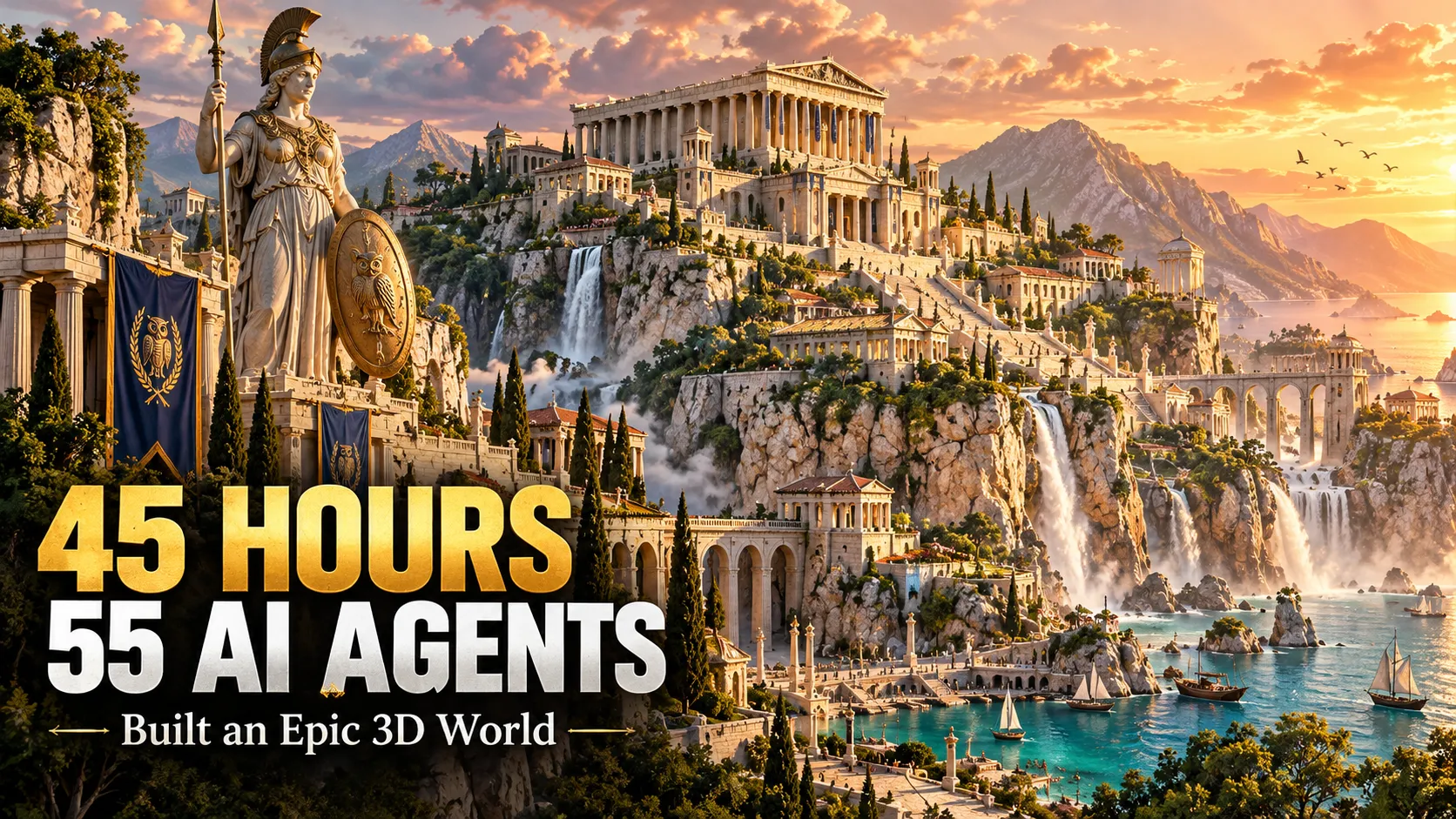
Athenaion is an ambitious open-source Three.js project that recreates a massive, cinematic ancient Greek fantasy environment entirely through programmatically generated graphics.
Created by GitHub developer Leonxlnx, the project was developed using Claude Code powered by Claude Opus 5.5 between October 16 and October 18, 2026.
The objective was to reproduce the atmosphere, architectural complexity, colors, and composition of nine AI-generated reference images as closely as possible.
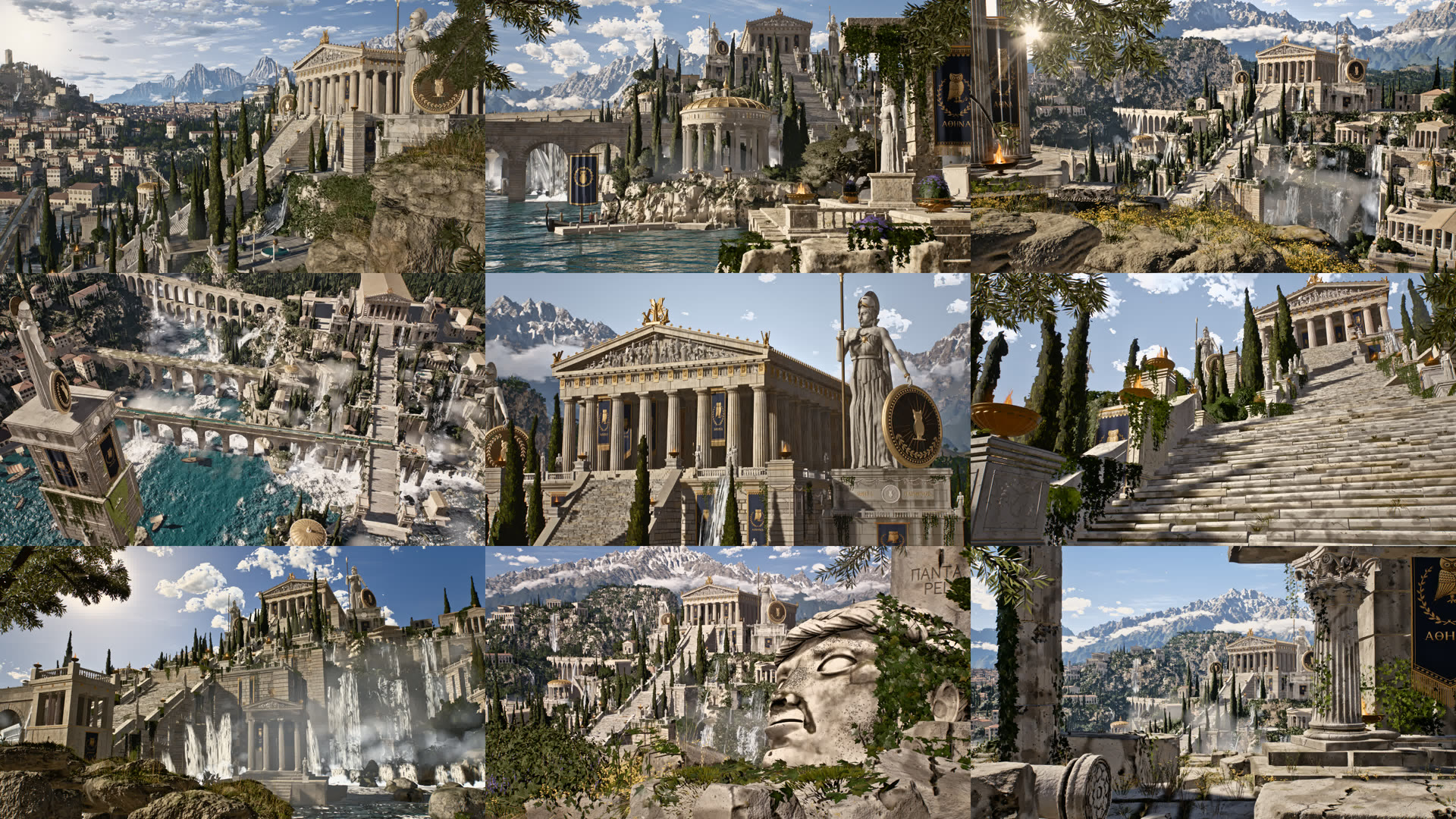
The resulting world contains monumental Greek temples, colossal Athena statues, vast limestone cliffs, dramatic waterfalls, mountainous landscapes, a coastal city, aqueducts, bridges, forests, and elaborate environmental details.
Unlike conventional 3D workflows, Athenaion does not rely on imported Blender models, purchased environment packs, or downloaded textures for its scene assets.
Instead, the underlying geometry, textures, shaders, and environmental effects are generated through code.
This distinction separates Athenaion from ordinary AI image generation.
An image generator produces pixels. Athenaion produces an executable 3D scene that can be inspected through different cameras, modified through JavaScript, and rendered into new images or videos.
The complete project is available at github.com/Leonxlnx/athenaion.
The repository also includes a comparison between the original reference images and final renders.
Athenaion Project Statistics: Development Time, Agents, Tokens, and Cost
The official GitHub README provides a detailed breakdown of the development process.
| Metric | Reported Result |
|---|---|
| Project name | Athenaion |
| Developer | Leonxlnx |
| AI coding environment | Claude Code |
| AI model | Claude Opus 5.5 |
| Graphics framework | Three.js |
| Development dates | October 16–18, 2026 |
| Elapsed development time | Approximately 45 hours |
| Building and iteration | Approximately 27 hours |
| Multi-agent development rounds | 9 |
| Total AI subagents | 55 |
| Maximum concurrent subagents | 12 |
| Cumulative agent work | Approximately 147 agent-hours |
| JavaScript code | Approximately 45,000 lines |
| JavaScript modules | 168 |
| Generated output tokens | Approximately 11 million |
| Cache-read tokens | Approximately 3.8 billion |
| Cache-write tokens | Approximately 161 million |
| Estimated API-equivalent cost | $1,800–$2,300 |
| Actual model access | Claude Max subscription |
| GPU | AMD Radeon 780M |
| Final video | 54 seconds, 4K, 30fps |
| Reported GPU rendering time | Approximately 13 hours |
| Open-source license | MIT |
These statistics come from the project's official README. They are developer-reported figures rather than independently audited performance benchmarks.
Two distinctions are particularly important.
First, 45 hours represents elapsed time, not the total sum of every AI agent's working time. The reported 147 agent-hours reflect overlapping work performed by multiple agents.
Second, the $1,800–$2,300 figure represents estimated API-equivalent usage, not the developer's actual API invoice.
These distinctions matter when evaluating the economics of large-scale AI-assisted software development.
What Did Claude Code Actually Build?
Athenaion is substantially more sophisticated than a basic Three.js scene composed of repeated cubes, standard materials, and simple lighting.
Its environment integrates numerous procedural subsystems that must remain visually consistent across multiple predefined camera angles.
Monumental Ancient Greek Architecture
The central environment features an enormous acropolis constructed on a limestone cliff massif.
Architectural elements include:
- A Parthenon-inspired Doric temple with detailed columns and sculpted pediments.
- Gilded architectural ornaments, including acroteria and decorative friezes.
- Monumental staircases connecting terraces at different elevations.
- Retaining walls, balustrades, colonnades, and smaller temples.
- Aqueducts and stone bridges spanning valleys and waterways.
- A circular tholos temple on an island.
- Residential neighborhoods containing procedurally generated houses.
- A harbor with ships, quays, and surrounding structures.
- Ruined porticoes, broken columns, and weathered architectural fragments.
Creating such structures procedurally requires a system that understands architectural relationships.
For example, a Doric temple is not simply a rectangular building surrounded by cylinders. Its visual identity depends on the proportions and arrangement of the stylobate, columns, capitals, architrave, frieze, cornice, and pediment.
Athenaion's published Art Bible documents many of these details, including column fluting, entasis, sculptural decorations, and material weathering.
Colossal Statues and Signed Distance Field Geometry
The environment includes enormous Athena statues, dozens of smaller sculptures, and a giant fallen marble head.
According to the repository, its statues were sculpted using signed distance fields (SDFs) before being converted into meshes.
A signed distance field is a mathematical representation of the distance between a point and an object's surface.
SDF techniques allow developers to construct complex geometry through mathematical operations rather than manually modeling every polygon.
They are especially useful for combining forms, creating smooth transitions, and defining reusable procedural shapes.
However, generating convincing human sculptures remains challenging because facial proportions, cloth folds, silhouettes, and anatomical features strongly influence perceived quality.
Athenaion's use of SDF-based sculpting illustrates how mathematical geometry can contribute to artistic scene generation when paired with careful visual evaluation.
57 Waterfalls, Rivers, and Reflective Water
Water is one of Athenaion's most technically demanding features.
The official README reports 57 traced waterfalls, alongside spray, mist, foam, a lagoon, river rapids, and an ocean surface with planar reflections.
A convincing waterfall requires several effects working together:
- Flowing water geometry with varied shapes and thicknesses.
- Lighting and transparency that suggest moving liquid.
- Foam and spray near impact points.
- Mist that interacts with atmospheric lighting.
- Water color and reflection consistency.
- Environmental integration with cliffs, stone channels, and river surfaces.
Simply animating a texture on a vertical surface would not reproduce the same visual complexity.
Water realism emerges from the interaction of geometry, movement, shading, lighting, and surrounding materials.
The developer also identifies waterfalls as one of the major areas refined during later multi-agent development rounds.
Approximately 149,000 Trees and Shrubs
Athenaion includes approximately 149,000 trees and shrubs, covering several types of Mediterranean and alpine vegetation.
The reported vegetation includes cypress trees, olive trees, pines, broadleaf trees, ivy, grass, and flowers.
At this scale, vegetation introduces substantial engineering challenges.
Rendering thousands of unique meshes individually can increase draw calls and consume GPU resources. Procedural environments therefore benefit from techniques such as geometry reuse, instancing, spatial culling, and level-of-detail management.
Three.js provides tools such as InstancedMesh for efficiently displaying many objects that share geometry and materials.
Although these techniques are relevant to projects of this type, individual optimization choices should be confirmed in the source code rather than assumed from the total vegetation count.
The broader lesson is that procedural generation must address both content diversity and rendering efficiency.
Mountains, Clouds, and Atmospheric Perspective
The project's environment includes snowy mountain ranges, layered cloud formations, volumetric clouds, fog, and atmospheric perspective.
Atmospheric perspective is particularly important in large outdoor scenes.
Distant objects typically lose contrast and shift toward the surrounding atmospheric color. Without this effect, mountains and buildings can appear unnaturally flat or equally close to the camera.
Athenaion uses atmospheric elements to separate foreground ruins, middle-distance architecture, and distant mountains.
This layered composition contributes substantially to the cinematic appearance of the finished renders.
Cinematic Offline Rendering
Athenaion's rendering system incorporates:
- Jittered sample accumulation for anti-aliasing.
- Soft shadows.
- Motion blur.
- AgX tone mapping.
- Local tone mapping.
- Bloom.
- Color grading.
These effects are not simply decorative additions.
They help unify procedurally generated assets into a visually coherent environment.
For example, realistic architecture can still appear artificial when materials are overexposed, shadows are excessively dark, or color saturation varies dramatically between components.
Athenaion addresses these issues through shared rendering and art-direction systems.
How Athenaion Was Built: The Five-Stage Multi-Agent Workflow
The most important technical achievement is not the quantity of generated geometry. It is the development workflow that coordinated its creation.
According to the repository, Claude Code used a structured process involving engine development, visual specification, specialist agents, repeated rendering, and final cinematic production.
Stage 1: Build the Rendering Engine First
Claude Code began by developing the technical foundation of the scene.
This included the rendering harness, atmospheric systems, sky, shadows, and sample-accumulation pipeline.
Building the renderer first gave subsequent agents a consistent environment in which to develop and test their components.
An engine-first workflow reduces the risk of generating disconnected assets that cannot be integrated or evaluated effectively.
For AI-assisted graphics projects, early infrastructure should establish camera conventions, scene organization, renderer settings, output formats, and testing commands.
Stage 2: Establish an Art Bible and Module Contract
The next step was to create shared specifications before delegating major implementation tasks.
Athenaion's Art Bible documents visual requirements for architecture, environments, materials, vegetation, lighting, and cameras.
For example, it specifies:
- Warm sunlight at approximately 15–30 degrees of elevation.
- Cream-colored illuminated marble with cooler blue-gray shadows.
- Turquoise water, dark green cypress trees, and navy-and-gold banners.
- Strong atmospheric perspective across distant mountains.
- Cinematic 16:9 compositions using mostly 35–50mm-equivalent camera views.
- Weathering, lichen, grime, and material variation to avoid artificial-looking surfaces.
The document even records reference-image luminance targets and a method for checking render color statistics.
The project also established module contracts so separately implemented systems could share a consistent architecture.
This is a critical requirement for multi-agent software development.
Without agreed interfaces, one agent might generate terrain in incompatible coordinates while another places architecture using different assumptions about scale or elevation.
Likewise, independently generated materials may appear inconsistent if agents use unrelated lighting or color conventions.
Shared specifications reduce these integration problems.
Stage 3: Delegate Work to 12 Specialist Roles
The first major parallel development phase involved 12 specialist areas.
| Specialist | Main Responsibility |
|---|---|
| Terrain | Cliffs, ground surfaces, and landscape geometry |
| Water | Waterfalls, rivers, lagoons, and water effects |
| Sky | Clouds, sky appearance, and atmospheric systems |
| Architecture | Buildings, columns, and architectural details |
| Acropolis | Central monumental environment |
| Aqueducts | Bridges and water infrastructure |
| Statues | Sculptures and monumental figures |
| Ruins | Damaged structures and environmental storytelling |
| Trees | Tree geometry and placement |
| Flora | Smaller vegetation, flowers, grass, and ivy |
| City | Houses, streets, and urban structures |
| Props | Supporting environmental objects and details |
Specialization made it possible to work on different parts of the scene simultaneously.
However, the agents were not entirely independent. Their output still had to match common architectural, visual, and technical requirements.
The coordinating workflow remained responsible for integration, quality control, and resolving conflicts between subsystems.
Stage 4: Render, Compare, and Improve
Athenaion's development process used visual feedback as a core evaluation mechanism.
Each specialist worked on its assigned component, rendered results, compared them with the reference imagery, and iterated.
Later rounds involved director, look-development, and module agents refining composition, colors, detail density, and waterfalls.
The workflow included side-by-side comparisons and color statistics against the nine reference images.
A simplified representation of the process is:
- Generate or modify scene code.
- Render the relevant camera view.
- Compare the render with the visual target.
- Identify significant differences.
- Modify geometry, materials, lighting, or composition.
- Render again to verify the improvement.
- Repeat until the result reaches an acceptable quality level.
The developer reports nine multi-agent development rounds.
This approach addresses a fundamental limitation of code-only evaluation.
A program may compile successfully while producing an incorrect image. A temple can be geometrically valid but poorly positioned. A waterfall can animate correctly but still appear unrealistic.
Visual verification evaluates the actual result experienced by the viewer, not merely whether the code executes successfully.
Stage 5: Produce the Final Cinematic Video
After the still images reached an acceptable quality level, the project moved to video production.
The final showcase was rendered frame by frame using four or eight samples per frame, with motion blur, crossfades, and background music.
The published result is approximately 54 seconds long at 4K resolution and 30 frames per second.
At 30fps, a 54-second video contains approximately 1,620 output frames.
Unlike a real-time recording, offline rendering can allocate more processing time to each frame.
The developer reports approximately 13 hours of GPU rendering for the final output work.
That time should not be interpreted as a universal rendering benchmark because performance depends on resolution, sample count, scene complexity, and hardware.
Athenaion's Original Prompt: What Did the Developer Tell Claude Code?
The developer published a consolidated prompt in docs/PROMPT.md.
The document combines the developer's messages from the session into a single set of instructions. The development environment used Claude Code, Claude Opus 5.5, the xhigh effort setting, and nine reference images.
This distinction matters: the published document is a consolidated prompt, not evidence that the entire project was produced from one uninterrupted prompt submission.
Requirement 1: Generate Everything Through Code
The developer prohibited the use of external scene assets.
Meshes, textures, shaders, and visual effects had to be produced programmatically.
This constraint prevented the coding agents from simply importing existing environment models and encouraged reusable procedural geometry systems.
It also significantly increased the technical difficulty of achieving the desired visual quality.
Requirement 2: Match the Reference Images
The instructions emphasized matching the references in composition, scale, materials, and especially color.
The developer specified a realistic cinematic appearance without excessive saturation or washed-out colors.
A 99.9% similarity target appeared in the instructions, but this was an aspirational goal rather than an independently measured similarity score.
The useful principle is to provide explicit visual acceptance criteria instead of vague instructions to create something attractive.
Requirement 3: Avoid Repetitive Procedural Content
The prompt required detail throughout the environment and discouraged simplistic or copy-pasted objects.
Buildings, trees, rocks, and waterfalls needed enough variation to remain convincing from different viewing distances.
Procedural generation can produce impressive scale, but uncontrolled repetition often exposes obvious patterns.
Introducing controlled variation in shape, placement, materials, and weathering helps address this limitation.
Requirement 4: Optimize for Available Hardware
The developer explicitly identified the Radeon 780M integrated GPU as a hardware limitation.
The instructions therefore favored efficient development and high-quality offline rendering rather than attempting to display the entire cinematic environment in real time at maximum resolution.
This was an important engineering decision.
A rendering pipeline designed around achievable hardware constraints is more useful than an ambitious system that cannot generate its final output.
Requirement 5: Iterate Until the Visual Target Is Met
The developer allowed the project to continue iterating for hours or days rather than stopping after an initial implementation.
The workflow also required approval of rendered still images before beginning the final video.
This introduced a quality gate between development and expensive cinematic rendering.
The strongest element of the prompt is its process design: clear targets, explicit constraints, continuous verification, and approval before final production.
The complete wording can be reviewed in the official prompt document.
How Much Did Athenaion Cost?
Athenaion's published cost estimate deserves careful interpretation.
The developer estimates that equivalent API consumption would have cost approximately $1,800–$2,300 at Claude Opus 5.5 API prices.
However, the development actually took place under a Claude Max subscription.
| Cost Category | Published Information |
|---|---|
| API-equivalent estimate | $1,800–$2,300 |
| Actual model access | Claude Max subscription |
| Output tokens | Approximately 11 million |
| Cache-read tokens | Approximately 3.8 billion |
| Cache-write tokens | Approximately 161 million |
| Exact incremental API payment | Not disclosed |
| Hardware | Radeon 780M integrated GPU |
| Electricity and hardware depreciation | Not quantified |
Why Were So Many Tokens Used?
Multi-agent development increases the number of independent model interactions.
Agents repeatedly examine project files, process instructions, generate code, evaluate changes, and inspect results.
When this work is distributed across dozens of agents and multiple development rounds, cumulative token usage can grow rapidly.
The token categories should be understood separately:
- Output tokens: Content generated by the model, including code and explanations.
- Cache-read tokens: Previously cached input processed again during model requests.
- Cache-write tokens: Input written into the prompt cache for potential reuse.
The reported 3.8 billion cache-read tokens do not mean that the project contains billions of unique lines of instructions or source code.
Caching can significantly alter the cost profile of repetitive, context-heavy workflows, but cached processing still has its own billing rules under API pricing.
Does Claude Max Make This Workflow Free?
No.
A subscription is not equivalent to unlimited API access, and usage restrictions or rolling limits can affect long-running agent workloads.
The developer's API-equivalent estimate should therefore not be treated as a guaranteed cash saving available to every subscriber.
Nor does the public account establish that another developer could reproduce the same workload under identical subscription conditions.
What Does the Cost Actually Demonstrate?
Athenaion demonstrates that parallel AI development can compress elapsed production time while consuming substantial model computation.
The 45-hour development figure is impressive, but it must be evaluated alongside the reported agent-hours, token volume, rendering requirements, and human review.
For commercial projects, a realistic budget also needs to account for integration, testing, failed attempts, maintenance, and deployment.
How Did Athenaion Render 4K Graphics on an Integrated GPU?
The use of an AMD Radeon 780M integrated GPU is one of the most interesting engineering details.
Athenaion demonstrates the difference between real-time rendering and offline rendering.
A real-time graphics application must produce frames continuously within a limited frame-time budget.
At 30fps, the available time per frame is approximately 33.3 milliseconds.
Offline rendering has no equivalent requirement to maintain continuous interactive playback. It can spend much longer computing each individual frame.
Athenaion's rendering pipeline uses jittered accumulation to combine samples and improve image quality.
Additional tone mapping, motion blur, bloom, and color grading contribute to the final cinematic appearance.
This makes it possible to create high-resolution output without proving that the same environment can run interactively at 4K and 30fps.
The distinction is particularly relevant to developers considering the project for real-time applications.
A scene that looks impressive in offline renders may require substantial optimization, simplified geometry, asset streaming, or reduced effects before it is suitable for interactive gameplay.
How to Install and Run Athenaion Locally
Athenaion is publicly available under the MIT license. Its repository includes the JavaScript source code, development tools, and setup instructions.
The package configuration lists Three.js, Puppeteer Core, and PNGJS as dependencies.
Step 1: Clone the Repository
Install Git and Node.js, then run:
git clone https://github.com/Leonxlnx/athenaion.git
cd athenaion
npm install
This downloads the project and installs its dependencies.
Step 2: Start the Development Server
Run:
node tools/serve.mjsOpen the local preview in a browser:
http://localhost:8080/?shot=1&quality=preview
The repository documents two basic controls:
- Press number keys
1–9to select predefined camera shots. - Use the mouse to orbit the camera.
The preview-quality setting is useful when inspecting the scene before generating more expensive high-quality output.
Step 3: Precompute Heavy Geometry
Some geometry is not committed to the repository because of its size and complexity.
According to the README, terrain meshes, statues, and the giant marble head may initially be generated at runtime, making the first load slow.
The following commands precompute those elements:
node tools/bake.mjs terrain
node tools/bake.mjs statues
node tools/bake.mjs head
Baking these components can reduce repeated initialization work during subsequent sessions.
Step 4: Render a 4K Image
The repository provides this high-quality still-rendering command:
node tools/render.mjs --shot 1 --quality high --spp 16 --w 3840 --h 2160The key parameters are:
--shot 1selects the camera view.--quality highselects the high-quality rendering preset.--spp 16requests 16 samples per pixel.--w 3840specifies the image width.--h 2160specifies the image height.
Generating high-quality renders requires Chrome or Edge, according to the repository documentation.
For early testing, reducing image resolution and sample count can help lower rendering requirements.
Step 5: Render a Video
The official README includes a video-rendering example:
node tools/render-video.mjs --w 1920 --h 1080 --spp 8 --quality highThis example produces a 1080p rendering configuration, rather than the 4K settings used for the published showcase.
Higher output resolutions require additional rendering work, memory, and storage.
Actual processing time depends on hardware, graphics configuration, and scene complexity.
Common Problems When Running Athenaion
The First Load Takes Too Long
This can occur because some complex geometry must be generated locally.
Run the documented baking commands and allow sufficient time for the initial geometry construction.
A slow first load does not necessarily indicate a failed installation.
The Browser Displays a Blank Scene
Inspect the browser's developer console and the server's terminal output.
Check for JavaScript exceptions, WebGL initialization errors, unavailable resources, and graphics-driver problems.
Complex scenes can also exceed available GPU memory on some systems.
High-Quality Rendering Is Extremely Slow
Start with lower-resolution previews and fewer samples per pixel.
Reserve full-resolution output for approved scenes rather than rendering every development change at maximum quality.
The Renderer Cannot Find Chrome or Edge
The project uses Puppeteer Core for rendering-related automation.
Unlike the standard Puppeteer package, Puppeteer Core does not bundle a browser executable automatically.
Verify that a compatible Chrome or Edge installation is available to the rendering process.
The Output Does Not Match the Reference Images
Check the selected camera, framing, field of view, lighting, exposure, and tone mapping before modifying geometry.
Visual differences can result from camera configuration or rendering settings even when the underlying scene objects are correct.
Athenaion vs Traditional 3D Modeling vs AI Image Generation
Athenaion occupies a distinctive position between traditional 3D modeling and generative image systems.
| Capability | Traditional 3D Workflow | AI Image Generation | Athenaion-Style Agentic Coding |
|---|---|---|---|
| Main output | Editable 3D scenes and assets | Generated images | Executable procedural 3D code |
| Geometry control | Direct modeling and editing | Often limited or indirect | Programmatic geometry control |
| Camera flexibility | High | Model-dependent | High within the generated scene |
| Visual consistency | Controlled through production pipeline | Can vary between generations | Managed through code and shared specifications |
| Asset reusability | Typically high | Depends on output format | Potentially high with modular code |
| Workflow | Artists and traditional tools | Prompting and image editing | AI coding agents and visual feedback |
| Main challenge | Modeling effort and production cost | Spatial consistency and editability | Code complexity, integration, and rendering |
The comparison highlights why procedural generation through coding agents is valuable.
An AI image generator can produce a compelling fantasy temple quickly, but the result is not necessarily a reusable 3D environment.
A traditional 3D artist can build an editable environment with precise control, but complex asset production may require substantial time.
An agentic coding workflow attempts to automate parts of the programming and procedural content-creation process while preserving the flexibility of executable software.
It does not eliminate the need for design expertise, visual evaluation, or technical optimization.
What Developers Can Learn From Athenaion
Athenaion offers practical lessons for AI-assisted programming beyond the field of 3D graphics.
1. Start With an Evaluation System
The project built its rendering infrastructure before scaling content development.
This made visual inspection possible throughout the process.
For a smaller project, developers should establish automated screenshots, reproducible camera positions, and clear quality criteria before delegating large amounts of implementation work.
Useful visual checks include:
- Camera composition and object positioning.
- Major shapes and proportions.
- Lighting direction and shadow consistency.
- Material colors and exposure.
- Rendering artifacts or missing geometry.
- Performance and memory usage.
Automated image comparisons can support evaluation, but numerical similarity alone cannot fully capture artistic quality.
2. Define Stable Interfaces Between Agents
Multi-agent workflows become more effective when responsibilities are separated by clear module boundaries.
For example, a terrain agent can generate ground geometry while a vegetation agent uses the same coordinate conventions to place plants.
A shared contract should define coordinate systems, units, module exports, dependencies, resource ownership, and integration expectations.
This reduces conflicting edits and expensive rework.
3. Separate Preview Quality From Final Rendering
Expensive rendering should not be part of every development iteration.
Use lower resolutions and smaller sample counts while making structural changes.
Switch to high-quality rendering when validating major milestones or producing final output.
This reduces wasted computation and shortens feedback cycles.
4. Use Specialized Agents Instead of Uncontrolled Parallelism
Athenaion involved 55 subagents, but its initial specialist structure was organized around 12 distinct areas of responsibility.
The important factor was task decomposition, not simply maximizing agent count.
More agents can create additional coordination overhead when they modify overlapping files or depend on incomplete shared systems.
For smaller applications, a carefully managed group of two or three agents may be more practical.
5. Validate the Actual User-Facing Result
Traditional software tests are necessary but insufficient for many visual applications.
A program can pass automated tests while displaying poorly aligned components, incorrect colors, broken animation, or unexpected visual artifacts.
Screenshot-based evaluation helps identify problems that code-level checks may miss.
This principle applies to websites, dashboards, interactive games, UI components, animations, and visualization tools—not only 3D environments.
How to Recreate an Athenaion-Style Workflow on a Smaller Budget
The most practical way to learn from Athenaion is to reproduce its development methodology with a smaller scope.
Consider a procedural Three.js scene containing one temple, a courtyard, a small garden, and cinematic lighting.
Phase 1: Define the Visual Target
Select one reference image and specify:
- The required architectural elements.
- The target camera position.
- Color and material requirements.
- Lighting direction and atmosphere.
- An acceptable preview resolution.
- Performance constraints.
Avoid adding an entire city or large procedural forest during the first iteration.
Phase 2: Divide the Work
Use three specialist responsibilities:
- Renderer agent: Camera, lighting, rendering configuration, and application setup.
- Environment agent: Architecture, terrain, materials, and vegetation.
- Validation agent: Screenshot capture, reference comparisons, and regression checks.
Assign clear ownership of files and module interfaces.
Phase 3: Use a Reusable Development Prompt
The following is an original simplified prompt inspired by Athenaion's methodology, rather than a reproduction of its published prompt:
Build a detailed procedural Three.js environment based on the supplied reference image.

Requirements:
- Generate scene geometry and materials through code.
- Use a modular architecture with clear component interfaces.
- Match the reference composition, scale, lighting, and colors.
- Optimize for browser-based preview on mid-range hardware.
- Avoid unnecessary geometry duplication and repetitive visual patterns.

Process:
1. Create a minimal working renderer and fixed camera.
2. Define the visual specification and component interfaces.
3. Implement architecture and terrain.
4. Add lighting, materials, and environmental details.
5. Capture screenshots from the reference camera.
6. Compare the output against the target image.
7. Fix the largest visual differences first.
8. Verify that the scene still renders correctly.
9. Request approval before producing final high-resolution images.

Prioritize correct composition and visual quality over object count.
This approach gives the AI system measurable expectations without requiring the enormous resource consumption of the original project.
Phase 4: Measure Cost and Quality
Track development time, token consumption, rendering duration, and visual progress.
| Metric | Evaluation Purpose |
|---|---|
| Elapsed development time | Measures practical completion speed |
| Model tokens and spending | Measures inference cost |
| Number of agent retries | Reveals inefficient iteration |
| Integration failures | Identifies coordination problems |
| Average preview frame time | Measures interactive performance |
| GPU memory consumption | Identifies hardware bottlenecks |
| Final render duration | Measures export cost |
| Visual review results | Evaluates output quality |
This creates a more meaningful evaluation than simply counting lines of AI-generated code.
Can Athenaion's Approach Be Used to Build Video Games?
Yes, but an impressive cinematic scene is not equivalent to a complete interactive game.
Athenaion primarily demonstrates procedural environment generation and high-quality rendering.
A production game would require additional systems, including some or all of the following:
- Character controls and input handling.
- Collision detection and physics.
- Interactive objects and gameplay mechanics.
- Animation and character state.
- Game-state persistence.
- Scene loading and asset management.
- User interface and accessibility features.
- Audio interaction and feedback.
- Real-time performance optimization.
The project is particularly relevant to creating browser-based 3D experiences, procedural environments, cinematic prototypes, virtual exhibitions, and interactive visualizations.
Its most expensive rendering techniques may need to be simplified or replaced when targeting interactive gameplay.
Limitations: What Athenaion Does Not Prove
Athenaion is an impressive technical demonstration, but its results should be interpreted carefully.
The performance numbers are self-reported. The developer has published source code and visual outputs, but the complete accounting of agent activity, token usage, and production time has not been independently audited.
The project does not prove real-time 4K performance. Its final cinematic quality depends on an offline rendering pipeline that can spend substantially more time on each frame.
The zero-assets claim refers to the procedural scene assets. The development process used nine AI-generated reference images, while the showcase video uses separately licensed background music.
The published prompt is not a one-click reproduction guarantee. It consolidates instructions from a longer development process involving iteration, visual comparison, and human approval.
More agents do not automatically mean faster development. Agent coordination, file conflicts, shared dependencies, and integration testing can reduce the benefits of parallelism.
Visual quality is not equivalent to production readiness. A scene may look excellent from selected camera angles while still requiring improvements in memory management, unrestricted navigation, maintainability, or runtime performance.
These limitations are important because they separate Athenaion's verified public deliverables from broader claims about fully autonomous software production.
Frequently Asked Questions
Is Athenaion Open Source?
Yes. Athenaion is available on GitHub under the MIT license. Commercial reuse of the source code is generally permitted under the license terms, although separately licensed media and other third-party content must be considered independently.
Which AI Model Was Used to Build Athenaion?
The developer identifies Claude Opus 5.5, accessed through Claude Code with the xhigh effort setting, as the model used during development.
Did Claude Code Really Build Athenaion in 45 Hours?
The developer reports approximately 45 hours of elapsed time, spanning October 16–18, 2026. The process involved 55 subagents and approximately 147 cumulative agent-hours, reflecting overlapping AI work.
How Much Did Athenaion Cost?
The developer estimates an API-equivalent cost of $1,800–$2,300. Development actually used a Claude Max subscription, and the precise incremental cash cost attributable to this project was not separately disclosed.
Does Athenaion Use Blender or Unreal Engine?
Athenaion is implemented with Three.js and JavaScript. Its documented visual assets are generated procedurally rather than imported from conventional 3D modeling packages.
Can Athenaion Run on a Laptop?
The developer used a laptop with AMD Radeon 780M integrated graphics. However, loading complex geometry and generating high-quality images can require substantial time and memory. Performance will vary across systems.
Where Is the Original Athenaion Prompt?
The consolidated development instructions are publicly available in docs/PROMPT.md.
Is Athenaion an AI 3D Generator?
Athenaion is an AI-developed procedural 3D codebase, not a hosted prompt-to-3D generation service. It demonstrates how coding agents can create a complex 3D environment by writing and iterating on executable graphics code.
What Makes Athenaion Different From Ordinary Vibe Coding?
Athenaion combines detailed visual references, specialized AI agents, shared engineering contracts, automated rendering, and repeated visual evaluation. Its development process resembles a coordinated software production pipeline rather than a single-prompt prototype.
Can Developers Use Athenaion for Commercial Games?
The MIT license allows broad reuse of the source code, subject to its terms. However, a commercial game would require additional gameplay systems, performance optimization, quality assurance, and review of separately licensed media.
Conclusion
Athenaion is a compelling demonstration of how AI-assisted programming is expanding beyond conventional applications and into sophisticated visual software production.
Using Claude Code, Claude Opus 5.5, Three.js, and 55 AI subagents, its developer created a massive procedural ancient Greek environment in approximately 45 hours of elapsed time.
The resulting project includes tens of thousands of lines of JavaScript, intricate architecture, enormous statues, 57 waterfalls, approximately 149,000 trees and shrubs, and a cinematic 4K rendering pipeline.
Yet its most important contribution is the methodology behind those results.
Reference-driven development, specialized agents, shared technical specifications, automated rendering, and iterative visual evaluation can transform AI-generated code into a coordinated creative production workflow.
Athenaion also highlights the costs and limitations of that approach, including substantial inference usage, coordination complexity, offline rendering requirements, and the continuing importance of human oversight.
For developers exploring agentic coding, procedural graphics, or browser-based 3D experiences, the project offers both a working example and a foundation for experimentation.
Explore the Athenaion GitHub repository, examine its development prompt and Art Bible, and apply its visual feedback and multi-agent principles to a smaller Three.js project.
Continue Reading
More articles connected to the same themes, protocols, and tools.

Referenced Tools
Browse entries that are adjacent to the topics covered in this article.