On This Page8 sections
Key Takeaways
- Muse Charm is Meta's dedicated pocket device for its Muse personal AI agent, announced at Meta Connect 2026.
- It is designed to provide fast, voice-first access to Muse without opening a phone or desktop app first.
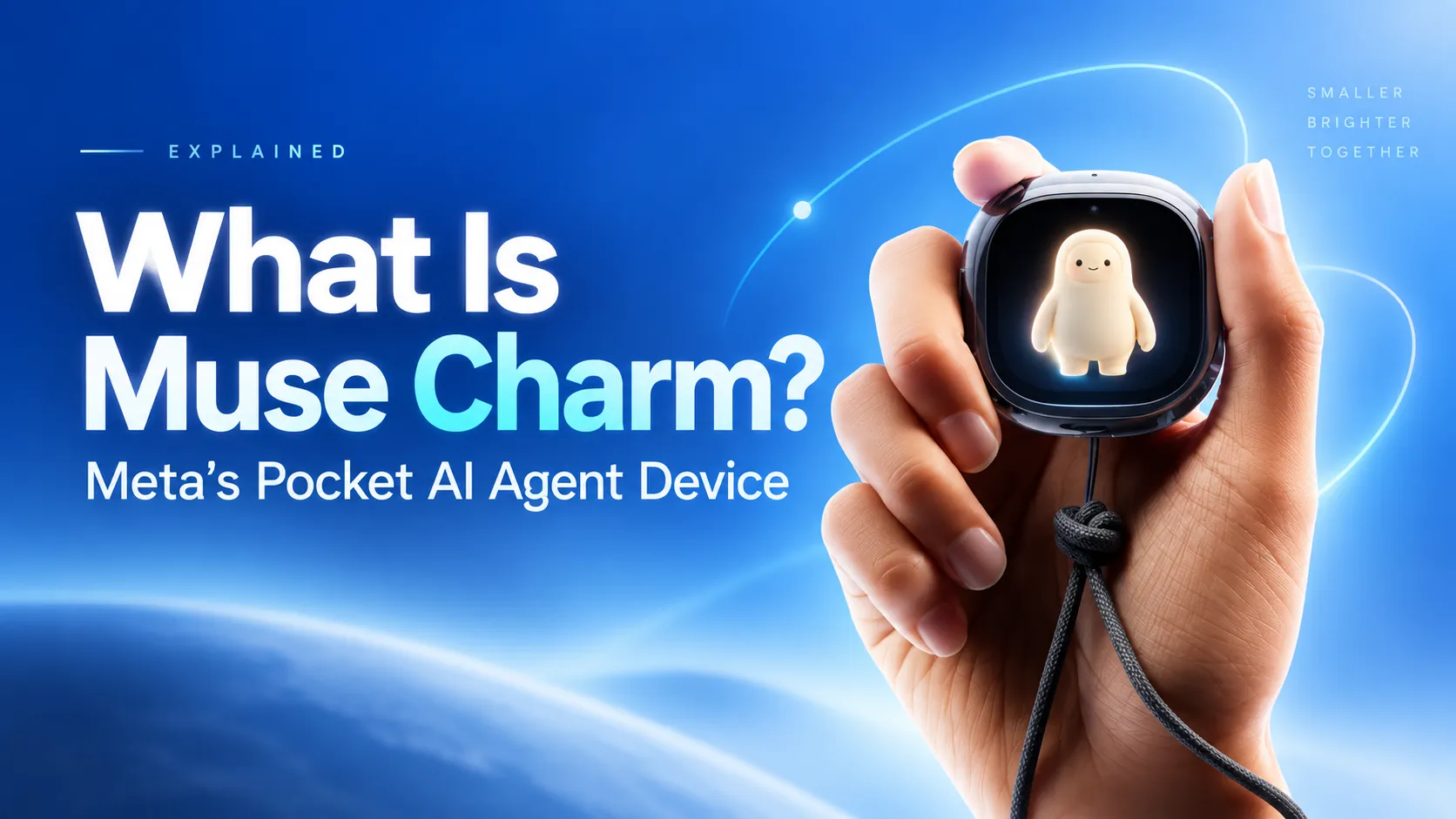
- Public demonstrations and reporting describe a compact device with a small touchscreen, a customizable Muse avatar, biometric activation, and cellular connectivity.
- Muse Charm matters less because of raw hardware specifications and more because it turns Muse into a dedicated physical interface for an agent that can remember context and act through connected services.
- Important details including final price, battery life, exact launch markets, storage, and complete hardware specifications have not yet been fully disclosed.
What Is Muse Charm?
Muse Charm is a compact hardware device built by Meta specifically for interacting with Muse, Meta's personal AI agent.
The simplest way to understand the product is to think of it as a dedicated AI remote rather than a miniature smartphone. Instead of unlocking a phone, finding an app, and opening a conversation, the intended interaction is much shorter:
Activate Charm
→ speak naturally
→ Muse interprets the request
→ Muse uses connected tools or services
→ Charm returns the result
That workflow explains why the product exists. The underlying AI can already be accessed through software, but Charm attempts to reduce the number of steps between a user's intention and an agent taking action.
Why Muse Charm Exists
The main problem Muse Charm tries to solve is interaction friction.
A typical phone-based AI workflow looks like this:
- take out the phone;
- unlock it;
- open the relevant AI app;
- start a new conversation or voice session;
- explain the task;
- switch to another app if the AI cannot complete the action itself.
Charm is designed to compress that process into a dedicated interaction surface.
This is important because successful AI agents depend on more than model intelligence. They also depend on how quickly users can delegate tasks.
A dedicated device can potentially make common actions feel more immediate:
- capturing reminders;
- checking schedules;
- asking contextual questions;
- delegating research;
- initiating purchases or bookings;
- following up on ongoing tasks.
The central product hypothesis is simple: if an AI agent becomes useful many times per day, a dedicated interface may be faster than repeatedly navigating through a smartphone.
How Muse Charm Works
Muse Charm should be understood as the physical front end of the broader Muse system.
Muse itself is designed to function as a personal agent rather than a conventional chatbot. That distinction matters.
A chatbot mainly responds to prompts. An agent can potentially:
- retain useful context;
- browse information;
- connect to external services;
- perform multi-step workflows;
- request approval for sensitive actions;
- return completed results instead of only instructions.
A simplified architecture looks like this:
Muse Charm
→ voice or touch input
→ Muse agent
→ memory and user context
→ connected tools and services
→ approval when required
→ completed action or answer
The hardware therefore does not need to replace a smartphone. Its purpose is to become the fastest way to reach the agent.
What Is Confirmed About the Hardware?
Meta has demonstrated Muse Charm publicly, but the final retail specification is still incomplete.
Current information indicates the following:
| Feature | Current status |
|---|---|
| Pocket-sized form factor | Confirmed |
| Voice-first Muse interaction | Confirmed |
| Small touchscreen | Demonstrated |
| Muse avatar interface | Demonstrated |
| Biometric or fingerprint-style activation | Demonstrated or reported |
| Cellular connectivity | Reported |
| Final retail price | Not announced |
| Battery life | Not announced |
| Processor and RAM | Not announced |
| Storage capacity | Not announced |
| Final camera specification | Not fully documented |
| Exact launch countries | Not fully announced |
This distinction is important. Early coverage often mixes demonstrated prototype features with final shipping specifications. Buyers should wait for Meta's final technical documentation before treating every reported detail as permanent.
What Can Muse Charm Do?
The most useful way to evaluate Charm is to look at the capabilities of Muse rather than the size of the screen.
Potential workflows include:
- Quick task capture: create reminders, notes, follow-ups, and tasks by voice.
- Calendar assistance: ask about upcoming events or delegate scheduling.
- Research: request summaries, comparisons, or background research without opening a browser.
- Shopping: ask Muse to compare products or interact with supported commerce services.
- Travel: delegate itinerary research, reservations, and planning tasks.
- Personal context: ask questions that depend on information Muse remembers from previous interactions.
- Connected workflows: use supported third-party services without manually navigating each application's interface.
For example:
User:
Find a dinner reservation near my hotel for 7:30 PM.
Avoid seafood and add the confirmed booking to my calendar.

Muse:
1. Uses the user's location or trip context.
2. Searches supported reservation services.
3. Filters restaurants using the stated preference.
4. Requests confirmation if payment or booking approval is required.
5. Completes the reservation.
6. Adds the event to the calendar.
7. Returns a short confirmation.
The important difference is that the user expresses an outcome, while the agent determines the sequence of steps.
Muse Charm vs. the Muse App
Muse Charm does not appear to replace the Muse app. Instead, the two interfaces are optimized for different situations.
| Muse App or Web | Muse Charm |
|---|---|
| Runs on an existing phone or computer | Dedicated Muse hardware |
| Better for long-form text and documents | Better suited to rapid voice interactions |
| No additional device required | Requires carrying another device |
| Uses the host device's connectivity | Designed around independent access |
| Competes with other apps for attention | Dedicated almost entirely to Muse |
| Large display for complex work | Minimal display for fast interactions |
The question is therefore not whether Charm is more powerful than a smartphone.
The real question is whether dedicated access to an AI agent saves enough time and attention to justify carrying another device.
Muse Charm vs. AI Glasses
Muse Charm also fits into Meta's broader strategy around AI glasses.
The two product categories solve similar problems in different ways.
AI glasses are designed for hands-free, always-available interaction. Depending on the model, they can also provide visual context from the wearer's perspective.
Muse Charm is a separate object that can stay in a pocket, bag, or on a keychain. It does not require the user to wear hardware continuously.
This creates a useful distinction:
- AI glasses are optimized for ambient, wearable access.
- Charm is optimized for intentional, pocketable access.
- Phones remain optimized for general-purpose computing and rich visual interfaces.
Charm could therefore appeal to users who want faster AI access but do not want to wear smart glasses all day.
Muse Charm vs. Rabbit R1 and Other AI Gadgets
Muse Charm will inevitably be compared with earlier dedicated AI devices such as Rabbit R1.
The similarity is obvious: both attempt to create a small, purpose-built interface for AI.
The more important comparison, however, is the ecosystem behind the hardware.
A dedicated AI device succeeds only if the agent can do useful things reliably. A small screen and attractive industrial design are not enough.
Muse Charm's potential advantage is that it is tied to a much larger Meta ecosystem. If Muse can connect to communication, commerce, productivity, browser, and social services, the hardware becomes an entry point into that ecosystem rather than an isolated gadget.
That also creates a different failure mode.
If users stop carrying Charm, Muse can still remain useful through other devices and software interfaces. The agent is not necessarily dependent on one piece of hardware.
Privacy and Security Questions
A personal AI agent becomes more useful as it gains access to more personal context.
That makes privacy and security one of the most important parts of the Muse Charm story.
Users should pay attention to several questions before buying:
- What information is stored locally on the device?
- What information is processed in the cloud?
- How are microphone and camera inputs handled?
- What does biometric authentication authorize?
- Can sensitive actions require explicit confirmation?
- How are payment credentials protected?
- Can users review an audit trail of actions taken by Muse?
- What happens if the device is lost or stolen?
- Can cellular connectivity be disabled?
- Does the device require a separate data subscription?
These are not minor implementation details. They determine whether users can safely give an agent permission to act on their behalf.
Does Muse Charm Run AI Locally?
There is currently no strong basis for assuming that the complete Muse agent runs locally on Charm.
The more likely architecture is a hybrid system in which the device handles interaction, authentication, audio processing, and potentially some lightweight local tasks while the more computationally intensive agent operates through Meta's cloud infrastructure.
That model would make sense for several reasons:
- large agent models require substantial compute;
- cloud execution allows the agent to use browser sessions and remote tools;
- server-side systems can be updated without replacing the hardware;
- a small device has tighter battery and thermal constraints than a phone or laptop.
Until Meta publishes a detailed technical specification, claims that Charm runs the full Muse system entirely on-device should be treated cautiously.
Why Muse Charm Matters
Muse Charm is significant because it represents a shift from app-centric computing to agent-centric computing.
Traditional software works like this:
Intent
→ choose an app
→ navigate the interface
→ complete several steps
→ get the result
Agentic software aims to work like this:
Intent
→ tell the agent
→ agent chooses tools
→ approve sensitive actions
→ get the result
If that model becomes reliable, the interface requirements change.
The most important functions may no longer be:
- a large app grid;
- dozens of menus;
- complex navigation;
- manual switching between services.
Instead, the device needs to provide:
- fast identity verification;
- reliable voice input;
- persistent personal context;
- access to tools and services;
- clear confirmation before sensitive actions;
- concise feedback when a task is complete.
Muse Charm is Meta's attempt to build hardware around that new interaction model.
The Biggest Challenge: Why Not Just Use a Phone?
This is the most important question for Muse Charm.
Modern smartphones already have:
- microphones;
- cameras;
- speakers;
- cellular connectivity;
- biometric authentication;
- large screens;
- AI apps;
- voice assistants.
A dedicated device therefore needs to provide a meaningful advantage.
That advantage could come from several areas:
- faster activation than opening an app;
- better conversational continuity;
- persistent access to personal context;
- stronger integration with Muse actions;
- less distraction than a smartphone;
- more convenient physical access.
If Charm merely reproduces a smartphone AI app on a smaller screen, its value will be difficult to justify.
If it becomes a reliable one-step interface for delegating real tasks, the product becomes much more interesting.
Who Is Muse Charm For?
Muse Charm is most likely to appeal to users who expect to interact with a personal agent frequently throughout the day.
Potential early adopters include:
- people who regularly delegate scheduling and research tasks to AI;
- users who prefer voice interaction over typing;
- users who want instant access to an agent without opening a phone;
- people interested in AI hardware but unwilling to wear smart glasses;
- developers and early adopters studying agent-centric interfaces.
It is less compelling for users who:
- only ask AI occasional questions;
- mostly work with long text or code;
- already use earbuds and a phone for voice AI;
- do not want to carry or charge another device;
- are uncomfortable granting an agent access to connected services.
Common Misconceptions
Muse Charm is an AI model
No. Muse Charm is hardware. Muse is the personal AI agent that the device is designed to access.
Muse Charm is a smartphone replacement
There is currently no evidence that Meta intends Charm to replace a full smartphone. Its role is much narrower: fast access to Muse.
Every reported specification is final
Not necessarily. Some details come from demonstrations and early reporting rather than a complete final retail specification.
Muse Charm performs everything locally
That has not been established. The agent is expected to rely substantially on cloud infrastructure.
A small screen means the device has limited value
Not necessarily. For an agent device, the most important capability may be completing tasks rather than displaying complex interfaces.
What to Watch Before Buying
Five factors will determine whether Muse Charm becomes a useful everyday device.
1. Latency
Voice interaction must feel nearly immediate. If opening a phone is faster, the dedicated hardware loses its main advantage.
2. Agent reliability
Muse needs to complete tasks accurately. A device that frequently asks users to finish workflows manually will struggle to justify itself.
3. Battery life
A dedicated AI device is only useful if it is available throughout the day. Battery performance may be more important than processor specifications.
4. Privacy controls
Users need clear controls for microphones, cameras, connected services, account permissions, payments, and stored context.
5. Total cost
The real price may include more than the hardware. Potential subscription fees, premium Muse features, or cellular data plans could materially change the value proposition.
FAQ
What is Muse Charm?
Muse Charm is a small dedicated hardware device from Meta designed to provide fast access to the company's Muse personal AI agent.
Is Muse Charm a phone?
No. It is better understood as a dedicated AI interface than as a conventional smartphone.
Does Muse Charm have a screen?
Yes. Public demonstrations show a small touchscreen-style display used for the Muse interface and avatar.
Does Muse Charm work without opening a phone app?
That is one of its primary purposes. The product is designed to make Muse directly accessible through dedicated hardware.
Does Muse Charm have cellular connectivity?
Reporting around the announcement describes built-in cellular connectivity. Final network requirements and subscription details still need to be confirmed in Meta's retail documentation.
Does Muse Charm run Muse completely on-device?
There is no confirmed evidence that the complete Muse system runs locally. Cloud-based agent execution is likely to remain an important part of the architecture.
How much does Muse Charm cost?
Meta has not yet published a final retail price.
When will Muse Charm be released?
Meta is targeting a late-2026 launch window, but exact availability may vary by market.
Conclusion
Muse Charm is best understood as Meta's attempt to create a dedicated physical interface for the personal AI agent era.
The hardware itself is intentionally simple. The real value depends on Muse's ability to remember context, connect to services, understand natural voice requests, and complete useful actions reliably.
That makes the most important questions surprisingly practical: Is it faster than using a phone? Can Muse reliably finish tasks? How long does the battery last? What does it cost? And can users trust the privacy and permission model?
Those answers will determine whether Muse Charm becomes an everyday AI interface or simply another experimental AI gadget.
For anyone considering the device, the best approach is to watch Meta's final hardware specifications, pricing, supported integrations, privacy documentation, and launch-market details before making a purchase decision.
Continue Reading
More articles connected to the same themes, protocols, and tools.

Referenced Tools
Browse entries that are adjacent to the topics covered in this article.