On This Page8 sections
Key Takeaways
- The X Subscription is an official unified subscription launched on October 12, 2026, combining Grok, Grok Bot, Cursor, and X Premium benefits under a single billing system. X Pass is an informal name sometimes used in social media discussions.
- Five plans are available: Free ($0), Plus ($8/month), Premium ($30/month), Super ($100/month), and Ultra ($200/month).
- Premium is the most important tier for developers to evaluate. At $30/month, it combines Grok, Grok Bot, Cursor coding capabilities, and X Premium+ benefits.
- Grok and Cursor share a weekly AI usage allowance. Using more of one product reduces the included capacity available to the others.
- Claude, GPT, and other supported third-party models are not included in the new subscription allowance. They are available in Cursor on Premium and higher plans, but usage is billed separately at API list prices from the first request.
- Existing Cursor users do not have to switch immediately. Their current plans and included third-party model allowances remain available until they migrate or other announced changes take effect.
- Account unification is permanent. Canceling the new subscription does not reverse account merging or automatically restore an old Cursor plan.
- Limited-time migration promotions exist, but a universal 50% discount has not been established by the official documentation. Eligibility and actual checkout prices must be checked individually.
The X Subscription represents a significant change in how AI assistants, coding agents, and social platform subscriptions are packaged. Its advertised pricing is attractive, but the difference between included first-party usage and separately billed third-party AI models determines whether switching actually saves money.
This guide examines the official plans, real billing mechanics, Cursor migration implications, and the financial trade-offs developers should understand before subscribing.
Pricing and policy information reviewed October 13, 2026. Subscription terms, included capabilities, and promotional offers may change.
What Is The X Subscription?
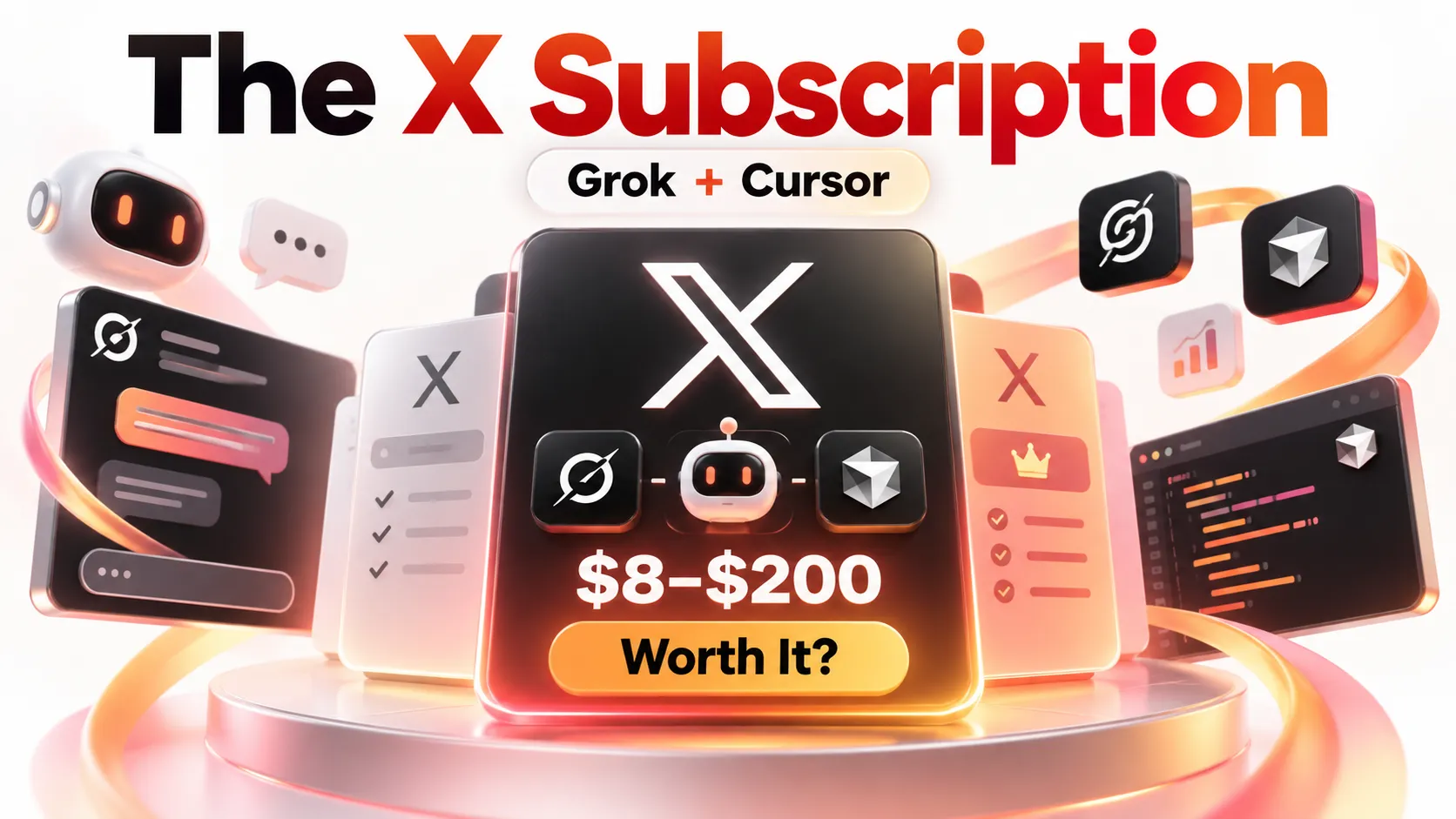
The X Subscription is a unified subscription offering access to several products through a consolidated subscription and billing experience.
It covers four main product categories:
- Grok: An AI assistant supporting text conversations, voice interactions, image generation, video creation, and other AI workflows.
- Grok Bot: An AI agent product designed to carry out tasks and workflows rather than simply answer questions.
- Cursor: An AI-powered coding environment offering local coding assistance and cloud-based coding agents.
- X Premium: Subscription benefits for the X social network, including creator features, verification-related benefits, and reduced advertising depending on the selected tier.
The strategic change is broader than bundling four products at a discounted price.
Previously, developers could subscribe to Cursor, use Grok through another subscription, and pay separately for X Premium. The X Subscription introduces a common account and billing framework, with a shared allowance for eligible first-party AI activity.
That shared allowance changes how usage must be measured and compared.
Is X Pass the official name?
No. The official announcement and documentation consistently use The X Subscription.
X Pass has appeared as informal terminology in online discussions. Users searching for X Pass pricing, X Pass Cursor access, or X Pass Grok benefits are generally looking for information about the official unified subscription.
The authoritative references are the official launch announcement and subscription documentation.
The X Subscription Pricing: All Five Plans Compared
The official pricing documentation lists five individual plans, including a free option.
| Plan | Monthly Price | Annual Price | Included AI Usage | Grok Bot | X Benefits |
|---|---|---|---|---|---|
| Free | $0 | $0 | Limited | Limited starter access only; no paid Bot entitlement | Standard X |
| Plus | $8 | $80 | Base allowance | No | Checkmark, creator tools, fewer ads |
| Premium | $30 | $300 | 4x Plus | Yes | X Premium+ |
| Super | $100 | $1,000 | 15x Plus | Yes | X Premium+ |
| Ultra | $200 | $2,000 | 50x Plus | Yes | X Premium+ |
The usage multipliers are relative to the Plus plan, not independent allocations for each product.
Annual billing offers approximately 16.7% savings compared with paying the listed monthly rate for 12 months.
These are published US-dollar list prices. Sales tax, regional billing conditions, and eligible promotions can affect the final amount. Check the official pricing details and the account checkout page before purchasing.
Free: $0/month
The Free tier provides an entry point to the ecosystem without a subscription payment.
According to the official announcement, it includes daily access to Grok Chat, Imagine, Voice, and Build, alongside a starter allowance for Cursor coding agents and standard X functionality.
Free is most appropriate for occasional AI questions and exploratory coding tasks. It should not be treated as a dependable allowance for sustained agent workloads.
Plus: $8/month
Plus adds a larger AI usage allowance and selected X Premium benefits.
Its appeal is straightforward: users who primarily want Grok and X benefits can access both for a relatively low monthly price.
However, two limitations matter:
- Grok Bot is not included. Full Grok Bot entitlement begins with Premium.
- Paid third-party models in Cursor are associated with Premium and higher tiers. Plus should not be treated as a replacement for a full Cursor Pro subscription.
The $8 price is therefore attractive for lightweight AI activity, but not necessarily for professional software development.
Premium: $30/month
Premium is the central offering in the new product lineup.
It provides the combined benefits associated with Grok, Cursor Pro, and X Premium+, alongside access to Grok Bot and four times the Plus first-party allowance.
The official launch announcement describes this combination as replacing standalone benefits that previously cost approximately $90 per month when purchased together.
That comparison is useful, but it does not mean every historical plan entitlement is reproduced identically.
In particular, previously included third-party model usage in certain Cursor plans does not carry into the new shared allowance.
Premium is best suited to users who regularly use Grok models, want integrated coding agents, and value having X Premium+ as part of the same subscription.
Super: $100/month
Super increases the included AI allowance to 15 times the Plus baseline.
Its primary value is capacity for frequent first-party AI workflows, rather than a fundamentally different billing model.
It is aimed at developers and agent users whose first-party AI consumption regularly exceeds Premium's weekly allowance.
Before upgrading, compare actual weekly usage against the live plan details. A higher subscription is not automatically more economical than occasional top-ups.
Ultra: $200/month
Ultra provides 50 times the Plus included usage and targets particularly intensive AI workflows.
It may appeal to users running extensive coding sessions, multiple agent tasks, or frequent multimodal generation.
The X Subscription Ultra is not equivalent to the historical Cursor Ultra subscription. The new plan focuses on its unified first-party usage allowance, while third-party models remain separately billed.
For a developer who primarily uses Claude or GPT models, the higher base price alone does not eliminate API charges.
How the Shared Weekly AI Usage Pool Works
The shared usage pool is the most important technical detail in the subscription system.
Under the new model, eligible first-party AI activity across supported Grok and Cursor products draws from a single allowance assigned to the subscription seat.
The included allowance refreshes weekly.
One allowance, multiple products
Consider a Premium subscriber who uses Grok Chat, Cursor, and Grok Bot during the same week.
- On Monday, several Grok conversations consume part of the included pool.
- On Tuesday, Cursor coding sessions using eligible Grok models consume more of that same pool.
- On Wednesday, Grok Bot executes a series of complex tasks, reducing the remaining allowance further.
- Once the included usage is exhausted, the subscriber can wait for the next reset or pay for additional eligible usage through prepaid credits.
The products do not each receive an independent four-times-Plus allocation.
According to the official usage limits documentation, different products and activities can consume the pool at different rates.
What does 4x, 15x, or 50x actually mean?
These multipliers describe relative included usage compared with the Plus baseline.
They do not establish a universal number of prompts, coding requests, agent runs, video generations, or tokens.
A short chat response and a complex autonomous coding task may have substantially different consumption characteristics.
This means a direct comparison based only on the number of messages can be misleading.
The live usage dashboard is the appropriate reference for determining the remaining allowance and the next reset date.
Does the usage pool reset weekly or monthly?
The included first-party allowance refreshes weekly.
However, several other billing mechanisms operate separately, including prepaid credit balances, monthly additional-usage spending caps, and the subscription billing cycle.
A weekly reset does not reset the user's monthly paid-usage spending cap.
This distinction matters when planning workloads that frequently exceed the included allocation.
Does sharing a pool automatically reduce value?
Not necessarily.
A shared allowance can be useful when demand varies between products. Someone who uses relatively little Grok Chat one week can devote more of the eligible capacity to coding.
However, a shared pool can be less predictable for users who previously relied on separate product allowances.
The economic result depends on how the products are actually used, which models are selected, and how quickly different tasks consume the allowance.
The Biggest Hidden Cost: Claude and GPT in Cursor
The most consequential limitation is that the new subscription's included usage does not cover third-party models in Cursor.
This includes supported models from providers such as Anthropic and OpenAI.
Third-party models remain available on Premium, Super, and Ultra, but their usage is billed at API list prices from the first request and paid through prepaid credits.
The distinction is confirmed in the Cursor subscription overview and official additional-usage documentation.
Why this changes the value proposition
A developer using Cursor primarily with Grok models benefits directly from the included first-party allocation.
A developer using Cursor primarily with Claude or GPT can accumulate additional charges even when substantial first-party allowance remains unused.
For such a user, the new plan behaves more like a subscription fee plus metered model consumption.
Illustrative example:
| Cost Component | Monthly Amount |
|---|---|
| The X Subscription Premium | $30 |
| Hypothetical third-party model usage | $25 |
| Total before tax | $55 |
The $25 figure is a hypothetical workload cost, not an official usage estimate or benchmark.
The calculation is important because the advertised $30 monthly fee does not necessarily represent the complete operating cost of Cursor when using third-party models.
Do existing Cursor Pro subscribers lose included third-party usage?
Not if they remain on their eligible existing plan under the current transition policy.
Cursor's October 13, 2026 community clarification confirms that subscribers retaining their previous plans continue receiving their existing included third-party allowances.
Moving to The X Subscription replaces that structure with the new billing rules.
The company also states that existing plans will not be removed immediately and that advance notice will be provided before any future mandatory transition.
The official Cursor discussion contains direct staff explanations of these distinctions.
Additional Cursor Token Rate for teams
There is another cost that applies specifically to team subscriptions.
The official documentation specifies a Cursor Token Rate of $0.25 per million tokens for third-party model requests on team plans, in addition to the underlying model's API pricing.
For example, 10 million chargeable third-party tokens would generate a $2.50 Cursor Token Rate charge, plus the associated model API usage charges.
Individual subscriptions do not pay this additional Cursor Token Rate.
First-party models, including Grok and Composer, are exempt from that rate. This exemption should not be confused with a guarantee that every model or activity is included in the same weekly usage pool.
See the Cursor Token Rate documentation for the current scope.
The Four Billing Controls You Need to Understand
The new system separates included AI usage from additional paid consumption.
Understanding its four controls prevents both unexpected charges and avoidable workflow interruptions.
| Billing Control | Purpose | Important Detail |
|---|---|---|
| Weekly included pool | Covers eligible first-party AI usage | Shared across supported products; refreshes weekly |
| Prepaid balance | Pays for additional AI consumption | Third-party Cursor models use it from the first request |
| Monthly spending cap | Limits paid additional usage | Separate from the amount of prepaid credit held |
| Auto Top-up | Automatically replenishes prepaid credit | Disabled unless explicitly enabled |
Prepaid credits
When first-party included usage is exhausted, further eligible usage can be funded with prepaid top-ups.
Third-party models in Cursor also consume prepaid credits from their first billable request.
Without sufficient prepaid credit, paid additional usage may stop.
Monthly additional-usage cap
A spending cap places a limit on paid additional usage during a calendar month.
It does not limit the purchase of prepaid credits themselves.
As a result, an account can still have a prepaid balance but be unable to continue paid additional usage because the monthly cap has been reached.
Auto Top-up
Auto Top-up automatically purchases additional credits when the prepaid balance falls below a configured threshold.
It is optional and is not automatically enabled by account migration.
For cost-conscious developers, the safest starting configuration is to keep Auto Top-up disabled, purchase only the credit required for initial evaluation, and establish a monthly additional-usage cap.
Settings are available through the Grok billing dashboard.
The X Subscription vs Cursor Pro, SuperGrok, and X Premium+
The official announcement emphasizes the value of combining previously separate subscriptions.
However, the correct comparison depends on which parts of those subscriptions an individual actually uses.
| Existing Product or Plan | Historical Standalone Price | Relevant X Subscription Alternative | Key Consideration |
|---|---|---|---|
| Cursor Pro | $20/month | Premium, $30/month | Grok coding capacity increases, but third-party usage is separate |
| Cursor Pro+ | $60/month | No exact one-to-one equivalent | Compare actual model allowances and workflows |
| Cursor Ultra | $200/month | Ultra, $200/month | The included third-party model entitlement is different |
| SuperGrok | $30/month | Premium, $30/month | Adds Cursor and X benefits under the unified subscription |
| X Premium+ | Varies by purchase terms and region | Premium or higher | Personal X account must be connected |
| Grok Bot | Depends on existing entitlement | Premium or higher | Draws from the unified weekly pool |
Historical prices describe the previous standalone offerings, not an assertion that they remain available for new sign-ups.
Is the $30 bundle really equivalent to $90 of old subscriptions?
The launch announcement explicitly markets Premium as combining benefits previously priced at approximately $90 per month.
That is a comparison of bundled product access, not necessarily a guarantee of identical usage economics.
A subscriber who genuinely pays for and regularly uses all three categories may experience substantial savings.
But a developer paying only $20 per month for Cursor Pro does not automatically save money by moving to a $30 subscription, especially if additional model charges increase the total.
A more useful break-even calculation
The effective monthly cost can be modeled as:
Effective Monthly Cost = Subscription Fee + Third-Party Model Charges + First-Party Overages + Applicable Taxes
For a hypothetical subscriber previously spending $90 per month across separate products, moving to $30 Premium creates $60 of nominal monthly headroom for extra usage before reaching the same $90 total, excluding taxes.
If additional usage costs $20, the resulting $50 total is lower than $90.
If additional usage costs $70, the resulting $100 total is higher.
Neither outcome proves the plans have equivalent capabilities. The calculation only demonstrates why usage-based spending must be included in the comparison.
Who benefits most from consolidation?
Likely beneficiaries:
- Users already paying for multiple products in the ecosystem.
- Developers who prefer Grok models for most coding tasks.
- Creators who actively use X Premium+ alongside AI generation tools.
- Users who want Grok Bot and Cursor within a consolidated workflow.
Users who should evaluate migration carefully:
- Developers whose existing Cursor plans include substantial Claude or GPT usage.
- Subscribers with discounted legacy pricing.
- Users who rarely use X Premium features.
- Teams with established billing, identity, and governance requirements.
How to Switch to The X Subscription
Existing subscribers can begin migration through official account-unification interfaces.
The correct entry point depends on the service they already use.
For existing Cursor users
- Open Cursor account unification.
- Sign in to the Cursor account intended for migration.
- Choose eligible Grok and personal X accounts to connect.
- Review the linked accounts carefully, particularly if multiple work and personal accounts exist.
- Select the new subscription tier.
- Examine the billing terms, applicable offer, refunds, and changed model allowances before confirming checkout.
- After switching, manage billing, prepaid credits, and usage through the Grok dashboard.
For existing Grok subscribers
Start from the Grok account unification page and follow the prompts to associate eligible Cursor and X accounts.
An X subscription entry point may also be offered within X itself.
Different account email addresses are supported
The email addresses associated with Cursor, Grok, and X do not need to match.
The migration process connects the specific accounts the user authenticates, not every account sharing an email address.
This makes account selection particularly important for users maintaining separate business and personal identities.
Account unification is irreversible
The official documentation explicitly states that completed account unification cannot be undone, including by Support.
Cancellation does not restore the original independent account arrangement or historical subscription benefits.
This is fundamentally different from a normal reversible monthly plan upgrade.
Review the official unification guide before proceeding.
What Happens to Existing Subscriptions and Refunds?
For eligible directly billed subscriptions, switching cancels the selected existing plans and issues prorated refunds for unused subscription time.
However, the refund is processed separately from the new purchase.
For example, a subscriber may initially pay the full new plan price while the unused portion of an old subscription is refunded later to the original payment method.
The refund is not necessarily applied as an immediate discount at checkout.
Apple App Store subscriptions require special attention
If an existing Cursor subscription was purchased through Apple's App Store, switching does not automatically cancel or refund that Cursor subscription.
The user must cancel it through Apple and request any applicable refund directly from Apple.
For certain Grok and X subscriptions purchased through Apple's App Store, the service may initiate cancellation and request an Apple-managed refund, but Apple determines the outcome.
Google Play subscriptions
After migration, users with relevant Google Play subscriptions should inspect their subscription status and manually cancel any subscription that remains scheduled to renew.
Failing to verify the old subscription can create overlapping charges.
Is migration mandatory?
Not immediately, as of October 13, 2026.
Existing eligible Cursor, SuperGrok, and X Premium subscribers can retain their current plans under the published transition policy.
The official announcement indicates that remaining subscribers may eventually be moved to the new system, but it gives no fixed migration date and promises advance notice.
For subscribers benefiting from grandfathered model allowances, postponing migration can preserve meaningful economic value.
The X Subscription for Teams and Enterprises
The unified subscription also introduces team pricing and centralized management.
Team seats are available at the following published monthly rates:
| Team Tier | Monthly Price Per Seat | Included Usage Multiplier |
|---|---|---|
| Premium | $30 | 4x Plus |
| Super | $100 | 15x Plus |
| Ultra | $200 | 50x Plus |
Plus is not offered as a team seat tier.
Mixed seat tiers
Teams can assign different subscription levels to individual members.
For example, a small development team might allocate Premium seats to occasional users and Super seats to developers running more frequent agent workflows.
This avoids requiring every member to purchase the same high-capacity tier.
Team usage is not one unlimited shared pool
Each paid team seat has its own weekly included first-party allowance.
The team's prepaid balance for additional usage is shared at the workspace level.
That distinction is important when estimating costs: one member's unused weekly included allocation should not be assumed to transfer automatically to another team member.
Administrative capabilities
The official offering includes centralized subscription management, invoicing, usage visibility, and organizational controls.
Team members can obtain the corresponding X benefits after linking eligible personal X accounts.
Organization-managed or affiliate X accounts cannot be connected for those personal benefits under the current rules.
Enterprise eligibility depends on the existing contractual and account structure. Some enterprise migrations require an account team, while other enterprise combinations are not yet supported.
The team plan documentation explains workspaces, seats, and additional-usage balances.
The X Subscription 50% Discount: Is It Available?
Social media discussions surrounding the launch have mentioned discounts of up to 50%.
The official announcement confirms that limited-time upgrade offers exist for eligible existing subscribers.
However, published documentation does not establish a universal 50% discount available to every subscriber, for every tier, in every region.
Users should distinguish three separate pricing concepts:
- Standard list price: The publicly documented price of the plan.
- Annual billing discount: The lower effective monthly cost associated with paying annually.
- Promotional upgrade offer: An account-specific or time-limited discount displayed during the migration process.
A promotion may apply only to particular plans, subscribers, or billing periods.
Before subscribing, inspect the actual checkout total, renewal amount, and promotional duration. A first-month discount should not be interpreted as a permanent reduction unless its terms explicitly say so.
The most reliable place to check eligibility is the account's official billing or migration interface.
Common Problems and Mistakes to Avoid
1. Assuming $8 includes full Cursor Pro
Plus provides access to selected AI and coding capabilities, but it does not reproduce all higher-tier Cursor functionality. Grok Bot is also excluded.
Users requiring professional coding agents and supported third-party model access should evaluate Premium or higher.
2. Assuming a 4x allowance means four times as many prompts
AI tasks have different resource costs. The multiplier does not translate into a fixed universal message count.
Track real usage in the account dashboard rather than relying on estimated prompt counts.
3. Using third-party models without monitoring credit consumption
Claude and GPT requests in Cursor are additional paid usage under the new system.
Set a spending cap and inspect model selection before beginning long-running workloads.
4. Expecting old Cursor Ultra entitlements to transfer unchanged
A new Ultra subscription does not automatically preserve the previous Cursor Ultra model allowance structure.
Existing Ultra subscribers should compare their current contract, historical model usage, and projected API expenses before migrating.
5. Confusing prepaid credit with a spending cap
Adding prepaid money does not increase the monthly paid-usage cap.
If additional usage stops despite remaining prepaid credit, inspect the monthly cap before purchasing more credit.
6. Accidentally combining personal and work accounts
Account unification is permanent, and eligible personal accounts must remain distinct from incompatible enterprise or team configurations.
Confirm account identity, repositories, workspaces, and billing ownership before proceeding.
7. Forgetting an App Store subscription
A successful web migration does not guarantee that every older mobile-store subscription has been canceled.
Check the relevant Apple or Google subscription management page after migration.
8. Assuming chat subscriptions include unrestricted developer API credits
Access to Grok's consumer AI products should not be interpreted as unlimited Grok API or X API usage.
Developer API access, usage-based billing, and any applicable credits should be verified against the specific Grok API documentation and developer billing console. The unified consumer subscription does not establish an unlimited API allowance.
Which X Subscription Plan Should You Choose?
The best plan depends primarily on actual usage rather than the number of products displayed in its feature list.
| User Profile | Suggested Starting Point | Reason |
|---|---|---|
| Occasional AI user | Free | No commitment; limited starter access |
| X user seeking Grok features | Plus, $8 | Low monthly price and X benefits |
| Developer using Grok with Cursor | Premium, $30 | Meaningful shared coding usage and agent access |
| Developer heavily using Claude or GPT | Compare existing Cursor plan before switching | Third-party API charges may dominate cost |
| Frequent Grok Bot user | Premium initially; evaluate Super from measured usage | Bot and coding tasks share the same pool |
| High-volume first-party AI user | Super or Ultra | Larger included first-party allowance |
| Development team | Premium seats with selective upgrades | Per-member allocation and centralized billing |
Practical evaluation strategy
A controlled evaluation is more reliable than choosing Ultra based on its headline multiplier.
- Identify the models used in existing workflows and separate first-party from third-party consumption.
- Record actual spending on current subscriptions and additional model usage.
- Estimate the proportion of work that could be performed with included Grok models.
- If starting a new subscription, choose the lowest plan offering the essential capabilities.
- Monitor weekly first-party consumption and separately billed model usage.
- Compare the total monthly cost with the previous setup before selecting a higher tier or annual commitment.
Existing subscribers should make this comparison before irreversible migration, not afterward.
Frequently Asked Questions
Is The X Subscription officially launched?
Yes. The official announcement was published on October 12, 2026, and the service began rolling out to new customers and eligible existing subscribers. Availability of migration options may vary by account during rollout.
Is X Pass the same as The X Subscription?
X Pass is an informal name used in some discussions. The official product name is The X Subscription.
How much does The X Subscription cost?
The published monthly individual prices are $0 for Free, $8 for Plus, $30 for Premium, $100 for Super, and $200 for Ultra. Annual options are also available.
Does the $8 Plus plan include Grok Bot?
No. Full Grok Bot entitlement is included with Premium, Super, and Ultra.
Does Premium include Cursor Pro features?
The official launch describes Premium as combining the benefits associated with Cursor Pro, Grok, and X Premium+. However, third-party model allowances differ materially from previous standalone Cursor plans.
Can Claude and GPT models still be used in Cursor?
Yes, supported third-party models remain available on Premium and higher plans. They are billed separately at API list prices and consume prepaid additional-usage credit from the first request.
Does the $200 Ultra plan include unlimited Claude usage?
No. The higher included usage multiplier concerns the unified first-party allowance. Third-party model usage remains separately billed.
Is Grok Bot usage separate from Cursor usage?
No. Eligible Grok Bot activity consumes the same weekly first-party allowance as supported Grok and Cursor usage.
Can existing Cursor users keep their current subscription?
Yes, under the current transition policy. Existing eligible plans continue unless subscribers change or cancel them, with advance notice promised before future mandatory changes.
Can account unification be reversed?
No. Official documentation states that completed unification is permanent and cannot be reversed by Support.
What happens if the weekly allowance runs out?
Users can wait for the next reset or continue eligible activity using additional prepaid credits, subject to account controls and spending caps.
Is The X Subscription available for teams?
Yes. Premium, Super, and Ultra team seats are available with centralized billing and management. Each seat receives its own weekly included allowance.
Is the 50% discount guaranteed?
No. The official announcement confirms limited-time upgrade offers, but eligibility, discount amount, and duration must be confirmed in the subscriber's billing interface.
Does subscribing automatically include X Premium benefits on every X account?
No. Paid benefits apply when an eligible personal X account is connected. Organization-managed X accounts are not supported for personal benefit linking under the published rules.
Does canceling restore an old Cursor plan?
No. Canceling ends the new subscription according to its billing terms, but does not reverse account unification or automatically restore historical plan entitlements.
Conclusion
The X Subscription is an important shift toward unified AI subscriptions that connect conversational assistance, autonomous agents, software development, and social platform features.
Its headline value is compelling: Premium combines multiple major products at $30 per month, while Super and Ultra provide larger allowances for users with intensive first-party AI workloads.
But the most important purchasing decision is not whether $30 is cheaper than a collection of historical subscription prices.
It is whether the included Grok-based usage matches the subscriber's actual workflows.
For developers who frequently use Grok, Cursor, and Grok Bot together, the new plans could offer meaningful value. For developers who depend primarily on Claude or GPT through Cursor, the additional API charges and potential loss of legacy allowances require closer examination.
Existing subscribers should also account for the irreversible nature of account unification, differences in refund handling, and the possibility of overlapping mobile-store subscriptions.
Before switching, compare real model usage, calculate total expected monthly expenses, configure spending limits, and verify any promotional terms.
Explore the official subscription announcement, review the complete pricing documentation, and check the current account offer before making a permanent migration decision.
Continue Reading
More articles connected to the same themes, protocols, and tools.



Referenced Tools
Browse entries that are adjacent to the topics covered in this article.