
On This Page8 sections
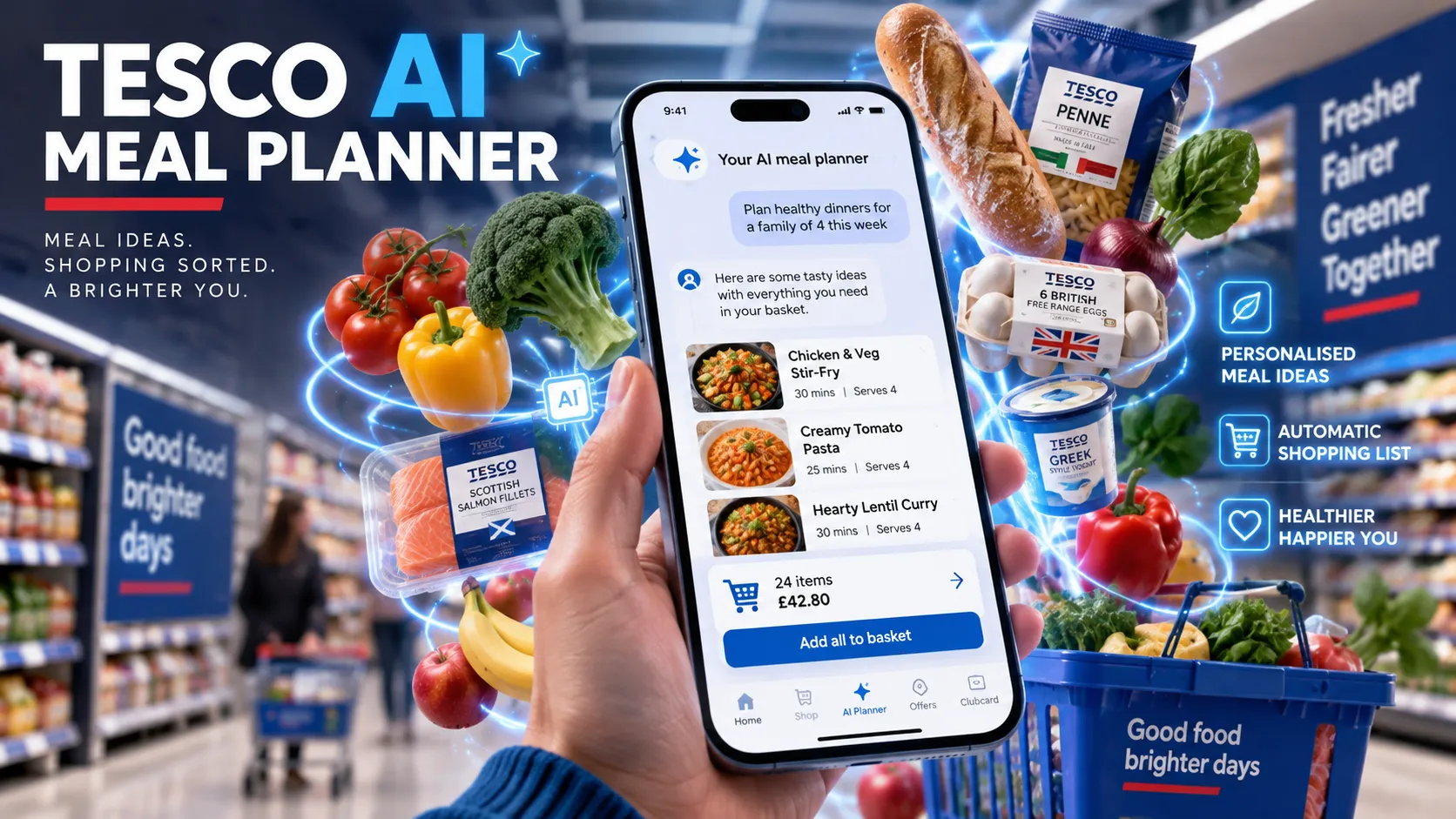
Tesco is bringing artificial intelligence directly into the weekly grocery shop. After testing an AI-powered meal-planning assistant with its workforce, the UK's largest supermarket has begun rolling out the technology to selected customers through the Tesco app.
The new Tesco Meal Planner uses conversational AI to suggest recipes, accommodate dietary preferences, plan meals around a budget and help customers add ingredients to their shopping baskets. It can also draw on relevant Tesco shopping history to make recommendations more personalised.
The development represents a significant expansion of Tesco's AI strategy. Instead of using AI solely for marketing, forecasting and personalised offers, the retailer is introducing an assistant that participates directly in everyday shopping decisions.
However, the rollout has important limitations. The feature remains in beta, availability is restricted, and customers should not assume that every Clubcard account automatically has access.
Key Takeaways
- Tesco began rolling out its AI Meal Planner to selected customers in September 2026, following an employee beta launched on April 9, 2026.
- Approximately 280,000 Tesco employees were offered early access to the initial trial. This figure does not represent the number of customers currently using the feature.
- The assistant can recommend recipes, consider dietary preferences, build meal plans, identify ingredients and help populate Tesco shopping baskets.
- Clubcard-related shopping information can improve personalisation, but the assistant does not necessarily know which groceries are currently in a customer's home.
- Tesco confirmed the customer rollout in its October 8, 2026 interim financial results, alongside the expansion of its separate Your Clubcard Prices programme.
- The Meal Planner is free during its beta period, although normal grocery ordering and delivery charges may still apply.
- Customers must verify ingredient information, allergens, nutritional details, availability and prices before relying on AI-generated suggestions.
- Tesco's rollout arrives as competitor Sainsbury's introduces its own AI-powered shopping feature, SmartLists.
What Is the Tesco Clubcard AI Feature?
The feature commonly described as the Tesco Clubcard AI assistant is officially presented by Tesco as its AI-powered Meal Planner.
It is integrated into the existing Tesco app rather than distributed as a standalone AI application. Its purpose is to simplify the process of deciding what to eat, finding suitable recipes and purchasing the required groceries.
Traditional online grocery shopping generally begins with a product search. Customers search for individual ingredients, compare products and manually add items to their baskets.
Tesco's new approach begins earlier in the decision-making process.
A customer might ask for five affordable family dinners, a vegetarian meal using leftover vegetables or a quick recipe that avoids particular ingredients. The assistant can interpret that request, suggest meals and help identify suitable products from Tesco's catalogue.
According to Tesco's original April 2026 announcement, the system was designed around a natural, two-way conversation that takes account of individual preferences.
The distinction matters: Tesco is moving from product discovery toward AI-assisted shopping workflows. The assistant is intended to bridge the gap between planning a meal and assembling the ingredients required to prepare it.
It should not, however, be confused with a fully autonomous purchasing agent. Tesco has confirmed assistance with basket building, not independent checkout or payment without customer involvement.
Tesco AI Meal Planner Rollout Timeline
The product has moved through several identifiable stages.
| Date | Development | Significance |
|---|---|---|
| April 9, 2026 | Tesco announces its AI assistant beta | Around 280,000 employees are offered early access |
| August 19, 2026 | Tesco publishes public Meal Planner support documentation | Official instructions describe functionality, access restrictions and privacy controls |
| September 2026 | Customer rollout begins | Selected Tesco customers begin receiving access |
| October 7, 2026 | Sainsbury's launches SmartLists | Competition in AI-assisted grocery shopping intensifies |
| October 8, 2026 | Tesco confirms rollout in its interim results | The retailer publicly connects Meal Planner expansion with its wider personalisation strategy |
| October 10, 2026 | Latest verified status | The feature remains in a gradual, selected-customer rollout |
In its October 8 interim financial results, Tesco confirmed that it had launched the assistant in April, trialled it with approximately 280,000 colleagues and started its broader customer rollout in September.
The same announcement reported that Your Clubcard Prices had expanded to approximately 2.5 million customers.
These are two separate developments. The 2.5 million figure relates to personalised Clubcard pricing, not the number of customers who have received the AI Meal Planner.
As of October 10, 2026, Tesco has not established a publicly confirmed date when every eligible customer will receive the assistant.
How Does the Tesco AI Meal Planner Work?
The assistant combines natural-language interaction with information that can make recipe suggestions and shopping recommendations more relevant.
Its workflow can be understood through five stages.
1. Understanding the meal-planning request
The experience begins with a conversational request rather than a conventional grocery search.
Customers can describe their requirements using ordinary language, including meal types, ingredients, cuisine preferences, family needs and budget considerations.
2. Accounting for personal preferences
The system can use relevant shopping information, preferences shared by customers and information remembered from earlier interactions.
For example, a customer who frequently chooses vegetarian meals could receive more relevant suggestions after providing that preference to the assistant.
However, historical shopping activity does not provide perfect knowledge of someone's current food inventory or dietary requirements.
3. Generating meal and recipe suggestions
The assistant suggests meals that appear compatible with the customer's instructions.
Users can refine the results through additional questions rather than beginning an entirely new search.
4. Matching recipes to Tesco products
After a suitable recipe has been identified, the system can help match the required ingredients to actual Tesco products.
This is a crucial difference between an ordinary AI chatbot and a retailer-integrated shopping assistant. A generic chatbot may produce an ingredient list, while Tesco's assistant can help convert that list into products available through its own shopping experience.
5. Building a shopping basket or shopping list
Customers can use the suggested ingredients to build an online grocery basket or prepare a list for shopping in a physical store.
Tesco's official Meal Planner introduction confirms these capabilities.
The customer should still inspect the resulting products, quantities, prices and suitability before proceeding.
What Can Tesco's AI Assistant Actually Do?
The confirmed functionality extends beyond basic recipe generation.
| Capability | What customers can do | Important limitation |
|---|---|---|
| Recipe recommendations | Request meal ideas using natural language | Suggestions may not always be appropriate |
| Dietary preferences | Share food preferences and ingredients to avoid | Not a reliable substitute for allergy verification |
| Budget-based planning | Request inexpensive meals or a spending target | Final basket prices must be checked |
| Weekly meal planning | Organise meals across multiple days | Customers should check portions and practical requirements |
| Shopping history personalisation | Receive suggestions informed by relevant Tesco shopping activity | Purchase history is not a live inventory |
| Ingredient lists | Identify groceries needed for a recipe | Quantities and pack sizes may require adjustment |
| Shopping basket assistance | Match ingredients to Tesco products | Does not establish autonomous checkout capability |
| Personalised memory | Reuse some preferences shared during previous interactions | Depends on information and permissions available |
| In-store assistance | Consult meal plans and shopping lists while shopping | Requires connectivity and feature access |
Tesco explains that the Meal Planner can build and update remembered preferences, including disliked ingredients, nutritional goals and preferences for other household members.
This information can improve relevance over time, but it also creates important privacy considerations discussed later in this guide.
How to Access Tesco's AI Meal Planner
The assistant is accessed through the existing Tesco app. There is no separate official Meal Planner application that customers need to install.
According to Tesco's access instructions, eligible users should follow these steps:
- Update the Tesco app. Install the latest available version through the appropriate app store.
- Open the app and sign in. Use the Tesco account associated with normal shopping activity.
- Switch to Online mode. The mode selector is located near the top of the app's home screen.
- Look for the Meal Planner button. Tesco says it may appear near the bottom of the home page or on basket and product screens.
- Open the assistant. Customers who have received access can begin using the meal-planning experience.
- Describe a meal-planning requirement. Specify the budget, number of people, dietary preferences and ingredients already available.
- Review the recommendations. Verify suggested products before adding them to an order or relying on the information for an in-store shop.
Important: Access is account-dependent during the beta. Updating the app does not guarantee that the Meal Planner button will appear.
Tesco may also inform selected customers about access through marketing communications where they have agreed to receive them.
Why Is Tesco Meal Planner Not Showing in the App?
A missing Meal Planner button does not necessarily mean that the feature has been discontinued or that an account is malfunctioning.
Tesco identifies several possible explanations.
The account has not been selected.
The most significant limitation is the phased beta rollout. Not every customer can access the assistant yet.
The Tesco app is outdated.
Older app versions may not display newly introduced functionality. Updating the application is an appropriate first troubleshooting step.
The app is displaying the wrong shopping mode.
Tesco specifically instructs customers to check the Online section rather than relying on the In-store mode interface.
The customer is viewing a screen without the button.
The Meal Planner entry point may appear on selected screens rather than remaining continuously visible throughout the app.
If these checks do not resolve the problem, the customer may simply need to wait until their account becomes eligible.
The official availability FAQ confirms that access is expanding gradually and not every customer will be included during the beta.
There is no confirmed public method for bypassing this eligibility restriction.
Practical Examples: What to Ask Tesco's AI Meal Planner
The quality of an AI-generated meal plan depends partly on the specificity of the request.
A vague question such as asking for dinner ideas leaves the assistant to infer many important details. A more complete prompt provides constraints that can improve practical usefulness.
Example 1: Budget-conscious family dinners
Create five weekday dinners for a family of four.
Keep the total ingredient budget below £50.
Use chicken, rice, potatoes and seasonal vegetables.
Prefer ingredients that can be reused across meals.
List the ingredients I need to buy at Tesco.
This request establishes a budget, household size, planning period and ingredient preferences.
Example 2: Using existing groceries
I have eggs, spinach, rice and two tomatoes.
Suggest three dinner options using these ingredients.
Tell me what additional ingredients I would need.
Prioritise meals that minimise food waste.
This example addresses an important weakness of shopping-history-based personalisation: the customer explicitly describes what is currently available at home.
Example 3: Dietary preferences and time constraints
Suggest four vegetarian dinners for two adults.
Each meal should take around 30 minutes or less.
Avoid mushrooms and use affordable ingredients.
Create a shopping list with quantities for each item.
The assistant can use these preferences to guide its suggestions. However, dietary restrictions involving allergies or medical requirements require additional independent verification.
Example 4: Adjusting an existing plan
Make the second and third meals cheaper.
Reuse more ingredients between the recipes.
Replace any unavailable products with suitable alternatives.
Show the revised ingredients and estimated shopping cost.
Follow-up questions are particularly useful because the system supports a conversational workflow.
These prompts illustrate intended use cases rather than independently verified outputs from a specific Tesco account.
Can Tesco's AI Meal Planner Actually Save Money?
Tesco positions the assistant as a way to reduce the time, effort and potential cost of meal planning.
There are several plausible mechanisms through which it could help customers spend less.
Reducing unnecessary purchases. A meal plan that reuses ingredients across several recipes may reduce the number of separate products required.
Making better use of existing food. Customers who tell the assistant what is already in their kitchen may receive suggestions that reduce duplicate buying and unused ingredients.
Introducing budget constraints earlier. Asking for meals within a defined spending target may discourage expensive recipes before customers begin filling their baskets.
Reducing planning friction. A shopping assistant that connects recipes to actual products may make it easier to compare meal options without repeatedly searching for individual ingredients.
However, an AI-generated inexpensive recipe is not automatically an inexpensive grocery order.
Consider a hypothetical meal with an estimated ingredient cost of £8. The recipe might require only a small amount of oil, flour or seasoning, while the shopper must purchase full retail packs. The checkout cost could therefore exceed the estimated cost of ingredients consumed.
A useful comparison should distinguish between:
- Recipe consumption cost: The estimated value of ingredients actually used in the meal.
- Basket purchase cost: The amount required to buy the available retail packages.
- Effective cost per serving: The relevant cost divided by the number of servings, with assumptions about leftover ingredients made explicit.
- Final order cost: The actual amount paid after applicable promotions, substitutions and ordering charges.
These distinctions are especially important for small households, where buying full packages may result in unused food.
Tesco has not published sufficiently detailed independent evidence establishing the average financial savings produced by the Meal Planner. Claims that every user will save a specific amount would therefore be premature.
How Does Clubcard Data Improve AI Recommendations?
Clubcard and Tesco shopping activity provide useful context because they reveal aspects of customers' purchasing behaviour.
Tesco's information and personalisation FAQ explains that the assistant may use account information, shopping history, previous conversations and preferences that users choose to share.
The information available depends on how the service operates and the permissions supplied.
For example, repeated purchases of particular foods could provide clues about familiar ingredients or preferred products. A customer who explicitly tells the assistant that they dislike a specific ingredient may receive better suggestions in subsequent conversations.
The major limitation is that historical purchasing data is not the same as current household inventory.
A customer might have bought milk last week and already finished it. Another household member might have purchased ingredients elsewhere. Some previously purchased food might have expired or been discarded.
Tesco explicitly acknowledges this limitation in its guidance on knowing what customers have at home.
Consequently, customers should provide current information about available ingredients rather than assuming that the assistant knows exactly what is inside their refrigerators.
Tesco Meal Planner vs Your Clubcard Prices: What Is the Difference?
The two initiatives appeared together in Tesco's October 2026 financial reporting, but they serve different purposes.
| Feature | Tesco AI Meal Planner | Your Clubcard Prices |
|---|---|---|
| Primary purpose | Personalised meal planning and shopping assistance | Personalised product pricing |
| Main experience | Conversational AI recommendations | Customer-specific promotional offers |
| Core information | Preferences, conversations and relevant shopping activity | Customer and shopping personalisation signals |
| Customer action | Create meal plans and build shopping baskets | Purchase eligible products at applicable personalised prices |
| Reported rollout status | Selected-customer beta expansion | Approximately 2.5 million customers reached by October 2026 |
Your Clubcard Prices is a distinct personalised pricing initiative. It should not be interpreted as evidence that millions of shoppers already have access to the Meal Planner.
Likewise, the presence of Clubcard Prices on a product does not guarantee that an AI-generated recipe will meet a particular budget.
The final prices and applicable offers should always be verified in the actual shopping basket.
What Technology Powers the Tesco AI Assistant?
Tesco developed the assistant with support from Tomoro, a UK-based enterprise AI engineering company.
In its public description of the project, Tomoro characterised the Meal Planner as a multi-agent AI system built around conversational meal planning and shopping-basket creation.
A multi-agent approach generally means that multiple specialised AI components or workflows cooperate to complete a larger task.
For a grocery assistant, the underlying problem can involve several logically distinct operations:
- Interpreting the shopper's request and constraints.
- Maintaining relevant preferences and conversational context.
- Producing appropriate recipe suggestions.
- Translating ingredients into products from a retailer's catalogue.
- Helping update a shopping list or basket.
These stages explain why supermarket shopping assistants are technically more demanding than standalone recipe generators.
Recipe generation can produce plausible text without needing to know whether a product exists in a particular retailer's inventory. Grocery integration requires matching that text to real products, quantities, prices and availability information.
The stages above describe the functional requirements, not a verified internal architecture diagram. Tesco and Tomoro have not publicly disclosed every implementation detail, model selection, routing mechanism or validation process.
The OpenAI and Tomoro connection
Tomoro has an established relationship with OpenAI.
On May 11, 2026, OpenAI announced the creation of the OpenAI Deployment Company and stated that it had agreed to acquire Tomoro.
This connection makes Tesco's assistant an interesting example of enterprise AI moving into a customer-facing retail application.
However, the relationship does not establish which particular model currently processes Meal Planner requests. Claims that the service definitely uses a specific GPT model or model version would require additional technical disclosure.
Tesco has also announced broader AI partnerships, including initiatives involving Mistral AI and Adobe. Those relationships should not be conflated with the exact technology stack powering the Meal Planner.
What Customer Data Does Tesco's AI Meal Planner Use?
Personalisation is one of the assistant's main advantages, but it introduces legitimate questions about data collection, access and retention.
According to Tesco's official data FAQ, the Meal Planner may process several categories of information, including:
- Information associated with a Tesco account.
- Relevant Tesco shopping information.
- Conversations with the AI assistant.
- Preferences supplied by customers.
- Activity within the Meal Planner experience.
- Information remembered to improve future recommendations.
Tesco says customers can review the latest applicable data privacy information through the Meal Planner menu by selecting Data privacy.
The assistant may build a personalised profile from information provided during interactions. Tesco identifies dietary preferences, disliked ingredients, nutritional goals and household preferences as examples of information that may be remembered.
This can improve the experience, but users should understand that information shared in an AI conversation can have implications beyond the immediate question.
What happens to sensitive health information?
Tesco states that special-category information, such as health details voluntarily provided to the Meal Planner, is used to operate and personalise that experience.
According to its health information and marketing guidance, this information is not used for personalised promotions or marketing without additional consent if that use changes.
The distinction is important because dietary preferences can sometimes reveal sensitive information about a person's health.
Can customers opt out?
Yes. Using the Meal Planner is optional, and customers can continue shopping through Tesco's regular app experience without using it.
Tesco also provides controls for withdrawing consent related to the Meal Planner.
Its opt-out guidance states that withdrawing consent prevents further use until consent is provided again. Tesco says identifiable Meal Planner chat history will be deleted as soon as possible following withdrawal.
Users seeking an exact explanation of retention periods, data recipients and processing conditions should consult the current privacy notice available within the app rather than relying solely on general product descriptions.
Limitations and Risks: What Tesco's AI Cannot Guarantee
AI integration does not eliminate the practical risks associated with food shopping.
Allergen and dietary safety
Tesco acknowledges that the assistant may misunderstand an allergy, intolerance or dietary preference.
A suggested recipe should never be treated as proof that its ingredients are safe for someone with a food allergy.
Customers must check current labels and product information before purchasing, preparing or eating the suggested food.
Nutrition accuracy
AI-generated nutrition estimates may be incorrect or based on assumptions about portion sizes, brands or ingredients.
A shopping assistant is not a substitute for professional medical or nutritional advice where such guidance is required.
Ingredient availability
A recommended product may be unavailable in a particular store or delivery area. Customers may need to select alternatives.
Price changes and substitutions
The cost of a suggested meal may differ from the final order total. Product prices, pack sizes, promotions and availability can affect the result.
Incomplete knowledge of household supplies
The assistant may infer that an ingredient is available because it was previously purchased, even though it has already been consumed.
AI-generated mistakes
The system may misunderstand a request or produce suggestions that do not fully satisfy the original constraints.
Tesco's official guidance on possible mistakes specifically advises checking important product details.
These limitations are particularly relevant during beta testing, when real-world feedback is being used to improve the experience.
Tesco AI Meal Planner vs Sainsbury's SmartLists
Tesco is not the only major UK supermarket introducing AI into grocery shopping.
On October 7, 2026, Sainsbury's announced SmartLists, an AI-powered feature integrated into its redesigned shopping app.
The two products approach a related problem from different directions.
| Category | Tesco AI Meal Planner | Sainsbury's SmartLists |
|---|---|---|
| Primary focus | Planning meals and discovering recipes | Creating and managing shopping lists |
| Starting point | Conversational meal requirements | Typed requests, meal ideas or photographs of lists |
| Personalisation | Relevant shopping history and preferences | Product matching and Nectar-related pricing |
| Basket integration | Assists with Tesco basket building | Matches items to Sainsbury's products for trolley addition |
| In-store utility | Meal plans and ingredient lists | Shopping lists and product finding |
| Public launch milestone | Customer rollout began September 2026 | Announced October 7, 2026 |
Sainsbury's describes SmartLists as a way to turn informal shopping requests or photographed lists into actual products available through its catalogue.
Its official SmartLists announcement also highlights integration with Nectar Prices and an in-store Product Finder.
Tesco's assistant places greater emphasis on meal discovery and conversational planning, while SmartLists emphasises converting shopping intentions into product lists.
The strategic similarity is more important than the interface differences: both retailers are trying to reduce the work required between deciding what to buy and placing products into a shopping basket.
For retailers, this creates potential opportunities to improve convenience, digital engagement and repeat purchasing. However, neither launch announcement establishes a verified long-term improvement in customer savings or AI-driven conversion rates.
Why Tesco's AI Rollout Matters for the Retail Industry
The broader significance of Tesco's initiative lies in the transition from AI-generated recommendations to AI-assisted transactions.
Traditional e-commerce interfaces require shoppers to navigate categories, product pages, filters and search results.
Conversational shopping assistants can allow the customer to describe an outcome instead.
For example, a shopper may care more about preparing healthy family meals for a week than about searching for 15 separate grocery items.
A capable assistant can begin with that higher-level objective and help translate it into a practical shopping workflow.
Three factors make this particularly relevant to supermarket retail.
First, grocery shopping is repetitive. Many households purchase similar categories of products every week. This creates opportunities for preference-based recommendations, although historical behaviour must not be confused with current needs.
Second, grocery purchases are constraint-heavy. Budgets, household sizes, allergies, preferences, stock availability and package quantities all affect purchasing decisions. These constraints provide practical reasons for using conversational interfaces rather than relying exclusively on keyword search.
Third, the retailer controls the product catalogue. Connecting an AI assistant to a real shopping environment can make its recommendations immediately actionable.
The remaining challenge is reliability.
Retail AI must do more than generate convincing language. It must preserve user constraints, handle product substitutions, minimise inaccurate assumptions and avoid presenting unsafe or unavailable products as suitable choices.
What could come next?
Potential future directions include more accurate household inventory estimation, better cross-recipe ingredient reuse, improved product substitution, stronger budgeting tools and more contextual shopping recommendations.
These are logical opportunities for the category, not confirmed features on Tesco's published roadmap.
As of October 2026, there is no confirmed public evidence that the Tesco Meal Planner independently completes payments, guarantees the lowest available grocery bill or has achieved a specified commercial return on investment.
Frequently Asked Questions
Is Tesco's AI Meal Planner available to everyone?
No. As of October 10, 2026, Tesco is gradually making the beta available to selected customers. Full availability has not been confirmed.
Is Tesco Clubcard AI a separate app?
No. The Meal Planner is built into the existing Tesco app. Clubcard-related shopping information may support its recommendations, but Tesco presents the product as an AI Meal Planner.
How do I know whether my account has access?
Look for the Meal Planner button in the updated Tesco app while using Online mode. The button may appear on the home page, basket or product screens.
Why can't I find the Tesco AI feature?
Your account may not have been selected for the beta, the app may need updating, or the relevant button may not be visible in your current shopping mode.
Is Tesco's AI Meal Planner free?
Yes. Tesco confirms that the Meal Planner is free during beta testing. Standard charges associated with grocery orders may still apply.
Can it plan a full week of meals?
Yes. Tesco's documentation identifies weekly meal planning as a supported use case. Customers should specify their household size, budget and dietary preferences for more useful suggestions.
Does the assistant automatically know what is in my fridge?
No. Shopping history can provide clues, but customers should explicitly describe ingredients they currently have at home.
Can I use it without placing an online order?
Yes. Tesco states that customers can use the assistant for meal inspiration, planning and shopping lists without completing an online grocery purchase.
Can I use it while shopping inside Tesco?
Yes, provided the feature is available to the account and the mobile device has a working connection. Product availability may vary between stores.
Can Tesco's AI guarantee allergy-safe meals?
No. Tesco warns that AI-generated recommendations may not correctly interpret allergies or dietary restrictions. Product labels and current official ingredient information must be checked independently.
Does Tesco use my previous purchases?
The Meal Planner may use relevant Tesco shopping activity, depending on the information available and the permissions associated with the account.
Can I delete my Meal Planner information?
Tesco provides a consent-withdrawal process and states that identifiable chat history will be deleted as soon as possible after withdrawal. Customers should review the latest privacy notice for the applicable details.
Is Tesco using a specific OpenAI model?
Tomoro, which developed the assistant with Tesco, has an established relationship with OpenAI. However, Tesco has not publicly confirmed the exact underlying model configuration used by the Meal Planner.
When will Tesco release the AI Meal Planner to all customers?
Tesco has confirmed a gradual expansion but has not announced a definitive date for universal availability.
Conclusion
The Tesco Clubcard AI feature rollout marks an important step toward conversational grocery shopping. Tesco's AI Meal Planner connects recipe discovery, personalised recommendations and shopping-basket assistance within an existing retail application.
The rollout is already underway, but it remains gradual. The assistant began with an employee beta in April 2026, reached selected customers starting in September and received renewed attention following Tesco's October 8 financial results.
Its most promising capability is not simply generating recipes. It is the ability to connect everyday meal-planning decisions with products customers can actually purchase.
Yet the experience has meaningful limitations. Availability remains restricted, shopping history is not a live pantry inventory, estimated costs may differ from checkout totals, and AI-generated dietary suggestions must always be independently verified.
For customers who want to try the feature, the practical next step is to update the Tesco app, switch to Online mode and check for the Meal Planner button. Tesco's official Meal Planner help pages provide the most reliable information about current access, functionality and privacy controls.
For the wider retail industry, Tesco's experiment will be worth watching as AI shopping assistants evolve from answering questions to helping customers complete increasingly complex purchasing tasks.
Continue Reading
More articles connected to the same themes, protocols, and tools.

Referenced Tools
Browse entries that are adjacent to the topics covered in this article.