
On This Page3 sections
What Happened
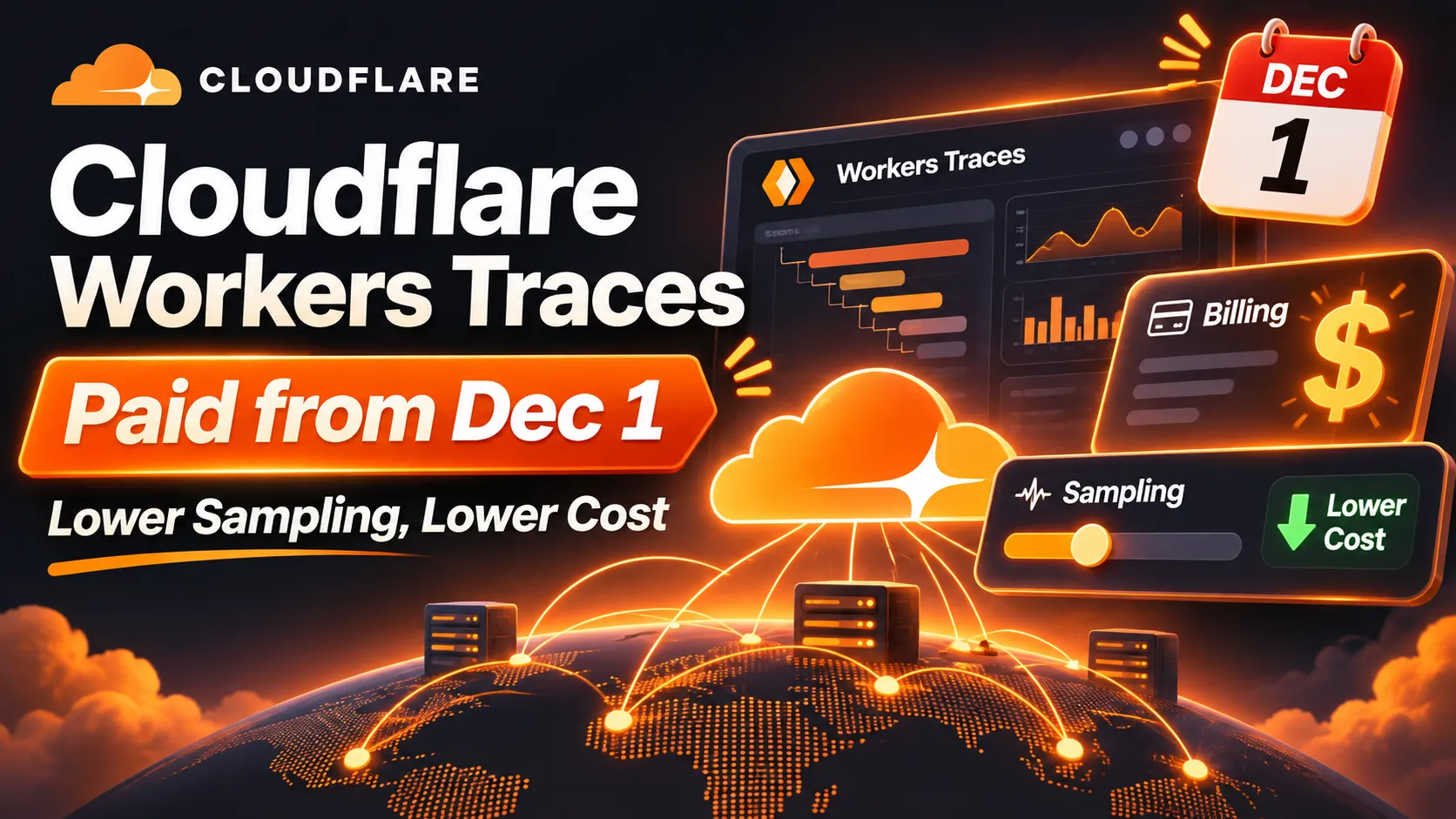
Cloudflare Workers Traces will transition to usage-based billing on December 1, 2026, potentially increasing Observability costs for developers running high-traffic Workers applications.
Under the new pricing model, trace data stored in Cloudflare Observability will be billed based on data ingestion and storage rather than the number of requests or individual traces.
The pricing changes will take effect for Free, Pro, and Business accounts on December 1, while Enterprise customers will transition at their next contract renewal.
According to Cloudflare's Observability pricing documentation, the updated pricing includes:
- Free plan: 0.5 GB of data ingestion per day, with seven-day retention. Ingestion stops when the daily allowance is exhausted, without automatic overage charges.
- Paid plans: 50 GB of data ingestion and 10 GB-month of storage included per billing cycle.
- Additional ingestion: $0.25 per GB beyond the included allowance.
- Additional storage: $0.10 per GB-month beyond the included allowance.
These allowances are shared across supported Observability products, including Workers Logs, Workers Traces, Cloudflare Traces, and AI Gateway Logs.
Why It Matters
Workers Traces helps developers diagnose performance issues by automatically capturing request execution details, external fetch calls, and interactions with services such as KV, R2, and Durable Objects.
However, the default sampling rate for enabled Workers Traces is 1, representing 100% of requests unless developers explicitly configure a lower value.
For applications processing millions of requests, collecting traces for every request can generate substantial data ingestion and storage usage. With the upcoming billing changes, developers who previously relied on full tracing may face unexpected costs.
Cloudflare provides a configuration option called head_sampling_rate that controls the proportion of incoming requests selected for tracing.
For example:
1(100%): Trace every request.0.1(10%): Trace approximately one in ten requests.0.01(1%): Trace approximately one in 100 requests.0.001(0.1%): Trace approximately one in 1,000 requests.
Reducing the sampling rate from 100% to 1% can theoretically reduce the number of sampled requests by approximately 99%, while preserving a smaller dataset for performance analysis and troubleshooting.
Actual billing savings will depend on trace sizes, request volume, storage retention, and usage from other Observability products. A 99% reduction in sampled requests does not necessarily translate into a 99% reduction in the total bill.
What's Next
Developers should review their Workers Traces configuration before December 1 and adjust sampling rates based on their monitoring requirements.
How to Reduce Workers Traces Sampling
For projects using wrangler.toml, add or update the following configuration to enable 1% tracing:
[observability.traces]
enabled = true
head_sampling_rate = 0.01
For projects using wrangler.jsonc, configure the same settings inside the observability object:
{
  "observability": {
    "traces": {
      "enabled": true,
      "head_sampling_rate": 0.01
    }
  }
}
After updating the configuration, redeploy the Worker:
npx wrangler deployDevelopers who do not need distributed tracing can disable Workers Traces entirely:
[observability.traces]
enabled = false
Important: Workers Traces and Workers Logs have independent sampling configurations. Disabling traces does not automatically disable logs or eliminate other Observability charges.
For production applications, starting with a 1% trace sampling rate may provide a reasonable balance between operational visibility and cost control. Developers can temporarily increase sampling during investigations or reduce it further for high-volume workloads.
Cloudflare also provides billing usage information to help customers monitor data ingestion, storage, and estimated charges under the updated pricing model.
Developers should review the official Workers Traces documentation and Observability pricing details to verify their configurations and understand the new billing model before it takes effect.
Continue Reading
More articles connected to the same themes, protocols, and tools.


Referenced Tools
Browse entries that are adjacent to the topics covered in this article.