On This Page8 sections
Key Takeaways
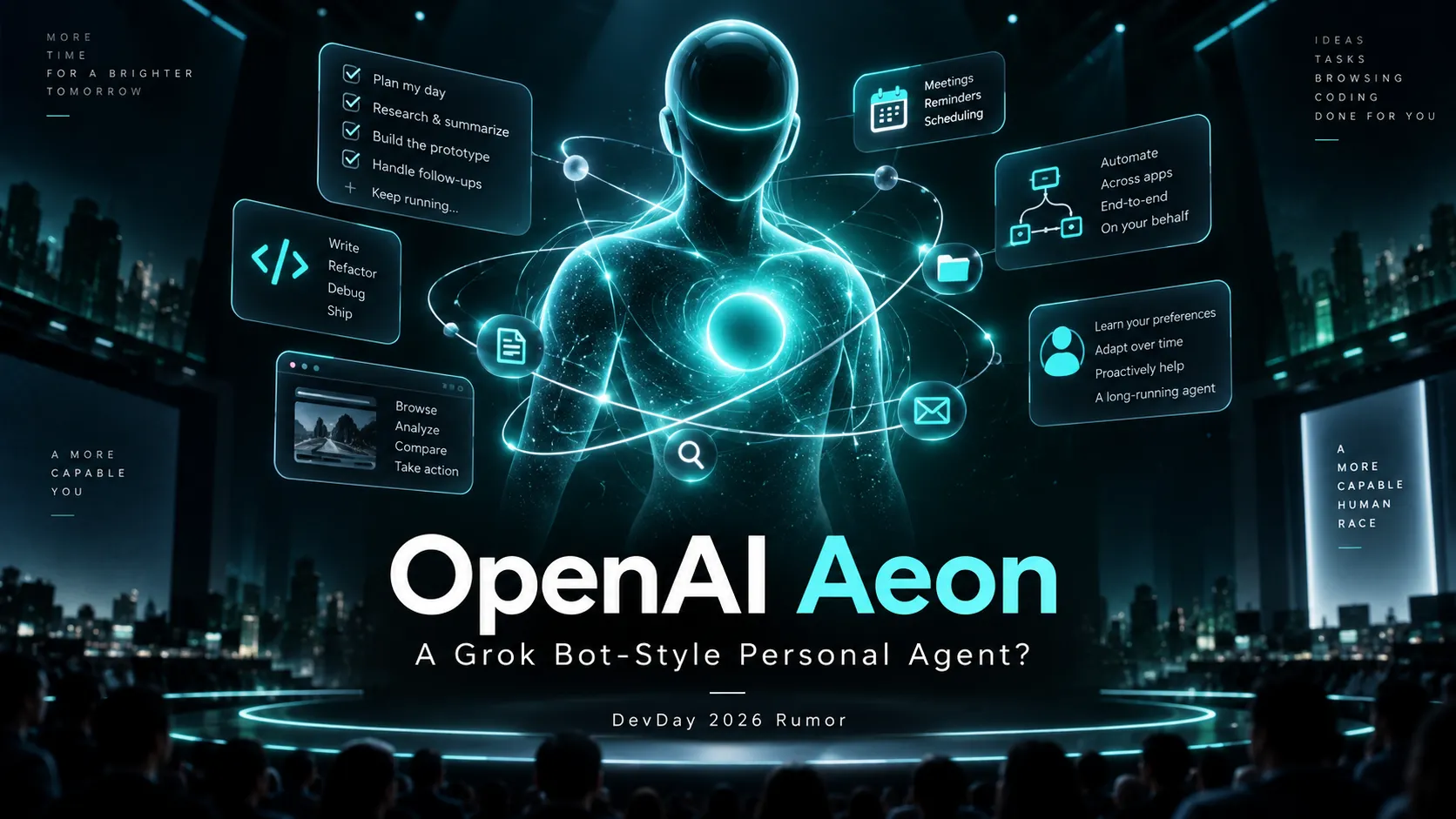
- OpenAI is reportedly developing features to compete directly with Grok Bot, an always-on AI teammate product designed to handle recurring tasks, operate software, and continue working in the background.
- The most credible public clue is not the rumored name Aeon, but OpenAI's broader move toward persistent agents.
- OpenAI already has much of the required infrastructure. Its Agents API is designed for cloud agents that can run for days, use tools, coordinate subagents, work with files, execute code, and save intermediate results.
- OpenClaw creator Peter Steinberger joined OpenAI in February 2026 to work on the next generation of personal agents, providing another strong signal that persistent personal agents are a strategic direction.
- The name Aeon has appeared in leak discussions around OpenAI and Codex, but OpenAI has not officially announced a product called Aeon.
- OpenAI DevDay 2026 takes place on September 29 in San Francisco. OpenAI has not confirmed that Aeon will launch there.
- The bigger story is the shift from chatbots that answer prompts to long-lived agents that own goals, maintain context, use applications, and continue work without constant prompting.
What Is Actually Confirmed About OpenAI's Grok Bot Rival?
The strongest evidence does not come from a screenshot, an anonymous leak, or a speculative model name.
On September 21, 2026, The Information reported that OpenAI is developing features intended to compete more directly with Grok Bot, an always-on AI teammate designed to handle routine work, manage software, collaborate in the background, and report back when tasks are completed or require approval.
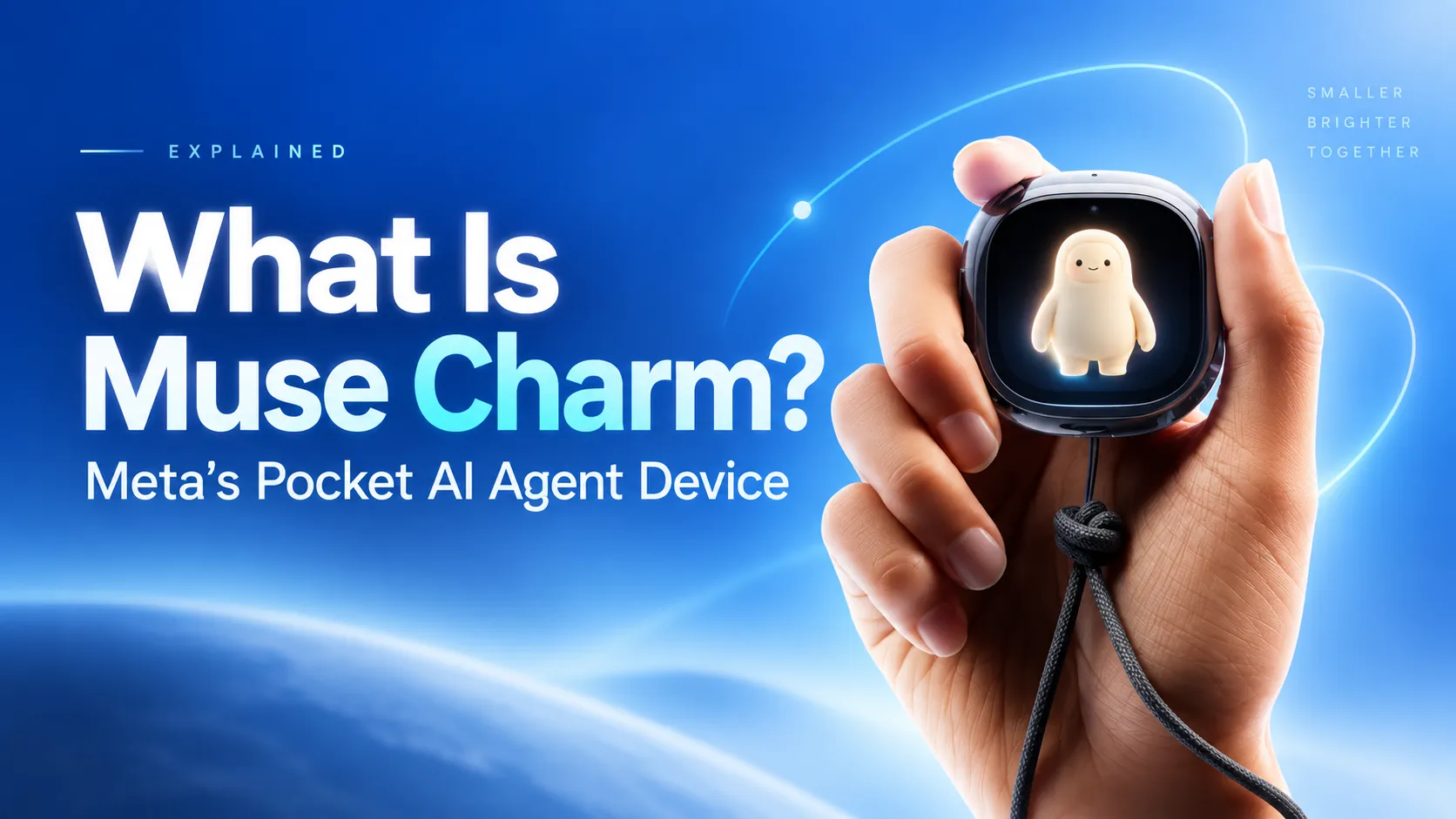
The same reporting said OpenAI has also discussed a consumer personal assistant in response to Meta's Muse.
The important point is that OpenAI may not need to build such a product from scratch. It can combine technologies already available across ChatGPT, Codex, persistent execution, connected apps, computer use, and its agent infrastructure.
The question is therefore no longer whether OpenAI has the technical ingredients for a persistent personal agent.
The unanswered questions are:
- What will the product be called?
- How much autonomy will it receive?
- Will it exist as a persistent identity rather than a chat session?
- Which models will power it?
- How will permissions and approvals work?
- Will it launch at DevDay?
Why the Name Aeon Is Getting So Much Attention
The codename Aeon has become the center of recent speculation because leak trackers have reported Aeon-related identifiers around OpenAI products and Codex builds.
Reported strings have included names such as:
aeonModelId
aeonDraftName
aeonDraftAppearance
aeonId
memberAeonIds
thread/startAeon
These strings are interesting because, if authentic and interpreted correctly, they appear to describe more than a model selector.
For example:
aeonDraftNamecould indicate a named agent instance.aeonDraftAppearancecould point to an avatar or visual identity.aeonModelIdwould make sense if the agent and its underlying model are separate concepts.aeonIdcould indicate a durable agent object with its own identifier.memberAeonIdscould be consistent with agents participating in a larger workspace or group context.
However, none of those interpretations should be treated as confirmed product behavior.
Client strings routinely expose experiments that change, remain internal, or never ship. A field called appearance does not prove that users will create animated AI characters, and memberAeonIds does not prove that OpenAI is launching an AI social network.
The safest interpretation is narrower: OpenAI appears to be exploring increasingly persistent and configurable agent concepts, while Aeon is a plausible internal name associated with that work.
Persistent Mode Is the Strongest Clue
Aeon may still be a rumor, but persistent Codex agents are a much stronger signal.
In August 2026, WIRED reported that OpenAI had been testing a Codex Persistent mode intended to let an agent continue working until it is explicitly put to sleep.
The important part is not simply that a task can run for a long time.
A truly persistent agent needs several capabilities:
- Long-lived state: it must remember what it was doing across sessions.
- Task continuation: it must resume unfinished work without reconstructing the entire plan from scratch.
- Proactivity: it may create follow-up work after the original request is completed.
- User awareness: it needs enough historical context to know what remains relevant.
- Notification logic: it must decide when to stay quiet and when human input is required.
- Permission boundaries: it needs clear rules for actions that require approval.
- Recovery mechanisms: it must survive errors, tool failures, expired sessions, and changing external state.
That is much closer to an AI coworker than a conventional chatbot.
Peter Steinberger and the OpenClaw Connection
Another major signal arrived months before the Aeon leaks.
In February 2026, OpenClaw founder Peter Steinberger joined OpenAI. Sam Altman said Steinberger would work on the next generation of personal agents.
This matters because OpenClaw represents the same broader product philosophy now appearing across the agent market: an assistant should not merely produce text. It should be able to use tools, interact with services, manage ongoing work, and remain available over time.
The strategic direction is therefore unusually consistent:
OpenClaw-style personal agents → Steinberger joins OpenAI → persistent Codex work → Agents API → reports of a Grok Bot competitor → Aeon leaks.
No individual step proves that Aeon is the final product, but together they make the broader personal-agent direction difficult to dismiss.
The Agents API Makes an Always-On Agent Technically Plausible
OpenAI's Agents API provides much of the infrastructure required for long-running autonomous systems.
Useful persistent agents need a harness that manages context, uses tools efficiently, coordinates subagents, and provides infrastructure capable of keeping agents running reliably for long periods.
They also need environments where they can work with files, execute code, and retain intermediate state.
A consumer-facing personal agent could conceptually combine:
Persistent identity
        ↓
Long-term task state
        ↓
Agent harness
        ↓
Tools + connected apps
        ↓
Cloud execution environment
        ↓
Subagents
        ↓
Approvals and permission controls
        ↓
Notifications back to the user
The important architectural point is that the agent does not need to be the model.
A future OpenAI product could treat the agent as a durable container while allowing the underlying model to change over time.
Conceptually:
Agent identity = who is doing the work
Model = reasoning engine
Tools = capabilities
Cloud environment = computer
Memory = persistent context
Automations = triggers
Permissions = boundaries
That architecture would also explain why a field such as aeonModelId is interesting. It suggests a possible world in which the agent has a selectable model rather than being synonymous with one.
OpenAI Aeon vs. Grok Bot vs. Meta Muse
The personal-agent market is rapidly becoming a distinct competitive category.
| Capability | Grok Bot | Meta Muse | Possible OpenAI Direction |
|---|---|---|---|
| Persistent personal assistant | Yes | Yes | Strong evidence OpenAI is working in this direction |
| Background task execution | Core concept | Core concept | Supported by persistent-agent work |
| Connected applications | Yes | Yes | Already present across OpenAI products |
| Long-running cloud execution | Yes | Yes | Supported by OpenAI agent infrastructure |
| Coding and technical work | Agent dependent | Not the primary focus | Likely a major strength through Codex |
| Subagents | Product dependent | Not clearly central | Supported by OpenAI's agent architecture |
| User approvals | Important | Important | Existing OpenAI agents already use approval boundaries |
| Named or custom agent identities | Yes in bot-oriented systems | Assistant-oriented | Rumored for Aeon, not confirmed |
| Group or multi-agent social layer | Varies | Not core | Rumored, but currently unconfirmed |
For OpenAI, the opportunity is therefore not merely to copy Grok Bot.
The more differentiated strategy would be to combine consumer assistance, coding, computer use, connected apps, long-running execution, and subagents in one persistent agent system.
Why DevDay 2026 Is the Date to Watch
OpenAI DevDay 2026 is scheduled for September 29, 2026 in San Francisco.
Expectations have increased because OpenAI has signaled that the event will contain a large number of launches and updates.
That does not confirm Aeon.
It does, however, make DevDay a logical place to watch for announcements involving:
- Agent infrastructure
- Codex
- New APIs
- Plugins or application integrations
- Persistent execution
- Developer tooling
- New model access
- New ways to build or deploy AI applications
The key mistake would be to convert "DevDay will contain many launches" into "Aeon definitely launches at DevDay."
There is currently no official OpenAI announcement confirming that connection.
What Could OpenAI Actually Announce?
The available evidence supports several possibilities with very different confidence levels.
High Confidence: More Agent Infrastructure
This direction is already public.
OpenAI is investing heavily in long-running agents, Codex, subagents, tool use, and application integrations.
Additional tooling around deployment, tool access, context management, approvals, observability, or agent orchestration would fit the existing roadmap.
High Confidence: Deeper Codex and ChatGPT Agent Integration
OpenAI could combine existing agentic technologies from Codex and ChatGPT into a more coherent persistent-agent experience.
This could matter more than a completely new model.
A product can feel fundamentally new even when many of its underlying components already exist.
Medium Confidence: A Named Persistent Agent Product
Aeon is a plausible candidate, but the public evidence remains leak-level.
If OpenAI introduces a separate persistent-agent object, users may eventually be able to configure elements such as:
- Name
- Role
- Model
- Connected tools
- Cloud environment
- Approval policy
- Scheduled routines
- Memory scope
- Notification behavior
This would transform the interface from "start a new chat" into something closer to "create a new AI worker."
Lower Confidence: Profiles, DMs, and Groups
These ideas are attracting attention because they would turn AI agents into visible members of collaborative spaces.
A user could theoretically have:
Founder
├── Research Agent
├── Coding Agent
├── SEO Agent
├── Finance Agent
└── Operations Agent
A shared workspace could then look like:
Human team member
        ↕
Research Agent
        ↕
Coding Agent
        ↕
Operations Agent
But this remains speculative.
There is not enough official evidence to say OpenAI is building a social network for autonomous agents, and identifiers such as memberAeonIds should not be stretched beyond what they actually show.
Why a Persistent Agent Is More Important Than Another Chatbot Upgrade
The core AI interaction model has changed several times.
Phase 1: Ask AI
The user writes a prompt and receives an answer.
Phase 2: Ask AI to Do Something
The model gains browsers, code execution, computer use, and application connections.
Phase 3: Give AI Responsibility
The agent receives an objective and remains responsible for it over time.
That third phase changes the unit of value.
A chatbot is usually measured by response quality.
A persistent agent will increasingly be measured by:
- Tasks completed
- Time saved
- Correct actions
- Successful handoffs
- Approval efficiency
- Recovery from failures
- Cost per completed objective
- Reliability across hours or days
For developers, this also changes the architecture of AI products.
The important object is no longer only:
request → model → responseIt becomes:
goal
  ↓
persistent agent
  ↓
plan
  ↓
tools / apps / subagents
  ↓
state
  ↓
wait
  ↓
external event
  ↓
resume
  ↓
approval or completion
That is a much larger platform opportunity.
The Biggest Technical Challenges OpenAI Still Has to Solve
Persistent agents are powerful precisely because they can keep acting after the original prompt.
That also creates new failure modes.
Permission Scope
An agent that can read a calendar is very different from one that can cancel meetings.
A production system needs granular capabilities such as:
calendar.read
calendar.create
calendar.update
email.read
email.draft
email.send
payments.view
payments.execute
High-impact actions should not inherit permission simply because the agent has access to the underlying application.
Approval Fatigue
Requiring approval for every action defeats the purpose of automation.
Requiring approval for too few actions creates obvious security risks.
A strong personal-agent system therefore needs risk-sensitive approvals rather than a single global autonomy switch.
Long-Horizon Drift
The longer an agent runs, the greater the chance that its original assumptions become outdated.
A useful long-running agent must periodically check whether:
- The goal is still valid.
- External conditions have changed.
- A dependency failed.
- The user changed priorities.
- A previous instruction conflicts with a newer one.
Memory Boundaries
Persistent memory is useful for personalization, but an agent should not treat every historical detail as permanently relevant.
The system needs explicit boundaries around:
- What is remembered
- For how long
- In which workspace
- Which subagents can access it
- Whether personal and business contexts remain separated
Cost Control
Always-on agents can consume far more inference and tool usage than a conventional chat session.
Practical systems will need budgets, stopping rules, model routing, caching, and clear visibility into the cost of completing a task.
This is another reason why separating agent identity from model identity would make architectural sense. Routine monitoring could run on cheaper models while difficult reasoning is escalated to more capable ones.
What Developers Should Watch at DevDay
Rather than focusing only on whether the word Aeon appears on a slide, developers should watch for the primitives that would make persistent agents practical.
The most important signals would be:
- Durable agent IDs instead of disposable sessions
- Event-driven triggers for schedules, messages, application changes, or web events
- Persistent environments that survive across runs
- Subagent orchestration
- Tool permission policies
- Human approval APIs
- Agent-to-user notifications
- Agent memory controls
- Model routing inside one persistent agent
- Observability and execution logs
- Cost budgets and runtime limits
- Shared workspaces involving humans and agents
If OpenAI exposes these as APIs, the impact could extend far beyond a first-party assistant.
Developers could build specialized persistent agents for:
- Software maintenance
- Customer operations
- SEO monitoring
- Research
- Sales operations
- Finance workflows
- Competitive intelligence
- Content pipelines
- Personal administration
In that scenario, Aeon would be only the visible consumer layer of a much larger agent platform.
What Is Still Unconfirmed
Several claims circulating around Aeon should currently be labeled as rumors rather than facts:
- Aeon is the final public product name.
- Aeon will launch on September 29.
- Aeon is officially an independent personal identity inside ChatGPT.
- Every Aeon will have a customizable avatar.
- Aeons will have profiles and direct messages.
- Users will be able to create group chats containing multiple Aeons.
- OpenAI is launching an AI-native social network.
- A leaked Aeon-specific model name represents a new standalone frontier model.
- The product is officially called
o.
As of September 26, 2026, the strongest version of the story is more conservative:
OpenAI is building toward persistent personal agents, is reportedly working on features to compete with Grok Bot, already has long-running agent infrastructure, and is holding a launch-heavy DevDay on September 29.
That alone is significant.
Conclusion
The Aeon leak is interesting, but the rumored name is not the most important part of the story.
OpenAI has spent 2026 assembling the pieces of an always-on agent platform: Codex, persistent execution experiments, personal-agent talent, long-running cloud infrastructure, subagents, tool use, application connections, and agent APIs.
If those pieces are combined into a single consumer product, the interaction model could change from starting chats to creating durable AI teammates.
That would be a bigger shift than another incremental chatbot upgrade.
OpenAI DevDay on September 29 is therefore worth watching closely—not because an Aeon launch is guaranteed, but because the company now has both the technology and competitive pressure to show how its next generation of agents will work.
For developers, the key question is no longer simply which model is smartest.
It is becoming:
Which platform can turn intelligence into reliable, persistent work?
Continue Reading
More articles connected to the same themes, protocols, and tools.
Referenced Tools
Browse entries that are adjacent to the topics covered in this article.