On This Page8 sections
Key Takeaways
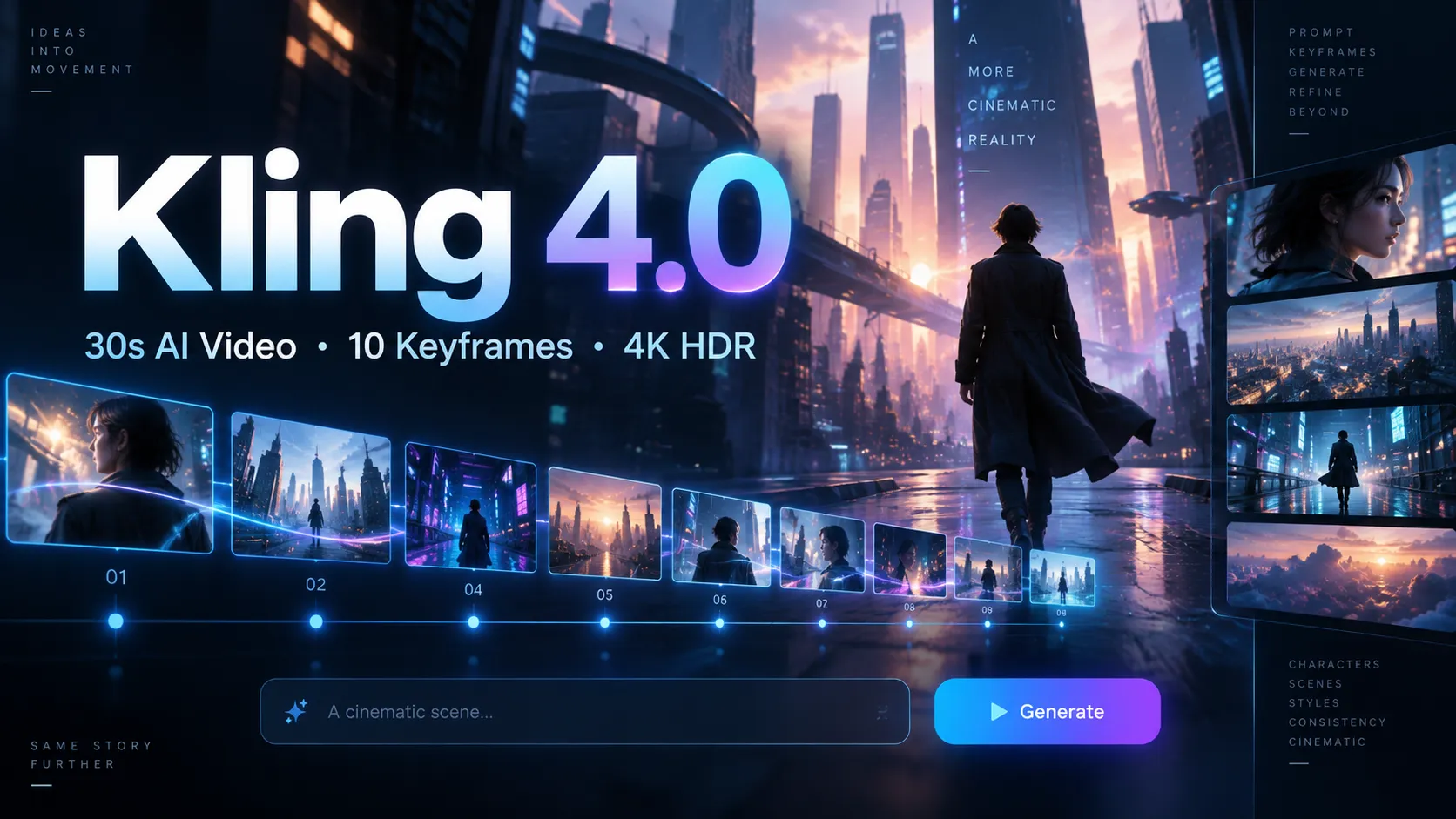
- Kling 4.0 is official. Kling AI announced on September 28, 2026 that the model will launch in October 2026, while Kling 4.0 Flash entered limited early access on September 28.
- The officially disclosed headline capabilities include up to 30 seconds in a single generation, 4K and 1080p 10-bit HDR output, and multimodal input combining as many as 10 images, 5 videos, and 7 subjects in one task.
- Early-access materials also describe up to 10 keyframes, richer Omni Reference controls, stereo audio, multilingual speech, localized video editing, format recreation, and longer extension workflows. These should still be treated as beta specifications that may change.
- The biggest upgrade is not simply 4K. Kling 3.0 already gained native 4K output earlier in 2026. Kling 4.0's more important shift is toward longer, storyboard-controlled, reference-heavy scene generation, combined with 10-bit HDR and stronger continuity.
- Final pricing, credit costs, and an official public Kling 4.0 API model ID have not yet been published.
What Is Kling 4.0?
Kling 4.0 is the next generation of Kuaishou's Kling AI video model family. It follows Kling 3.0, which launched in February 2026 with multimodal text, image, audio, and video input, native audio generation, multi-shot storytelling, reference-driven consistency, in-video editing, and video generation up to 15 seconds.
Kling 4.0 pushes that architecture toward a more directorial workflow.
Instead of treating AI video as a single prompt that produces a short clip, the new generation is increasingly built around longer scenes, more references, explicit keyframes, and tighter control over what changes throughout a sequence.
That distinction matters because the hardest problem in production AI video is no longer generating one attractive five-second clip. The difficult problem is maintaining the same character identity, wardrobe, product geometry, environment, camera language, audio, and narrative state for an entire scene.
Kling 4.0 appears designed to attack that problem directly.
Kling 4.0 Release Date and Availability
Kling AI announced Kling 4.0 on September 28, 2026 and said the full model will launch in October 2026. Kling 4.0 Flash began a limited rollout on September 28.
As of September 29, the important distinction is:
- Kling 4.0: officially announced, with broader availability planned for October 2026.
- Kling 4.0 Flash: already available through limited early access.
- Exact public release date: not officially specified yet.
- Public API: no final official Kling 4.0 API identifier or pricing schedule has been announced.
- Third-party integrations: availability will depend on each provider separately.
Any page claiming a precise October release day should distinguish an official announcement from leaks or partner estimates.
Kling 4.0 Confirmed Specifications
The currently disclosed core capabilities include:
| Capability | Kling 4.0 |
|---|---|
| Public launch window | October 2026 |
| Flash availability | Limited early access from September 28, 2026 |
| Maximum native generation | Up to 30 seconds |
| Resolution | 4K and 1080p |
| Color output | 10-bit HDR |
| Image inputs | Up to 10 |
| Video inputs | Up to 5 |
| Subjects | Up to 7 |
| Mixed multimodal input | Yes |
| Long-take generation | Yes |
| Continuous storytelling | Yes |
Early-access materials add several more capabilities, including up to 10 keyframes, stereo audio, multilingual speech, 21:9 output, video editing, format recreation, voice references, and extended long-video workflows. These are useful for understanding Kling's direction, but some limits may change before broad release.
The Biggest Upgrade: 30-Second Native Video
Kling 3.0 supports video generation of up to 15 seconds. Kling 4.0 doubles that native generation window to 30 seconds.
That sounds like a simple duration increase, but it changes what the model can reasonably attempt in one generation.
A five- to ten-second model is usually best suited to a shot:
- a character turns toward camera,
- a car drives through rain,
- a product rotates on a table,
- a dancer performs one movement.
Thirty seconds is long enough to attempt an actual scene:
- establish the environment,
- introduce the subject,
- perform an action,
- change camera position,
- deliver dialogue,
- reveal a product or narrative beat,
- finish on a deliberate ending frame.
The practical advantage is less stitching.
Every time separately generated clips are joined, the creator risks face drift, wardrobe changes, background discontinuity, lighting changes, altered product geometry, inconsistent camera motion, and audio mismatches.
A longer native generation does not guarantee perfect continuity, but it moves more of the sequence into one generation state where consistency should be easier to maintain.
Up to 10 Keyframes Could Matter More Than 30 Seconds
Early-access Kling 4.0 materials describe a keyframe workflow supporting up to 10 keyframes per generation.
This may be one of the most consequential changes for professional creators.
Traditional image-to-video systems usually offer a starting frame and, in some cases, an ending frame:
start -> model improvises -> end
A ten-keyframe workflow changes the control model:
frame 1 -> frame 2 -> frame 3 -> ... -> frame 10
The model still synthesizes motion between those states, but the creator gains far more control over the visual trajectory.
For example, a 30-second product advertisement could define:
| Approx. time | Keyframe direction |
|---|---|
| 0s | Product hero shot |
| 3s | Hand enters frame |
| 6s | Product is picked up |
| 10s | Camera moves to close-up |
| 14s | Product is used |
| 18s | Environment changes |
| 22s | Lifestyle shot |
| 25s | Product returns to center |
| 28s | Logo composition |
| 30s | Final end card |
This is closer to storyboard-driven generation than conventional prompt-driven generation.
It also creates a better debugging workflow. If the middle of a sequence fails, the creator can constrain specific visual beats rather than rewriting one enormous prompt and regenerating the entire concept blindly.
Omni Reference: Images, Videos, and Subjects in One Task
Kling 4.0 can combine up to:
- 10 images
- 5 videos
- 7 subjects
in the same generation task.
Different reference types solve different problems.
Image references are useful for:
- character appearance,
- product design,
- clothing,
- environments,
- art direction,
- lighting,
- composition.
Video references can communicate:
- body movement,
- camera movement,
- choreography,
- timing,
- pacing,
- transitions,
- performance style.
Subject references can lock persistent entities such as:
- an actor,
- a mascot,
- a branded product,
- a vehicle,
- a creature,
- a recurring prop.
A commercial workflow could therefore use product photography for geometry, a model reference for identity, a motion clip for choreography, and an example commercial for camera pacing inside the same generation workflow.
That is a fundamentally richer control surface than text prompting alone.
4K Is Not the New Part — 10-Bit HDR Is
It would be inaccurate to describe Kling 4.0 as the first Kling model with 4K.
Kuaishou rolled out native 4K output for the Kling 3.0 series earlier in 2026.
The more meaningful image-quality change in Kling 4.0 is the combination of:
- 4K or 1080p output
- 10-bit HDR
10-bit output can represent much finer tonal gradations than conventional 8-bit output. In practical creative work, that is particularly relevant for:
- skies and gradients,
- neon scenes,
- sunsets,
- fog and smoke,
- skin tones,
- strong backlighting,
- bright highlights,
- dark cinematic scenes,
- reflective products,
- professional color grading.
It does not automatically make every generation cinematic. Motion quality, temporal stability, exposure behavior, texture consistency, and compression still matter.
But for filmmakers and advertisers, 10-bit HDR is a more production-relevant improvement than simply adding more pixels.
Audio, Lip Sync, Languages, and Dialects
Kling 3.0 already introduced native audio generation across multiple languages, accents, and dialects, including support for complex multi-character dialogue.
Kling 4.0 early-access materials describe additional improvements including:
- stereo audio,
- improved lip synchronization,
- broader multilingual speech,
- multiple accents and Chinese dialects,
- voice references.
Some beta materials list nine spoken languages: Chinese, English, Japanese, Korean, Spanish, Portuguese, German, French, and Hindi.
These language counts should still be treated as early-access specifications, not immutable public-release limits.
The strategic direction is nevertheless clear: Kling is trying to generate the visual performance and its soundtrack as one coordinated scene, rather than forcing creators to generate silent video first and solve speech, ambience, sound effects, and lip synchronization in separate tools.
Kling 4.0 Video Editing Could Reduce Regeneration Waste
One of the most expensive problems in generative video is that a mostly successful clip often has to be regenerated because one small detail is wrong.
Early Kling 4.0 materials describe localized editing for properties such as:
- facial expression,
- body movement,
- camera angle,
- camera motion,
- background,
- visual style.
The intended workflow is essentially:
keep the successful parts, modify the failed part.
For example, if a 20-second product video has the correct actor, product, lighting, and camera path but the actor looks in the wrong direction around second 12, localized editing could be far cheaper than regenerating the entire clip.
This is why reference-driven editing may eventually matter as much as text-to-video generation itself. Professional teams care less about producing infinite random outputs than about getting one chosen output to the finish line.
Kling 4.0 Flash
Kling 4.0 Flash entered limited early access on September 28, ahead of the broader Kling 4.0 rollout.
The Flash naming suggests a speed- and efficiency-oriented variant.
Likely use cases include:
- prompt iteration,
- storyboard previews,
- social content,
- batch generation,
- reference testing,
- camera-direction testing,
- generating several candidates before a final high-quality render.
However, final Flash limits should not be guessed.
Pre-release interfaces and partner pages have shown different combinations of duration and resolution limits. Until the public specifications are published, specific Flash credit rates, maximum duration, and maximum resolution should be treated as provisional.
Kling 4.0 vs Kling 3.0
| Feature | Kling 3.0 | Kling 4.0 |
|---|---|---|
| Launch | February 2026 | October 2026 planned |
| Native video duration | Up to 15s | Up to 30s |
| Multimodal input | Text, image, audio, video | Expanded image/video/subject references |
| Image references | Supported | Up to 10 |
| Video references | Supported | Up to 5 |
| Subjects | Element and subject consistency | Up to 7 |
| Keyframe direction | Storyboard and shot control | Up to 10 in early-access materials |
| Native audio | Yes | Enhanced audio controls described in beta |
| 4K | Yes | Yes |
| HDR | Not a headline feature | 10-bit HDR |
| Native scene duration | Up to 15s | Up to 30s |
| Editing | In-video and reference editing | More granular editing described in beta |
| Fast tier | Kling 3.0 Turbo | Kling 4.0 Flash |
Kling 4.0 is therefore better understood as an expansion of Kling's multimodal generation system than as an entirely new product category.
Kling 4.0 Pricing and Credits
Kling AI has not yet published a final Kling 4.0 pricing table.
Creators should be cautious with pages claiming definitive:
- credits per second,
- cost per 5-second generation,
- cost per 30-second generation,
- 4K surcharges,
- Flash pricing,
- API per-second pricing.
Those numbers may come from beta accounts, regional subscriptions, partner pricing, or pre-release interfaces rather than the final public product.
The more useful production metric after launch will not simply be price per generation.
A better metric is:
cost per usable second
A model that costs more per render can still be cheaper in production if it requires fewer failed generations, follows keyframes more accurately, preserves product identity better, and requires less editing afterward.
Kling 4.0 API Status
As of September 29, 2026, no final official public Kling 4.0 API model ID or production pricing has been published.
Developers should therefore avoid hard-coding speculative identifiers such as kling-4-0 into production systems until official API documentation appears.
When the API becomes available, the most important fields to verify will include:
- model identifier,
- duration options,
- resolution options,
- aspect ratios,
- HDR controls,
- keyframe schema,
- image-reference limits,
- video-reference limits,
- subject-reference format,
- audio and voice controls,
- asynchronous job lifecycle,
- webhook behavior,
- moderation errors,
- regional availability,
- pricing units.
A Better Kling 4.0 Prompting Strategy
A 30-second model should not be prompted like a five-second model.
Instead of writing one dense paragraph, prompts should separate identity, environment, timeline, camera, audio, and continuity constraints.
A useful structure is:
SUBJECT
A 32-year-old woman with short black hair, beige trench coat, silver watch.

PRODUCT
Matte-black wireless earbuds case. Preserve exact shape and logo placement.

LOCATION
Rainy Tokyo side street at night, reflective pavement, practical neon lighting.

TIMELINE
0-5s: Wide establishing shot. Subject walks toward camera.
5-10s: Medium tracking shot. She removes the earbuds case from her coat.
10-16s: Close-up. She opens the case and inserts one earbud.
16-23s: Camera circles to profile. Traffic moves naturally in the background.
23-27s: She smiles and looks toward a passing train.
27-30s: Product hero close-up, shallow depth of field.

CAMERA
Natural handheld stabilization, 35mm cinematic look, no sudden focal-length changes.

AUDIO
Rain ambience, distant traffic, subtle train sound. No music.

CONTINUITY
Keep face, coat, watch, earbuds case geometry, logo, weather, and time of night consistent.

AVOID
Extra fingers, changing logos, duplicated pedestrians, text artifacts, abrupt scene resets.
For keyframe workflows, adjacent keyframes should remain physically and narratively reachable.
If one frame places a character facing left in a small indoor room and the next suddenly places the same character outdoors with entirely different clothing, lighting, and camera orientation, the model must invent a huge transition.
Keyframes work best when they define reachable states rather than unrelated images.
How to Use References More Efficiently
More references are not automatically better.
Ten images that contradict one another can reduce consistency rather than improve it.
A stronger reference package gives each asset a clear purpose:
- Identity reference: neutral face or full-body subject image.
- Wardrobe reference: clothing details.
- Product reference: clean front, side, and three-quarter views.
- Environment reference: location and lighting.
- Motion reference: desired body movement.
- Camera reference: desired camera path or shot structure.
- Voice reference: only when voice identity is essential.
Avoid using references with conflicting hairstyles, logos, product colors, time of day, clothing, or camera styles unless the variation is intentional.
For commercial generation, exact product geometry should normally have higher priority than decorative style references.
What Should Be Benchmarked After Public Release?
Marketing demos demonstrate the ceiling of a model, but they do not establish reliability.
Kling 4.0 should be tested with repeatable prompts across several difficult categories.
1. 30-Second Identity Consistency
Compare the same character at 0, 10, 20, and 30 seconds. Check face identity, hairstyle, accessories, clothing, and body proportions.
2. Ten-Keyframe Adherence
Create ten visually distinct but logically connected states and measure whether every state appears in the correct order, whether transitions are natural, and whether identity remains consistent.
3. Product Geometry
Use products with easily identifiable geometry such as packaging, shoes, phones, watches, and vehicles. Check logo placement, text, seams, buttons, proportions, and front-to-back consistency.
4. Multi-Character Dialogue
Test speaker identity, lip synchronization, voice assignment, turn-taking, eye contact, and overlapping speech.
5. Large Motion
Use difficult motion such as running, fighting, dancing, jumping, spinning, collisions, and rapid camera tracking. High-motion scenes reveal temporal failures that static portrait demos can hide.
6. Camera Continuity
Test one continuous camera move through an environment. Look for impossible geometry, background resets, teleportation, changing subject scale, and inconsistent lighting.
7. HDR Stress Test
Use sunsets, neon signs, bright windows, dark interiors, fog, reflective metals, and skin highlights. The important question is whether 10-bit HDR produces cleaner gradients and highlight retention rather than simply more saturation.
8. Reference Conflict Test
Deliberately provide references with partly conflicting information and observe which inputs dominate. This matters because real production asset packages are rarely perfectly clean.
Where Kling 4.0 Fits in Professional Workflows
Kling 4.0 is especially relevant where consistency and directability matter more than producing random impressive clips.
Advertising
Multiple product images, an actor reference, camera references, and a 30-second timeline could reduce the number of separately generated shots needed for a complete social advertisement.
E-commerce
Product geometry, branding, readable text, consistent colors, and reusable creative structures matter more than cinematic spectacle.
Short Drama
Longer native scenes, dialogue, keyframe direction, and continuous storytelling are directly relevant to AI short-form series.
Music Videos
Reference images, movement, visual style, audio, and longer scenes can help maintain a performer across multiple shots.
Games and Animation
Character references and storyboard controls can accelerate concept trailers, cinematics, previsualization, and promotional assets.
Localization
Multilingual audio and reusable scene structures could allow a successful campaign to be adapted across markets without rebuilding the visual sequence from zero.
Why Kling 4.0 Matters Strategically
Kling is no longer a small experimental AI product inside Kuaishou.
Kuaishou reported that Kling AI generated more than RMB650 million in revenue in Q1 2026, representing year-over-year growth above 300%. Its annualized revenue run rate reached approximately US$500 million in March 2026.
In Q2 2026, Kling AI generated more than RMB850 million, up more than 200% year over year. Kuaishou also expanded the platform with native 4K generation, Kling 3.0 Turbo, MCP, and CLI tooling.
That commercial scale helps explain Kling 4.0's direction.
The platform is increasingly optimized not only for casual prompt-to-video creation but also for:
- repeatable professional workflows,
- enterprise content production,
- automated generation,
- film and advertising,
- multi-asset creative pipelines,
- agent-driven batch production.
The 4.0 upgrade is best understood as an attempt to increase control density: giving creators more ways to specify exactly what a longer video should contain and how it should evolve.
What Is Still Unconfirmed?
Several Kling 4.0 claims circulating online come from leaked interfaces or invite-only beta materials rather than the core public announcement.
They include:
- exact Kling 4.0 Flash duration limits,
- final Flash resolution limits,
- exact credit pricing,
- exact API pricing,
- a final public API model ID,
- three voice-reference limits,
- final nine-language availability,
- 21:9 availability across every mode,
- a 60-second extension mode,
- an experimental 120-second long-video mode,
- final localized editing limits,
- Kling Image 4.0 resolution claims.
Some of these features may already exist in beta. The uncertainty is whether their limits will remain unchanged at public launch.
For an accurate product page, label these claims beta, reported, or pre-release until Kling publishes final documentation.
Frequently Asked Questions
When will Kling 4.0 be released?
Kling AI says Kling 4.0 will launch in October 2026. The company had not announced a specific October date as of September 29. Kling 4.0 Flash entered limited early access on September 28.
How long can Kling 4.0 generate in one pass?
The announced maximum is 30 seconds in a single generation.
Does Kling 4.0 support 4K?
Yes. The announced output formats include 4K and 1080p with 10-bit HDR.
Does Kling 4.0 support 10 keyframes?
Early-access materials describe control with up to 10 keyframes. Because the broad public release is still pending, the final workflow may change.
How many references can Kling 4.0 use?
The announced limits include up to 10 images, 5 videos, and 7 subjects in one generation task.
Is the Kling 4.0 API available?
No final official public Kling 4.0 API specification had been announced as of September 29, 2026.
Is Kling 4.0 the first Kling model with 4K?
No. Kling 3.0 received native 4K output earlier in 2026. Kling 4.0 adds 10-bit HDR to its announced 4K and 1080p output options.
Is the rumored 120-second mode confirmed?
Not as part of the core public specification. Long-video and extension modes have appeared in beta materials, while the clearly disclosed native generation limit is 30 seconds.
Conclusion
Kling 4.0 is a more significant update than a simple resolution bump.
The combination of 30-second native generation, 4K/1080p 10-bit HDR, up to 10 image inputs, 5 video inputs, 7 subjects, long-take support, and continuous storytelling moves Kling toward a more controllable scene-generation system. Early-access support for up to 10 keyframes may be even more important because it gives creators a storyboard-like mechanism for directing what happens throughout a longer sequence.
The next questions are practical rather than promotional: how reliably can Kling 4.0 preserve identity for 30 seconds, how closely does it follow ten keyframes, how accurately does it preserve product geometry, how much do 10-bit HDR and improved audio matter in final delivery, and what will those capabilities cost at scale?
Until the October public rollout, pricing, API details, Flash limits, long-video modes, and several beta features should remain clearly labeled as unconfirmed or subject to change.
For creators evaluating the next generation of AI video models, Kling 4.0 is worth watching not simply because it generates longer clips, but because it is attempting to turn those longer clips into directable, reference-controlled scenes rather than isolated AI shots.
Continue Reading
More articles connected to the same themes, protocols, and tools.

Referenced Tools
Browse entries that are adjacent to the topics covered in this article.