
On This Page8 sections
Key Takeaways
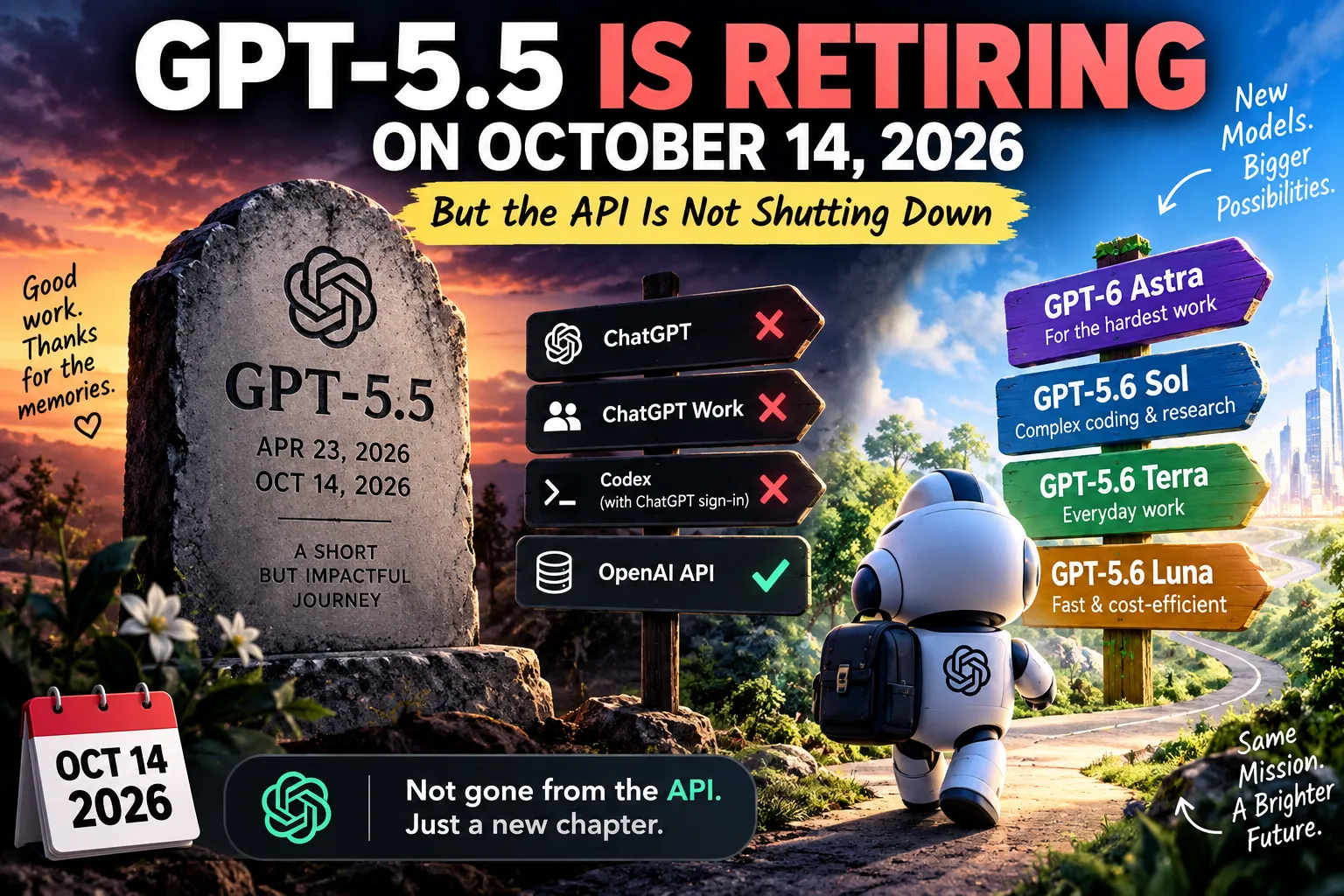
- OpenAI has officially confirmed that GPT-5.5 will retire from ChatGPT, ChatGPT Work, and Codex on October 14, 2026. The notice applies across consumer, Business, Enterprise, and Edu plans.
- This is not a full GPT-5.5 shutdown. OpenAI explicitly says the October 14 retirement does not apply to the OpenAI API.
- For Codex users who sign in with ChatGPT, OpenAI's direct migration path is
gpt-5.5→gpt-5.6-sol. - GPT-6 Astra is the higher-end option for the hardest multi-step work, while GPT-5.6 Terra is positioned as a practical starting point for many everyday tasks previously given to GPT-5.5.
- Developers should check workspace defaults, saved model settings, managed configurations, custom agents, scheduled tasks, scripts, and CLI commands for hard-coded references to
gpt-5.5. - GPT-5.5 launched on April 23, 2026 and will leave these ChatGPT surfaces just 174 days later, making it a notably short-lived default-era model in the product experience.
- API users do not have an October 14 migration deadline. As of September 16, 2026, the GPT-5.5 API model page remains live with a 1.05M-token context window, 128K max output, and pricing of $5 per million input tokens and $30 per million output tokens.
OpenAI Has Confirmed the GPT-5.5 Retirement
This is no longer a rumor.
OpenAI's official ChatGPT and Codex changelog now states that GPT-5.5 will retire from ChatGPT, ChatGPT Work, and Codex on October 14, 2026. The retirement applies to all listed plan categories, including consumer, Business, Enterprise, and Edu.
The most important sentence in the announcement is the one that can easily disappear in short social posts:
The retirement does not apply to the OpenAI API.
That distinction changes the story considerably.
October 14 is not a universal kill date for the gpt-5.5 model ID. It is primarily a product-surface retirement affecting ChatGPT and ChatGPT-authenticated Codex access.
The practical status looks like this:
| Access method | GPT-5.5 after October 14, 2026 |
|---|---|
| ChatGPT | Retired |
| ChatGPT Work | Retired |
| Codex with ChatGPT sign-in | Retired |
| OpenAI API | Still available under the announced scope |
| Codex using an API-key workflow | Not part of the ChatGPT-sign-in retirement |
| Business / Enterprise / Edu ChatGPT access | Retired |
This is the first fact developers should understand before changing production API code unnecessarily.
GPT-5.5 Had an Unusually Short Product Life
GPT-5.5 was introduced on April 23, 2026 as a flagship model for real-world work. OpenAI emphasized agentic coding, research, data analysis, document creation, software operation, and multi-tool workflows. API access followed on April 24.
The next major family moved quickly.
OpenAI began a limited preview of GPT-5.6 Sol, Terra, and Luna on June 26, 2026, then formally launched the GPT-5.6 family on July 9, 2026.
GPT-5.5's ChatGPT and ChatGPT-authenticated Codex retirement date is October 14.
That creates a simple timeline:
April 23, 2026
GPT-5.5 launches

April 24, 2026
GPT-5.5 API availability follows

June 26, 2026
GPT-5.6 Sol / Terra / Luna limited preview begins

July 9, 2026
GPT-5.6 family launches broadly

September 11, 2026
OpenAI posts GPT-5.5 retirement guidance

October 14, 2026
GPT-5.5 retires from ChatGPT, Work, and ChatGPT-signed-in Codex
From April 23 to October 14 is 174 days, or roughly 5.7 months.
That does not mean GPT-5.5 itself only existed for 174 days. The API remains outside this retirement announcement. But for users who experience models primarily through ChatGPT and Codex subscriptions, the visible lifecycle is exceptionally fast.
What Codex Users Should Switch To
OpenAI's migration guidance is unusually direct.
For Codex users authenticated through ChatGPT:
gpt-5.5
   ↓
gpt-5.6-sol
The Codex documentation explicitly says to replace gpt-5.5 with gpt-5.6-sol before the retirement date.
A current CLI invocation can therefore move from:
codex --model gpt-5.5to:
codex --model gpt-5.6-solOpenAI also documents the shorter GPT-5.6 alias:
codex --model gpt-5.6The API model documentation says the gpt-5.6 alias routes to GPT-5.6 Sol.
For non-interactive Codex runs:
codex exec -m gpt-5.6-sol 'Review the current changes'The important point is that Sol is the official direct Codex migration target for GPT-5.5. Astra is not presented as the mandatory one-for-one replacement.
GPT-6 Astra Is an Upgrade Path, Not the Default Replacement
GPT-6 Astra sits above Sol in the current model hierarchy.
OpenAI describes Astra as its most capable model for complex work across code, apps, and research, combining advanced reasoning, computer use, and stronger judgment. GPT-5.6 Sol is described as the strongest GPT-5.6 option for complex coding, computer use, research, and cybersecurity.
A practical task split is therefore:
Routine or everyday work
→ GPT-5.6 Terra

Complex coding, research, debugging, architecture
→ GPT-5.6 Sol

Hardest end-to-end, multi-step, cross-tool work
→ GPT-6 Astra
OpenAI's own Codex model guidance follows essentially this pattern: Astra for the strongest capability across multiple steps and tools, Sol for difficult open-ended work, Terra for everyday work, and Luna for clear repeatable tasks.
This matters because a simplistic migration rule such as GPT-5.5 → Astra for everything can increase usage and cost without improving every workload.
Terra May Be the Most Overlooked GPT-5.5 Replacement
The direct Codex migration is Sol, but OpenAI's documentation contains another important recommendation.
It describes GPT-5.6 Terra as a natural starting point for work previously given to GPT-5.5.
That makes Terra important for teams that historically used GPT-5.5 as a general-purpose default rather than only for the hardest coding tasks.
OpenAI's GPT-5.6 preview also described Terra as competitive with GPT-5.5 while being substantially cheaper.
The useful routing model is:
Simple, repetitive, high-volume tasks
→ Luna

Everyday coding and agent work
→ Terra

Complex coding and research
→ Sol

Highest-difficulty multi-tool work
→ Astra
This is more efficient than replacing every old GPT-5.5 invocation with the most expensive available model.
The Biggest Migration Risk Is Hard-Coded gpt-5.5
Most users will notice a model disappearing from a picker.
Developers can have a more subtle failure mode: old model names buried inside automation.
OpenAI specifically tells users to update:
- Workspace defaults
- Saved model settings
- Managed configurations
- Custom agents
- Scheduled tasks
- Scripts that explicitly select
gpt-5.5
For local Codex users, that means checking more than the visible model selector.
A config.toml may still contain:
model = "gpt-5.5"Replace it with:
model = "gpt-5.6-sol"Shell scripts may contain commands such as:
codex exec -m gpt-5.5 'Run the test suite and fix failures'Those should be updated as well.
A fast repository-wide check with ripgrep can catch many cases:
rg 'gpt-5\.5'It is also worth checking Codex configuration directories and deployment scripts rather than assuming all model choices live inside application source code.
Update Codex CLI Before Migrating
Model migration can fail for a reason unrelated to the model ID: an outdated client.
OpenAI currently requires at least Codex CLI 0.144.0 for GPT-5.6 access and 0.153.0 for Astra.
The safest migration path is to update Codex first:
npm install -g @openai/codex@latestThen verify the installed version:
codex --versionFor teams pinning CLI versions in CI or development containers, the version constraint should be updated there as well.
This is especially important for developers who migrate the model ID correctly but continue running an older globally installed Codex binary.
API Users Do Not Need to Panic on October 14
The October 14 retirement announcement explicitly excludes the OpenAI API.
As of September 16, 2026, the GPT-5.5 API page still lists:
- 1,050,000-token context window
- 128,000 max output tokens
- December 1, 2025 knowledge cutoff
- $5 per 1M input tokens
- $0.50 per 1M cached input tokens
- $30 per 1M output tokens
So an application using:
gpt-5.5through the API does not have an October 14 shutdown deadline based on the current announcement.
That does not mean GPT-5.5 will remain in the API forever.
It means only that OpenAI has not attached the October 14 product retirement to the API.
Teams running production systems should therefore avoid two opposite mistakes:
- Do not rush an unnecessary emergency API migration because of a ChatGPT retirement headline.
- Do not assume GPT-5.5 API access is permanent; continue watching the model deprecation documentation for a future API-specific date.
GPT-5.6 Sol Is Also Cheaper Than GPT-5.5 in the API
Even without a forced API migration, the economics make GPT-5.6 Sol worth evaluating.
Current model pages list:
| Model | Context | Max output | Input / 1M | Output / 1M |
|---|---|---|---|---|
| GPT-5.5 | 1.05M | 128K | $5 | $30 |
| GPT-5.6 Sol | 1.05M | 128K | $4 | $20 |
| GPT-5.6 Terra | 1.05M | 128K | $2 | $12 |
| GPT-6 Astra | 1.05M | 128K | $10 | $50 |
GPT-5.5 specifications and pricing are listed on its API model page, while the current model catalog lists Sol at $4/$20, Terra at $2/$12, and Astra at $10/$50 per million input/output tokens.
Relative to GPT-5.5, GPT-5.6 Sol currently cuts:
- Input price by 20%
- Output price by about 33%
That makes Sol attractive even for API users who are not forced to migrate.
Astra is a different economic tier. At $10 input and $50 output per million tokens, it is designed for cases where additional capability can justify materially higher inference cost.
Why Is GPT-5.5 Retiring So Quickly?
OpenAI has not published a GPT-5.5-specific explanation saying the model failed, was unpopular, or had a technical problem.
Those interpretations should not be presented as fact.
What can be observed is a broader product-line transition.
GPT-5.6 introduced three named capability tiers:
Luna
→ fast and cost-sensitive

Terra
→ balanced everyday work

Sol
→ complex professional work
Astra now occupies the highest-complexity tier for the hardest end-to-end work.
This structure is cleaner than a model picker filled with many overlapping generations and specialized names.
A reasonable interpretation is that GPT-5.5's ChatGPT retirement is part of OpenAI consolidating users onto the newer model hierarchy. That is an inference from the current lineup, not an officially stated retirement reason.
The 90-Day Model Lifecycle Is Becoming Important
OpenAI's ChatGPT release notes previously stated that models will generally remain available in ChatGPT for 90 days after a successor is released.
The GPT-5.6 family launched on July 9.
GPT-5.5 retires from ChatGPT on October 14.
That is roughly three months later.
The pattern matters for developers because AI model names are becoming more ephemeral than conventional infrastructure APIs.
A configuration such as:
model = "gpt-5.5"may be perfectly reasonable today and obsolete a few months later.
Applications that expect rapid model turnover should add an abstraction layer.
For example:
const MODELS = {
  fast: 'gpt-5.6-luna',
  balanced: 'gpt-5.6-terra',
  smart: 'gpt-5.6-sol',
  frontier: 'gpt-6-astra',
}
Business logic can then target a capability class instead of scattering specific model IDs through dozens of files.
When a model changes, one routing configuration can be updated instead of performing a repository-wide emergency migration.
What Happens to Existing GPT-5.5 Chats?
OpenAI's September retirement notice does not currently specify an exact replacement mapping for every existing GPT-5.5 ChatGPT conversation.
That means users should not assume a mapping such as:
GPT-5.5 Instant → GPT-5.6 Luna
GPT-5.5 Thinking → GPT-5.6 Sol
GPT-5.5 Pro → GPT-6 Astra
unless OpenAI documents it.
There is precedent for automatic conversation migration. When GPT-5.2 models retired in June 2026, OpenAI said existing GPT-5.2 conversations would continue on corresponding GPT-5.5 models.
However, that does not establish the exact GPT-5.5 mapping for October.
The safe conclusion is simple:
GPT-5.5's product retirement is confirmed; the exact continuation model for every old GPT-5.5 conversation should be treated as pending until OpenAI publishes the mapping.
What Changes for Business, Enterprise, and Edu?
The retirement is not limited to consumer ChatGPT accounts.
OpenAI explicitly says the October 14 change applies across consumer, Business, Enterprise, and Edu plans.
Managed organizations have additional places where a deprecated model may remain configured:
- Workspace model defaults
- Managed configuration policies
- Organization-level agents
- Scheduled tasks
- Shared automation
- Internal documentation
- CLI bootstrap scripts
- Developer environment images
This makes enterprise migration less about clicking a model picker and more about configuration inventory.
Administrators should search for gpt-5.5 anywhere a model can be explicitly pinned.
A Practical GPT-5.5 Migration Checklist
Before October 14, Codex users signing in with ChatGPT should complete the following:
- Update Codex CLI to a GPT-5.6-compatible version.
- Change default Codex usage from
gpt-5.5togpt-5.6-sol. - Search local and shared configuration files for hard-coded
gpt-5.5. - Review workspace defaults.
- Review managed configuration.
- Review custom agents.
- Review scheduled tasks.
- Review CI scripts and shell automation.
- Review documentation that tells developers to launch Codex with GPT-5.5.
- Test important workflows on Sol before the deadline.
- Identify routine GPT-5.5 work that can move to Terra.
- Reserve Astra for tasks that actually need its stronger multi-step capability.
- Do not treat October 14 as an API shutdown date.
A simple local audit can begin with:
rg 'gpt-5\.5' ~A narrower search inside development directories is usually safer on machines with large home directories:
rg 'gpt-5\.5' ~/code ~/.codexThen update intentional references rather than performing blind search-and-replace across archived material.
What Model Should Replace GPT-5.5?
There is no single best replacement for every workload.
A practical migration table is:
| Previous workload | Recommended starting point |
|---|---|
| Repetitive edits, straightforward generation | GPT-5.6 Luna |
| Everyday coding and agent tasks | GPT-5.6 Terra |
| Difficult coding, debugging, architecture, research | GPT-5.6 Sol |
| Hardest multi-tool, long-horizon work | GPT-6 Astra |
| Production API workload that cannot migrate yet | GPT-5.5 API remains available under the current announcement |
OpenAI specifically identifies Sol as the Codex migration target and Terra as a natural starting point for everyday work previously assigned to GPT-5.5.
This suggests that the most efficient transition is routing, not merely replacing one old model with one expensive new model everywhere.
What This Retirement Means for AI Product Developers
The bigger lesson is not simply that GPT-5.5 is leaving ChatGPT.
It is that model lifecycle management is becoming a normal engineering responsibility.
Teams building on AI models should assume:
- User-facing model availability can change within months.
- ChatGPT retirement dates and API retirement dates may differ.
- Authentication method can affect model availability in tools such as Codex.
- Saved agent configurations can outlive the model they reference.
- CLI compatibility can block access even when the account has permission.
- New model families may make old one-model-for-everything strategies inefficient.
The safest architecture separates:
Product intent
↓
Capability tier
↓
Current model mapping
↓
Provider model ID
Instead of:
Product feature
↓
Hard-coded gpt-5.5
That small architectural difference makes future model retirements far less disruptive.
Conclusion
GPT-5.5 is officially retiring from ChatGPT, ChatGPT Work, and Codex sessions that use ChatGPT sign-in on October 14, 2026. The change applies across consumer, Business, Enterprise, and Edu plans.
But the headline needs an important qualification:
GPT-5.5 is not being removed from the OpenAI API on October 14. OpenAI explicitly excludes the API from this retirement notice.
For Codex users, the immediate migration path is clear:
gpt-5.5
→ gpt-5.6-sol
Developers should update model defaults, saved configurations, agents, scheduled tasks, scripts, and CLI commands before the deadline.
For broader workload routing, Terra is increasingly compelling for everyday GPT-5.5-style work, Sol is the main complex-work replacement, and Astra is the higher-end choice for the hardest multi-step agentic tasks.
The most important action is therefore not panic-migrating every GPT-5.5 API call. It is separating ChatGPT product retirement from API lifecycle, removing hard-coded model assumptions, and testing the newer model tiers before October 14.
For teams that still depend heavily on GPT-5.5, the next announcement to watch is an API-specific deprecation date. Until OpenAI publishes one, October 14 should be treated as a ChatGPT and ChatGPT-authenticated Codex deadline—not the end of GPT-5.5 everywhere.
Continue Reading
More articles connected to the same themes, protocols, and tools.



Referenced Tools
Browse entries that are adjacent to the topics covered in this article.