On This Page7 sections
Key Takeaways
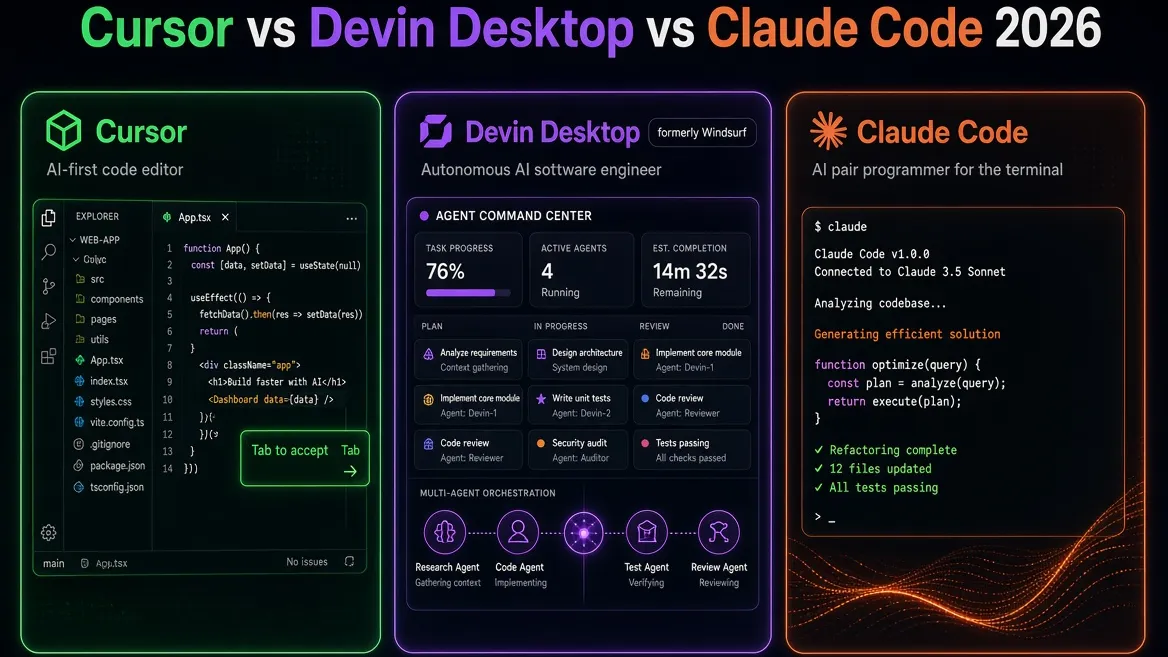
- Cursor delivers the most polished AI-native IDE experience, excelling at fast Tab completions, multi-model flexibility, and well-scoped multi-file edits via Composer and Agents Window.
- Devin Desktop (formerly Windsurf) shifted in June 2026 to an agent-command-center model under Cognition AI, emphasizing Cascade/Devin Local flows, cloud agent delegation, and ACP compatibility for multi-agent orchestration.
- Claude Code leads terminal-native autonomous workflows, with community data showing it accounts for the majority of attributed public agent commits; it shines on long-horizon, end-to-end features via sub-agents, hooks, MCP, and headless modes.
- Pricing clusters around $20/month entry paid tiers (Cursor Pro legacy or equivalent, Claude Pro including Claude Code, Devin Desktop Pro), but real costs depend on model usage pools, API overages, and team scaling.
- Analysis of benchmarks and attributed output indicates no universal winner—selection hinges on IDE preference, task horizon length, and integration needs (e.g., JetBrains plugins, CI/CD, or pure terminal).
The 2026 AI Coding Tools Landscape
The AI coding ecosystem has matured from autocomplete plugins into full agentic systems. Three dominant approaches define the space: AI-native IDEs (VS Code forks), terminal-native agents, and hybrid cloud-delegation platforms.
Cursor (from Anysphere) remains the reference AI-native IDE. It indexes entire codebases for semantic awareness, offers frontier model choice (Claude, GPT, Gemini, Grok, and in-house Composer variants), and pairs industry-leading Tab completion with Composer for multi-file refactors and background agents.
Devin Desktop, rebranded from Windsurf on June 2, 2026 after Cognition AI's acquisition, centers the Agent Command Center (Spaces, Kanban views, multi-agent management). Legacy Cascade gave way to a Rust-rewritten Devin Local agent noted for improved token efficiency and subagent support. It supports ACP so external agents (including Claude Agent or Codex) can run inside the editor, alongside native Devin Cloud delegation.
Claude Code (Anthropic) operates primarily as a terminal/CLI agent with IDE plugins. Its strengths lie in deep codebase understanding, long-running autonomous execution, MCP servers, hooks, and headless/Auto modes. Public commit attribution data positions it as the volume leader among coding agents.
These tools diverge in interaction model more than raw model quality: one prioritizes in-editor fluidity, another multi-agent orchestration, and the third unattended terminal autonomy.
Feature Comparison: Agents, Models, and Interfaces
| Dimension | Cursor | Devin Desktop (Windsurf) | Claude Code |
|---|---|---|---|
| Primary interface | Full AI-native IDE (VS Code fork) | Full IDE + Agent Command Center | Terminal/CLI + plugins |
| Signature agent | Composer + Agents Window + background agents | Devin Local / Cascade successor + Devin Cloud | Sub-agents, hooks, headless, Auto Mode |
| Model flexibility | Multi-provider + Composer/Grok variants | Adaptive router + SWE models + ACP agents | Claude family (Opus/Sonnet series) |
| Tab / inline completion | Industry-leading speed and quality | Strong Tab preview and flow actions | Not the primary surface |
| Context / memory | Semantic codebase index | Cross-session Cascade-style memory + Spaces | Full codebase read + persistent context |
| Multi-file / long tasks | Excellent for scoped 5–15 file edits | Strong continuous local flows + cloud delegation | Best for multi-hour end-to-end features |
| IDE / ecosystem | VS Code native; limited other IDEs | VS Code fork + JetBrains plugins (maintenance mode) | Terminal + VS Code/JetBrains plugins |
| MCP / extensibility | Supported | Supported + ACP | Native, mature hooks and MCP |
Why the differences matter. Cursor's Tab model reduces keystrokes on routine work because it predicts contextually across the open project. Devin Desktop's Command Center treats agents as first-class objects that can be managed, paused, or delegated to the cloud—useful when multiple parallel tasks run. Claude Code's terminal design enables scripting, piping, and unattended runs in CI or remote environments that GUI tools handle less naturally.
Benchmarks such as SWE-bench variants and internal CursorBench-style evaluations consistently rank frontier Claude models at or near the top for complex reasoning and multi-file correctness. Tool-level results, however, depend on orchestration, context management, and human-in-the-loop review more than raw model scores.
Pricing and Real-World Cost Analysis
Entry paid plans converge near $20/month:
- Cursor: Legacy Pro at $20/month (or annual equivalent); newer X Subscription tiers start lower for Grok-only and rise for full frontier access. Usage pools separate Cursor models from third-party API-priced models. Teams begin around $30–40/user.
- Devin Desktop: Pro around $20/month with free tier quotas; Max higher. Plans carried over from Windsurf at rebrand; overages at API rates. Cloud agent usage adds variable cost.
- Claude Code: Included in Claude Pro ($20/month or ~$17 annual) and higher Max tiers ($100/$200). No separate free Claude Code tier. Heavy use or Enterprise shifts to per-token API pricing (e.g., Sonnet-class ~$2/$10 per million input/output tokens depending on exact version).
Hidden costs and edge cases. All three can exceed the subscription when agents run long sessions on expensive models. Cursor and Devin Desktop meter third-party models against included pools or API rates. Claude Code shares usage with the broader Claude product and offers usage credits. Teams should model cost-per-feature or cost-per-PR rather than headline subscription price—community feedback indicates power users on any platform routinely add usage credits.
Privacy mode, SSO, audit logs, and model access controls appear at team/enterprise tiers across the board. Data retention and training policies differ; review current vendor terms before processing proprietary code.
Ideal Use Cases and Decision Framework
Choose Cursor when:
- The team already lives in VS Code and values the fastest, most reliable Tab completions.
- Tasks are well-scoped multi-file edits rather than multi-hour autonomous builds.
- Model flexibility (switching between Claude, GPT, Grok, etc.) is a priority.
- Background agents and in-editor diff review fit the review culture.
Choose Devin Desktop when:
- Orchestrating multiple local and cloud agents from one command center is central.
- Cross-session memory and continuous flow-style agents reduce re-prompting on long features.
- ACP support for mixing agents or existing JetBrains workflows matters.
- Cloud delegation for longer-running work complements the local IDE.
Choose Claude Code when:
- Workflows are terminal-first, scriptable, or integrated into CI/CD pipelines.
- Tasks require deep, long-horizon autonomy (full feature implementation, large refactors, multi-step debugging) with minimal supervision.
- Sub-agents, hooks, and MCP servers enable custom tooling.
- Public output data and model rankings favor Claude-family reasoning for the workload.
Hybrid approaches are common: use Cursor or Devin Desktop for interactive editing and Claude Code for overnight or CI agent runs.
Advanced Tips, Edge Cases, and Common Pitfalls
Large codebases. All three rely on indexing or full reads. Cursor's semantic index and Claude Code's repository-wide awareness generally outperform naive context windows. Pitfall: incomplete indexing or ignored files leads to hallucinated references—explicitly configure ignore rules and verify index status.
MCP and custom tools. Claude Code and Cursor have mature MCP support. Define tools that expose internal APIs, lint rules, or test runners. Pitfall: overly broad tool permissions can allow unintended shell or network actions; start with least-privilege and review agent plans.
Review and safety. Diff-based review (Cursor Composer, Devin Local streams) reduces risk compared with fully autonomous commits. Community practice favors requiring explicit approval for production-impacting changes and running agents in feature branches or sandboxes.
Model and version drift. Frontier models update frequently (Opus/Sonnet series, Composer variants, SWE models). Pin or prefer known-stable versions for critical work and re-benchmark after major releases. Pitfall: assuming last month's ranking still holds.
Terminal vs IDE friction. Switching from a GUI IDE to Claude Code requires learning the harness (permissions, planning mode, hooks). Conversely, forcing terminal-native agents into GUI workflows can under-utilize their strengths.
Example Claude Code headless invocation pattern (illustrative):
claude --print "Implement the new endpoint and add tests" --dangerously-skip-permissionsAdjust flags and permission modes according to current CLI documentation and organizational policy.
Cost control. Set usage alerts, prefer cheaper models for routine tasks, and leverage annual billing. Track agent-attributed PRs or commits to calculate ROI.
Conclusion
Analysis of features, pricing structures, attributed agent output, and community usage patterns shows that Cursor, Devin Desktop, and Claude Code each optimize for distinct points on the autonomy-versus-control spectrum. Cursor remains the default for developers who want AI deeply embedded in a familiar, high-quality editor. Devin Desktop evolves the IDE into an agent management platform with cloud reach. Claude Code delivers the deepest terminal-native autonomy for long-running work.
The optimal choice depends on existing editor habits, average task length, team size, and integration requirements rather than a single benchmark score. Evaluate free or trial tiers against a representative internal codebase, measure time-to-review and defect rates, and model actual usage costs before standardizing.
Start by testing the tool that matches the primary interface the team already uses, then layer complementary agents where they add clear leverage.
Continue Reading
More articles connected to the same themes, protocols, and tools.
FilmCraft MCP: The Complete Guide to AI Agents Editing Video Like Premiere Pro
OpenCode 2.0 Is Here: Code Mode, Background Agents, and a Major Rebuild of the Open-Source Coding Agent
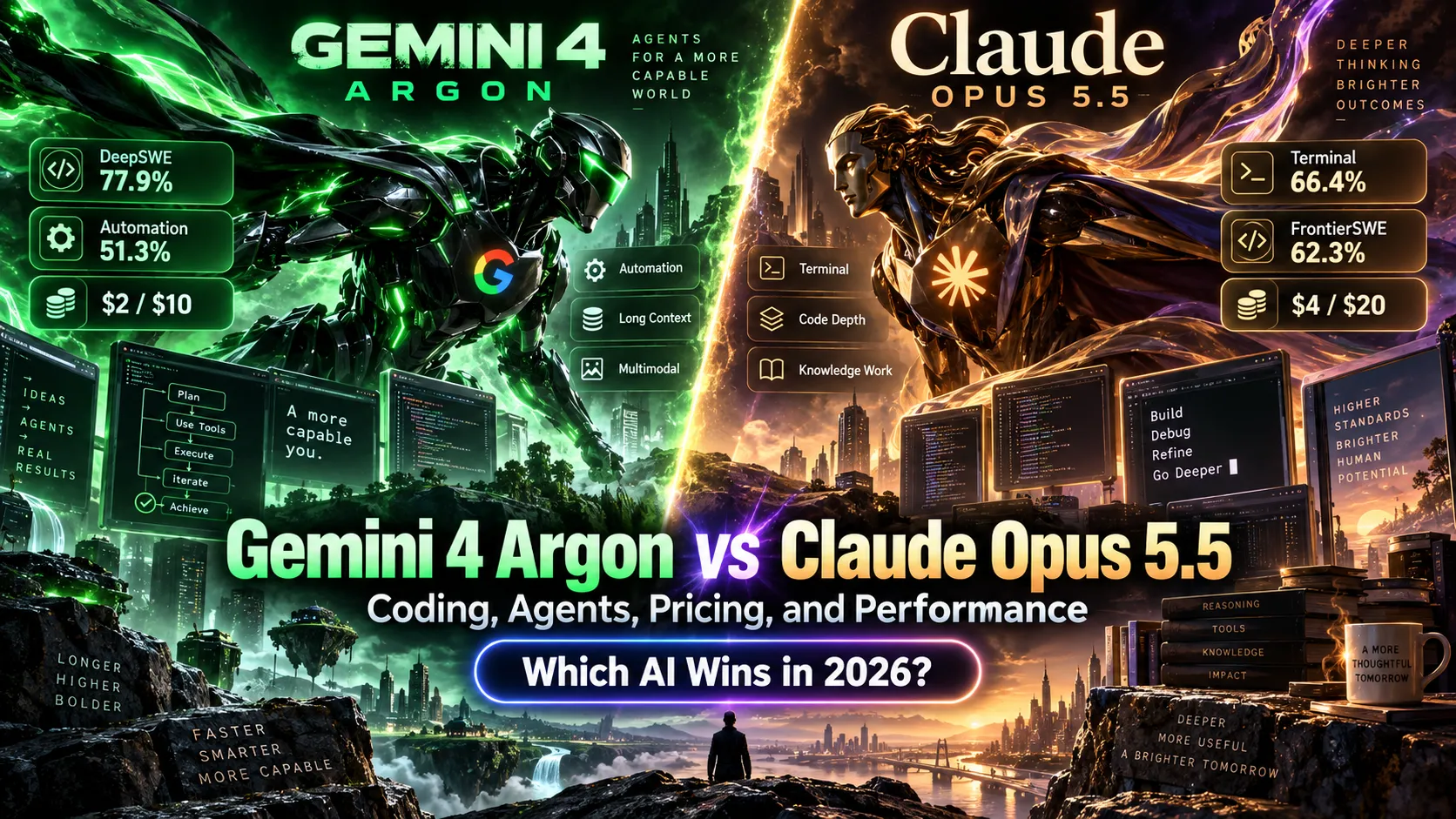
Gemini 4 Argon vs Claude Opus 5.5: Which AI Actually Wins at Coding, Agents, and Price in 2026?
Referenced Tools
Browse entries that are adjacent to the topics covered in this article.