On This Page8 sections
Key Takeaways
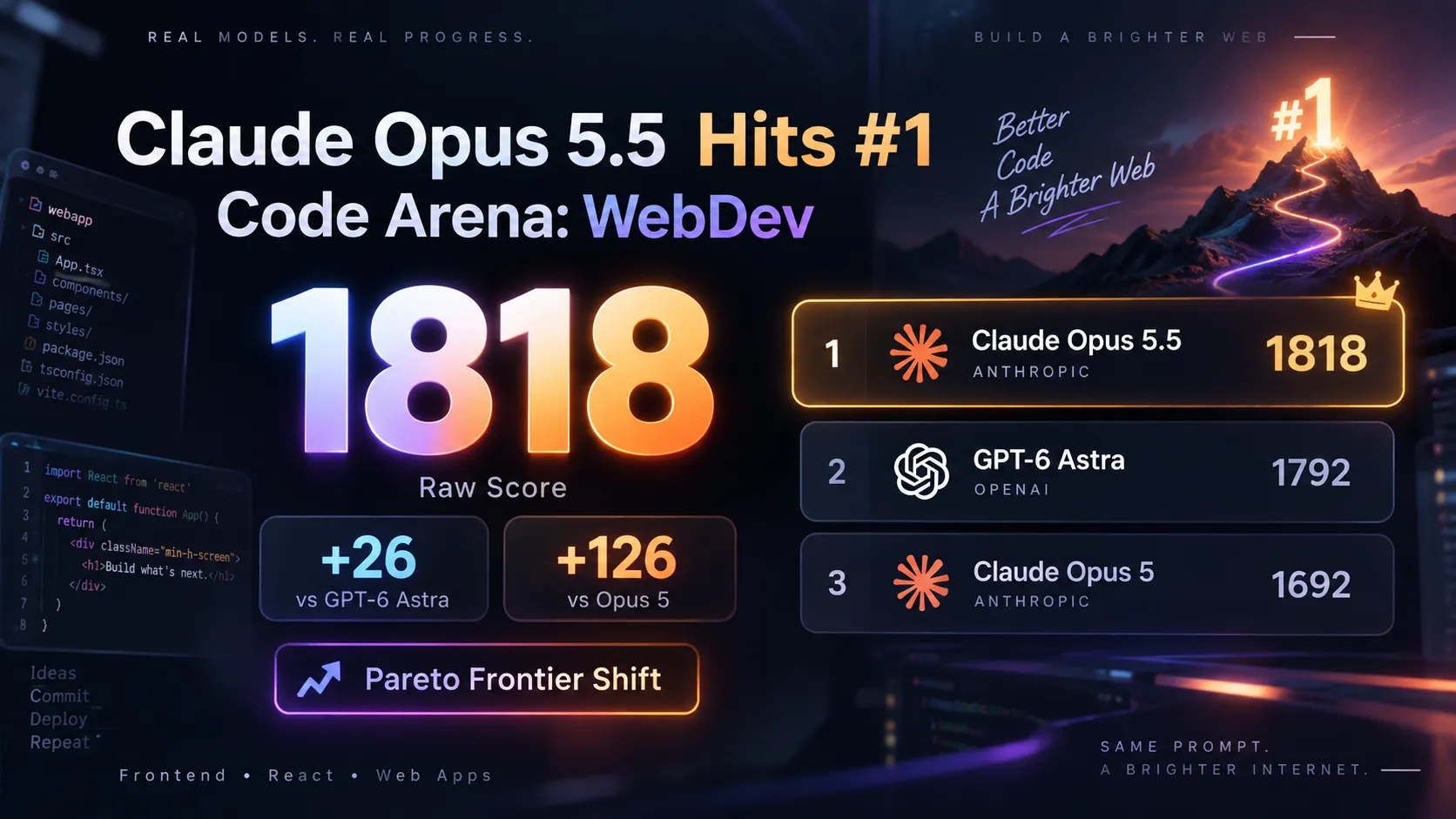
- Claude Opus 5.5 (Max) is currently #1 by raw score in Code Arena: WebDev, with 1818 ±21, ahead of GPT-6 Astra (Max) at 1792 ±12 and the previous Claude Opus 5 (Max) at 1692 ±7.
- The headline gaps are +26 points over GPT-6 Astra and +126 points over Opus 5.
- The lead over GPT-6 Astra is not yet statistically settled. Both models have a rank spread of 1–2, which means their confidence intervals still allow either model to occupy the top position.
- Opus 5.5 is especially strong in frontend work: it scores 1848 ±25 in Frontend and 1851 ±26 in React, ranking #1 by raw score in both views.
- The bigger story is not just the leaderboard win. Opus 5.5 costs $4 per million input tokens and $20 per million output tokens, 20% below Opus 5 and 60% below GPT-6 Astra's listed $10/$50 pricing.
- Arena now places Opus 5.5 on the WebDev Pareto frontier, meaning it changes the best-known trade-off between model quality and API cost.
- This result should not be interpreted as proof that Opus 5.5 is the best coding model for every workload. Code Arena measures human preference on generated web applications, while terminal agents, repository repair, scientific coding, automation, and security benchmarks test different capabilities.
Claude Opus 5.5 Just Took the Top Raw Score in Code Arena WebDev
Claude Opus 5.5 has arrived with one of the strongest early signals yet for AI-assisted web development.
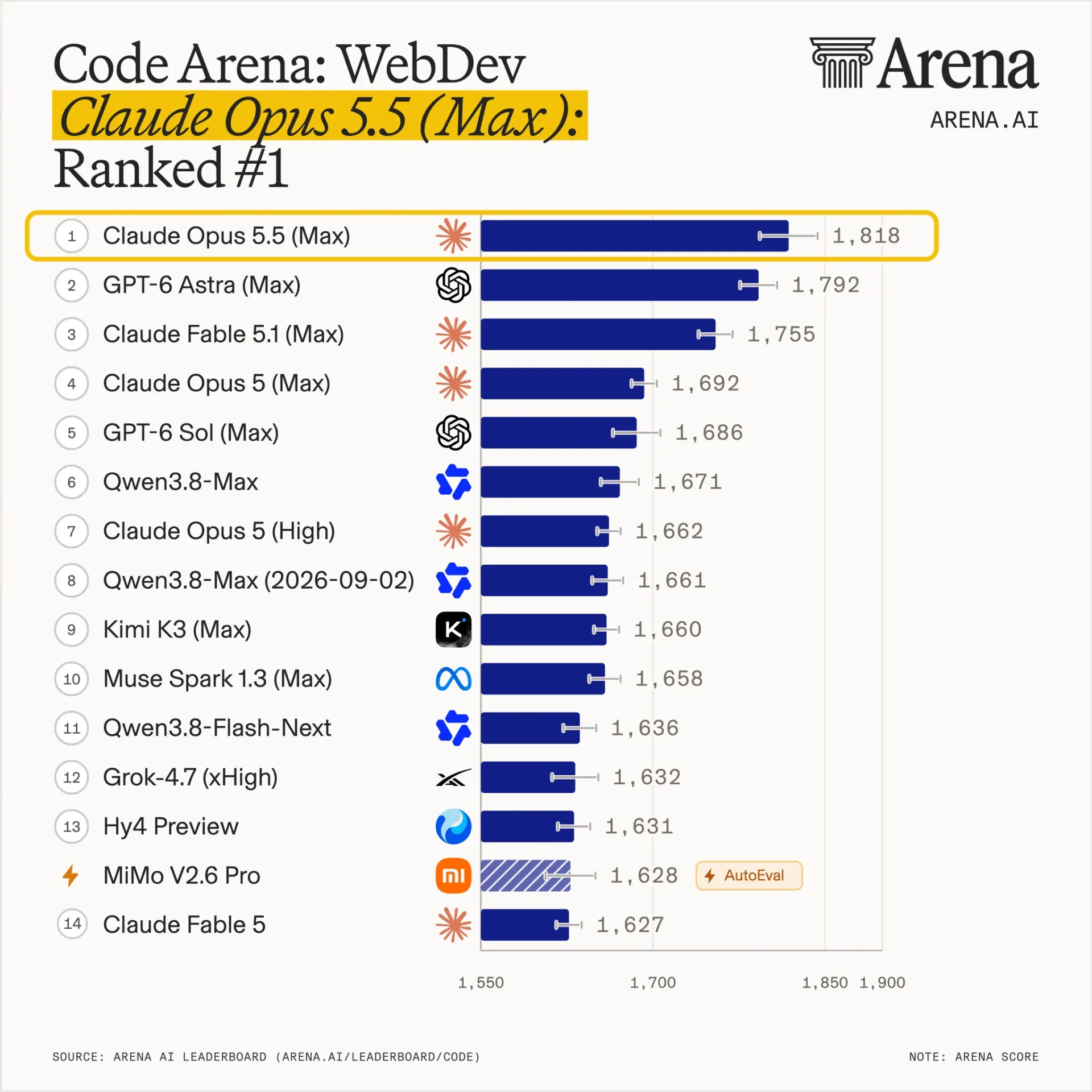
In Arena's September 23, 2026 Code Arena: WebDev snapshot, claude-opus-5.5-max reached an Arena score of 1818 ±21, placing it first by raw score. GPT-6 Astra (Max) followed at 1792 ±12, while Claude Fable 5.1 (Max) scored 1755 ±11 and the previous Claude Opus 5 (Max) scored 1692 ±7. The leaderboard contained 739,375 votes across 133 models, although Opus 5.5 itself had accumulated 1,219 votes at that point.
That produces two immediately striking comparisons:
- Opus 5.5 vs GPT-6 Astra: +26 Arena points
- Opus 5.5 vs Opus 5: +126 Arena points
The second number is particularly important. A 126-point movement over the previous Opus generation is much larger than the narrow margin separating the two current leaders.
But the raw score alone does not tell the full story.
What Does an Arena Score of 1818 Actually Mean?
An Arena score is not a percentage, test-pass count, or score out of 2,000.
Code Arena grew out of WebDev Arena, a human-preference evaluation system designed around real, interactive web application generation. A user gives two anonymous models the same development prompt, the models build competing applications, and the user interacts with both before voting for the better result. Arena then aggregates large numbers of these head-to-head outcomes into model ratings.
Arena has historically used a Bradley-Terry model for pairwise comparisons. In simplified terms, the method estimates the relative strength of each model from wins and losses against other models, much like an Elo-style competitive rating rather than a traditional percentage-based benchmark. Arena has also open-sourced its ranking implementation through Arena-Rank.
That means 1818 should be interpreted as:
A relative rating derived from human preferences between competing model-generated applications.
It does not mean:
- 90.9% coding accuracy
- 1818 successful tasks
- 1818 points out of a fixed maximum
- a 7.4% capability improvement over Opus 5
The difference matters because Bradley-Terry-style scores are not linear measures of general intelligence or coding accuracy.
Claude Opus 5.5 vs GPT-6 Astra: Is the 26-Point Lead Significant?
Not yet in the strongest statistical sense.
Arena reports both a raw rank and a rank spread. The raw rank sorts models by their current estimated Arena score. Rank spread incorporates confidence intervals to show the range of positions a model could plausibly occupy given the statistical uncertainty.
Arena explicitly states that models whose rank spreads overlap should be treated as tied contenders.
The September 23 overall WebDev numbers were:
| Model | Score | Votes | Raw Rank | Rank Spread |
|---|---|---|---|---|
| Claude Opus 5.5 (Max) | 1818 ±21 | 1,219 | #1 | 1–2 |
| GPT-6 Astra (Max) | 1792 ±12 | 4,325 | #2 | 1–2 |
| Claude Fable 5.1 (Max) | 1755 ±11 | 4,916 | #3 | 3 |
| Claude Opus 5 (Max) | 1692 ±7 | 14,351 | #4 | 4–5 |
The implied score intervals are roughly:
- Opus 5.5: 1797 to 1839
- GPT-6 Astra: 1780 to 1804
Those intervals overlap between approximately 1797 and 1804.
So the most accurate statement is:
Claude Opus 5.5 currently ranks #1 by raw Code Arena WebDev score.
A stronger statement such as Opus 5.5 has conclusively beaten GPT-6 Astra goes beyond what the current uncertainty supports.
This distinction may change as more votes arrive. Opus 5.5 had only 1,219 overall WebDev votes in the September 23 snapshot, compared with 4,325 for Astra and more than 14,000 for Opus 5.
The Opus 5.5 vs Opus 5 Improvement Is Much Harder to Dismiss
The generational comparison is more decisive.
Opus 5.5 reached 1818 ±21, while Opus 5 stood at 1692 ±7.
Even allowing for uncertainty, the ranges are far apart. This makes the +126-point jump more meaningful than the narrower +26 lead over Astra.
That does not mean Opus 5.5 is exactly 7.4% better than Opus 5. Arena ratings are not percentage scales.
It does indicate that, under Arena's current human-preference evaluation for web application development, users are producing a substantially stronger comparative signal for Opus 5.5 than for the previous Opus generation.
That is consistent with Anthropic's own positioning of Opus 5.5 as a significant coding and agentic upgrade rather than a minor refresh. Anthropic launched the model on September 22, 2026 and describes it as the first model in the Claude 5.5 family.
Frontend and React Results Make the WebDev Story Stronger
The overall leaderboard is only one view.
When the data is filtered to frontend tasks, Opus 5.5 currently posts an even higher raw score.
Frontend
Arena's September 23 Frontend leaderboard shows:
- Claude Opus 5.5 (Max): 1848 ±25, 912 votes
- GPT-6 Astra (Max): 1810 ±13
- Claude Fable 5.1 (Max): 1789 ±12
- Claude Opus 5 (Max): 1714 ±8
Opus 5.5 ranks #1 by raw score, with a rank spread of 1–2.
React
On the React-specific leaderboard:
- Claude Opus 5.5 (Max): 1851 ±26, 856 votes
- GPT-6 Astra (Max): 1814 ±14
- Claude Fable 5.1 (Max): 1804 ±13
- Claude Opus 5 (Max): 1714 ±8
Again, Opus 5.5 holds the #1 raw score while its rank spread remains 1–2.
For developers building dashboards, SaaS interfaces, landing pages, browser games, internal tools, and React applications, these category-specific results may be more useful than a generic coding benchmark.
The signal is not simply that Opus 5.5 can produce correct syntax. Code Arena evaluates the complete application experience, where visual hierarchy, layout, component composition, interaction design, functional behavior, and overall polish can affect human preference.
Opus 5.5 Also Leads Several WebDev Domains
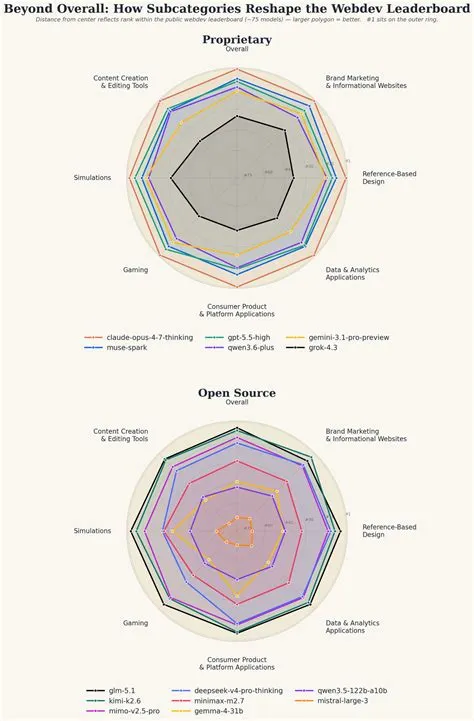
Arena's announcement for the model reported top raw placements across several domain-specific WebDev categories:
- #1 Brand & Marketing
- #1 Reference-Based Design
- #1 Data & Analytics
- #1 Simulations
- #1 Gaming
- #2 Consumer Product
These categories matter because modern AI coding use is increasingly heterogeneous.
A model that performs well on a marketing page may not be equally strong at a simulation, dashboard, game, or screenshot-driven reconstruction. Arena introduced domain views after analyzing more than 250,000 Code Arena prompts and observing major differences between the kinds of applications users were asking models to build.
The category results therefore suggest that Opus 5.5's early WebDev strength is not confined to a single page type.
However, category leaderboards often contain fewer votes than the overall leaderboard. Smaller samples produce wider confidence intervals, so category positions should be monitored as voting volume grows.
The Pareto Frontier May Be the Bigger Story
The #1 raw ranking is eye-catching.
The cost-performance shift may matter more to developers actually paying for API calls.
Anthropic prices Claude Opus 5.5 at:
- $4 per million input tokens
- $20 per million output tokens
- $0.20 per million cache-read tokens
Opus 5 was priced at $5 input and $25 output per million tokens, so the new model's headline token prices are 20% lower. Anthropic says typical workloads can cost about 40% less overall because Opus 5.5 also uses compute and tokens more efficiently, while output generation is more than 30% faster.
Arena lists GPT-6 Astra (Max) at:
- $10 per million input tokens
- $50 per million output tokens
That makes Opus 5.5's listed input and output token rates 60% lower than Astra's while Opus 5.5 simultaneously holds the higher raw WebDev score.
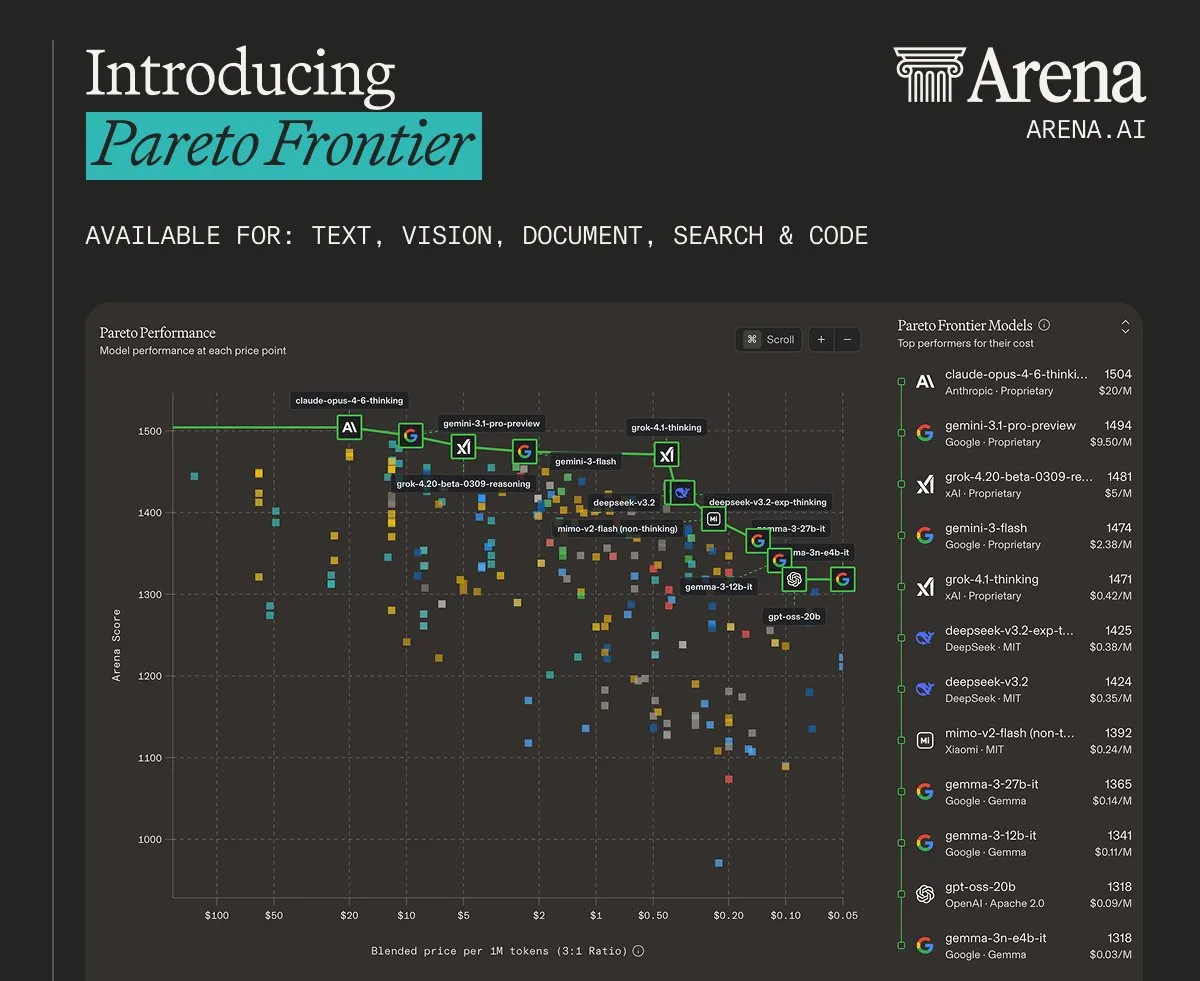
This is why Arena says Opus 5.5 reshapes the Pareto frontier.
A model lies on a Pareto frontier when there is no other compared option that is simultaneously better on the relevant performance dimension and cheaper on the cost dimension.
Arena's current WebDev Pareto view lists claude-opus-5.5-max at the high-performance end with a score of 1818.
For production teams, this can be more consequential than a small benchmark lead. A model that is both stronger and materially cheaper can change routing strategies, default-model choices, and the economics of long-running coding agents.
Claude Opus 5.5 Pricing Compared With Opus 5 and GPT-6 Astra
| Model | Input / 1M Tokens | Output / 1M Tokens | WebDev Score |
|---|---|---|---|
| Claude Opus 5.5 (Max) | $4 | $20 | 1818 ±21 |
| GPT-6 Astra (Max) | $10 | $50 | 1792 ±12 |
| Claude Opus 5 (Max) | $5 | $25 | 1692 ±7 |
The comparison shows three simultaneous changes from Opus 5 to Opus 5.5:
- Higher WebDev preference score
- Lower token pricing
- Better reported serving efficiency
That combination is what makes the release strategically important.
Anthropic's Other Coding Benchmarks Point in the Same Direction — With Caveats
Anthropic's release materials include several additional coding and agentic evaluations.
At high or maximum effort, Anthropic reports:
| Benchmark | Opus 5.5 | Opus 5 | GPT-6 Astra |
|---|---|---|---|
| Terminal-Bench 4.0 | 66.4% | 52.3% | 57.9% |
| FrontierCode v1.1 | 54.4% | 48.0% | 53.3% |
| AutomationBench | 40.0% | 26.9% | 41.4% |
| Terminal-Bench-Science 0.1 | 58.7% | 29.0% | 64.6% |
These results add useful context.
Opus 5.5 leads Astra in Anthropic's reported Terminal-Bench 4.0 and FrontierCode figures, but Astra remains ahead in AutomationBench and Terminal-Bench-Science.
That is exactly why a single headline such as best coding model is too broad.
Different benchmarks measure different things:
- Code Arena WebDev: human preference for generated web applications
- Terminal-Bench: multi-step professional command-line tasks
- FrontierCode: whether agent-generated code changes are strong enough to merge
- AutomationBench: connected business workflows
- Terminal-Bench-Science: agentic scientific research and computing
A model can lead one category and trail another without the results being contradictory.
There is another caveat: several competitive figures in Anthropic's launch table come from vendors or benchmark operators rather than one completely standardized independent evaluation harness. Anthropic explicitly notes, for example, that the GPT-6 Astra Terminal-Bench figure is reported by OpenAI.
The strongest conclusion therefore comes from combining multiple independent signals rather than treating any one table as definitive.
Why Code Arena Is Especially Relevant for Modern AI Web Development
Traditional coding benchmarks are often built around isolated functions, unit tests, or repository issues.
Those remain valuable, but AI development tools are now asked to do much more:
- Generate complete React applications
- Reproduce interfaces from screenshots
- Design responsive layouts
- Select and integrate packages
- Build browser games
- Create simulations
- Assemble dashboards
- Maintain state across multiple components
- Make multi-file edits
- Use execution and development tools
- Iterate on visual and interaction quality
Arena's WebDev methodology was designed to capture more of this end-to-end behavior. Users can interact with model-generated applications rather than judging code snippets alone.
That makes Code Arena useful for answering a practical question:
Which model tends to produce the web application users actually prefer?
For AI website builders, coding agents, browser-game generation, rapid prototyping, and UI-heavy development, that question is often closer to production reality than pure code-generation accuracy.
What Developers Should Infer From the Results
1. Opus 5.5 Deserves Serious Consideration for UI-Heavy Coding
The overall, Frontend, and React leaderboards all show an unusually strong early preference signal.
Teams doing substantial React, interface, dashboard, simulation, or interactive application work have a stronger reason to benchmark Opus 5.5 against their existing default model.
2. Test Medium Effort Before Defaulting to Maximum Effort
Anthropic says Opus 5.5 was designed to be more compute-efficient, and its release material repeatedly emphasizes strong results at default or medium effort.
For production routing, the optimal configuration may not be the leaderboard's maximum-effort setup.
A practical evaluation should compare:
- task completion rate
- number of iterations
- output tokens
- tool calls
- latency
- human correction time
- cost per accepted task
The cheapest model per token is not always cheapest per completed task, and the strongest maximum-effort model is not always the most economical default.
3. Do Not Route Every Coding Workload From One WebDev Result
WebDev performance is highly relevant to frontend generation, but it does not fully predict:
- backend architecture
- security-sensitive code
- large repository maintenance
- database migrations
- scientific computing
- terminal automation
- long-running autonomous debugging
- infrastructure-as-code
A robust model router should use task-specific evidence rather than one global leaderboard.
4. Watch Vote Count and Confidence Intervals
New models often arrive with fewer Arena battles and therefore wider uncertainty.
Opus 5.5's early numbers are strong, but the 1–2 rank spread matters. If the model remains near 1818 after several thousand additional votes and the confidence interval narrows, the evidence for a stable lead becomes much stronger.
5. Cost per Successful Task Is the Metric That Matters in Production
Suppose Model A costs twice as much per token but completes tasks in half the turns. Token price alone may mislead.
Conversely, Opus 5.5's combination of lower per-token pricing, reported token efficiency, and high WebDev preference scores could make it particularly attractive if those efficiencies survive real production workloads.
Teams should measure:
cost per accepted result = total inference cost / accepted completed tasks
That metric incorporates quality and cost instead of optimizing either in isolation.
Common Misinterpretations to Avoid
"1818 Means 90.9% Accuracy"
Incorrect. Arena ratings are relative scores derived from pairwise comparisons.
"Opus 5.5 Is 7.4% Better Than Opus 5"
Incorrect. The difference between 1818 and 1692 cannot be converted directly into a linear percentage improvement.
"A 26-Point Lead Proves Opus 5.5 Is Definitely Better Than Astra"
Too strong. Their current rank spreads overlap at 1–2.
"Code Arena Proves Opus 5.5 Is the Best Coding Model Overall"
Incorrect. It is evidence about a specific, highly relevant class of web development tasks.
"Max Means the Claude Max Subscription"
Not necessarily. Arena uses model/configuration labels such as -max to distinguish evaluated variants. The leaderboard suffix should not automatically be interpreted as Anthropic's consumer Claude Max subscription tier unless Arena explicitly documents that mapping.
Claude Opus 5.5 API Details
Anthropic makes Opus 5.5 available through the Claude API under:
claude-opus-5-5
The standard API pricing is:
text Input: $4 / 1M tokens Output: $20 / 1M tokens Cache read: $0.20 / 1M tokens
Anthropic also offers an Opus 5.5 Fast Mode with up to 2.5× faster output, priced at $8 per million input tokens and $40 per million output tokens.

The model supports a 1M-token context window according to Arena's model listing and Anthropic's current Opus information.

## Is Claude Opus 5.5 Better Than GPT-6 Astra for Web Development?

The current evidence supports a narrower answer:

Opus 5.5 has the highest raw Code Arena WebDev score in the September 23 snapshot, and it also holds the highest raw scores in Arena's Frontend and React views.

That is a meaningful advantage for web application generation.

But the overall Opus 5.5 and Astra rank spreads still overlap, so the Arena data does not yet establish a statistically settled #1 versus #2 ordering.

The pricing difference is less ambiguous. At listed API rates, Opus 5.5 is substantially cheaper per token than Astra while delivering the stronger current WebDev raw score.

For frontend-heavy teams, that combination makes Opus 5.5 one of the most important models to benchmark immediately.

For other software engineering workloads, task-specific testing remains necessary.

## Why This Release Matters Beyond One Leaderboard

The most interesting aspect of Opus 5.5 is the direction of movement.

Frontier-model releases have often followed a familiar pattern:

higher capability → higher cost

Opus 5.5 moves differently:

higher observed WebDev performance → lower pricing than its predecessor

Anthropic reduced headline token prices by 20%, reports roughly 40% lower costs on typical workloads, and Arena now places the model at the high-performance end of its WebDev Pareto frontier.

If those economics hold across production coding workloads, the competitive impact is larger than a 26-point leaderboard margin.

The key question becomes less:

Which model has the highest benchmark score?

And more:

Which model produces an accepted result with the fewest dollars, tokens, tool calls, iterations, and minutes of developer supervision?

That is the benchmark that ultimately determines which model becomes the default inside real products.

## Conclusion

Claude Opus 5.5 has made an unusually strong entrance.

On Arena's September 23 Code Arena: WebDev leaderboard, it reached 1818 ±21, giving it the #1 raw score, a 26-point advantage over GPT-6 Astra, and a 126-point improvement over Claude Opus 5. It also leads the current raw rankings for Frontend and React generation.

The result should still be read carefully. Opus 5.5 and Astra have overlapping rank spreads, so the top position is not statistically settled. And Code Arena measures web application preference, not every form of software engineering.

What makes the release more significant is the combination of performance and economics. Opus 5.5 is cheaper than Opus 5, dramatically cheaper per token than GPT-6 Astra's listed rates, and already sits on Arena's WebDev Pareto frontier.

For developers building React apps, dashboards, interactive sites, AI-generated interfaces, browser games, and other frontend-heavy products, Claude Opus 5.5 should now be part of any serious model comparison.

The next signal to watch is not simply whether the 1818 score goes up or down. It is whether Opus 5.5 retains the top tier as its vote count grows and its confidence interval narrows.
Continue Reading
More articles connected to the same themes, protocols, and tools.
Referenced Tools
Browse entries that are adjacent to the topics covered in this article.