
On This Page8 sections
Key Takeaways
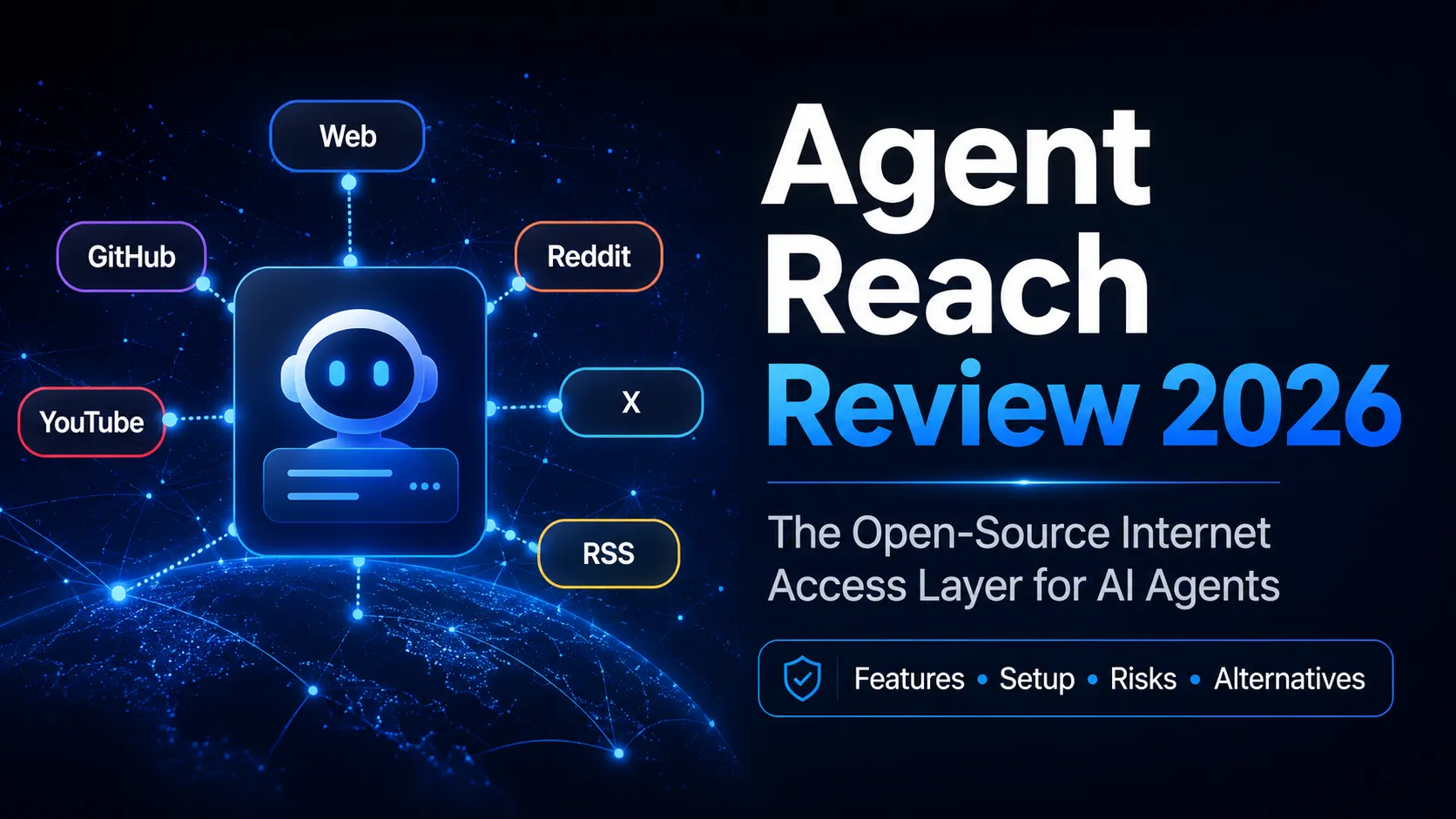
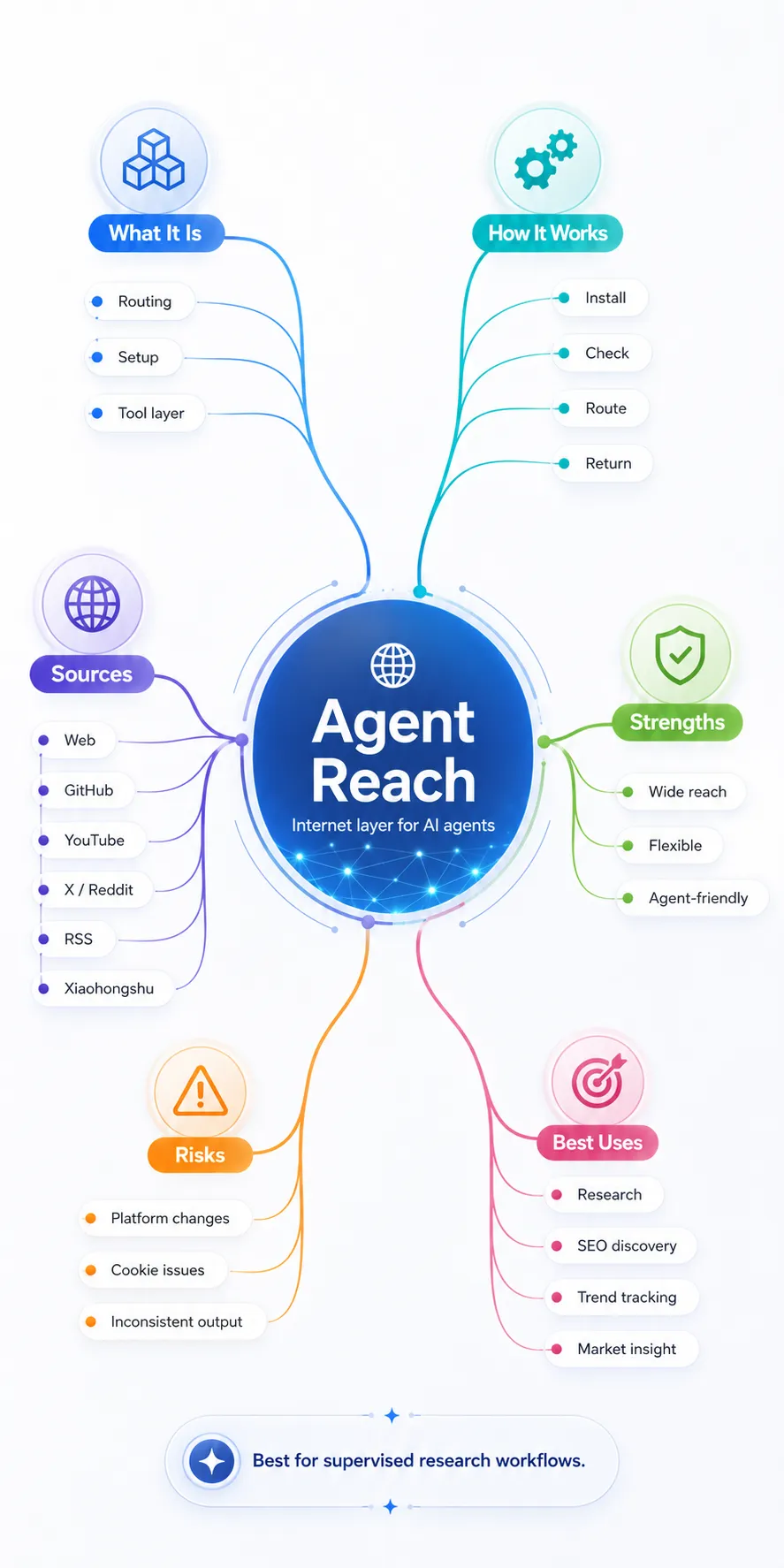
- Agent Reach is an open-source internet capability layer for AI agents, designed to help tools such as Claude Code, Cursor, Windsurf, OpenClaw, and other shell-capable agents access websites, social platforms, video content, GitHub, RSS feeds, and search services.
- It is not a new search engine, crawler, or unified scraping API. Instead, it installs, configures, routes, and monitors third-party CLI tools, MCP servers, browser sessions, and open-source utilities.
- The project has grown unusually quickly, reaching roughly 67,000 GitHub stars and more than 5,000 forks by mid-2026, making it one of the most visible projects in the emerging agent infrastructure category.
- Agent Reach is particularly notable for combining Western and Chinese internet sources, including X, Reddit, LinkedIn, GitHub, YouTube, Xiaohongshu, Bilibili, V2EX, Xueqiu, and Xiaoyuzhou.
- Its biggest strength is reducing the integration work required to give an AI agent broader internet access. Its biggest weakness is that reliability depends heavily on upstream tools, browser sessions, cookies, and frequently changing platform behavior.
- Agent Reach is best suited to research, competitive intelligence, content discovery, SEO research, developer workflows, and supervised agent tasks rather than mission-critical production data pipelines.
- Users should be especially careful with installation because the similarly named
agent-reachpackage on PyPI is not the same project as Panniantong/Agent-Reach.
What Is Agent Reach?
Agent Reach is an open-source project built around a simple but increasingly important problem: modern AI agents are capable of reasoning and executing code, but their ability to access the real internet is fragmented.
An agent may need one tool for GitHub, another for YouTube transcripts, another for X, a browser session for Xiaohongshu, and a separate search provider for general web research. Each integration can involve different installation commands, authentication mechanisms, output formats, rate limits, and failure modes.
Agent Reach attempts to make this infrastructure manageable.
Rather than building a proprietary crawler for every platform, it acts as an installation, configuration, routing, and diagnostic layer over existing tools.
A simplified architecture looks like this:
User request
    ↓
Claude Code / Cursor / OpenClaw / other agent
    ↓
Agent Reach skill and routing instructions
    ↓
Available CLI, MCP server, browser session, or API
    ↓
X / Reddit / YouTube / GitHub / Xiaohongshu / Bilibili / web
    ↓
Content returned to the agent
This distinction matters.
Agent Reach is not trying to become another Firecrawl, Apify, or Tavily. Its role is closer to an internet capability manager for autonomous agents.
Why Agent Reach Became Popular
Agent Reach addresses one of the biggest gaps between impressive AI demos and useful autonomous workflows.
Large language models already understand how to analyze competitors, summarize discussions, research software projects, compare products, and identify market opportunities. The difficult part is often acquiring the underlying information reliably.
Without a connectivity layer, developers frequently have to manually assemble workflows such as:
General web → search API
GitHub → gh CLI
YouTube → yt-dlp
Reddit → scraper or authenticated session
X → dedicated CLI or browser session
Xiaohongshu → browser automation or MCP server
RSS → feed parser
Agent Reach turns this fragmented setup into a more standardized environment.
Several factors explain its rapid adoption.
It solves an immediate agent infrastructure problem
AI agents need more than reasoning. They need tools, credentials, routing logic, fallback strategies, and health checks.
Agent Reach targets exactly this layer.
It fits naturally into coding agents
Claude Code-style agents are particularly suitable because they can already:
- execute shell commands;
- install packages;
- read configuration files;
- invoke CLIs;
- use MCP servers;
- retry failed commands;
- interpret structured or semi-structured output.
Agent Reach therefore does not need to build a large graphical application. It can expose capabilities through tools agents already understand.
It covers both English and Chinese internet ecosystems
Many agent research products focus almost entirely on English-language web search.
Agent Reach differentiates itself with support for sources such as:
- Xiaohongshu;
- Bilibili;
- V2EX;
- Xueqiu;
- Xiaoyuzhou;
- alongside X, Reddit, LinkedIn, GitHub, and YouTube.
For market research, product discovery, investment research, and consumer trend analysis, this cross-ecosystem coverage can be extremely valuable.
The open-source value proposition is strong
Instead of paying separately for numerous APIs, developers can often use open-source tools and authenticated browser sessions.
That does not make every workflow completely free. Proxies, infrastructure, third-party search services, or premium APIs may still introduce costs. However, the project substantially lowers the barrier to experimentation.
Agent Reach Features
Agent Reach should be evaluated as a collection of infrastructure capabilities rather than a single crawler.
Web page reading
Standard web pages can be converted into cleaner text suitable for LLM processing.
This is useful for:
- documentation research;
- article summarization;
- competitor analysis;
- product research;
- extracting information from public landing pages.
The advantage of using a reader-oriented service is that agents receive less navigation, advertising, and irrelevant page chrome than they would from raw HTML.
General web search
Agent Reach can connect agents with web search services such as Exa through its tool ecosystem.
This allows an agent to perform workflows such as:
Search for a topic
→ identify authoritative pages
→ retrieve those pages
→ compare information
→ summarize findings
The important value is not simply search itself. It is the ability to combine search with platform-specific research in the same agent workflow.
YouTube research
YouTube support can provide:
- video discovery;
- metadata retrieval;
- subtitle extraction;
- transcript-based research.
This is especially valuable because many technical discussions, product demonstrations, interviews, and niche tutorials exist primarily in video format.
However, YouTube increasingly applies automated traffic detection. Subtitle extraction may therefore fail or trigger bot verification depending on region, IP reputation, cookies, and the specific upstream tool being used.
GitHub access
GitHub integration is one of the more robust Agent Reach capabilities because it can rely on the official gh CLI.
Agents can potentially use it to:
- inspect repositories;
- search source code;
- read issues;
- examine pull requests;
- review releases;
- inspect project activity;
- access private repositories after authentication;
- create issues or pull requests when permissions allow.
For coding agents, this dramatically expands the amount of contextual information available during technical research.
RSS and Atom feeds
RSS remains one of the most stable ways for agents to monitor websites.
Agent Reach can use feed parsing for:
- blogs;
- release feeds;
- news sources;
- podcast feeds;
- project updates.
RSS is less glamorous than social scraping, but it is usually much more predictable and should be prioritized whenever a reliable feed exists.
X / Twitter
X is one of the most valuable but difficult sources for AI, software, finance, startup, and technology research.
Agent Reach can route requests through tools capable of accessing:
- posts;
- search results;
- timelines;
- discussions.
Authentication is often required for meaningful access.
This introduces several operational problems:
- session expiration;
- cookie handling;
- rate limits;
- account restrictions;
- anti-automation systems.
For serious automation, a dedicated account is safer than a primary personal account.
Reddit can provide exceptionally useful qualitative information for:
- product complaints;
- purchasing decisions;
- niche communities;
- software recommendations;
- competitor sentiment;
- emerging demand.
The difficulty is that anonymous and unofficial access has become significantly less reliable over time.
Agent Reach can provide routing into tools capable of accessing Reddit, but developers should expect authentication, rate limits, and changing access behavior.
Xiaohongshu
Xiaohongshu is one of Agent Reach's most differentiated integrations.
Potential workflows include:
- discovering posts;
- researching consumer trends;
- reading discussions;
- analyzing product sentiment;
- investigating travel destinations;
- identifying emerging keywords.
Several possible backends can be used, including OpenCLI-style browser access and dedicated Xiaohongshu MCP or CLI projects.
This multi-backend approach is useful because Xiaohongshu aggressively changes frontend and authentication behavior.
However, it also means results may be inconsistent. A command can technically succeed while returning incomplete engagement metrics or empty values.
Bilibili
Bilibili support extends video research into the Chinese internet ecosystem.
Agents can potentially retrieve:
- search results;
- video metadata;
- popular content;
- creator-related information.
This can be particularly useful for analyzing Chinese gaming, technology, AI, entertainment, and consumer trends.
LinkedIn is another high-value but fragile source.
Public profile pages may sometimes be readable through standard page extraction, while more detailed access can require authenticated scraping tools or browser sessions.
LinkedIn should generally be treated as a restricted source rather than a guaranteed zero-configuration integration.
Facebook and Instagram
These platforms typically depend heavily on logged-in browser sessions.
They may be useful for targeted research, but they are among the least suitable channels for unattended automation because results can be affected by:
- login requirements;
- geographic restrictions;
- account-specific page rendering;
- anti-bot detection;
- rapidly changing frontend code.
Agent Reach Architecture
The project is primarily implemented as a lightweight Python CLI rather than a heavy server platform.
Its dependency set includes familiar packages for HTTP requests, feeds, logging, configuration, terminal output, and media extraction.
Optional components can extend functionality through browser automation and MCP tooling.
The command-line interface becomes the control point for installation and diagnosis.
Typical commands include:
agent-reach install --env=auto
agent-reach install --safe
agent-reach install --dry-run
agent-reach doctor
agent-reach doctor --json
agent-reach uninstall
The doctor functionality is particularly important because the health of an agent's internet capabilities can change even when Agent Reach itself has not been updated.
Multi-Backend Routing Explained
One of the most important architectural improvements in newer Agent Reach releases is the move toward multiple backends per capability.
Instead of assuming one tool will remain functional indefinitely, the system can maintain a priority list.
Conceptually:
Twitter
├── Backend A
├── Backend B
└── Fallback backend

Xiaohongshu
├── OpenCLI
├── dedicated MCP backend
└── alternative CLI
The agent can select the highest-priority backend that is currently available.
This architecture reflects the reality of internet automation: platform integrations are disposable components.
A robust agent system should therefore optimize for replaceability rather than assuming permanent API compatibility.
How to Install Agent Reach Safely
Installation requires more attention than many users expect because of a package naming conflict.
The open-source Agent Reach project discussed here should be installed from its GitHub repository rather than blindly installing the similarly named PyPI package.
A typical isolated installation uses pipx:
pipx install https://github.com/Panniantong/agent-reach/archive/main.zip
agent-reach install --env=auto
A Python virtual environment can also be used:
python3 -m venv ~/.agent-reach-venv
source ~/.agent-reach-venv/bin/activate
pip install https://github.com/Panniantong/agent-reach/archive/main.zip
agent-reach install --env=auto
Before allowing an installer to modify the system, use dry-run mode:
agent-reach install --env=auto --dry-runFor more controlled environments:
agent-reach install --safeImportant: the PyPI package naming conflict
There is a package named agent-reach on PyPI that is not the same project as the widely starred Panniantong/Agent-Reach repository.
Running this without checking the package identity is therefore risky:
pip install agent-reachThis is an important supply-chain lesson for any fast-growing open-source project.
Package names, GitHub repositories, npm packages, and domain names should never be assumed to belong to the same maintainer.
Production Installation Best Practices
The official GitHub installation approach may retrieve the current main branch.
That is convenient for experimentation but less desirable for production systems because the same installation command can produce different code at different times.
A stronger deployment process should:
- inspect the repository;
- select a known release or commit;
- pin the exact version;
- record dependency versions;
- run installation in an isolated environment;
- run health checks after deployment;
- separately test whether each backend returns real content.
A production workflow might conceptually look like:
Review release
→ pin commit
→ install in container
→ configure credentials
→ run doctor
→ perform live content tests
→ approve deployment
Why doctor Is Useful but Not Enough
A common mistake is treating a successful health check as proof that a platform integration works correctly.
There are at least three different levels of health:
Level 1: Tool availability
Is the CLI installed?Level 2: Authentication health
Can the tool access the account or session?Level 3: Content health
Did the request return real, complete, plausible content?Only the third level matters to the final research output.
A backend might exit successfully while returning:
- zero results;
- empty engagement metrics;
- login pages;
- bot verification pages;
- incomplete text;
- stale cached data.
Reliable implementations should therefore add content assertions after Agent Reach's health checks.
For example:
Request succeeded
AND result count > 0
AND content length > threshold
AND expected fields exist
AND timestamp is plausible
This is one of the most important improvements teams should add before depending on Agent Reach for automated research.
Agent Reach Security and Privacy Risks
Agent Reach is local-first in many workflows, which is beneficial because credentials do not necessarily need to pass through a centralized Agent Reach cloud service.
However, local storage does not automatically make a workflow safe.
Browser cookies are effectively credentials
A valid session cookie can provide nearly the same access as a password-protected logged-in browser.
If an agent or subprocess can read those cookies, it may be able to act with the user's privileges.
Avoid using primary accounts for experimental automation.
A safer configuration uses:
- dedicated research accounts;
- limited account permissions;
- isolated Chrome profiles;
- separate operating-system users or containers;
- restricted filesystem access;
- credential rotation.
Agents can execute commands
Agent Reach is commonly used with powerful coding agents capable of running arbitrary shell commands.
This creates a larger attack surface than a conventional read-only research application.
A malicious webpage, compromised dependency, or badly designed instruction chain could potentially influence tool execution.
Production deployments should consider:
- sandboxing;
- command allowlists;
- filesystem restrictions;
- network restrictions;
- read-only credentials;
- audit logging.
Upstream dependencies matter
Agent Reach itself may be trustworthy while one of its upstream tools becomes compromised or abandoned.
This is an unavoidable consequence of its architecture.
Dependency trust should therefore be evaluated per backend, not only at the Agent Reach repository level.
Reliability Problems to Expect
Agent Reach operates in one of the least stable areas of software infrastructure: unofficial access to frequently changing internet platforms.
Users should expect occasional failures.
Anti-bot systems
Platforms can detect:
- unusual request rates;
- datacenter IP addresses;
- automation fingerprints;
- repeated navigation patterns;
- suspicious account activity.
YouTube, social networks, and authenticated platforms are especially sensitive.
Expired sessions
Cookie-based authentication introduces an unavoidable lifecycle problem.
A working integration today may fail tomorrow because:
- a session expires;
- the account is logged out;
- security verification is triggered;
- the platform rotates authentication tokens.
Frontend changes
Browser-based extraction is fragile because selectors and data structures change.
This is why multi-backend routing is valuable, but fallback tools can fail simultaneously if they all depend on the same frontend behavior.
Operating-system differences
Some upstream scripts behave differently across:
- macOS;
- Linux;
- Windows;
- WSL;
- Git Bash.
Path handling, shell commands, browser cookie access, executable names, and environment variables can all create platform-specific failures.
Agent Reach vs Firecrawl
Agent Reach and Firecrawl solve different problems.
Firecrawl is better understood as a structured web data infrastructure product. It focuses on capabilities such as:
- page scraping;
- crawling websites;
- search;
- structured extraction;
- standardized API output.
Agent Reach focuses more on connecting agents to a heterogeneous collection of internet tools.
The practical difference is:
Need reliable website extraction at scale → Firecrawl
Need an agent to research X + GitHub + YouTube + Xiaohongshu → Agent Reach
Agent Reach has broader source diversity, while Firecrawl provides a more controlled application interface.
Agent Reach vs Tavily
Tavily focuses heavily on AI-oriented web search and research.
Its strengths include:
- search APIs;
- extraction;
- research workflows;
- relatively predictable structured responses.
Agent Reach goes beyond ordinary web search by targeting authenticated social and platform-specific sources.
For a research agent, the two can actually complement each other:
Tavily → broad web discovery
Agent Reach → platform-specific deep research
Agent Reach vs Apify
Apify is more appropriate for scalable data collection infrastructure.
It provides cloud execution, schedulable actors, storage, datasets, and a large ecosystem of scraping applications.
Agent Reach is lighter and more convenient for agent-driven interactive research.
A useful distinction is:
Agent asks a question and needs information now → Agent Reach
Company runs thousands of scheduled extraction jobs → Apify
Agent Reach vs Composio
Composio primarily helps agents interact with software applications and authenticated business services.
Typical use cases include:
- Gmail;
- Slack;
- Notion;
- CRMs;
- SaaS APIs;
- OAuth-connected tools.
Agent Reach is more focused on internet information acquisition.
Composio is more focused on application actions and authenticated business workflows.
They solve adjacent but different parts of the agent infrastructure stack.
When Agent Reach Is a Good Choice
Agent Reach is particularly useful for exploratory and research-heavy workflows.
Competitive intelligence
An agent can combine:
- company websites;
- GitHub repositories;
- Reddit discussions;
- X posts;
- YouTube reviews;
- Xiaohongshu discussions.
This produces a more complete picture than general web search alone.
SEO and content research
Agent Reach can help discover:
- recurring user questions;
- complaints;
- emerging terminology;
- niche communities;
- product comparisons;
- new content opportunities.
This is especially useful when search volume tools lag behind rapidly emerging topics.
Product discovery
Cross-platform research can reveal demand before it becomes obvious in conventional keyword databases.
For example:
Reddit complaints
+ X discussions
+ GitHub activity
+ YouTube tutorials
+ Xiaohongshu demand
= stronger early product signal
AI tool research
The AI ecosystem moves extremely quickly, and many important announcements appear on GitHub and social platforms before traditional articles rank in search engines.
Agent Reach is well suited to this type of fast-moving research.
Travel and local discovery
Chinese social platforms contain significant amounts of travel information that may never rank prominently on global search engines.
An agent capable of combining conventional travel pages with Xiaohongshu, Bilibili, and community discussions can produce richer destination research.
When Agent Reach Is the Wrong Choice
Agent Reach should not automatically become the foundation of every internet-enabled product.
Avoid relying on it as the only data layer when the application requires:
- strict uptime guarantees;
- deterministic data structures;
- contractual SLAs;
- legally sensitive data collection;
- extremely high request volumes;
- guaranteed historical completeness;
- unattended account automation;
- stable enterprise authentication.
In these scenarios, commercial APIs or purpose-built data pipelines are usually safer.
How to Build a More Reliable Agent Reach Workflow
Agent Reach becomes substantially more useful when surrounded by additional reliability infrastructure.
1. Use multiple data sources
Never assume one platform or backend contains the truth.
A strong research workflow can use:
General search
+ official website
+ GitHub
+ social platform
+ community discussion
The agent can then compare claims across sources.
2. Preserve provenance
Every extracted item should retain metadata such as:
{
  "platform": "reddit",
  "retrievedAt": "2026-08-08T12:00:00Z",
  "backend": "selected-backend",
  "source": "original-content-location"
}
This makes it possible to audit research later.
3. Normalize outputs
Different backends produce different response structures.
A normalization layer can map them into a common schema:
{
  "platform": "x",
  "author": "example",
  "title": null,
  "text": "...",
  "publishedAt": "...",
  "engagement": {
    "likes": 0,
    "comments": 0
  }
}
This dramatically simplifies downstream ranking, deduplication, and analysis.
4. Add plausibility checks
Do not merely check whether a command executed successfully.
Validate whether returned data makes sense.
Examples:
- content length greater than a minimum threshold;
- expected author field exists;
- publication date is valid;
- search result contains at least one item;
- engagement metrics are not unexpectedly null;
- response is not a login page.
5. Add retries with backend switching
A resilient workflow should resemble:
Try primary backend
→ validate content
→ retry once
→ switch backend
→ retry
→ fall back to general search
→ mark source unavailable
This is much stronger than repeatedly executing the same broken tool.
6. Track per-channel reliability
Organizations using Agent Reach regularly should maintain metrics such as:
- successful request percentage;
- authentication failures;
- empty-result rate;
- average response latency;
- backend currently in use;
- last successful live test.
This turns a collection of fragile tools into an observable infrastructure layer.
Advanced Agent Reach Use Case: Cross-Platform Market Research
One of the strongest use cases is a research pipeline that looks for product opportunities.
For example:
Step 1: Search general web for product category
Step 2: Search Reddit for recurring complaints
Step 3: Search X for emerging terminology
Step 4: Search GitHub for new related projects
Step 5: Search YouTube for tutorial demand
Step 6: Search Xiaohongshu for Chinese consumer behavior
Step 7: Deduplicate findings
Step 8: Group complaints into demand clusters
Step 9: Score opportunities by frequency and urgency
The final output could classify signals into:
- existing demand;
- growing demand;
- unresolved complaints;
- underserved user segments;
- potential SEO opportunities;
- potential SaaS or tool opportunities.
This demonstrates why Agent Reach is more interesting than a simple scraping utility. It can become part of a broader agent research operating system.
A Bigger Product Opportunity Behind Agent Reach
The popularity of Agent Reach reveals a broader market opportunity.
AI models are becoming increasingly capable, while access to external systems remains fragmented.
The emerging infrastructure stack is therefore moving toward layers such as:
Model
↓
Agent runtime
↓
Tool selection
↓
Authentication
↓
Internet and SaaS connectivity
↓
Reliability monitoring
↓
Data normalization
Agent Reach occupies the connectivity and routing portion of this stack.
Several potentially valuable product categories can be built around the same problem.
Agent channel monitoring
A service could continuously test whether X, Reddit, YouTube, Xiaohongshu, and other integrations actually return valid data.
Useful metrics could include:
- live status;
- last successful retrieval;
- current recommended backend;
- authentication requirement;
- operating-system compatibility;
- geographic restrictions;
- recent failure rate.
This would solve an important weakness of decentralized agent tooling.
Secure enterprise agent connectivity
An enterprise-oriented version could provide:
- encrypted credential vaults;
- isolated browser sessions;
- permission policies;
- read-only modes;
- audit logs;
- containerized execution;
- automatic credential rotation;
- network allowlists.
Businesses are more likely to pay for security and reliability than for another collection of scraping scripts.
Vertical research agents
Instead of selling connectivity itself, products can sell outcomes.
Examples include:
- AI trend research agents;
- competitor monitoring agents;
- SEO opportunity agents;
- Reddit and Xiaohongshu sentiment agents;
- game trend discovery agents;
- investment research assistants;
- ecommerce product opportunity agents.
Agent Reach can serve as one component underneath these products.
Unified agent data gateways
Another opportunity is placing a standardized API above multiple open-source and commercial backends.
For example:
{
  "query": "AI coding agents",
  "platforms": ["web", "x", "reddit", "github", "youtube"],
  "results": [],
  "confidence": 0.91
}
The gateway could automatically decide whether to use Agent Reach, Firecrawl, Tavily, Apify, or another provider depending on reliability and cost.
That would transform fragile platform access into a production-oriented data layer.
Common Agent Reach Mistakes
Installing the wrong package
Do not assume a matching PyPI package is the same project.
Verify repository ownership and installation instructions first.
Using a primary social account
Research automation can trigger security systems or account restrictions.
Dedicated accounts reduce the potential damage.
Assuming successful execution means successful extraction
Always validate the returned content.
Relying on a single backend
The internet changes too quickly for this assumption to remain reliable.
Updating production environments from the main branch automatically
Pin versions or commits before production deployment.
Treating Agent Reach as a unified API
Its outputs come from heterogeneous upstream tools. Add a normalization layer when structured data matters.
Ignoring authentication lifecycle
Cookie-based integrations will eventually expire. Build session monitoring into long-running systems.
Is Agent Reach Worth Using in 2026?
For developers, researchers, and advanced AI-agent users, yes — with appropriate expectations.
Agent Reach substantially reduces the work required to give an agent broad internet access, particularly when research spans both Western and Chinese platforms.
Its strongest qualities are:
- broad platform coverage;
- strong fit with terminal-based agents;
- open-source flexibility;
- local-first workflows;
- multi-backend routing;
- excellent usefulness for exploratory research.
Its weaknesses are equally important:
- upstream dependency risk;
- fragile social-platform integrations;
- inconsistent output formats;
- authentication complexity;
- account safety concerns;
- insufficient guarantees for production workloads.
The right mental model is therefore:
Agent Reach is an internet capability toolkit and routing layer for agents, not a guaranteed data API.
Conclusion
Agent Reach represents an important shift in AI infrastructure. The challenge is no longer only making models more intelligent. The next challenge is giving agents reliable, flexible, and controlled access to the information they need.
Agent Reach tackles that problem pragmatically by combining existing CLIs, MCP servers, browser sessions, search services, and specialized platform tools rather than rebuilding every integration from scratch.
That approach makes it unusually useful for competitive research, SEO discovery, AI trend analysis, product research, developer workflows, and cross-platform intelligence.
For experimentation and supervised agent workflows, Agent Reach is one of the most interesting open-source projects in this category. For production use, it should be strengthened with pinned versions, isolated credentials, live content validation, fallback providers, output normalization, and channel-level monitoring.
The larger opportunity is even more significant: as autonomous agents become mainstream, the infrastructure that securely connects them to the real internet may become as important as the models themselves.
Continue Reading
More articles connected to the same themes, protocols, and tools.

Referenced Tools
Browse entries that are adjacent to the topics covered in this article.