 AppianAppian is an enterprise low-code and AI process automation platform for teams that need governed workflow applications, data-connected processes, and auditable AI agents.
Pega Platform
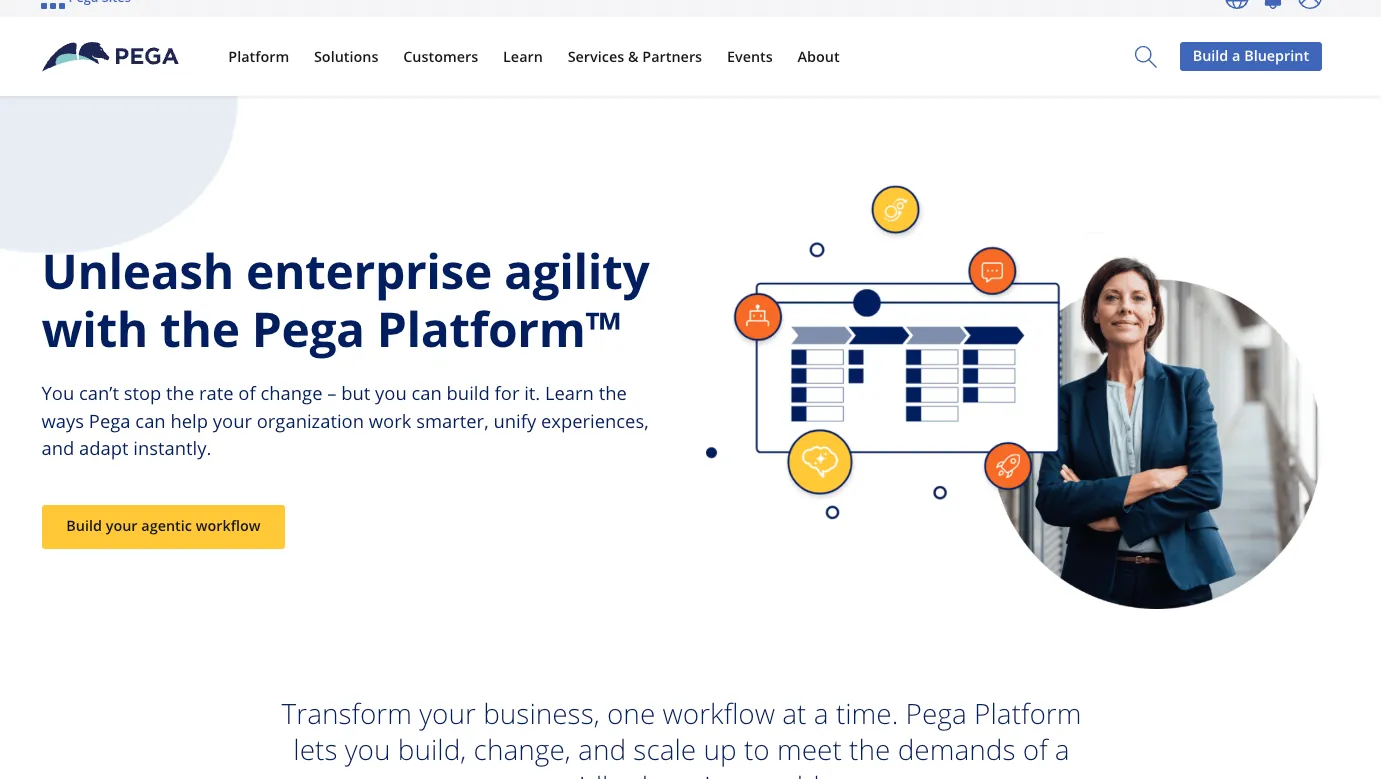
Pega Platform is an enterprise AI decisioning and workflow automation platform for organizations building governed applications around critical business processes.
Information checked: Jul 8, 2026 ·View sources
Tool details
- Type
- Developer workflows
- Platforms
- Web, Pega Cloud, Pega Cloud on AWS, Pega Cloud on Google Cloud, Client-managed Kubernetes, Private cloud, Hybrid cloud, iOS, Android
- Free plan
- Yes
- Open source
- No
- Bring your own key
- Yes
- Local models
- No
Overview
Best for
- Enterprise workflow applications
- Case management and BPM modernization
- AI-assisted legacy transformation
- Customer service and operations automation
- Real-time decisioning and next-best-action systems
- Regulated teams that need governance, auditability, and human oversight
Strengths
- Strong fit for complex, regulated enterprise workflows.
- Combines low-code apps, case management, decisioning, automation, and AI in one platform.
- Pega Blueprint helps align business and IT before implementation.
- Mature enterprise architecture with governance, reuse, and lifecycle controls.
- Community Edition and Blueprint make early evaluation possible without a full procurement cycle.
Limitations & trade-offs
- Developers looking for an AI code editor like Cursor or Windsurf
- Teams that want a terminal-first coding agent
- Small startups building quick public SaaS prototypes
- Open-source-first teams that require full source-level control
- Simple websites, blogs, ecommerce storefronts, or lightweight CRUD apps
- Not an AI-native code editor, CLI coding agent, or GitHub issue-to-PR automation tool.
- Commercial pricing is custom and enterprise-oriented rather than self-serve.
- Requires Pega-specific architecture, delivery, and governance skills for serious production use.
- Can be too heavy for simple prototypes, small internal apps, or public marketing sites.
- AI and deployment capabilities can vary by version, subscription, cloud model, and configured provider.
Get started
Pricing & usage limits
Free tier available
Community EditionFree
Developer-focused Pega Platform trial with access to App Studio, Dev Studio, and Prediction Studio.
Pega BlueprintFree
AI workflow and application design workspace available with a Pega Community login.
Pega Platform SubscriptionCustom / contract
Enterprise subscription for low-code application development, decisioning, workflow automation, and platform capabilities.
Pega Cloud / Client-Managed CloudCustom / contract
Deployment options for Pega-managed cloud or client-managed Kubernetes environments.
Pricing checked: Jul 8, 2026 · Subscription, usage limits, and model costs may be billed separately.
Features & details
Enterprise Low-Code Development
- App Studio and Dev Studio
- Visual case and workflow design
- Reusable rules and application layers
- AI-assisted app development and prototyping
Workflow and Automation
- Case Management and BPM
- Robotic Process Automation
- Process Mining and Task Mining
- Agentic Process Fabric
AI Decisioning and GenAI
- Next Best Action decisioning
- Process AI
- AI Agents
- Email Bot, Voice AI, and messaging AI
Enterprise Platform Controls
- Data and system integrations
- Deployment Manager and DevOps support
- Security, governance, and access controls
- Pega Cloud and client-managed deployment options
Why Choose Pega Platform?
Pega Platform is strongest when the real problem is not writing more code, but controlling how enterprise work moves across people, systems, decisions, and exceptions. It is built for organizations that need to model business processes, automate repeatable work, apply decision logic, and evolve applications without turning every change into a long custom development project.
That makes Pega different from AI coding assistants and prompt-to-app tools. A coding assistant helps a developer modify source code. A prompt-to-app builder helps a small team generate a prototype. Pega is closer to an enterprise operating layer for decisions and workflows that cannot be allowed to drift, break compliance rules, or become invisible to business owners.
The strongest reason to choose Pega is the combination of process discipline and adaptability. Teams can define work around cases, stages, rules, personas, data, decisions, and exceptions, then keep improving the system as policies, channels, and operating requirements change.
Core Workflow
A practical Pega implementation usually begins with business architecture rather than code generation. Teams identify the target process, the case lifecycle, the actors involved, the key decisions, the required integrations, and the points where human judgment is still necessary.
Pega Blueprint changes the early discovery phase by giving business and IT teams a shared AI-assisted workspace. Instead of starting with a blank requirements document, teams can describe the process, review a generated structure, adjust the case design, and use that design to accelerate later delivery inside Pega Platform.
Once the application is being built, the work typically moves through model-driven design, integration setup, rule configuration, user experience design, testing, deployment, and continuous process improvement. The important pattern is that the process model remains central. AI is useful, but it works best when it is bounded by an explicit workflow and governance model.
Use Cases That Fit Pega Platform
Pega is a strong fit for industries where operational work is complex, regulated, and high-volume. Common examples include financial services onboarding, claims processing, customer service operations, healthcare administration, telecom service workflows, public-sector casework, fraud operations, complaints management, and enterprise modernization programs.
It is also useful when a company has many legacy systems but cannot simply replace them all at once. In that situation, Pega can become a modernization layer that orchestrates work across old and new systems while giving users a more consistent process experience.
The platform is less compelling for small standalone applications that do not need process modeling, decisioning, governance, or enterprise integration. If the goal is only to ship a simple SaaS dashboard, landing page, or internal form, a lighter web framework or prompt-to-app builder will usually be faster.
Comparison to Alternatives
Compared with Appian, Pega is often evaluated for deeper decisioning, customer engagement, and case-management-heavy transformation programs. Appian is also highly process-oriented, but Pega's positioning places more emphasis on AI decisioning, next-best-action patterns, and reimagining complex legacy operations.
Compared with OutSystems and Mendix, Pega is usually less about general-purpose app development and more about enterprise processes that need decisions, cases, rules, and continuous adaptation. OutSystems and Mendix may appeal more to teams that want a broader custom application development platform; Pega is sharper when the project is tied to operating-model transformation.
Compared with Microsoft Power Apps, Pega is usually a more specialized enterprise platform. Power Apps can be attractive for Microsoft-centered teams building departmental apps. Pega becomes more relevant when the workflow spans many systems, carries higher compliance risk, or requires sophisticated decision logic and case orchestration.
Compared with ServiceNow App Engine, the distinction often depends on where the workflow lives. ServiceNow is a natural choice for organizations standardizing around ServiceNow service operations. Pega is more independent when the target process cuts across many departments, systems, and customer-facing channels.
Best Configuration
The best Pega rollout starts with one high-value workflow where cycle time, exception handling, compliance burden, or customer impact is easy to measure. A project that is too small will not justify the platform. A project that is too broad can become a transformation program before the team has learned how to deliver.
A good first configuration includes clear ownership from both business and IT. Business teams should define outcomes, policies, and exceptions. Technical teams should own integration quality, environment strategy, release management, security, and performance. Pega works best when these groups design together instead of passing requirements across a wall.
For AI-enabled use, define the boundary of automation early. Decide which decisions can be assisted, which must remain human-approved, what data can be sent to a model provider, how prompts are masked, and how outcomes will be reviewed. The goal is not to let AI improvise across the enterprise; it is to use AI inside a governed process architecture.
Migration Notes
Migrating to Pega should not be treated as a screen-for-screen rewrite of an old workflow. The better approach is to extract the business intent from the legacy system, map the real process, remove avoidable handoffs, and rebuild around a cleaner case model.
For mainframe, Lotus Notes, spreadsheet, or email-based operations, expect discovery to be the most important phase. The current process may be hidden inside documents, habits, exception paths, and undocumented business rules. Pega Blueprint can accelerate discovery, but humans still need to validate whether the generated design reflects the actual operating model.
For teams already using another BPM or low-code platform, migration planning should focus on rules, integrations, data ownership, testing, and change management. The technical move is only one part of the work. The larger question is whether the new process model will be easier to govern and improve over time.
Tradeoffs in Practice
Pega's main tradeoff is that it is powerful because it is opinionated. The platform rewards teams that accept its process-first model, reuse patterns, guardrails, and governance approach. Teams that want unconstrained custom code or lightweight experimentation may find that structure restrictive.
The platform also requires the right operating model. Successful programs usually involve certified Pega skills, business architecture, platform governance, release discipline, and executive sponsorship. Without those ingredients, organizations can underuse the platform or recreate the same complexity they were trying to escape.
When the workflow is mission-critical, that structure is often the point. Pega is not mainly for making developers type faster. It is for helping large organizations change how work gets designed, executed, measured, and improved.
Model support & data privacy
Supported models
- Amazon Bedrock
- Azure OpenAI
- Google Vertex AI
- GPT
- Gemini
- Claude
- Anthropic
- Amazon
- Cohere
- Meta
Privacy & data handling
Pega documents security and privacy controls for Pega Cloud and Pega Blueprint, including role-based access, encryption, and safeguards around GenAI subproviders. Teams should still review data residency, provider routing, prompt masking, model configuration, and contractual terms before using AI features with sensitive production data.
Guides, reviews & fixes
No published guides yet. Start with the official documentation above.
Product updates
No verified product updates listed yet. Follow this tool to see new relevant content in Saved.
See the content timelineAlternatives
AppianAppian is an enterprise low-code and AI process automation platform for teams that need governed workflow applications, data-connected processes, and auditable AI agents. OutSystemsOutSystems is an enterprise AI development and low-code platform for teams that need to build, run, and govern full-stack applications and agentic systems at scale.
 MendixMendix is an enterprise low-code application development platform for building, deploying, and governing business apps with AI-assisted model-driven development.
 Microsoft Power AppsMicrosoft Power Apps is an enterprise low-code and AI app-building platform for organizations that want to build governed business applications inside the broader Microsoft Power Platform ecosystem.
 ServiceNow App EngineServiceNow App Engine is an enterprise low-code and AI app development platform for building governed workflow apps and agents on top of ServiceNow data, processes, and lifecycle controls.
Sources & verification
Verification dates record when this directory checked the information. Product release dates appear separately above.
Official websitePega Platform capabilitiesAI-powered app developmentPega BlueprintPega GenAI Blueprint FAQsPega Platform TrialPega Community EditionPega Cloud documentationClient-managed CloudPega Trust CenterPega AWS strategic collaboration
Directory revision history
Created directory entry using Pega official product pages, Blueprint resources, Community Edition information, Pega Cloud documentation, Trust Center materials, and AI provider announcements.