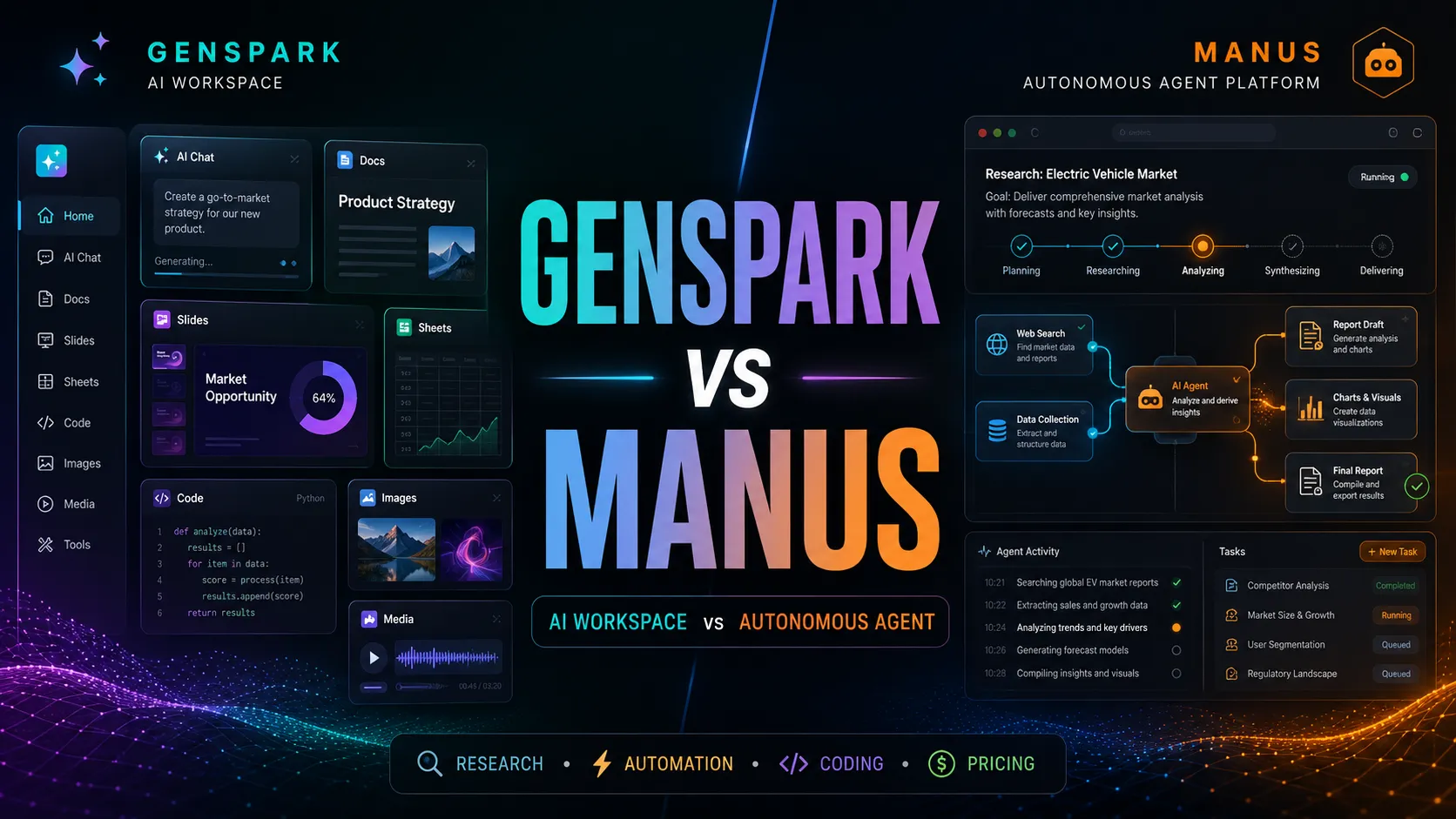
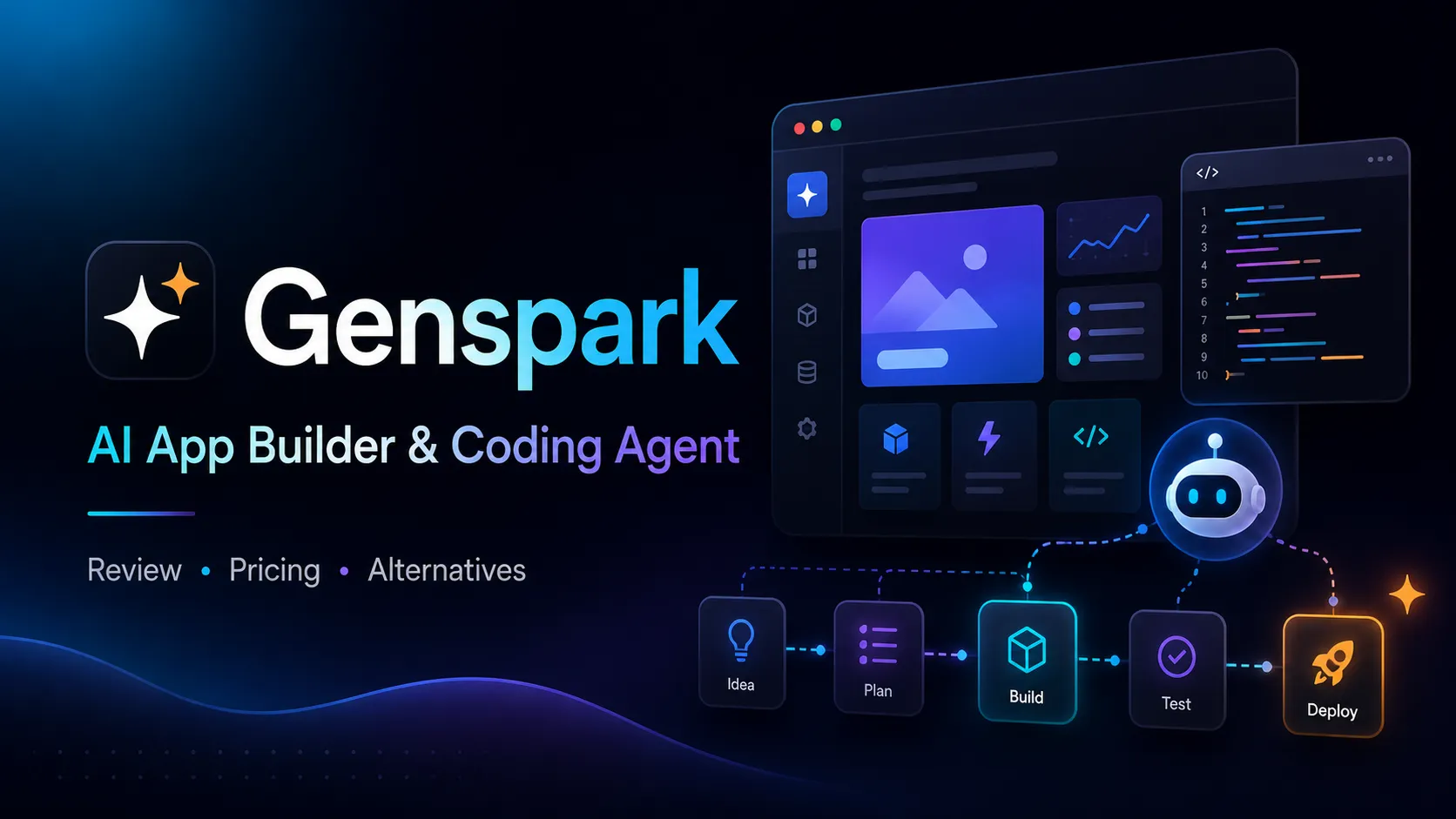
A browser-based AI workspace with an autonomous coding agent aimed at turning product requirements into working applications rather than acting primarily as an inline IDE assistant.
Basic access with 100 daily credits and limited model, storage, and agent access.
Plus$24.99 / month
Starts with 10,000 monthly credits, 50 GB AI Drive storage, and full workspace access including Genspark Code. Annual billing is $239.99.
Pro$249.99 / month
Starts with 125,000 monthly credits, 1 TB AI Drive storage, and early access to selected beta features. Annual billing is $2,399.99.
Team$30 / user/month
For 2-150 users with 12,000 credits per seat, centralized administration, SSO/SAML, analytics, billing, and connector management.
EnterpriseCustom
Contract pricing for larger organizations or teams requiring advanced governance, data residency, dedicated support, or custom security terms.
Pricing checked: Aug 9, 2026 · Subscription, usage limits, and model costs may be billed separately.
Features & details
AI Development
Autonomous planning, coding, testing, and deployment
Web, mobile, ecommerce, and existing-code workflows
Task-level access to multiple AI model providers
Natural-language application iteration
Application Stack
Simple sites and application prototypes
Built-in database support
Full-stack authentication and backend generation
Hono and Node.js production stack
Cloudflare Pages-optimized deployment path
Workspace Integration
Shared workspace with research, docs, sheets, slides, and design
Cross-project context through Genspark Hub
Design-to-working-code workflows
Reusable Skills and connected data sources
Team Controls
Centralized billing and seat management
Member roles and usage analytics
SSO/SAML support
Connector administration
Enterprise model and agent governance
Why Choose Genspark?
The main reason to evaluate Genspark is not that it replaces a traditional code editor line for line. Its differentiation is that software development sits inside a broader AI workspace where the same project can move through research, planning, documentation, visual design, implementation, and presentation without treating each stage as an unrelated tool session.
That changes the target user. A developer who already has a detailed specification and wants an AI to modify individual files may get more leverage from an AI-native editor or terminal agent. Genspark becomes more interesting when the specification itself is still evolving and the person directing the project wants AI assistance across the entire product-development process.
This is particularly relevant for founders, product managers, agencies, consultants, and small internal teams. Instead of translating a business requirement into a PRD, then a design brief, then developer tickets, Genspark can keep more of that intent inside the same workspace before handing implementation to Genspark Code.
Core Workflow
A practical Genspark development workflow starts with the desired outcome rather than the repository. Define the user, problem, constraints, data requirements, important workflows, and acceptance criteria first. Supporting research or product documentation can then become context for the implementation instead of being recreated in separate coding prompts.
Once the requirements are stable enough, Genspark Code can take responsibility for a larger implementation unit. This is an important distinction from autocomplete-oriented tools: prompts work better when they describe an outcome such as a complete onboarding flow, dashboard, or CRUD workflow rather than asking for isolated lines of code.
The most effective review loop is therefore specification-driven:
Define the product behavior and constraints.
Establish representative data, states, and edge cases.
Let the coding agent implement a coherent unit of functionality.
Review the running behavior rather than only the generated source.
Convert defects into explicit acceptance criteria and iterate.
Run conventional engineering checks before treating the result as production-ready.
Genspark's broader workspace can also make later iterations easier because product research, documents, designs, and previous project context do not necessarily have to be reconstructed for every coding task.
Use Cases
Genspark is a natural fit for greenfield projects where the desired product is clearer than the desired implementation. Examples include MVPs, marketing applications, customer portals, lightweight SaaS products, CRUD applications, dashboards, calculators, directories, prototypes, and internal business systems.
It can also be useful for experiments where a team wants to validate whether a workflow is worth engineering properly. An operations team, for example, can describe an internal process and evaluate a working implementation before committing conventional engineering resources.
Another useful pattern is cross-functional prototyping. A project can begin as research or a product document, move into interface exploration, and only then become an application. The ability to keep those stages close together is more important here than raw code-completion speed.
The fit becomes weaker as repository complexity increases. Large monorepos, unusual build systems, deeply customized infrastructure, extensive native dependencies, strict architectural boundaries, or sophisticated release processes reduce the advantage of an autonomous prompt-to-app workflow because more implementation decisions are already encoded in the engineering system itself.
Comparison to Alternatives
The closest buying comparison is with prompt-to-app products such as Lovable, Bolt.new, Replit Agent, v0, Base44, and Create. The important question is not simply which product can generate a page from a prompt. It is how much of the work surrounding that page needs to happen in the same environment.
If the job is narrowly defined as generating and iterating a web application, a specialized builder may provide a more focused experience. Genspark becomes more differentiated when the application is one deliverable within a larger project involving research, documents, data analysis, design, or presentation work.
Cursor and Windsurf are therefore useful reference points but are not direct substitutes. Those products are centered on developers working inside an editor and existing source tree. Genspark Code shifts more responsibility toward the agent and asks the user to supervise the outcome at a higher level.
Likewise, issue-to-PR agents occupy a different category. Genspark publicly exposes an existing-code workflow, but its product positioning remains strongly oriented toward building applications and complete solutions rather than functioning primarily as a GitHub ticket worker.
Best Configuration
For production-oriented work, use Genspark as an implementation layer rather than the only source of engineering truth. Keep repository history, dependency locks, environment configuration, automated tests, secrets management, deployment settings, monitoring, and review policies explicit even when the agent can generate much of the application itself.
Prompts should contain constraints that experienced developers normally keep in their heads. Specify runtime versions, preferred frameworks, API contracts, database assumptions, authentication rules, error states, responsive behavior, accessibility expectations, performance requirements, and what must not be changed. Autonomous agents become substantially easier to supervise when success can be tested rather than interpreted subjectively.
For larger builds, split the system into vertical slices instead of requesting the entire product repeatedly. A useful sequence might be authentication, core data model, one complete user workflow, administration, integrations, and final hardening. Each completed slice gives the next task a more concrete system to work against.
The multi-model approach can also be treated as orchestration rather than a reason to manually chase whichever model is currently fashionable. Let model choice follow the task unless there is a repeatable reason to prefer a particular provider for a specific workload.
Migration Notes
Genspark Code currently presents an Existing code path, but the public documentation is considerably more explicit about greenfield application generation than complex repository migration behavior. Teams evaluating it against a mature codebase should therefore begin with a disposable copy, isolated branch, or non-critical service rather than immediately handing the agent a production-critical repository.
Before migration, document environment variables, external services, generated files, package-manager rules, runtime versions, database migration procedures, test commands, and deployment assumptions. These details are often obvious to the existing engineering team but invisible to an autonomous agent unless they are encoded in the repository or supplied as context.
After an agent-driven change, compare architecture and dependency changes as carefully as feature behavior. A generated application can appear correct while quietly introducing a second state-management pattern, redundant library, new runtime assumption, or incompatible deployment convention.
For teams already satisfied with Cursor, Windsurf, Claude Code, or another developer-centric workflow, replacing the existing stack is not necessarily the right migration strategy. Genspark can instead be introduced earlier in the lifecycle for research, specification, prototyping, or isolated application generation while the established IDE, repository, and CI/CD system remain the engineering system of record.
Model support & data privacy
Supported models
Anthropic
OpenAI
Google
xAI
DeepSeek
Moonshot AI
MiniMax
Zhipu AI
Privacy & data handling
Genspark's privacy policy states that information included in prompts may be sent to third-party AI service providers such as OpenAI and Anthropic when required to generate responses. Team and Enterprise documentation states that organization workspaces are automatically opted out of model training; Enterprise plans add options such as configurable data residency, custom DPAs, and dedicated VPC deployment.
Current product documentation presents the development product as Genspark Code, formerly AI Developer, and integrates it into the broader Genspark AI workspace.
Genspark introduced AI Developer as an autonomous coding agent designed to plan, code, test, and ship applications with less human implementation work.