
On This Page8 sections
Quick Comparison
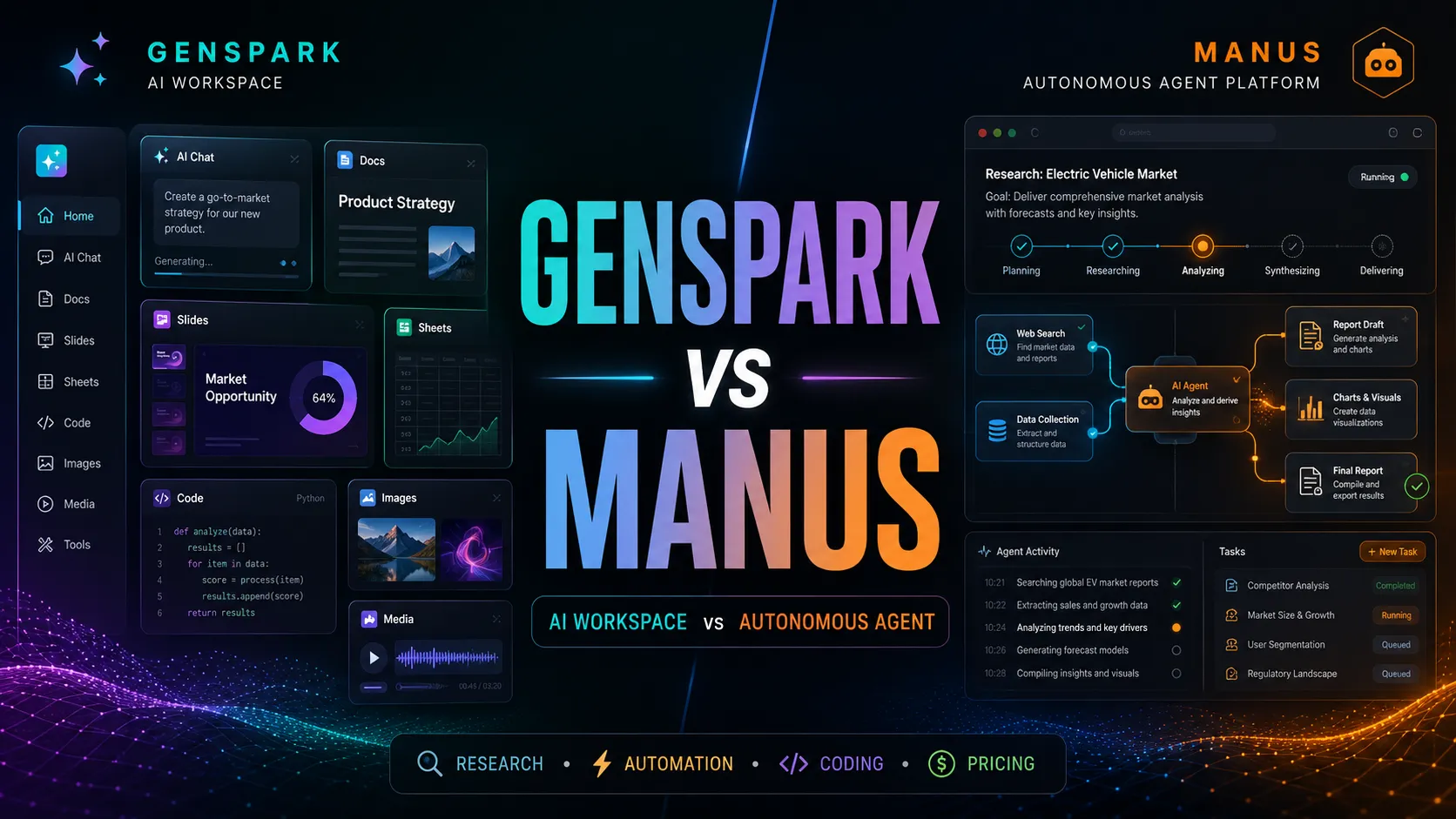
Genspark and Manus increasingly overlap, but they approach AI agents from different directions. Genspark is evolving into a broad AI workspace that combines frontier models, specialized creation tools, persistent memory, office applications, coding, media generation, and autonomous agents. Manus remains more centered on delegating complete tasks to an autonomous agent, particularly research, browser operation, scheduled work, and application building.
The comparison below reflects publicly documented capabilities and pricing available in August 2026.
| Dimension | Genspark | Manus |
|---|---|---|
| Current platform | Genspark AI Workspace 6.0 | Manus 1.6 / Manus 1.6 Max |
| Core philosophy | All-in-one AI workspace with specialized agents and multiple model providers | General-purpose autonomous agent for completing end-to-end tasks |
| Individual paid entry | $24.99/month for Plus; $19.99/month effective with annual billing | Starts at $20/month; annual billing receives about a 17% discount |
| Base paid credits | 10,000/month on Genspark Plus | 4,000/month on entry Manus Pro |
| Higher individual tier | Pro: 125,000 credits/month; $249.99 monthly or $199.99/month effective annually | Higher Pro tier: 8,000 credits/month starting at $40/month |
| Free usage | 100 credits refreshed daily | 300 daily credits; Chat Mode does not consume credits |
| Research | Super Agent, web research, Sheets, Docs and specialized tools | Agent Mode plus Wide Research with parallel agents |
| Large batch research | General multi-agent/tool orchestration | Explicitly designed around parallel processing of tens or hundreds of items |
| Browser automation | Chrome extension, AI Browser capabilities and Genspark Claw | Cloud Browser plus Browser Operator using existing local browser sessions |
| Persistent autonomous work | Genspark Claw cloud computer, schedules and Heartbeat | Scheduled Tasks, sandbox and persistent Cloud Computer |
| Presentations | Dedicated AI Slides workspace with 100+ expert Skills | Manus Slides with research, speaker notes and editable PPTX export |
| Coding | Dedicated Genspark Code with multiple selectable coding models | Agent Mode builds websites and mobile applications |
| Media generation | Broad image, video, music and audio model access | Image, video, slides, design and multimedia capabilities |
| Developer platform | Primarily emphasizes workspace, MCP, Skills and agents | Documented Manus API for tasks, projects, connectors and webhooks |
| Team pricing | $30/user/month for 2–150 users | Starts at $20/user/month |
Important: Genspark credits and Manus credits are proprietary accounting units. A Genspark credit cannot be compared directly with a Manus credit, so 10,000 versus 4,000 does not mean Genspark provides 2.5 times as much agent execution. Both platforms vary consumption according to the models and operations involved.
Product Philosophy and Architecture
The biggest difference is not a single feature. It is the scope of the product each company is trying to build.
Genspark: an AI workspace containing many agents
Genspark started as an AI research and search product and Super Agent, but its 2026 direction is significantly broader. AI Workspace 6.0 organizes the product around persistent context, general agent orchestration, specialized productivity applications, and collaborative agents.
That results in dedicated surfaces for:
- AI Slides
- AI Sheets
- AI Docs
- Genspark Code
- Genspark Design
- Image generation
- Video generation
- Music and audio
- Meeting notes
- GenMail
- AgentBase
- Custom agents
- Genspark Claw
- GenTeam
Genspark has described Super Agent as combining 30+ models, 150+ tools and 700+ MCP integrations, while broader Workspace 6.0 materials describe access to more than 70 models across the platform. These figures appear to refer to different scopes within the Genspark ecosystem rather than a single fixed model pool.
This makes Genspark closer to an AI operating environment than a single agent.
Manus: task delegation first
Manus retains a simpler conceptual model. There is a lightweight Chat Mode for conversations and an Agent Mode for tasks where the system needs to plan, browse, execute code, create files, build websites or otherwise perform work autonomously.
Around that core agent, Manus has added Projects, Skills, Wide Research, Cloud Browser, Browser Operator, Slides, scheduled tasks, connectors, website and application development, and a developer API.
The practical trade-off is straightforward:
- Genspark exposes more specialized workspaces and model choices.
- Manus keeps more workflows centered on assigning a goal to an autonomous agent.
Users who frequently move between presentations, spreadsheets, design, coding and media may benefit more from Genspark's specialized interfaces. Users who primarily want to describe an outcome and let an agent execute a long sequence of steps may find Manus's model easier to reason about.
Performance and Benchmarks
There is no current independent benchmark that conclusively establishes either Genspark Workspace 6.0 or Manus 1.6 Max as the faster or more reliable product across real-world workloads.
The most commonly cited comparison comes from the GAIA benchmark around the products' 2025 launches. GAIA measures assistants on multi-step questions involving reasoning, web browsing, multimodal information and tool use.
Historical published results were approximately:
| GAIA level | Genspark Super Agent | Manus | Difference |
|---|---|---|---|
| Level 1 | 87.8% | 86.5% | Genspark +1.3 pp |
| Level 2 | 72.7% | 70.1% | Genspark +2.6 pp |
| Level 3 | 58.8% | 57.7% | Genspark +1.1 pp |
These numbers should not be interpreted as a current 2026 ranking. Genspark has since changed its architecture substantially and released Workspace 6.0, while Manus moved through multiple generations to Manus 1.6 and 1.6 Max.
For a purchasing decision in 2026, workload-specific tests are therefore more useful than the historical GAIA difference of one or two percentage points.
A useful evaluation set would contain at least:
- 10 deep research assignments
- 10 authenticated browser workflows
- 10 spreadsheet or data-processing tasks
- 5 slide-generation tasks
- 5 coding or application-building tasks
- 5 tasks requiring more than 15 sequential actions
Track successful completion rate, human interventions, factual corrections, elapsed time and credit consumption, rather than simply judging which final answer looks better.
Research and Information Gathering
Both products can conduct substantial web research, but Manus has a particularly explicit architecture for large horizontal research jobs.
Genspark research workflow
Genspark Super Agent can research a subject and then route the results into Docs, Sheets, Slides or other specialized agents. Its multi-model approach is useful when a job combines different modalities—for example researching competitors, generating charts, writing the analysis and turning the findings into a presentation.
The advantage is workflow breadth. Research does not have to end as a text report; it can become a spreadsheet, visual presentation, website, design asset or follow-up task within the same workspace.
Manus Wide Research
Manus Wide Research is designed for tasks such as researching 50 companies, comparing 100 products or processing hundreds of similar records. Instead of asking one agent to process everything sequentially, the system can divide the workload across many parallel agents and synthesize the results afterward.
Examples of workloads associated with this model include:
- researching hundreds of people or companies
- comparing large product catalogs
- processing batches of biographies
- editing many media assets
- extracting large prompt or information datasets
This architecture gives Manus a structural advantage for workloads where the problem is not simply research depth but repeating the same research process across a large population.
For example, consider an analyst building a database of 200 SaaS competitors.
A conventional research agent may research company 1, then company 2 and eventually compress earlier context as the task grows. A parallel research workflow can instead treat those companies as independent units before consolidating the results.
For a single highly detailed industry report, both systems are credible options. For a 100- or 200-entity research job, Manus's Wide Research is the more purpose-built workflow.
Browser Automation and Real-World Execution
Browser control is another area where the platforms now overlap heavily.
Manus Browser Operator
Manus provides two browser approaches.
Its Cloud Browser runs in an isolated remote environment. Manus can navigate websites, collect information, interact with web applications and maintain authenticated browser sessions. When CAPTCHA, SMS verification or MFA requires human action, the user can temporarily take over the browser and return control afterward.
Its Browser Operator works with existing local browser sessions. That matters for services such as authenticated databases and SaaS applications because the agent can operate using accounts that are already signed in.
A representative workflow is:
- Open authenticated research or business tools.
- Research 20 target companies.
- Extract comparable metrics.
- Produce a structured table.
- Convert findings into a presentation.
Genspark browser and desktop automation
Genspark's browser tools can go beyond webpage summarization and perform interactions such as navigating interfaces and filling forms.
More consequentially, Genspark Claw can operate on a dedicated cloud computer or locally on the user's own Mac or Windows machine. It supports files, terminal access, schedules, memory, messaging channels and connected services.
That means the comparison is no longer simply cloud Manus versus web-based Genspark. Both now provide persistent environments capable of acting beyond a conventional chat session.
Genspark also has a distinctive execution capability: Call For Me, which can place telephone calls, conduct a task-oriented conversation and return structured results such as a transcript or summary.
If a workflow includes restaurant reservations, appointment booking, supplier calls or other telephone interactions, this is a meaningful Genspark-specific capability.
Persistent Agents, Memory and Scheduling
Both products can operate beyond a single interactive session.
Genspark Workspace 6.0 uses SecondBrain as a persistent memory layer covering emails, meetings, chats, documents, applications and Genspark projects. Genspark Claw adds scheduled tasks and a Heartbeat-style system that can periodically inspect connected services and act without receiving a new prompt.
Manus uses Projects to preserve instructions, files and task context. Scheduled Tasks can repeatedly execute work, while a Cloud Computer can support persistent workloads.
Manus publishes relatively concrete execution limits for its plans:
- Free: 1 concurrent task and 2 scheduled tasks
- Paid Pro: up to 20 concurrent tasks and 20 scheduled tasks
Genspark documents scheduling and background monitoring but does not expose an equivalent universal concurrency figure across its standard individual plans.
For users running many independent jobs simultaneously, Manus therefore provides the clearer capacity specification. For users who want the agent to continuously accumulate workplace context from many different activities, Genspark's SecondBrain architecture is more central to the product design.
Slides, Documents and Office Work
This is one of Genspark's strongest areas of differentiation.
Genspark AI Slides is a dedicated presentation environment rather than merely an Agent Mode output format. It supports 100+ expert Skills, importing existing PowerPoint files, reusable presentation styles, conversational editing, speaker notes, data-driven charts and common presentation export formats.
It sits alongside dedicated AI Sheets and AI Docs products, so an analyst can research a subject, structure data in Sheets, write a report and produce a deck without leaving the same workspace.
Manus also has a substantial Slides product. It can produce presentation structure, custom charts, generated visuals, speaker notes and branding, with exports including editable presentation formats.
The difference is primarily emphasis:
- Genspark: presentation creation is a full specialized application with extensive model, style and Skill selection.
- Manus: slides are one of several polished deliverables an autonomous task can produce.
Teams producing presentations every day may benefit from Genspark's deeper presentation workspace. Teams that usually want a presentation as the final artifact of a broader research task may prefer Manus's integrated agent workflow.
Image, Video and Audio Generation
Genspark has a broader explicit media-model aggregation strategy.
Its paid workspace combines image generation, video generation, music, podcasts, TTS and design, while also exposing models from multiple AI providers.
This matters for workflows such as:
- researching a product category
- writing an advertising concept
- generating campaign visuals
- creating social assets
- producing a short promotional video
- generating narration or music
Manus supports multimedia generation and design as well, but its primary differentiation remains autonomous execution rather than providing the largest visible selection of individual media models.
For users who frequently choose between specific image or video model families, Genspark generally offers more model-level control.
Coding and Application Development
Both platforms have moved well beyond generating code snippets.
Genspark Code
Genspark offers a dedicated coding environment with access to multiple coding models rather than locking development to one model family. Its application-building workflows can create websites and web applications and connect coding with other Workspace capabilities.
This model-selection strategy can be useful when developers want different models for architecture, implementation, debugging or UI work.
Manus development
Manus Agent Mode can build websites and applications, and newer versions have expanded development capabilities into additional application formats.
The most important distinction for developers, however, may be API access rather than code generation itself.
Manus provides a documented API for creating and managing agent tasks programmatically. Developers can create tasks and projects, supply files and connectors, conduct multi-turn interactions and build automations around Manus.
Genspark's product strategy places considerably more emphasis on its workspace, Skills, MCP integrations and specialized agents than on positioning a general remote agent API as the center of the platform.
Therefore:
- Interactive AI development and multi-model coding: Genspark has a strong proposition.
- Embedding a general autonomous agent into another product or backend workflow: Manus has the clearer developer-oriented model.
Integrations and Ecosystem
Genspark and Manus use somewhat different ecosystem strategies.
Genspark emphasizes a large MCP ecosystem, reusable Skills and a growing suite of first-party applications. It has described Super Agent as supporting 700+ MCP integrations, while Claw connects with multiple communication and productivity channels.
Manus provides connectors for productivity and developer services and exposes agent functionality through both its application and developer interfaces.
This creates two different ecosystem advantages:
Genspark favors breadth inside one AI workspace. The objective is to replace or consolidate numerous individual AI applications.
Manus favors agent infrastructure. The same agent can increasingly be used through the Manus interface, projects, browser environments, connectors, scheduled tasks or API workflows.
Pricing and Credit Economics
Pricing initially appears similar, but the products allocate usage differently.
Genspark pricing
As of August 2026, published individual pricing includes approximately:
- Free: 100 credits refreshed daily
- Plus: $24.99 monthly, or about $19.99/month with annual billing; starts with 10,000 credits/month
- Pro: $249.99 monthly, or about $199.99/month with annual billing; starts with 125,000 credits/month
- Team: $30/user/month with 12,000 credits/user/month
- Enterprise: custom pricing
Plus includes substantially more workspace capacity than the free plan, while Pro targets much heavier agent and creative-model usage.
Manus pricing
Current Manus pricing is structured approximately as follows:
- Free: $0 with daily credits
- Pro entry tier: starts around $20/month with 4,000 monthly credits
- Higher Pro tier: starts around $40/month with 8,000 monthly credits
- Team: starts around $20/user/month
- Annual billing: discounted relative to monthly billing
Chat Mode does not consume the same Agent Mode credits, while autonomous tasks consume credits based on execution requirements.
Why credit counts are misleading
A frequent mistake is to compare 10,000 Genspark credits directly with 4,000 Manus credits.
That calculation is meaningless without knowing what each platform charges for the same completed task.
A more useful cost benchmark is:
cost per successfully completed workflow = subscription cost + additional credits / number of workflows completed without manual replacement
For example, a market-research team should record how many credits each platform consumes to research the same 50 companies, how many records require correction and how much analyst time remains afterward.
Genspark may offer better economic value when its subscription replaces several separate AI media or productivity subscriptions. Manus may be economically attractive when a smaller number of autonomous tasks replaces substantial manual browser work.
Team Features, Governance and Privacy
Both products offer paid organization-oriented plans, but governance requirements should be evaluated separately from general feature comparisons.
Genspark's Team and Enterprise offerings include centralized administration and collaboration features, with additional enterprise controls available for larger organizations.
Manus Team also includes organization-oriented administration and access controls alongside its agent capabilities.
Organizations should separately evaluate browser and computer automation permissions. An agent that can browse authenticated websites or operate a local computer presents a different security profile from a conventional chatbot.
For example, local computer agents can potentially interact with files, terminals and applications, while browser agents may operate inside authenticated sessions.
Neither capability should automatically receive access to sensitive finance systems, production infrastructure or administrative accounts without appropriate permission boundaries and human approval policies.
Ease of Use
Manus has the simpler basic mental model:
- Describe the outcome.
- Choose Chat or Agent Mode when necessary.
- Watch the agent plan and execute.
- Intervene if authentication or clarification is required.
- Receive the artifact or completed action.
Genspark presents considerably more choices because users can work through Super Agent or jump directly into Slides, Sheets, Docs, Code, Design, media generation, Claw, Skills and other applications.
That additional complexity is useful when users know exactly which environment they want. It can be unnecessary overhead for someone whose only requirement is to delegate a research task.
Consequently, ease of use depends on the workflow:
- Single autonomous assignment: Manus usually has the cleaner conceptual workflow.
- Repeated specialized production work: Genspark's dedicated applications can reduce friction once the user learns the workspace.
Real-World Scenario Comparison
Scenario 1: Research 100 competitors
Likely fit: Manus.
Wide Research is explicitly designed for parallel analysis across large item sets. Each competitor can receive an independent research context before synthesis. Genspark can perform the research, but Manus has the more specialized architecture for this exact workload.
Scenario 2: Create a board presentation every week
Likely fit: Genspark.
Genspark combines research, spreadsheets, presentation generation, reusable presentation styles and detailed slide editing in one office-oriented workflow. Manus can produce strong decks, but Genspark offers the more specialized presentation environment.
Scenario 3: Automate work inside authenticated websites
Likely fit: Manus, with Genspark also competitive.
Manus Browser Operator is designed around operating existing authenticated browser sessions. Genspark's browser automation can perform similar actions, while Claw expands automation beyond the browser and onto the computer itself.
Choose based on whether the workflow is primarily browser-centered or computer/workspace-centered.
Scenario 4: Run a persistent personal AI employee
Close comparison.
Genspark Claw provides cloud and local modes, persistent memory, messaging channels and schedules. Manus provides scheduled tasks and persistent Cloud Computer environments.
Genspark has the stronger cross-workspace memory narrative through SecondBrain. Manus publishes clearer task concurrency limits.
Scenario 5: Build a research-agent feature into a SaaS product
Likely fit: Manus.
The Manus API makes it possible for applications to create and manage agent tasks programmatically, making Manus relatively straightforward to evaluate as backend agent infrastructure rather than only as an end-user application.
Scenario 6: Replace several separate AI subscriptions
Likely fit: Genspark.
If the existing stack contains separate products for LLM chat, image generation, video generation, presentations, coding and research, Genspark's multi-model workspace strategy has a stronger consolidation argument.
The value decreases if most of those capabilities are never used.
Scenario 7: Make phone reservations or outbound calls
Likely fit: Genspark.
Call For Me adds a first-party workflow for telephone conversations, including task-oriented calls and structured results after the call.
Which Should You Choose?
Choose Genspark when your work regularly crosses several creative and productivity formats. It is particularly well suited to users who want research, presentations, spreadsheets, documents, coding, image generation, video generation and other AI models under one subscription and one persistent workspace.
Genspark is also the more natural choice when:
- presentation creation is a major part of the workload;
- access to many frontier model providers matters;
- image, video and audio generation are frequent requirements;
- you want an AI workspace rather than only an autonomous task runner;
- persistent workplace memory through SecondBrain is valuable;
- desktop automation through Claw is important;
- phone-call automation is part of the workflow.
Choose Manus when autonomous execution itself is the main requirement. Its product structure is especially compelling when tasks involve browser interaction, asynchronous execution, scheduled work or large-scale parallel research.
Manus is particularly suitable when:
- you routinely research dozens or hundreds of similar entities;
- authenticated browser automation is central to the workflow;
- you need clearly documented concurrent and scheduled task capacity;
- you want to expose autonomous agent functionality through an API;
- the final deliverable may vary from task to task rather than always being a particular document type;
- you prefer a task-centric agent interface over a large collection of specialized AI applications.
For teams choosing between them, the most reliable approach is not to ask which AI agent is universally better. Use the same representative workload on both platforms and measure completion rate, intervention rate, correction time, execution time and cost per successful task.
Genspark's primary advantage is breadth and consolidation. Manus's primary advantage is focused autonomous execution and scalable task delegation. As the products continue adding overlapping capabilities, that distinction is more useful than treating either platform as the categorical winner.
Continue Reading
More articles connected to the same themes, protocols, and tools.
Referenced Tools
Browse entries that are adjacent to the topics covered in this article.