Amazon Bedrock
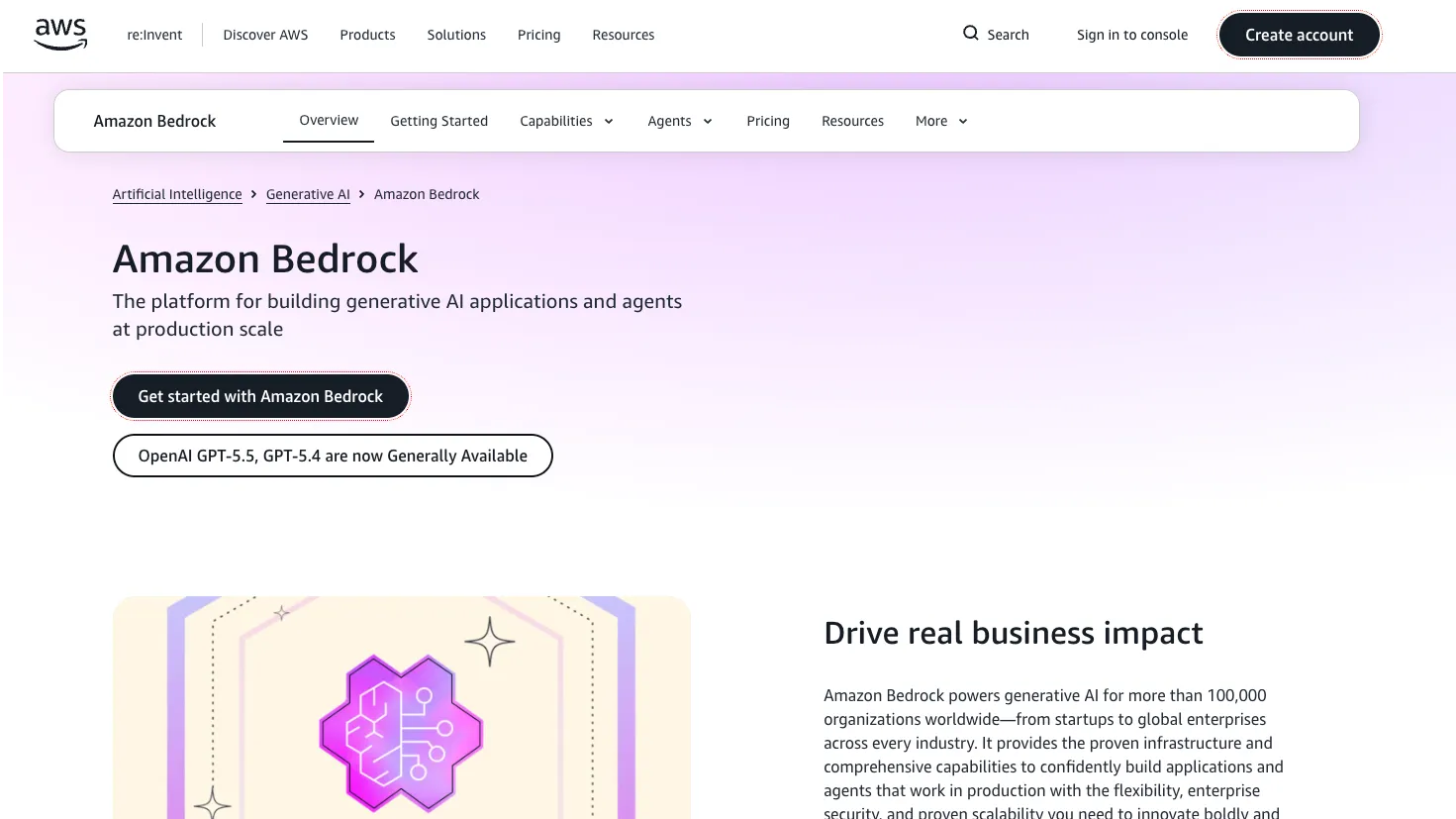
Amazon Bedrock is AWS’s fully managed platform for building generative AI applications with foundation models, agents, RAG, guardrails, evaluation, and model customization. It is best suited for teams that want enterprise-grade model access inside the AWS cloud rather than a standalone AI coding IDE.
Choose Amazon Bedrock when you need enterprise AWS controls around foundation models, agents, RAG, and model governance; choose a provider-native API or lightweight inference platform when simplicity and speed of integration matter more than AWS-native operations.
Pricing Plans
On-Demand Inference
Pay-as-you-go inference pricing varies by provider, model, modality, region, and service tier.
Batch Inference
Batch jobs are available for selected models and can be lower cost than on-demand inference.
Provisioned Throughput
Reserved capacity for workloads that need predictable throughput and latency.
Knowledge Bases
RAG costs depend on ingestion, retrieval, storage, vector database, reranking, and model usage.
Guardrails
Charged based on guardrail checks, content units, and enabled safety features.
Model Customization
Fine-tuning, distillation, and custom model import pricing depends on training, hosting, and model units.
Enterprise / AWS Account Team
Enterprise support, quota planning, private networking, committed usage, and large-scale deployment discussions.
Core Features
1Foundation Model Access
- Managed access to 100+ foundation models
- Model providers include Amazon, Anthropic, OpenAI, Meta, Mistral AI, Cohere, DeepSeek, Qwen, Stability AI, and others
- Text, image, video, speech, embedding, reranking, and multimodal workloads
- Converse API, InvokeModel API, OpenAI-compatible API patterns, and AWS SDK support
2Agentic AI
- Amazon Bedrock Agents
- Action groups for external tools and APIs
- Knowledge base integration
- Agent traces and aliases
- Multi-agent collaboration
3RAG & Knowledge Workflows
- Amazon Bedrock Knowledge Bases
- Managed and customer-managed RAG options
- Connectors for enterprise data sources
- Citations, reranking, multimodal retrieval, and document-level permission filtering
4Safety & Governance
- Amazon Bedrock Guardrails
- Content filters, denied topics, word filters, and sensitive-information filters
- IAM, KMS, CloudTrail, CloudWatch, and AWS PrivateLink integration
- Model evaluation and prompt management
5Model Customization
- Supervised fine-tuning
- Model distillation
- Custom model import
- Private customized models
- Provisioned throughput for selected custom models
6Developer Operations
- AWS Management Console
- AWS SDKs and CLI
- boto3 and Bedrock Runtime APIs
- Prompt Management and Flows
- Cost allocation by IAM principal
- Integration with broader AWS infrastructure
Pros
- Strong fit for enterprises already standardized on AWS.
- Broad model choice through one AWS-managed service surface.
- Security, IAM, KMS, PrivateLink, CloudTrail, and compliance controls are central to the platform.
- Useful managed building blocks for agents, RAG, evaluation, prompt management, and guardrails.
- Customer prompts and outputs are not shared with model providers or used to train base models by default.
Cons
- Not an AI IDE, code editor, or prompt-to-app builder.
- Pricing is complex because cost varies by model, modality, region, tier, and add-on service.
- Some models, regions, quotas, and advanced capabilities require access requests or AWS account planning.
- Best experience assumes familiarity with AWS IAM, networking, billing, and cloud operations.
- Developers who only need a simple hosted LLM API may find Bedrock heavier than provider-native APIs.
Why Choose Amazon Bedrock?
Amazon Bedrock is most compelling when generative AI needs to live inside an existing AWS operating model. Instead of treating model calls as a separate vendor workflow, teams can use familiar AWS controls for identity, encryption, private networking, monitoring, cost allocation, and governance.
The other major reason to choose Bedrock is model optionality. Many teams do not want to bet an entire product on one model provider. Bedrock gives them a single AWS surface for evaluating and running multiple model families, then layering agent orchestration, retrieval, prompt management, evaluation, and safety controls around those models.
That makes Bedrock less like an AI IDE and more like a managed AI application platform. It will not replace a code editor, but it can become the model and orchestration layer behind developer tools, copilots, internal assistants, customer support agents, search systems, and enterprise automation.
Core Workflow
A typical Bedrock workflow starts with model selection in the console or through an SDK. Teams test candidate models in a playground, compare latency and quality, request model access where needed, then integrate the chosen model through Bedrock Runtime APIs.
Once the first model call works, the workflow often expands into application architecture. Private data may move into a RAG system, business tools may be exposed through agent action groups, prompts may be versioned, and safety policies may be enforced with guardrails. At that point, Bedrock becomes a collection of managed building blocks rather than just a model endpoint.
For production teams, the most important workflow is operational discipline. IAM policies, model access, quotas, logging, prompt versions, guardrail versions, evaluation sets, and cost allocation should be designed before the application is widely rolled out.
Use Cases
Bedrock is well suited to enterprise assistants, customer support copilots, document search, legal and compliance review, call-center summarization, financial research, code and data analysis assistants, knowledge-base chat, sales enablement, internal workflow agents, and multi-step automation where AWS systems are already involved.
It is also useful for organizations that need to evaluate several model providers under consistent governance. A team can test a high-capability model for reasoning, a lower-cost model for background processing, an embedding model for retrieval, and a specialized image or video model without wiring every provider separately.
Comparison to Alternatives
Compared with OpenAI API or Anthropic API, Bedrock adds an AWS governance and infrastructure layer. Direct provider APIs may be faster to start with and sometimes expose provider-native features earlier. Bedrock is more attractive when AWS identity, security, procurement, networking, and audit requirements are central to the deployment.
Compared with Azure AI Foundry, the decision often follows cloud gravity. Microsoft-centric teams may prefer Azure because of Microsoft 365, Entra ID, Azure OpenAI, and enterprise tooling. AWS-centric teams may prefer Bedrock because it fits naturally into IAM, VPC, CloudTrail, CloudWatch, Lambda, S3, KMS, and other AWS services.
Compared with Google Vertex AI, Bedrock is more focused on multi-provider foundation model access and AWS-native generative AI building blocks. Vertex AI is broader across Google Cloud machine learning workflows, model training, MLOps, and Gemini-centered application development.
Compared with Fireworks AI, Together AI, or GroqCloud, Bedrock is heavier but more enterprise-oriented. Those inference platforms can be simpler for fast open-model API usage, while Bedrock is stronger when the buyer needs cloud governance, private connectivity, compliance posture, and AWS account-level controls.
Compared with Amazon SageMaker, Bedrock is the higher-level option for using and orchestrating foundation models without managing the full ML lifecycle. SageMaker remains relevant when teams need custom training pipelines, model hosting control, feature stores, notebooks, experiments, and traditional MLOps.
Best Configuration
The best Bedrock setup starts with model routing by task. Do not use the same model for every workload. Summarization, classification, extraction, embeddings, agent reasoning, multimodal analysis, and background batch processing may each have different quality and cost requirements.
For RAG systems, invest early in retrieval quality. Data source selection, chunking, access controls, metadata, citations, reranking, and evaluation sets often matter more than switching between two frontier models. A stronger model cannot always compensate for weak retrieval design.
For agents, start with narrow tools and explicit boundaries. Action groups should be easy to test, reversible where possible, and protected by authorization logic outside the model. Agent traces are useful during development, but they are not a substitute for application-level safeguards, approval steps, and monitoring.
For sensitive workloads, treat guardrails as one layer in a broader security model. IAM boundaries, network controls, logging review, prompt injection testing, data classification, and human escalation paths should be part of the system design.
Migration Notes
Migrating from a direct provider API to Bedrock usually requires more than changing the base URL. Teams need to adjust authentication, model IDs, request formats, streaming behavior, regional availability, quotas, logging, and cost dashboards. Prompt behavior should be retested because the same model family may behave differently across versions, regions, or API surfaces.
Migrating from a lightweight prototype to Bedrock is often a governance upgrade. The application may gain better audit, identity, and networking controls, but the team also inherits AWS operational complexity. That tradeoff is usually worthwhile for enterprise production systems, but it can be unnecessary for small prototypes.
Migrating from self-hosted open-source models to Bedrock can reduce infrastructure maintenance, but it may also reduce low-level serving control. Teams should map any existing batching, caching, prompt formatting, custom runtime logic, and model-specific optimizations before replacing a self-managed stack.
Best For
- AWS-native teams building production generative AI applications
- Enterprises that need model choice with centralized IAM, audit, networking, and governance
- RAG systems that use private company data and AWS data sources
- Agent workflows that need tool use, action groups, aliases, and observability
- Teams evaluating multiple foundation model providers without separate vendor integrations
- Organizations that need guardrails, model evaluation, prompt management, and private model customization
Not Ideal For
- Developers looking for an AI code editor like Cursor, Windsurf, or Replit IDE
- Small projects that only need one simple chat-completion endpoint
- Teams outside AWS that do not want to manage IAM, regions, service quotas, or cloud billing
- Builders who require fully local inference or self-hosted open-source model serving
- Products that need direct provider-native APIs with no AWS abstraction layer
- Users who want a fixed monthly SaaS subscription instead of usage-based cloud pricing
Privacy Notes
Amazon Bedrock is designed so customer prompts, completions, and customization data are not shared with third-party model providers or used to train base foundation models by default. Data is encrypted in transit and at rest, and teams can use IAM, AWS KMS, CloudTrail, CloudWatch, and AWS PrivateLink for access control, encryption, auditing, monitoring, and private connectivity. Teams should still review model availability, data residency, logging choices, guardrail configuration, and service-specific retention behavior before sending sensitive data.
Alternatives
Sources
- Amazon Bedrock Official Website
- Amazon Bedrock Pricing
- Amazon Bedrock Documentation Overview
- Supported Foundation Models
- Amazon Bedrock Agents
- Multi-Agent Collaboration
- Amazon Bedrock Knowledge Bases
- Amazon Bedrock Guardrails
- Prompt Management
- Amazon Bedrock Flows
- Model Customization
- Model Distillation
- Custom Model Import
- Amazon Bedrock Security and Privacy
- Amazon Bedrock Data Protection
- Amazon Bedrock FAQs
- Amazon Bedrock Samples GitHub
Update History
- Jun 30, 2026: Created directory entry and checked official AWS Bedrock product, pricing, supported models, agents, Knowledge Bases, Guardrails, Prompt Management, Flows, customization, security, data-protection, FAQ, and GitHub sample resources.
Related Tools
More listings in a similar part of the directory.




Amazon Bedrock Articles
Guides, comparisons, and launch notes connected to this listing.