
On This Page8 sections
Key Takeaways
- Gambo AI shut down in 2026 after a short but highly visible run. Official Gambo pages state that Gambo will be shutting down on May 1, 2026. The same date appears on Terms, Privacy, Help, and project pages operated by Dora Platform Pte. Ltd.
- There is no detailed official postmortem naming one cause. Any claim that Gambo closed specifically because of GPU costs, competition, weak demand, or a failed technical migration goes beyond the public evidence.
- The strongest direct clue is financial runway. Coverage of an interview with Dora co-founder Zhou Zhuoquan reported that Dora had been going through a difficult period and that investors were surprised the remaining team could still build Gambo with limited capital left.
- Dora and Gambo did not appear to be isolated failures. Dora, the team's earlier no-code website product, also announced: "Dora will be shutting down on May 1, 2026." That synchronized timing points to a company-level reset or wind-down rather than a narrow Gambo product issue.
- Gambo's product was technically ambitious: it combined an AI coding agent with character generation, animation, VFX, tilesets, maps, music, sound effects, a map editor, hosting, and code export. That breadth made the product impressive, but it also created a much heavier product and cost structure than a simple text-to-code wrapper.
- The most defensible explanation is therefore: limited runway + expensive multimodal product economics + an unresolved gap between fast prototypes and a sustainable creator business. Only the runway pressure is supported by first-party-adjacent reporting; the rest should be treated as analysis, not an official explanation.
What Was Gambo AI?
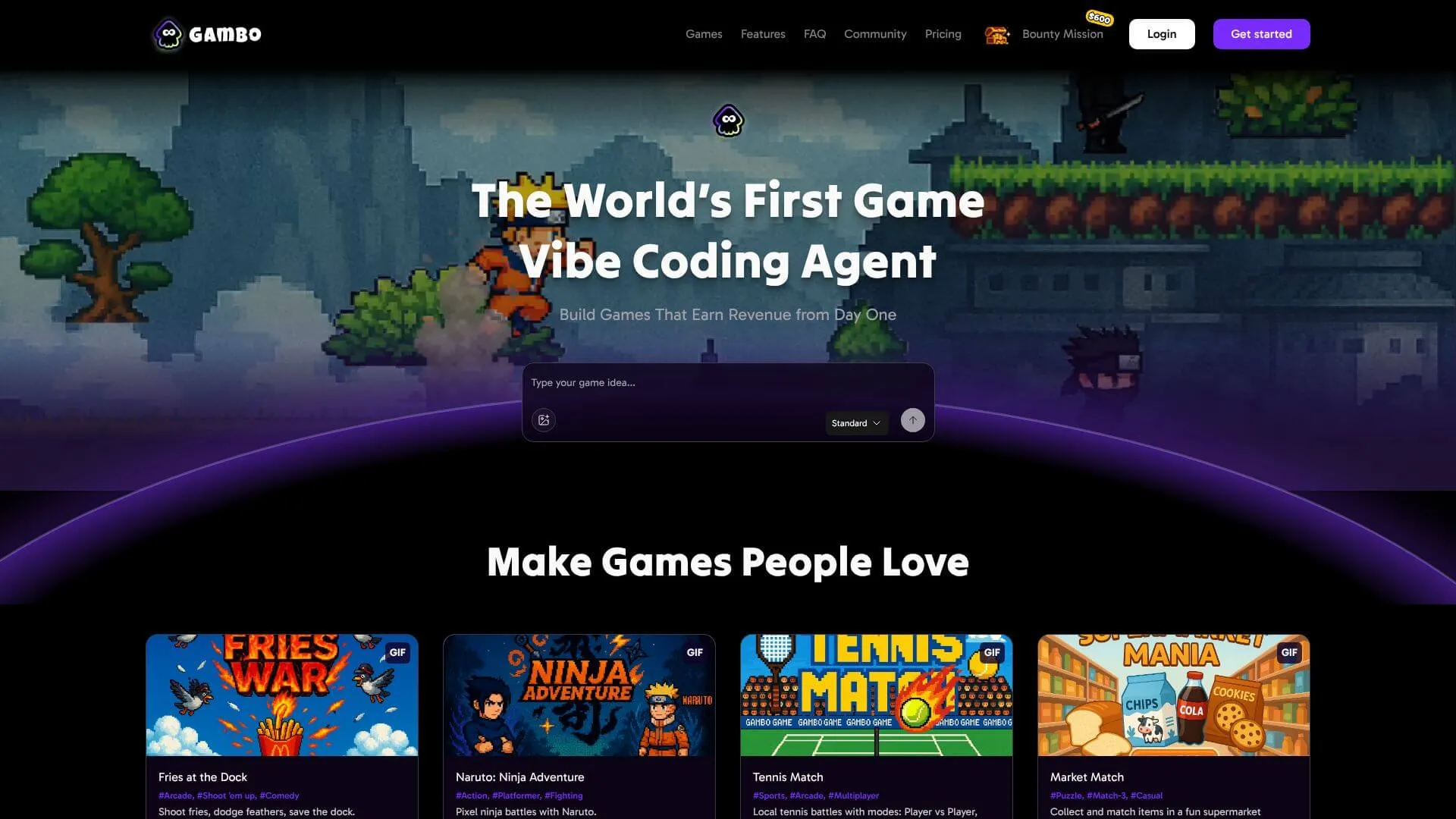
Gambo AI described itself as the world's first Game Vibe Coding Agent.
Instead of asking users to open an IDE, choose a framework, source game art, create animations, wire audio, build levels, and deploy a project manually, Gambo attempted to compress the workflow into a conversation.
A typical request could start with something as simple as:
Create a side-scrolling pixel-art action game with fast combat,
multiple enemies, boss fights, weapon upgrades, and a jungle map.
Gambo would then attempt to generate much more than code.
Its product stack included:
- game logic and mechanics;
- characters and other visual assets;
- action animations and VFX;
- tilesets and map assets;
- background music and sound effects;
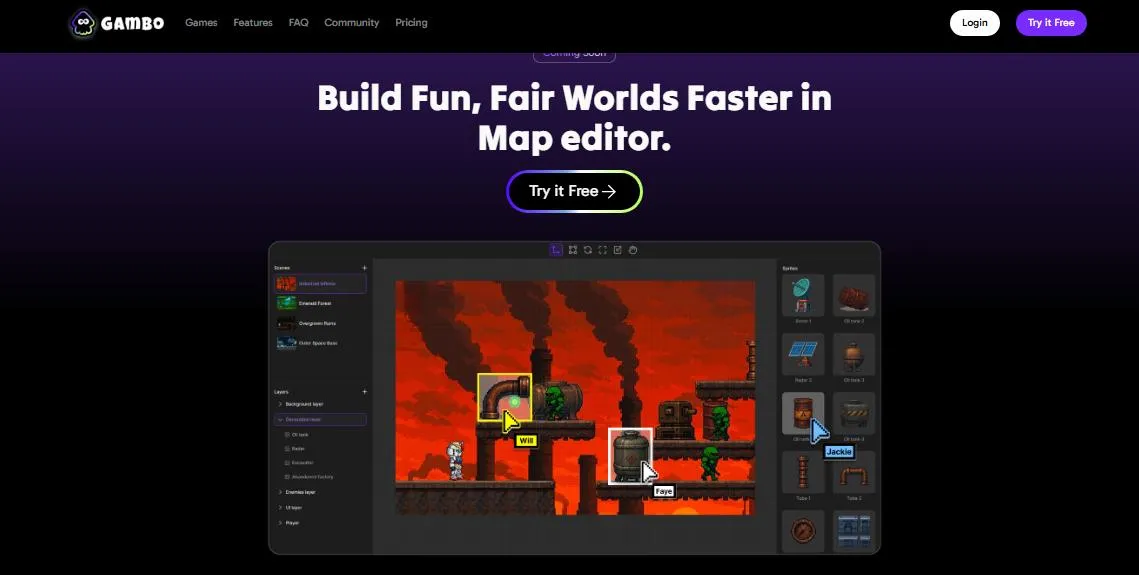
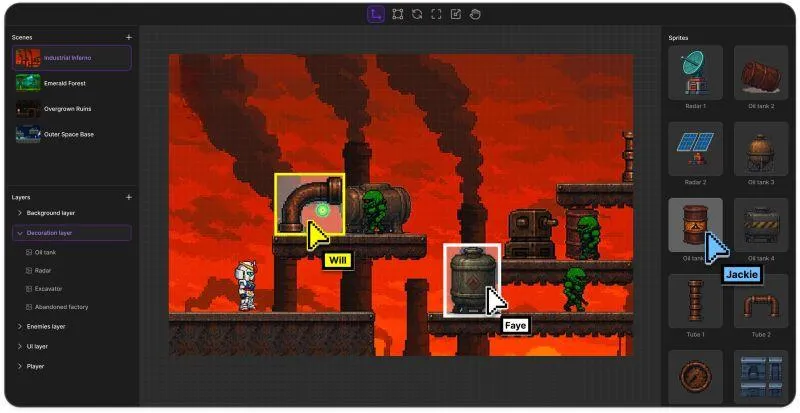
- a visual map editor;
- browser-based playable previews;
- iterative changes through prompts;
- custom domains;
- project-code export on paid plans.
Public product listings showed a Free plan with 100 editing credits and a Pro plan priced at $25 per month for 2,000 credits, including image generation, animation/VFX generation, tilesets, audio generation, custom domains, badge removal, and source-code export. The official pricing page also listed 1,500 extra credits in the first Pro month.
That distinction matters. Gambo was not simply another interface around an LLM.
It was trying to become a vertically integrated AI game-development environment.
When Did Gambo AI Shut Down?
Official Gambo pages displayed a shutdown banner:
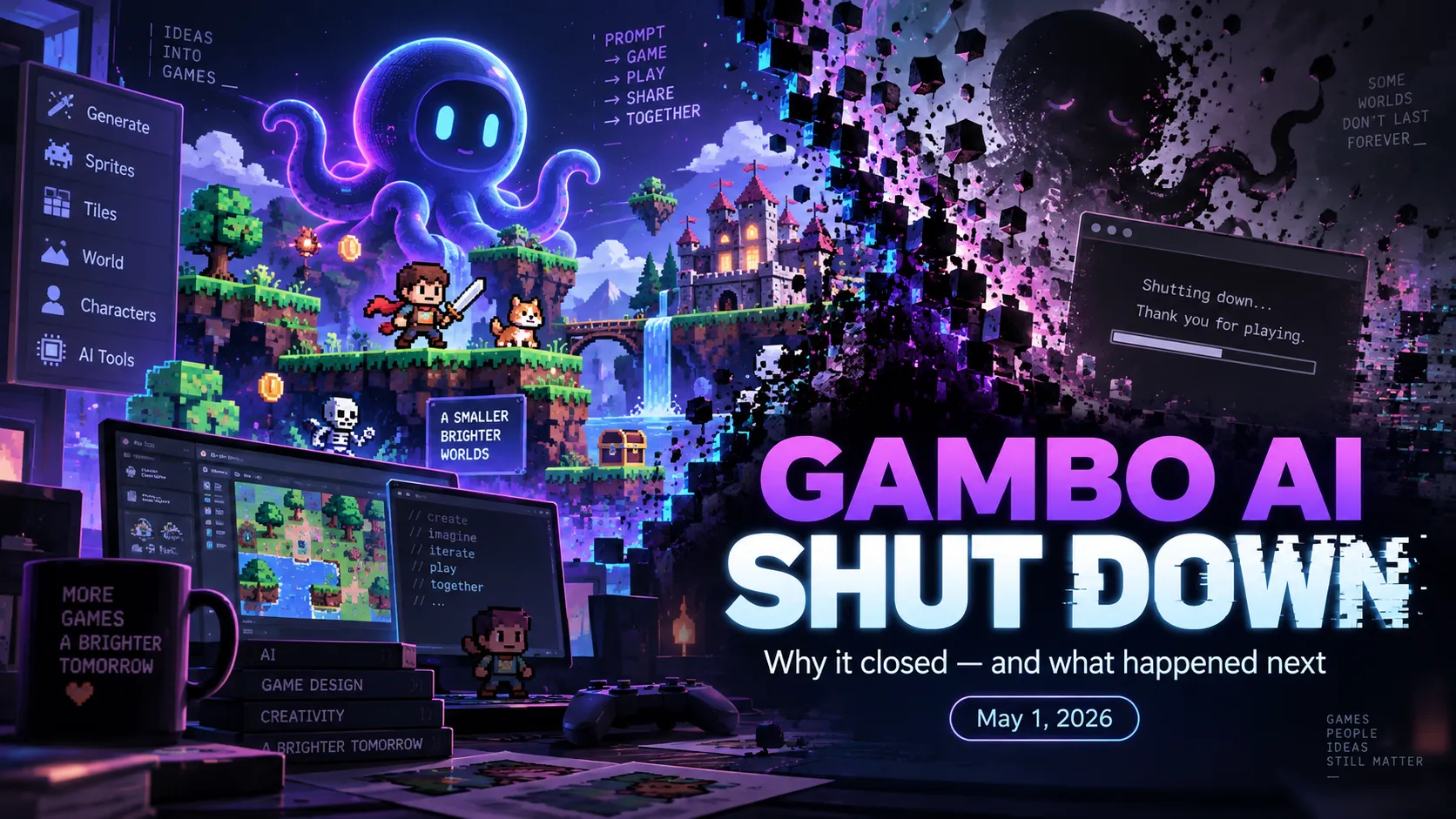
Gambo will be shutting down on May 1, 2026.
The same date appears across Terms of Service, Privacy Policy, Help, and project pages. Gambo was operated by Dora Platform Pte. Ltd.
The date is especially notable because Dora, the earlier product from the same team, also announced:
Dora will be shutting down on May 1, 2026.
That synchronized timing is one of the most important pieces of evidence when trying to understand what happened.
Why Did Gambo AI Shut Down?
The short answer is:
The company did not publish a detailed official explanation, but the available evidence points most strongly to financial runway pressure at the Dora/Gambo team level.
Several additional product and business-model pressures likely made that problem harder to solve.
It is important to separate those two categories.
What Is Directly Supported by Evidence
The strongest clue comes from reporting around an interview with Zhou Zhuoquan, a Dora co-founder and a key figure behind Gambo.
Discussing the transition from Dora to Gambo, coverage stated that Dora had recently been going through a difficult period and that investors were surprised the remaining team, with very little money left, had still managed to build Gambo.
That statement was made before the final shutdown.
It changes the interpretation of Gambo considerably.
Gambo was not necessarily launched by a company with a fresh balance sheet and years of runway. The public comments indicate that it was built while the previous business was already under significant pressure.
Then both Dora and Gambo shut down.
This makes runway and company-level sustainability a much stronger explanation than theories such as a single broken feature or one failed model migration.
Reason 1: The Team Appears to Have Been Running Out of Runway
This is the most important factor because it comes closest to first-party-adjacent evidence.
The sequence appears to have been:
Dora grows as a no-code / 3D website builder
        ↓
Dora enters a difficult period
        ↓
Team pivots toward vibe coding
        ↓
Gambo is built with a small team and limited remaining capital
        ↓
Gambo launches as an AI game agent
        ↓
Dora and Gambo both shut down in 2026
The interview coverage states that the team believed vibe coding would increasingly replace traditional no-code workflows, so it used experience from Dora's image-processing and vertical-model work to build Gambo.
That was a rational product pivot.
But a rational pivot can still arrive too late for the company's cash position.
A startup can have:
- impressive technology;
- strong social-media demos;
- a rapidly growing category;
- enthusiastic early users;
and still fail if it cannot reach sustainable revenue before its remaining capital is exhausted.
Gambo's history is a useful reminder that technical novelty does not extend runway by itself.
Reason 2: Gambo Was Expensive to Deliver Compared With a Normal Coding Agent
Gambo's economics were structurally harder than those of a text-only coding product.
A normal AI coding workflow might require:
Prompt → LLM tokens → codeGambo was closer to:
Prompt
  ↓
Planning
  ↓
Code generation
  ↓
Image generation
  ↓
Character assets
  ↓
Animation / VFX
  ↓
Tileset generation
  ↓
Map generation
  ↓
Music
  ↓
Sound effects
  ↓
Game build
  ↓
Preview
  ↓
More prompts and regeneration
That does not prove infrastructure cost caused the shutdown.
No official statement says that.
However, it does explain why Gambo used a credit system instead of offering unlimited creation. Official docs said credits were required for images, audio, and conversations, and that more complex tasks consumed more credits. The Pro plan gave users 2,000 monthly credits. Tileset generation alone was listed at 86–125 credits depending on quality.
The issue is not just LLM inference.
A game agent has to pay for or operate multiple generation pipelines while users repeatedly retry assets until they are usable.
That creates a difficult equation:
Subscription revenue
-
LLM inference
-
image generation
-
animation generation
-
audio generation
-
storage
-
game hosting
-
iteration / regeneration
=
gross margin
Gambo's credit model was therefore not merely a pricing choice. It reflected the underlying reality that multimodal game creation has significant variable costs.
Reason 3: Gambo Solved Prototype Creation Better Than Game Success
The product's greatest strength may also have exposed its commercial weakness.
Gambo could dramatically reduce time to first playable prototype.
That does not automatically reduce the difficulty of creating a good game.
Independent testing found that Gambo could produce a playable project quickly, but users still had to iterate on controls, collision behavior, level logic, difficulty, and other gameplay details.
The team's own interview acknowledged a related problem.
Zhou said many users were creating relatively simple games partly because they did not know which tools Gambo had available. He compared it to needing to know there is a pair of scissors and a hammer before you can command those tools. The team was preparing examples and documentation so users could understand what the agent could actually do.
That is a significant product-design challenge.
For a general-purpose tool, users already know what they want:
Build this page.
Fix this API.
Add this database table.
Game design is different.
A user may be able to describe a theme but still not know how to specify:
- movement feel;
- enemy AI;
- progression;
- level pacing;
- economy;
- difficulty curves;
- retention loops;
- reward schedules;
- combat balance;
- replayability.
AI can remove the coding barrier without removing the game-design barrier.
That means the funnel can look impressive at the top:
Prompt → playable gamewhile still becoming weak further down:
Playable game
→ good game
→ retained players
→ repeat creators
→ revenue
For a consumer creation platform, that second funnel is the one that determines the business.
Reason 4: The Monetization Story Was Stronger Than the Proven Monetization System
One of Gambo's most viral messages was essentially:
one prompt → full game → day-one revenue
The platform promoted built-in advertising as a way for creators to monetize games without building an ad stack themselves.
That is an excellent acquisition message because it transforms the pitch from:
make a game faster
into:
make an asset that can earn money faster.
But reporting during Gambo's early public period noted that the built-in advertising monetization feature was not yet live at the time of some tests, even while the homepage marketed day-one revenue.
This matters because creator platforms generally need more than creation.
They need a flywheel:
Create
  ↓
Publish
  ↓
Distribution
  ↓
Players
  ↓
Retention
  ↓
Revenue
  ↓
Creator creates again
Gambo clearly understood this.
The team's stated long-term ambition was not merely to build an engine. Zhou described an eventual community where creators from different backgrounds could make, improve, and collaborate on games. He said the long-term goal was to make Gambo the world's largest creative game community.
In other words, the intended moat was likely:
creation tools + distribution + community + remixing + monetization
rather than the generator alone.
The shutdown suggests the company did not have enough time or capital to fully establish that flywheel.
Reason 5: The Product Was Technically Ambitious Before the Business Had Fully Matured
Gambo attempted to solve several difficult problems simultaneously.
One example was tileset generation.
A game map is not simply one AI-generated background image. Tile-based games need sets of compatible edges, corners, transitions, surfaces, and other pieces that can be arranged without visible seams.
In an interview, Zhou used grass as an example and described a requirement for 47 compatible tile variants to support arbitrary map shapes. He presented this type of structured asset generation as one of Gambo's technical differentiators.
The team was also moving beyond its original Phaser-based approach toward Godot, while explicitly saying that commercially useful 3D generation was still not ready for the quality bar it wanted.
These are real engineering problems.
But each one consumes:
- engineering time;
- model work;
- inference budget;
- QA;
- editor development;
- infrastructure;
- user education.
For a well-funded platform with strong revenue, that breadth can become a moat.
For a team already operating with limited runway, the same breadth can become a burden.
Again, this is an analytical inference rather than an officially stated shutdown cause.
Was Competition the Main Reason?
There is not enough public evidence to say that competition was the main reason Gambo shut down.
The AI creation market was becoming crowded, and Gambo competed indirectly with both general-purpose coding agents and game-specific AI creation tools.
But competitive pressure alone does not explain the synchronized closure of both Gambo and Dora.
The stronger evidence remains:
- Dora was already in a difficult period.
- The team had limited remaining capital.
- Gambo was launched as a major pivot.
- Both products later shut down on the same date.
Competition may have made fundraising, acquisition, retention, or monetization harder, but presenting it as the confirmed cause would overstate the evidence.
Was Gambo Shut Down Because Its Technology Failed?
There is no evidence supporting that conclusion either.
In fact, the opposite is visible in surviving projects.
Users created playable action games, RPGs, strategy experiments, browser experiences, and other prototypes with the platform, and some creators exported or archived them before the service disappeared.
The more accurate distinction is:
The technology could generate games, but a technically functional product is not the same thing as a sustainable company.
Was the Godot Migration Responsible?
There is no public evidence that the planned Phaser-to-Godot transition caused the shutdown.
The migration is relevant because it shows the team's ambitions.
Phaser made sense for early Gambo because browser-based 2D games can be generated, previewed, shared, and hosted quickly.
Godot offered a path toward a more capable game engine.
But Zhou specifically said that the team did not intend to rush into 3D because available 3D generation technology was not yet commercially sufficient for its needs.
Nothing in the available shutdown evidence identifies Godot, Phaser, or an engine rewrite as the cause.
The Most Likely Explanation, Ranked by Evidence
| Explanation | Evidence strength | Assessment |
|---|---|---|
| Limited runway / financial pressure | Strong | Supported by pre-shutdown interview coverage about Dora's difficult period, a small remaining team, and limited capital while building Gambo. |
| Company-level wind-down or reset | Strong | Dora and Gambo both announced shutdown on May 1, 2026. |
| High multimodal generation costs | Moderate inference | Gambo generated code, images, animation, tilesets, audio, and hosted games, and used a credit-based model. No official statement names cost as the cause. |
| Weak conversion from prototype to sustainable creator economy | Moderate inference | Fast prototypes were possible, but iteration remained significant and the broader community/monetization flywheel was unfinished. |
| Competition | Plausible but unconfirmed | The category was crowded, but no first-party shutdown statement identifies competition as the decisive cause. |
| Technical failure | Weak | Surviving playable projects show the technology worked at least at prototype level. |
| Acquisition or regulatory shutdown | No solid evidence found | There is no reliable public evidence establishing either explanation. |
Why Gambo Still Matters
Gambo's shutdown does not make the product irrelevant.
It may be more useful as a case study now than when it was operating.
The project identified an important distinction that many AI coding products still miss:
games are not just code.
A serious game-generation agent needs domain-specific tools for:
character generation
sprite consistency
animation
VFX
tilesets
level design
collision
combat systems
audio
game state
progression
balancing
testing
publishing
That is why the next generation of AI game builders will likely compete less on which LLM they use and more on the quality of the agent harness and game-specific tool layer.
The model can write JavaScript.
The product moat is whether the agent understands what a game needs.
The Bigger Lesson: Creation Was Only Half of the Problem
Gambo's original vision was more ambitious than a prompt-to-game demo.
The team wanted to move toward a community where people could create and improve games together.
That points toward the more defensible long-term model:
AI game agent
      +
asset generation
      +
instant publishing
      +
discovery
      +
community
      +
remixing
      +
monetization
The generator gets attention.
The network creates retention.
This is similar to the difference between:
- a tool that generates videos and TikTok;
- a tool that generates 3D objects and Roblox;
- a tool that writes game code and a platform where games can find players.
Gambo had started with the creation side of that equation.
Its challenge was reaching the platform side before runway ran out.
What Gambo's Shutdown Means for AI Game Builders
For founders building similar products, several lessons stand out.
1. Optimize for Cost per Successful Game, Not Cost per Generation
A cheap generation that users immediately discard has little value.
The important metric is closer to:
Total AI + infrastructure cost
÷
games users actually publish and continue improving
That forces the product to improve both generation quality and iteration efficiency.
2. Exportability Is Essential
Gambo's paid plan included project-code export.
The shutdown demonstrates why this matters.
Creators should be able to move:
- source code;
- art assets;
- audio;
- configuration;
- project files;
out of the platform.
AI creation tools are infrastructure. Vendor lock-in becomes particularly painful when the vendor disappears.
3. A Game Generator Needs Testing Agents, Not Just Coding Agents
The next major improvement is unlikely to be another prettier prompt box.
A stronger system would automatically:
generate
→ run
→ playtest
→ detect failure
→ measure difficulty
→ inspect collisions
→ evaluate progression
→ patch
→ replay
This turns the product from a generator into an autonomous game-development loop.
4. Distribution Should Be Designed From Day One
If every generated game starts with zero players, users eventually ask why they are paying to generate more of them.
A durable platform needs discovery and retention mechanisms alongside creation.
5. Do Not Confuse Viral Demos With Recurring Product Demand
A one-prompt game demo is highly shareable on social media.
Recurring usage requires a different value proposition.
The product must still be useful after the user experiences the initial magic.
Is Gambo AI Still Available?
Gambo is no longer operating as the paid AI game-building service originally marketed in 2025.
Official pages state that Gambo would shut down on May 1, 2026.
Some games created with Gambo remain playable elsewhere because their creators exported or archived standalone versions before the service ended.
That distinction is important:
Gambo-generated games can survive even when the Gambo platform does not.
Did Gambo Fail?
Calling Gambo simply a technical failure would be misleading.
The product demonstrated that an AI agent could coordinate code and multiple categories of game assets into playable browser experiences.
The business, however, did not survive long enough to turn that capability into a durable platform.
The more accurate conclusion is:
Gambo proved an interesting product thesis, but the company appears to have run out of time and financial runway before the surrounding business model reached maturity.
That interpretation fits the team's own comments far better than claims that one model, framework, or feature suddenly broke.
Conclusion
Gambo AI's 2026 shutdown is one of the more instructive examples from the first wave of vertical AI coding agents.
The official public record does not provide a detailed one-line explanation for the closure.
But the evidence points in a clear direction.
Dora was already under pressure. Interview coverage acknowledged that the team had very little money remaining while building Gambo. Gambo then attempted an unusually ambitious combination of coding, image generation, animation, tilesets, audio, hosting, editing, and eventually creator monetization. Before that ecosystem could fully mature, both Dora and Gambo announced shutdown on May 1, 2026.
So the most useful lesson is not that AI game generation does not work.
It is almost the opposite.
Generating a playable game became easier faster than building a sustainable business around generated games.
The next successful AI game platform will need to solve not only:
prompt → gamebut also:
game → quality → players → retention → revenue → creator retentionThat is the part of the problem Gambo did not have enough runway to finish.
Continue Reading
More articles connected to the same themes, protocols, and tools.
Referenced Tools
Browse entries that are adjacent to the topics covered in this article.