
On This Page8 sections
Key Takeaways
- Universal Modder is an open-source AI game-modding toolkit, not a one-click patcher. It gives coding agents a repeatable workflow for game discovery, route selection, reverse engineering, asset creation, in-game testing, packaging, and documentation.
- It is agent-agnostic. The repository documents Claude Code, Codex, Gemini CLI, VS Code/GitHub Copilot, Cursor, OpenCode, and other Agent Skills-compatible setups.
- The
umCLI is the operational core. It covers scanning, backups, fal/ComfyUI generation, sprite processing, 3D rendering, Windows automation, video creation, publication checks, and a shared knowledge base. - Verification and safety are first-class concerns. The workflow treats the running game as the oracle, backs up saves, and rejects anti-cheat bypasses, DRM bypasses, multiplayer cheats, and redistribution of game files.
- As of October 5, 2026, the package reports version 0.2.0, requires Python 3.10+, is MIT licensed, and its knowledge index lists 38 game field notes.
What Is Universal Modder?
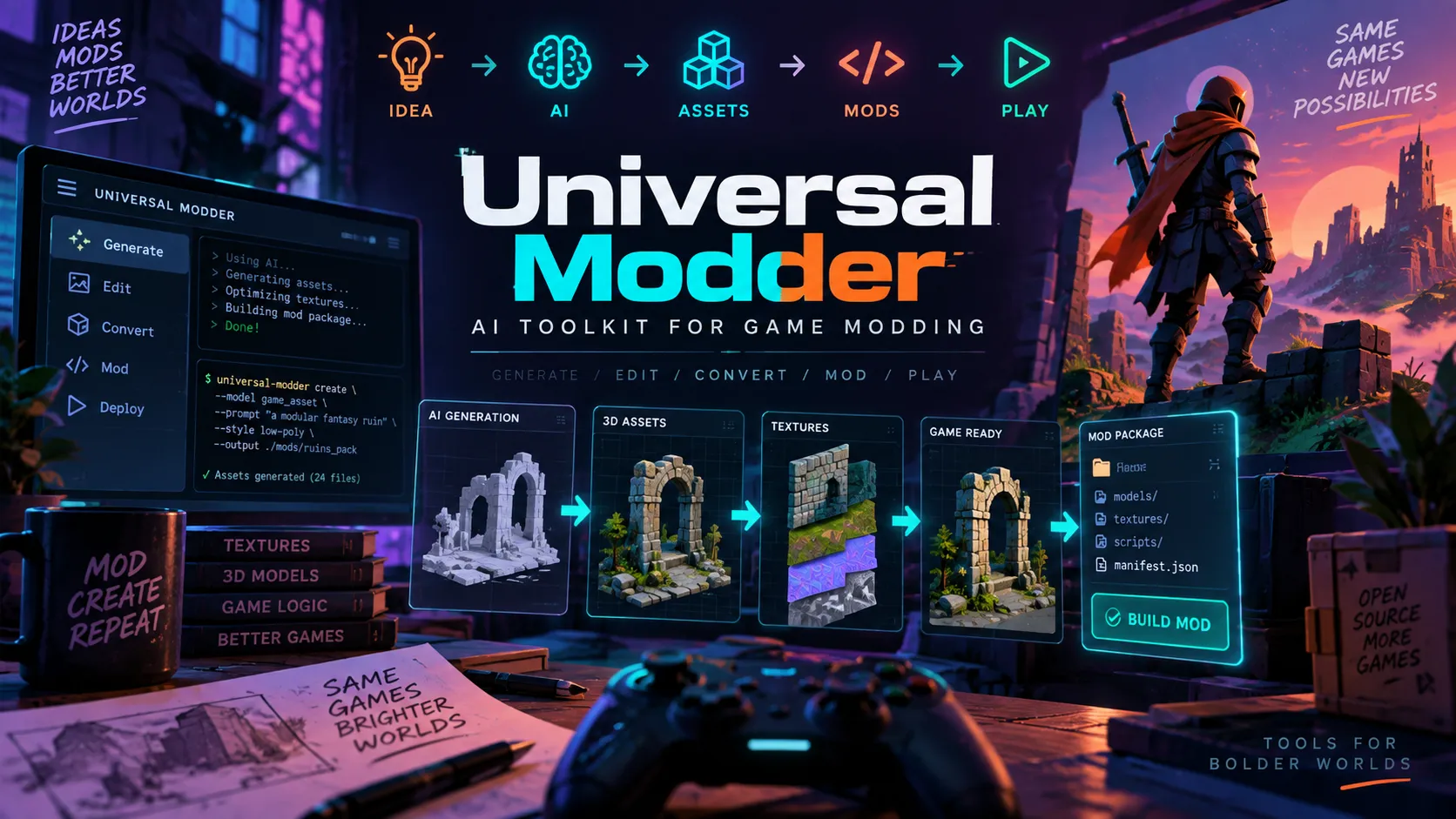
Universal Modder is an open-source toolkit designed to make AI coding agents better at real PC game modding. Instead of asking an agent to guess where a game is installed, infer its engine, find a compatible loader, edit assets, launch the game, and verify the result, the project packages those tasks into a reusable workflow.
It is not a replacement for tModLoader, BepInEx, UE4SS, REFramework, SKSE, Fabric, SMAPI, or other game-specific frameworks. Universal Modder sits above them. Its job is to identify the cheapest viable route and help the agent use existing tooling correctly; if no high-level loader fits, it can guide data editing, managed patching, native hooks, reimplementation, or mashups.
The project combines Agent Skills, the um command-line toolkit, fal MCP/CLI asset generation, local ComfyUI support, engine playbooks, and an agent-readable knowledge base. That makes it closer to an agentic modding framework than a conventional mod manager.
Why It Is Different From a Generic AI Coding Agent
A normal coding agent can write C#, C++, Lua, Java, Python, and configuration files. The harder part of modding is environment discovery and feedback.
Universal Modder helps answer questions such as:
- What engine and version is this game using?
- Is code managed, IL2CPP, native, or mixed?
- Which executable is the real game rather than a launcher?
- Is a current community loader available?
- Is anti-cheat present?
- Where are saves, logs, config files, and mod folders?
- Did the mod actually load and work in the running game?
- Can the package be shared without including copyrighted game content?
Its default loop is: knowledge search → recon → route selection → safe lab → source-of-truth inspection → vertical slice → assets → in-game verification → recording → packaging → field note.
This is the project's key idea: make modding an evidence-driven engineering process instead of a long code-generation chat.
Supported AI Coding Agents
The repository documents installation paths for Claude Code, Codex, Gemini CLI, VS Code/GitHub Copilot, Cursor, and OpenCode. Generic agents can also consume the repo's AGENTS.md and Agent Skills.
The skills themselves are intentionally agent-neutral, so the same modding methodology can move between coding agents rather than being locked to one vendor.
How to Install Universal Modder
Claude Code
/plugin marketplace add rehan-remade/universal-modder
/plugin install universal-modder@universal-modder
Codex
codex plugin marketplace add rehan-remade/universal-modder
codex plugin add universal-modder@universal-modder
Gemini CLI
gemini extensions install https://github.com/rehan-remade/universal-modderGeneric clone
git clone https://github.com/rehan-remade/universal-modder
cd universal-modder
Install the um CLI directly
uv tool install git+https://github.com/rehan-remade/universal-modderThe repository lists Python 3.10+ and ffmpeg as baseline requirements. uv is recommended. Blender is required for 3D-to-sprite rendering. Hosted fal generation needs a fal API key, while um comfy can use a local ComfyUI server for image workflows.
export FAL_KEY="your_key_here"Universal Modder itself is MIT licensed; optional hosted model usage can have separate costs and licensing terms.
How the Workflow Works
1. Search the knowledge base
um kb search "Terraria"
um kb search "Unity"
Field notes can provide exact versions, proven loaders, failed approaches, and gotchas before the agent touches the game. As of October 5, 2026, the index lists 38 game notes.
2. Scan the installed game
um scan --list
um scan "Terraria"
um scan "Terraria" --json
um scan can inspect Steam, Epic, and Xbox installs and report engine/version signals, executable type, likely managed/native status, anti-cheat indicators, installed loaders, save locations, and ranked modding routes. The scan is read-only.
3. Research the current community route
The workflow tells agents to check current modding wikis, Nexus Mods, Thunderstore, mod.io, Steam Workshop, GitHub, and recent community announcements. This matters because loaders and supported game versions can change after updates.
4. Pick the cheapest viable route
| Route | Best fit | Examples |
|---|---|---|
| Data / assets | Editable game data is enough | JSON, scripts, pak overrides |
| Loader API | Mature loader exposes hooks | tModLoader, SMAPI, BepInEx, UE4SS, REFramework, SKSE |
| Managed patching | .NET/Mono/IL2CPP/Java needs runtime changes | Harmony, MonoMod, Mixin |
| Native hooks | Native game lacks a high-level loader | Proxy DLLs, signature scans |
| Reimplementation / recomp | Total control or retro systems | Decomp/recomp projects |
| Mashup / passthrough | Two games exchange state/rendering | Cross-game integrations |
Universal Modder prefers the simplest route that reaches the feature rather than defaulting to reverse engineering.
5. Build a reversible lab
um backup create "/path/to/saves" --name game-savesThe workflow recommends separate profiles or test worlds, fixed window sizes, and keeping extracted or decompiled material outside the mod repo.
6. Inspect the source of truth
Depending on the engine, the agent may use ILSpy, Cpp2IL, Vineflower, Ghidra, IDA, UnityExplorer, UE4SS, REFramework, Cheat Engine, FModel, xEdit, or other engine-specific tooling. Universal Modder does not replace these tools; it organizes when and how to use them.
7. Prove one vertical slice
The project recommends taking one item, mechanic, enemy, or unit all the way through the game with placeholder assets before scaling. This exposes loader, hook, and data-format mistakes early.
8. Verify in the real game
The running game is treated as the final oracle. Logs, screenshots, deterministic test scenes, and controlled input matter more than plausible-looking code. The skill even recommends stopping and changing approach after the same failure repeats three times.
The um CLI Explained
| Command | Purpose |
|---|---|
um scan | Find installed games; fingerprint engine, code type, anti-cheat, loaders, saves, and routes |
um fal | Generate sprites, images, textures, PBR, 3D, rigs, SFX, music, voice, and video |
um comfy | Run local ComfyUI image workflows |
um sprite | Cut out, fit, pixelate, palette-map, sheet, slice, and prepare sprites |
um render3d | Render GLB assets into directional sprite frames through Blender |
um win | Launch, screenshot, record, drive input, inspect processes, and manage selected Windows settings |
um video | Build contact sheets and compile showcase videos |
um backup | Snapshot, diff, and restore save folders |
um publish check | Flag game files, decompiled code, and leaked secrets before sharing |
um kb | Search, create, validate, index, sync, and submit field notes |
The um render3d presets include aoe2, iso8, trueiso, topdown, side, and turntable. The project also ships Windows-focused helpers for game-only audio recording and controlled input.
AI Asset Generation Is a Major Differentiator
Universal Modder treats assets as part of the engineering loop rather than an afterthought. Its skills cover transparent sprites, consistent variants, pixel art, seamless textures, PBR maps, image-to-3D, auto-rigging, SFX, music, voice, cutscene video, sprite sheets, directional rendering, palettes, and team-color conversion.
The recommended process is to study the game's frame size, palette, outline, camera angle, facing directions, and sheet format first, then transform generated output into exactly what the engine expects.
For multi-angle characters, one useful pattern is to generate a consistent concept, convert it to 3D, and render every direction from a fixed camera. That reduces the visual drift caused by independently generating eight or sixteen directions.
The Shared Knowledge Base Is the Long-Term Moat
The knowledge/ directory records exact versions, chosen routes, engine behavior, build steps, verification evidence, unverified assumptions, and gotchas in symptom → cause → fix form.
Agents can scaffold notes from their project journal, validate them, and prepare a pull request after human approval. Contribution rules require truthful status labels and forbid game files, pirated content, decompiled dumps, secrets, multiplayer cheats, anti-cheat bypasses, and DRM bypasses.
The strategic value is a flywheel: every solved game or technique can make future agent sessions faster and more grounded. The 38-note index is still small relative to the PC game ecosystem, but it already extends beyond the original showcase projects.
Real Projects Built With It
- Terraria: Fal Arsenal uses tModLoader and includes multiple weapons, new enemies, and a two-phase boss, with sprites generated through fal.
- Age of Empires II: Definitive Edition adds a new civilization concept with a Robotaxi unique unit, Delivery Drones, a Transamerica Pyramid wonder, 3D-to-sprite rendering, and reverse-engineering work around the
.sldsprite format. - Minecraft inside GTA V uses a Fabric mod plus a ScriptHookV/ReShade add-on, exchanging camera and event data over a local WebSocket while compositing Minecraft color and depth into GTA's frame.
These examples show why Universal Modder is more than a prompt library: the workflows cross code, runtime behavior, data formats, generated assets, and verification.
Safety and Legal Boundaries
Universal Modder permits modding owned games for offline/single-player use and servers controlled by the user. It treats anti-cheat as a stop condition for injection and prohibits disabling or bypassing anti-cheat, spoofing hardware IDs, tampering with DRM, or creating cheats that affect other players.
It also separates research artifacts from distributable mod content. Decompiled source, extracted assets, ROMs, ISOs, and game files should not be shipped; distributable mods should use original code/assets, patches, diffs, or converters that operate on the user's own installation.
Limitations
- It is not literally universal. Custom engines, packed executables, unusual launchers, and mixed runtimes can still require manual work.
- Protected live-service games are intentionally constrained. A route requiring anti-cheat bypass should stop.
- Game updates can invalidate loaders, signatures, offsets, and formats. Current community research remains necessary.
- Hosted generation can cost money. Universal Modder is open source, but fal usage is separate.
- Windows is especially important. Many target games and automation features are Windows-centric, though Windows games can also be driven from WSL.
- Reverse engineering still requires expertise. Native hooks, proprietary formats, rendering injection, and cross-game synchronization remain hard problems.
- It is early-stage. Version 0.2.0 signals active development rather than a stable long-term API.
A more accurate interpretation is that Universal Modder aims to make the process universal, not the underlying modding technique.
Universal Modder vs Other Approaches
| Capability | Universal Modder | Generic AI agent | Game-specific framework |
|---|---|---|---|
| Game/engine discovery | Built in | Mostly manual | Usually unnecessary |
| Route selection | Yes | Prompt-dependent | No |
| Reverse-engineering playbooks | Yes | General knowledge | Limited |
| AI asset pipeline | Integrated | Separate tools | Usually no |
| In-game verification | Built into workflow | Environment-dependent | Usually outside scope |
| Backup/restore | Built in | Manual | Varies |
| Agent-readable field notes | Core feature | No shared domain memory by default | Community docs vary |
| Actual game hook/API | Usually no | No | Yes |
The strongest setup is usually Universal Modder + a capable coding agent + the game's established mod framework.
FAQ
Is Universal Modder free?
Yes. The repository is MIT licensed. Optional hosted model calls can have separate costs.
Does it work with every game?
No. Feasibility depends on the engine, available loaders, game updates, requested feature, mod policy, and anti-cheat constraints.
Does it require Claude Code?
No. The repository documents Claude Code, Codex, Gemini CLI, VS Code/GitHub Copilot, Cursor, OpenCode, and generic Agent Skills-compatible setups.
Can it generate game assets?
Yes. Its tooling covers images, sprites, textures, PBR maps, 3D, rigging, SFX, music, voice, and video, with local ComfyUI support for image workflows.
Can it create multiplayer cheats?
Its published rules explicitly prohibit cheats against other players, anti-cheat bypasses, DRM bypasses, and injection into protected online clients.
Conclusion
Universal Modder is a strong example of AI coding moving beyond source generation into end-to-end computer-based engineering. It gives agents a repeatable way to research an unfamiliar game, choose a realistic modding route, protect saves, create assets, verify behavior inside the game, package the result, and preserve lessons for future projects.
Its biggest strength is also the best way to interpret its name: it does not make every game universally moddable. It attempts to make the agent workflow for discovering, building, testing, and documenting mods universal.
For developers already using Claude Code, Codex, Cursor, Gemini CLI, Copilot, or OpenCode, a practical evaluation is to run um kb search, scan an owned game with um scan, build one reversible vertical slice, and judge the toolkit by whether it can turn an AI-generated idea into a change that is visibly working in the real game.
Continue Reading
More articles connected to the same themes, protocols, and tools.


Referenced Tools
Browse entries that are adjacent to the topics covered in this article.