On This Page8 sections
TierMaker has become one of the internet's most recognizable ranking platforms. Its familiar colored rows, typically labeled S, A, B, C, and D, appear in YouTube videos, Reddit discussions, livestreams, gaming communities, and social media debates.
What looks like a relatively simple drag-and-drop image tool has developed into a substantial user-generated content platform. According to Semrush's September 2026 traffic estimates, TierMaker attracted approximately 17.29 million website visits in one month.
The more interesting questions concern the business behind that growth: Who created TierMaker? When did it become popular? Why did so many creators adopt it? And how did an uncomplicated ranking format become the foundation of a large content and distribution ecosystem?
The available evidence points toward a combination of gaming culture, creator-driven distribution, reusable community templates, search visibility, and a remarkably effective sharing mechanism. However, important details about its individual founder and earliest growth milestones remain publicly unverified.
Key Takeaways
- TierMaker is operated by Tastier Adventures LLC. The company is identified through the platform's branding and official mobile-app listings. A named individual founder could not be reliably established from the available public records.
- Tier lists existed long before TierMaker. The format emerged from competitive gaming communities and expanded into mainstream internet culture during the late 2010s.
- TierMaker benefited from a creator-led distribution model. YouTubers, streamers, Reddit users, and fans could turn subjective opinions into recognizable visual content that others wanted to recreate or challenge.
- The platform has enormous content breadth. TierMaker's own documentation reports more than two million reusable tier-list templates.
- Semrush estimated 17.29 million visits in September 2026, compared with 18.43 million in August. These are modeled visits, not verified unique users.
- Its competitive advantage extends beyond the editor. Searchable templates, community rankings, social sharing, brand recognition, and related products make the platform more difficult to replace than its basic functionality suggests.
- Its growth is not fully attributable to one viral moment. The evidence supports a continuing relationship between a popular cultural format and an accessible publishing tool, rather than a confirmed single influencer campaign or launch event.
What Is TierMaker?
TierMaker is an online platform for organizing images or subjects into customizable ranking tiers.
A typical tier list contains colored horizontal rows, often following this arrangement:
| Tier | Common Interpretation |
|---|---|
| S | Exceptional, top-tier, or best |
| A | Excellent |
| B | Good or above average |
| C | Average or situational |
| D | Below average |
| F | Lowest-ranked or worst |
These labels are conventions rather than fixed objective measurements. Creators can rename tiers, change their colors, and apply their own ranking criteria.
For example, the same collection of Pokémon could be ranked according to competitive strength, visual design, nostalgia, usefulness, or personal preference. A single image collection therefore supports many different outcomes.
This flexibility is central to the product. TierMaker supplies the reusable objects and visual structure while its users supply the opinions, judgments, and entertainment.
Main TierMaker features
The platform includes:
- Reusable templates: Search existing collections of images and start ranking immediately.
- Custom tier lists: Create individual rankings with editable tiers and image placement.
- Public templates: Publish image collections that other users can reuse.
- Image export: Download completed rankings as shareable images.
- Community rankings: View aggregated rankings derived from eligible user-submitted lists.
- Live voting: Create interactive events where participants collectively rank items.
- Alignment charts: Place subjects into two-dimensional classification grids.
- Mobile apps: Access a subscription-oriented version of the service on iOS and Android.
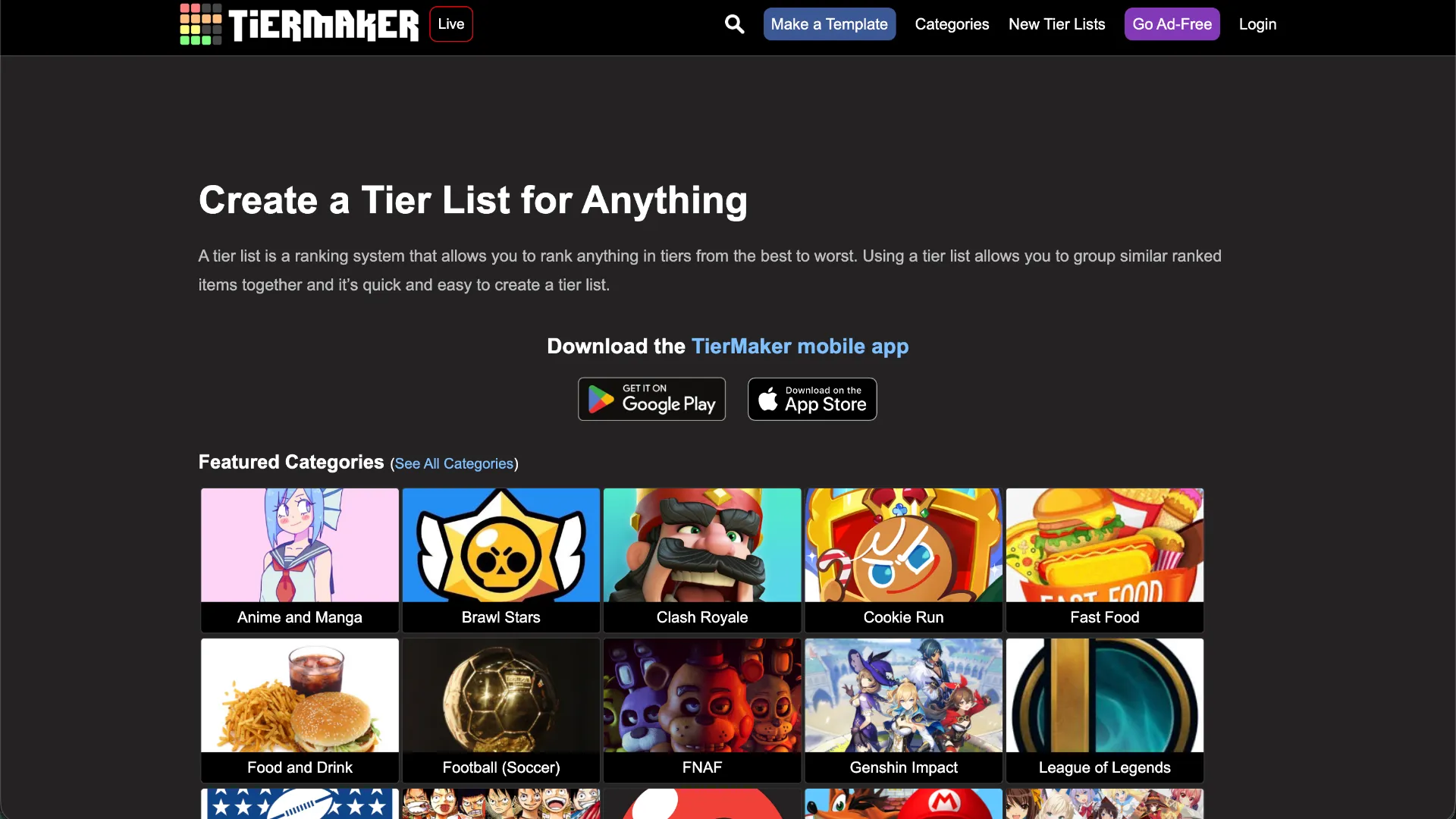
The site's featured categories demonstrate its breadth, including anime, Pokémon, video games, football, music, movies, food, and internet culture.
That breadth matters commercially because TierMaker does not depend on one franchise, one game, or one creator community remaining popular indefinitely.
Who Founded TierMaker?
The verified company behind TierMaker
TierMaker publicly identifies itself as a Tastier Adventures brand.
The official Apple App Store listing names Tastier Adventures LLC as the app's seller and developer organization. Google's Play Store listing identifies the same business.
The app-store business information supplies a Fargo, North Dakota, United States contact address. That is an officially displayed business contact location, but it does not independently establish where the original product was developed or where its founder lives.
Tastier Adventures operates a broader family of interactive entertainment and community-ranking products, including:
- TierMaker — image-based tier rankings.
- BracketFights — tournament-style brackets.
- TriviaCreator — interactive trivia quizzes.
- SpinWheelMaker — customizable spinning wheels.
Other brands associated with the company include AlignmentChart and EpisodeRatings, as described by the AlignmentChart company information.
This portfolio suggests a broader business strategy built around lightweight interactive content formats rather than a standalone ranking editor.
Is the individual founder publicly known?
A verified individual founder's name could not be established from the available public evidence.
The official website, application listings, and accessible company information consistently identify the operating brand or legal entity, but do not provide a sufficiently reliable biography naming the original creator.
This is an important distinction. An app-store developer name is not automatically a founder's personal identity, and a domain registrant is not necessarily the person who designed the original product.
The ownership question was also discussed in a November 2023 independent essay titled Tier Lists. Its author identified Tastier Adventures as the operator but was unable to verify the individual behind it. That investigation is supporting context, not definitive evidence about beneficial ownership.
Consequently, claims that a particular YouTuber, streamer, or developer founded TierMaker should be treated cautiously unless supported by a direct founder interview, official disclosure, or authoritative company filing.
What is confirmed: Tastier Adventures LLC is the publicly identified company behind the current product.
What is not confirmed: The original individual founder, founding team composition, initial investment, original development budget, and precise company revenue.
When Was TierMaker Created? A Historical Timeline
TierMaker's precise public launch date is not established conclusively by the sources reviewed. Domain registration records and surviving template metadata provide useful historical clues, but neither constitutes a complete product-launch history.
| Period | Verifiable Development or Context |
|---|---|
| July 2016 | Public WHOIS-derived records identify July 7, 2016 as the registration date for tiermaker.com. Registration does not prove a functioning website existed that day. |
| 2018–2019 | Tier-list memes and character-ranking generators gained visibility across gaming communities, especially around Super Smash Bros. Ultimate. |
| Early 2019 | TierMaker template records include early-2019 modification dates, providing historical evidence of the product during this period. |
| 2023 | TierMaker documented Google account sign-in as an additional login option, introduced in June 2023. |
| May 2025 | The official iOS app's version history shows version 1.0 dated May 3, 2025. |
| August 2026 | Semrush estimated approximately 18.43 million monthly website visits. |
| September 2026 | Semrush estimated approximately 17.29 million monthly website visits. |
The domain registration lookup reports July 7, 2016, but a registered domain can remain unused, redirect elsewhere, or host a substantially different product before a public launch.
A surviving 2018 Memes template displays a January 2, 2019 modification date. That is useful evidence of historical template activity, although a modification date should not be interpreted as a certified product-launch date.
Likewise, the rise of the format in 2018 and 2019 should not be confused with proof that TierMaker itself originated every popular tier-list meme of that period.
Where Did Tier Lists Come From?
Understanding TierMaker's success requires separating the history of the ranking format from the history of the website.
Tier lists were already established within competitive gaming communities well before TierMaker became widely recognizable.
In games with multiple playable characters, players needed convenient ways to compare relative strength, tournament viability, matchups, and strategic usefulness.
The format became especially prominent in fighting-game communities associated with games such as Street Fighter, Tekken, and Super Smash Bros.
Know Your Meme's history of tier lists documents early examples and the movement from competitive character rankings into parody and other subjective classifications.
One important transition occurred when tier lists stopped being exclusively about competitive strength.
Instead of asking which character wins the most matchups, creators began asking which character would make the best roommate, which snack tastes best, or which fictional villain is most memorable.
The ranking structure stayed the same, but the range of possible subjects became effectively unlimited.
This transformation was commercially significant. A specialized gaming analysis format became a universal method for expressing opinions and inviting disagreement.
The Super Smash Bros. Ultimate connection
The launch period surrounding Super Smash Bros. Ultimate was particularly important to the visibility of character-ranking memes.
Know Your Meme's Smash Ultimate tier-list history documents how parody rankings circulated in 2018 and early 2019. It also identifies an earlier tier-list generator on SSBWorld, demonstrating that TierMaker was not the only tool involved in this trend.
This distinction strengthens the historical explanation: TierMaker succeeded within an existing and expanding behavior rather than inventing the underlying cultural format.
How Did TierMaker Become So Popular?
There is no independently verified public growth log establishing exactly which creator or campaign generated TierMaker's first major traffic spike.
However, its product architecture, historical cultural context, publicly visible content, and present-day traffic profile reveal several mutually reinforcing growth mechanisms.
1. It transformed opinions into instantly recognizable images
A conventional review requires readers to interpret paragraphs, numbers, or multiple criteria.
A tier list communicates an opinion almost immediately.
The viewer sees familiar subjects, recognizable colors, and their relative positions. Even without reading explanatory text, the central message is usually apparent.
This creates an extremely low barrier to consumption.
A ranking of 30 animated characters might require several minutes to explain verbally, but a tier-list image allows someone to identify controversial placements within seconds.
That compression makes the format especially effective for social platforms where attention is limited.
2. Controversy and disagreement became distribution mechanisms
Tier lists are subjective by design.
A controversial placement can encourage viewers to comment, dispute a decision, create a reaction, or publish an alternative ranking.
For example, putting a popular character into D Tier immediately creates a discussion opportunity. The disagreement itself becomes part of the entertainment.
The mechanism can be summarized as:
Ranking → Disagreement → Discussion → Alternative Ranking → More Sharing
Unlike a conventional static image editor, TierMaker gives participants a direct way to reproduce the original format and express an opposing opinion.
This makes the product useful not only to the initial creator but also to the audience responding to that creator.
3. YouTube and streaming creators provided recurring exposure
Tier lists fit naturally into several creator formats:
- Long-form videos explaining each placement.
- Livestreams where the audience debates rankings in real time.
- Short-form reaction clips emphasizing controversial opinions.
- Community challenges asking viewers to create their own versions.
- Follow-up content comparing creators' rankings with community consensus.
The broader popularity of the format is supported by YouTube's own research.
In August 2025, the official YouTube Culture & Trends report on tier lists stated that videos containing tier list in their titles accumulated more than one billion views globally during the first six months of 2025.
This is an important demand signal, but the measurement applies to the overall YouTube video category. It does not mean that TierMaker itself generated one billion views, nor does it establish the website's referral traffic.
The likely advantage for TierMaker is repeated visibility whenever creators use its recognizable output or reference its templates.
4. Reusable templates removed most of the work
Creating an original ranking from scratch can be tedious.
A creator might need to locate images, crop them, standardize dimensions, arrange a layout, and prepare an export.
TierMaker reduces that effort by allowing someone to reuse an existing template containing the required subjects.
The user can focus on the entertaining part: making choices.
This produces a useful division of labor:
- One community member prepares a collection of images.
- Many other people reuse it.
- Each person creates a different ranking.
- Some participants publish their results and encourage additional users to participate.
According to TierMaker's account documentation, its template library exceeded two million reusable templates when that documentation was published or updated. This is a platform-reported figure, not an independently audited count for October 2026.
The larger the library becomes, the more likely a new visitor is to find an immediately usable template.
5. User-generated content created long-tail search opportunities
TierMaker's searchable pages cover both general ranking terms and highly specific interests.
Relevant search intents can include:
- Pokémon tier list maker.
- Anime character tier list.
- Football player tier list.
- Roblox game tier list.
- Best fast food tier list.
- League of Legends champion ranking.
These examples represent categories of search demand, not verified keyword-volume claims for every phrase.
The site's architecture allows the same core editor to serve thousands of distinct topics.
Instead of manually writing a separate software product for each fandom, TierMaker can distribute reusable collections through topic-specific pages.
This creates potential organic discovery at scale. However, the existence of many template pages does not prove that all of them rank, receive clicks, or meet search quality standards.
6. It expanded beyond gaming into everyday culture
Gaming communities provided a natural starting audience, but the tier-list format works equally well for entertainment, celebrities, food, music, television, and sports.
The TierMaker homepage demonstrates that broad coverage directly through featured category collections.
This diversification reduces dependence on any single game's popularity cycle.
When a franchise becomes less popular, users may still create rankings around a newly released show, viral snack, sports season, or emerging online trend.
In this sense, TierMaker functions as a flexible infrastructure layer for internet fandoms rather than a tool tied to one game.
The TierMaker Viral Growth Loop
TierMaker's model can be represented as a reinforcing distribution loop:
A user creates a template → Other users rank its images → Rankings appear in videos or social discussions → New audiences discover the format or website → More people reuse or create templates → The searchable library becomes more valuable.
Several mechanisms operate at the same time.
| Mechanism | User Benefit | Potential Business Benefit |
|---|---|---|
| Template reuse | Faster creation | Repeat usage and greater template utility |
| Social image sharing | Easy communication | Brand exposure and possible referrals |
| Public template pages | Discoverable interests | More search entry points |
| Community rankings | Compare opinions | Return visits and deeper engagement |
| Creator integrations | Entertaining content | Exposure to creator audiences |
| New fandom coverage | Relevant new topics | More diverse acquisition opportunities |
The word potential matters. The evidence supports these mechanisms as plausible drivers, but TierMaker has not publicly disclosed a complete attribution model quantifying the historical contribution of each one.
Another distinction is essential: a screenshot shared without a clickable URL may generate awareness without producing an attributable referral or backlink. Brand impressions, direct visits, search visits, and measurable referred sessions are different outcomes.
TierMaker Traffic in 2026: How Big Is the Website?
The most concrete measure of TierMaker's scale comes from external traffic estimation services.
According to Semrush's September 2026 analysis, the website recorded the following modeled metrics.
| Metric | September 2026 Estimate |
|---|---|
| Total monthly visits | 17.29 million |
| August 2026 visits | 18.43 million |
| Month-over-month visit change | -6.19% |
| Average pages per visit | 3.89 |
| Average visit duration | 9 minutes 13 seconds |
| Bounce rate | 53.68% |
| Global website rank | 3,160 |
| Authority Score | 67 |
| Referring domains | Approximately 25,550 |
| Backlinks | Approximately 488,510 |
These figures were available in Semrush's October 11, 2026 update. They should be interpreted as third-party modeled estimates rather than TierMaker's internal analytics.
A visit is not equivalent to a unique visitor. One person can generate multiple visits within a month, and one visit can contain multiple pageviews.
The traffic estimates also do not establish profit, revenue, conversion rates, or the number of people actively creating tier lists.
Which countries generate the most traffic?
Semrush's September 2026 geographical estimates show the following distribution:
| Country | Share of Website Visits |
|---|---|
| United States | 35.29% |
| Brazil | 7.69% |
| Germany | 4.23% |
| France | 3.83% |
| Russia | 3.55% |
The American audience represents the largest individual national segment, but TierMaker clearly reaches an international user base.
The strong representation of countries such as Brazil and Germany is consistent with the broad international appeal of gaming, anime, football, and entertainment ranking culture. It does not, by itself, prove which topics drive traffic in each country.
Where does TierMaker's traffic come from?
For September 2026, Semrush's desktop traffic-journey analysis identified approximately:
- 51.43% direct traffic.
- 38.16% arriving from google.com.
The figures refer to the reported desktop journey view and should not be treated as an all-device acquisition breakdown.
Furthermore, traffic arriving from Google is not automatically identical to the organic-search figure in a separate SEO estimation model.
The direct-traffic component is especially interesting. It may include bookmarked visits, typed URLs, untagged links, and visits whose original referring information was unavailable.
Consequently, high direct traffic can be consistent with significant brand familiarity, but it is not sufficient evidence that every direct visitor already knew TierMaker by name.
What does the backlink profile reveal?
Semrush estimated approximately 25,550 referring domains and 488,510 backlinks in September 2026.
That profile is consistent with a website widely referenced across other pages and communities.
Possible sources of links include creator descriptions, fan wikis, forum discussions, template recommendations, and community posts.
However, individual link quality and the precise origins of those backlinks require a dedicated backlink-level audit. Aggregate totals alone do not establish how much authority was created by any specific campaign.
The practical conclusion is that TierMaker combines substantial direct demand with discoverability through search and external references.
Why TierMaker's SEO Model Is Difficult to Replicate
The platform's SEO advantage is not simply a large quantity of pages.
Its more significant advantage is the relationship between pages, active functionality, and existing audience demand.
A page devoted to a specific game's characters is useful because visitors can interact with those characters immediately. The page is not merely a keyword-targeted article pointing elsewhere.
This creates several advantages:
1. Search intent alignment. Someone searching for a particular tier-list template usually wants to make or inspect that exact ranking.
2. Immediate interaction. The main task is accessible without a lengthy tutorial or software installation.
3. Repeatable utility. Users can return as characters, game updates, and personal opinions change.
4. Community reinforcement. Saved public rankings and consensus views add activity beyond the original static template.
5. Internal discovery. Category pages and related templates provide routes into additional topics.
The risk is that unrestricted user-generated content can also produce duplicates, low-quality pages, personal-only templates, and search-index bloat.
TierMaker's own template creation guidelines explicitly discourage duplicate templates, excessively personal collections, and low-value titles. The documentation also explains the option to hide unsuitable templates from category and search discovery.
For operators building similar platforms, Google's canonicalization guidance and spam policies are relevant. Duplicated collections, thin programmatic pages, and abusive user submissions can undermine search quality instead of improving it.
The strategic lesson: A reusable interactive page with genuine demand is more defensible than thousands of automatically generated pages containing little more than different keywords.
How to Create a Tier List on TierMaker
The basic workflow is straightforward.
Step 1: Find an existing template
Open TierMaker.com and search for a subject such as an anime series, video game, or collection of athletes.
Select a template containing the images or items to rank.
Step 2: Customize the tier labels
Most templates begin with conventional S, A, B, C, and D tiers.
Depending on the editor options, users can modify label text, adjust colors, and add or remove ranking rows.
Custom labels can make a ranking more entertaining or more useful to a specific audience.
Step 3: Drag images into the rankings
Move each image into the desired tier.
The visual structure allows viewers to see relative placements without requiring a numerical scoring system.
Step 4: Save or download the result
Use the available save or download controls to produce an image.
TierMaker's account documentation states that an account is not necessary to rank images and download results from existing templates.
Creating a reusable public template or saving a list to a profile involves additional account functionality.
Step 5: Share or compare with the community
The resulting image can be shared on social platforms or included in creator content.
Eligible public submissions can also contribute to community rankings, allowing users to compare individual preferences with broader patterns.
Creating a Reusable Public Template: Important Limits
Public template creation has a different purpose from producing a one-time personal image.
TierMaker's official creation guide describes the following technical constraints:
| Setting | Documented Limit or Rule |
|---|---|
| Supported image formats | JPG, JPEG, PNG, and WebP |
| Maximum images per template | 3,000 |
| Maximum images per upload batch | 500 |
| Maximum upload batch size | 50 MB |
| Public template creation | Account required |
| Reusable public templates | Available for other visitors |
| Hidden templates | Remain accessible through their URL but are removed from normal discovery surfaces |
Upload limits and interfaces may change, so the current help documentation should be checked before preparing very large collections.
The platform also advises creators to choose broad, reusable template subjects rather than overly specific personal-ranking titles.
For instance, a general collection of characters from a game can support numerous rankings. A template created only for one individual's ranking of those same characters has substantially less reuse potential.
This reflects an important platform-design decision: templates are most valuable when they serve an audience rather than merely storing one person's completed opinion.
Community Rankings and Live Voting: Beyond Static Images
TierMaker has gradually expanded beyond static downloadable images.
Community Rankings
The platform offers aggregated community rankings based on eligible published lists.
For example, the 2018–2019 Meme community ranking describes a cumulative average generated from submitted tier lists.
These results should be interpreted as the preferences of participating users, not as representative scientific surveys of the general population.
Self-selection, uneven participation, and the composition of the audience can all influence the outcome.
Nevertheless, community aggregation gives users a reason to revisit a template after completing their own ranking.
TierMaker Live
TierMaker Live supports interactive audience participation.
Its official page describes two voting modes:
- Voting Window: Voting can remain open for a period ranging from one hour to one week.
- Livestream: Participants vote on the same image simultaneously.
These features align with the needs of Twitch streamers, YouTubers, online communities, and group events.
They also move the product into a more interactive category: rather than simply generating an image, TierMaker can facilitate a shared activity that people return to while it is unfolding.
How Does TierMaker Make Money?
TierMaker operates a combination of free website access and paid mobile-app functionality.
Free website usage and advertising
The primary website provides free access to existing templates and basic ranking functionality.
Its visible advertising and ad-removal options indicate an advertising-supported component to the website business model.
However, public evidence does not establish verified advertising revenue, RPM, fill rate, or annual profit.
Traffic estimates alone are not sufficient to calculate actual earnings accurately because monetization depends on geographic distribution, ad placements, consent, blocked ads, viewability, and other factors.
Paid mobile-app functionality
The official mobile application provides an ad-free experience, improved output quality, and additional capabilities.
The US Apple App Store listing has displayed the following in-app purchase prices:
| Product | Listed US Price |
|---|---|
| TierMaker Pro Monthly | $1.99 |
| TierMaker Pro Annual | $9.99 |
| TierMaker Pro Lifetime | $19.99 |
These are regional store-listing prices, not guarantees of current checkout pricing in every country or on every platform.
The app is free to download but generally requires a subscription or lifetime purchase for continued usage after its trial, according to the official mobile-app information.
Business-model interpretation
TierMaker combines several complementary monetization characteristics:
- Free entry reduces barriers to adoption.
- Searchable community content supports recurring acquisition.
- Active ranking sessions create opportunities for advertising impressions.
- Heavy users can purchase a more convenient experience.
- Related entertainment products broaden potential audience overlap.
The exact contribution of each revenue stream has not been publicly verified.
There is insufficient trustworthy evidence to assign a precise monthly recurring revenue, annual revenue, company valuation, or profitability figure to TierMaker.
TierMaker's Broader Product Ecosystem
The related Tastier Adventures brands serve similar underlying user motivations: comparing, voting, debating, and making interactive entertainment content.
| Product | Core Interaction | Main User Motivation |
|---|---|---|
| TierMaker | Place items into ranked tiers | Express opinions and compare preferences |
| BracketFights | Advance entries through a tournament | Determine winners through matchups |
| TriviaCreator | Answer or create quizzes | Test knowledge and compete |
| SpinWheelMaker | Spin a configurable wheel | Random selection and anticipation |
| AlignmentChart | Classify subjects within a grid | Debate behavior, personality, or other attributes |
This portfolio illustrates a scalable product strategy.
Instead of requiring one extremely complex application, the company operates multiple focused experiences that share common traits: clear rules, low onboarding friction, participation, and shareable outcomes.
A ranking template, tournament bracket, and spinning wheel may appeal to the same creator audience while supporting different video and community formats.
TierMaker's Weaknesses and Competitive Risks
Despite its scale, TierMaker has several potential disadvantages.
Account creation friction
Creating public templates requires an account linked through supported identity providers.
Some users may be uncomfortable connecting external social accounts to a ranking website.
A 2023 Reddit discussion about TierMaker alternatives documents concerns about login permissions, interface limitations, and template-creation friction.
Such discussion is useful evidence of individual user complaints, but it should not be interpreted as a representative satisfaction survey.
Mobile subscription complaints
Public Google Play reviews include complaints about paying for app functionality when a free web experience exists.
The distinction between free website usage and paid app access should therefore be communicated clearly.
Copyright and intellectual-property exposure
A large portion of tier-list culture involves copyrighted character artwork, game assets, brand logos, and entertainment imagery.
TierMaker's terms of use discuss transformative commentary and fair-use principles.
However, fair use is context-dependent and does not automatically authorize every uploaded image or commercial use. Platform operators must consider rights complaints, moderation, licensing, and takedown procedures.
Content quality and search-index management
A large user-generated library can accumulate duplicates, outdated collections, misleading titles, and irrelevant pages.
Without editorial controls, growth in the number of URLs can exceed growth in actual content value.
This is particularly important for websites attempting to compete through automated page creation.
The core editor is technically reproducible
A basic tier-list editor requires familiar web-interface components: image collections, draggable items, configurable rows, and image export.
These functions are not inherently difficult to imitate.
TierMaker's stronger defensive advantages are likely its existing community, template coverage, accumulated brand awareness, links, and established creator habits.
The editor is the entry point. The surrounding network of content and distribution is the more substantial competitive asset.
TierMaker Alternatives: How Do Other Ranking Tools Compare?
Several alternatives serve users who prefer a different editing experience, design flexibility, or access model.
| Platform | Primary Strength | Main Trade-Off |
|---|---|---|
| TierMaker | Large community-template library and ranking ecosystem | Account requirements for publishing and paid mobile features |
| Canva | Advanced visual design and presentation | More general-purpose than a dedicated community ranking platform |
| TierBuddy | Specialized tier-list creation | A different template ecosystem and feature offering |
| Tier List Maker | Lightweight editor with free PNG export | Does not provide TierMaker's established community network |
The preferred choice depends on the task.
For users wanting to rank familiar subjects with existing community templates, TierMaker is especially convenient.
For marketing visuals or heavily customized presentations, Canva may be more suitable.
For creators prioritizing a simpler workflow, smaller dedicated alternatives deserve consideration.
These are qualitative feature comparisons, not the results of a standardized performance benchmark.
What Can Independent Developers Learn From TierMaker?
TierMaker provides several actionable lessons for interactive website builders, gaming-directory operators, and niche community products.
Lesson 1: Start with a behavior people already enjoy
TierMaker did not need to introduce audiences to the idea of ranking things.
It improved the convenience of a behavior already established in gaming and internet communities.
That reduced the educational burden of the product.
When evaluating new opportunities, developers can look for popular activities that are still performed through screenshots, spreadsheets, shared documents, or awkward manual processes.
Lesson 2: Make the result easy to share
A successful interactive content product should ideally produce a useful result outside its own interface.
For ranking products, that result may be an image, a short video, or a reusable link.
The output should remain understandable when seen without the original application.
Lesson 3: Separate reusable templates from individual results
A template can be valuable to hundreds or thousands of users, while one person's completed ranking may only be relevant to a smaller group.
Keeping these content types separate improves navigation, reduces duplication, and makes it easier to decide what belongs in search indexes.
Lesson 4: Build topic-specific discovery around actual demand
Broad generic tools are difficult to differentiate from established incumbents.
Smaller products may have better opportunities by concentrating on a community with underserved needs.
Potential areas for validation include competitive game rankings, sports roster comparisons, creator-specific ranking events, and collaborative group voting.
However, opportunities should be selected using observed search demand, community activity, and actual product gaps. A plausible keyword alone is not evidence of a commercially attractive market.
Lesson 5: Treat content quality as part of the product
Moderation is not merely an administrative cost.
Removing duplicate templates, correcting inaccurate image labels, preserving updated collections, and preventing inappropriate uploads all improve the usefulness of a community platform.
Quality controls can also reduce the risk of low-value pages accumulating in search results.
Lesson 6: Build distribution into normal usage
An effective sharing mechanism should not require users to perform marketing tasks unrelated to their goal.
Tier lists are naturally shared because the user's opinion is the content.
The strongest version of this strategy allows sharing to create value for both the sender and the recipient.
A Practical Growth Strategy for a New Niche Ranking Website
Developers attempting to build a differentiated alternative can apply the following framework.
Phase 1: Validate a specific community
Identify one narrow category and investigate whether users regularly create rankings, request templates, discuss comparisons, or publish community polls.
Research should cover:
- Recurring ranking-related searches.
- Relevant Reddit and Discord activity.
- Existing YouTube and livestream formats.
- Complaints about current editors.
- Whether users need specialized ranking rules or data.
A new site should have an identifiable reason to exist beyond offering another generic S-to-F grid.
Phase 2: Build a small, high-quality library
Begin with a limited number of genuinely useful templates rather than automatically generating thousands of near-identical pages.
Each template should provide accurate images, understandable item names, a clear subject, and a reason for users to participate.
Important pages should be linked from meaningful category and topic hubs.
Phase 3: Improve the creation and sharing experience
Prioritize fast loading, responsive drag-and-drop controls, accessible touch interactions, reliable image export, and straightforward sharing.
Avoid requiring an account before users can experience the core value of the product unless a clear operational requirement makes registration necessary.
Phase 4: Add features that competitors do not serve well
Possible differentiators include:
- Private group voting.
- Real-time collaborative ranking.
- Named and searchable image items.
- Ranking history across game updates.
- Structured community consensus.
- Creator-specific branded templates.
- Data export and accessibility improvements.
Each proposed feature should be validated against a concrete user problem.
Phase 5: Measure activation, sharing, and retention
An interactive ranking product should monitor more than raw pageviews.
Useful metrics include:
| Metric | What It Measures |
|---|---|
| Template-to-start rate | Percentage of template visitors who begin ranking |
| Ranking completion rate | Percentage of started rankings successfully completed |
| Export rate | Percentage of completed rankings downloaded |
| Share initiation rate | Percentage of completed rankings shared through measurable actions |
| Return usage | Users who return to create or update rankings |
| Template reuse | Average number of completed rankings per reusable template |
| Organic entry rate | Traffic arriving through search landing pages |
| Moderation burden | Time and resources required to maintain content quality |
These metrics expose different failure modes. A website may rank well in search but have poor completion rates, or generate many exported images without producing meaningful return traffic.
A healthy growth strategy improves the entire interaction rather than maximizing a single vanity metric.
Why Copying TierMaker's SEO Structure Alone Is Not Enough
The largest mistake is to assume that TierMaker succeeded simply because it has millions of searchable templates.
The platform benefits from accumulated network effects, established brand recognition, creator exposure, and genuine repeated use.
A new website that copies page titles and generates thousands of empty ranking pages will not automatically reproduce those advantages.
Google's spam policies explicitly warn against scaled content created primarily to manipulate rankings rather than help users.
For a sustainable competitor, the more defensible strategy is to combine real demand with better functionality, stronger editorial quality, or a narrowly differentiated community experience.
The strongest opportunities are likely to exist where the incumbent's general-purpose interface fails to address a specialized workflow.
Frequently Asked Questions
Who owns TierMaker?
TierMaker is publicly identified as a Tastier Adventures brand. Official mobile-app listings identify Tastier Adventures LLC as the developer and seller organization. The original individual founder has not been reliably verified from the available public evidence.
When did TierMaker launch?
The exact public launch date remains unverified. The domain was registered in July 2016, while historical template records and the broader cultural context establish the platform's presence around the late-2010s ranking trend. Domain registration should not be equated with product launch.
Why did TierMaker become popular?
Its growth is consistent with several reinforcing factors: recognizable visual rankings, the popularity of tier-list debates, exposure from creators, easily reused templates, community participation, and search discovery. There is insufficient evidence to attribute the entire success to one influencer or campaign.
How many people visit TierMaker?
Semrush estimated approximately 17.29 million visits during September 2026. This is a third-party traffic estimate, not a verified count of unique individuals or internal analytics users.
How many templates does TierMaker have?
Official TierMaker documentation reports more than two million templates. The available documentation does not provide a freshly audited October 2026 total.
Is TierMaker free?
The core website provides free access to existing ranking templates and image downloads. The official mobile apps use a free-trial model followed by paid access, with subscription or lifetime purchase options.
Does TierMaker require an account?
Users can work with existing templates and download completed images without registering, according to the official help documentation. Publishing reusable templates and saving certain results to a profile require account functionality.
Did TierMaker invent tier lists?
No. Tier-list ranking systems predate the website and were already used by competitive gaming communities. TierMaker popularized a convenient implementation of an established format.
How much money does TierMaker make?
A reliable public revenue figure was not established. Although advertising and paid app purchases are identifiable business-model components, traffic estimates and listed prices are insufficient to calculate actual earnings.
Can a new website compete with TierMaker?
Yes, particularly through specialized ranking workflows, better collaboration, more accessible interfaces, or underserved communities. However, reproducing the basic editor is substantially easier than reproducing TierMaker's extensive community content and established distribution network.
Conclusion
TierMaker demonstrates how a simple interaction can develop into a substantial internet platform when it aligns with an existing cultural behavior.
Its publicly identified operator is Tastier Adventures LLC, while the identity of its original individual founder remains insufficiently documented. Its precise launch date and first viral traffic milestone are also not independently established.
What is clear is the scale of its present-day influence. Semrush estimated 17.29 million visits in September 2026, and TierMaker's own documentation describes a library containing millions of reusable templates.
The platform's central advantage is not complicated software. It is the combination of low-friction creation, recognizable outputs, existing audience demand, community-generated content, and repeated sharing.
For creators, the easiest starting point is to explore an existing TierMaker template and experience how quickly a personal opinion becomes a shareable result.
For developers and publishers, the more valuable lesson is to identify an activity users already want to perform, remove unnecessary friction, and build a product in which every genuinely useful creation can encourage further participation.
That principle—not merely the colored ranking grid—is the foundation of TierMaker's enduring growth.
Continue Reading
More articles connected to the same themes, protocols, and tools.

How ChoicerVoicer.games Reportedly Reached 4.49 Million Monthly Visits: The Viral Game SEO Growth Case Study

Bulin 47 Video Explained: Original Freestyle, Dame Hombro AI Trend & How to Make One
EveryGen MCP Guide 2026: Setup, AI Video Tools, Pricing, and Both Servers Explained
Referenced Tools
Browse entries that are adjacent to the topics covered in this article.