
On This Page8 sections
Key Takeaways
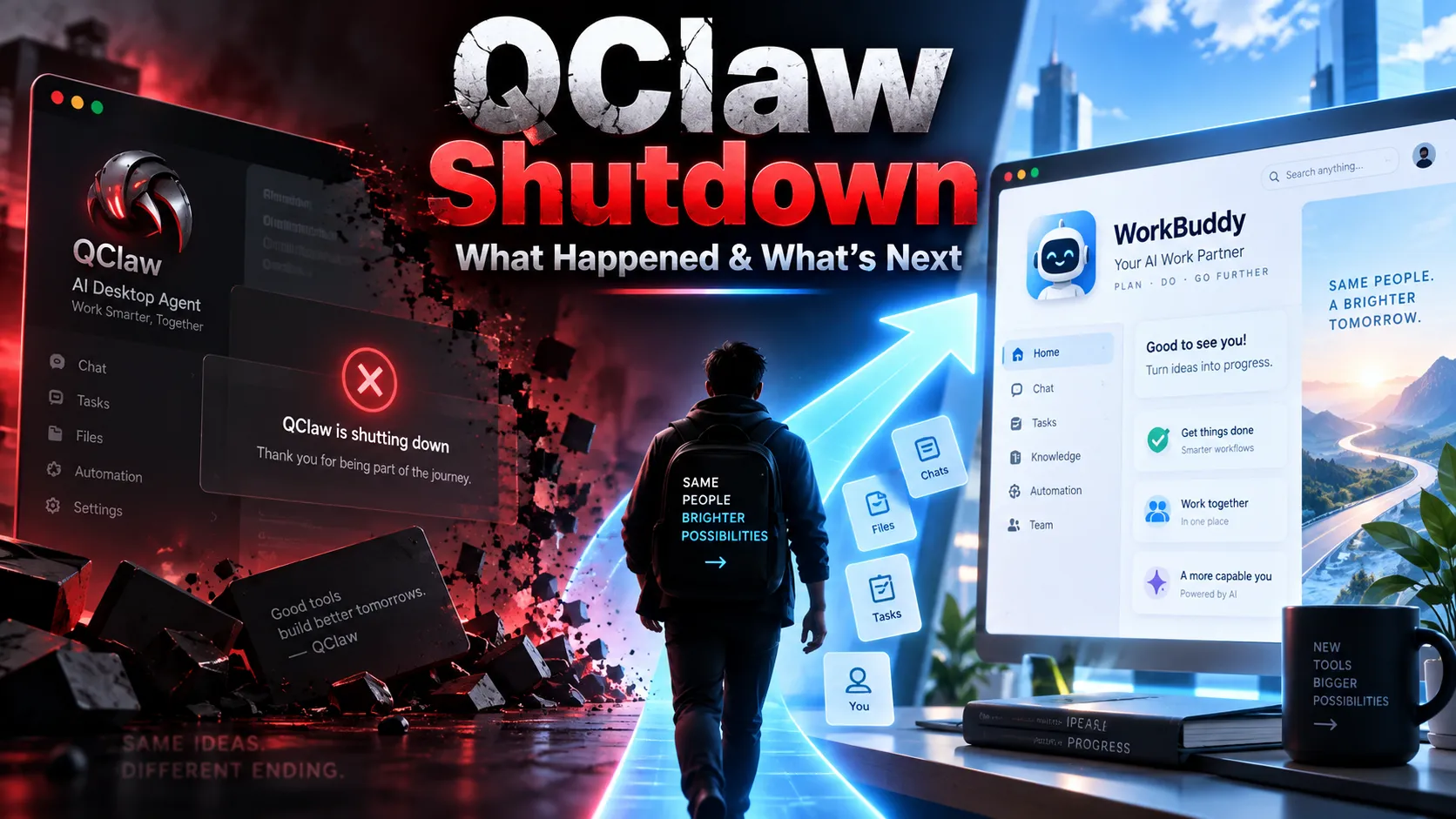
- Tencent has officially announced the shutdown of QClaw. The service will stop normal operations at 00:00 on December 24, 2026.
- QClaw is not fully offline yet. Existing users can continue using the service during the transition period, but new registrations, new subscription purchases, and renewals stopped on September 24, 2026.
- Tencent is directing users toward WorkBuddy, its broader AI agent workspace. Users who complete a valid migration can receive 1,000 WorkBuddy credits.
- QClaw users can keep downloading backups after the shutdown until March 24, 2027, after which Tencent says remaining user data will be deleted except where retention is legally required.
- The shutdown follows an earlier organizational change: in July 2026, QClaw-related business and part of its team were moved into the Tencent Cloud department that also houses WorkBuddy. That makes the shutdown look more like product-line consolidation than a sudden technical failure.
- There is no reliable public evidence that Tencent shut QClaw down because of poor usage or a failed product. Tencent's stated reason is a business adjustment intended to consolidate resources and provide a better Agent service.
Is QClaw Already Shut Down?
Not completely.
Tencent announced QClaw's shutdown on September 24, 2026, but the product entered a transition period rather than disappearing immediately.
From the announcement date:
- New user registration stopped.
- New subscription purchases stopped.
- Subscription renewals stopped.
- Existing automatic renewals were disabled.
- Existing registered and paid users can continue using QClaw until the formal shutdown date.
- Existing credits retain their original expiration dates.
The important date is December 24, 2026 at 00:00. At that point, QClaw will stop normal operations. Tencent says only backup and migration functions will remain available afterward.
That distinction matters for search queries such as "Is QClaw down?" or "Did Tencent close QClaw?" The most accurate answer is:
QClaw has been discontinued, but it is still operating temporarily for existing users during the shutdown and migration window.
QClaw Shutdown Timeline
QClaw had an unusually fast product lifecycle.
| Date | Event |
|---|---|
| March 20, 2026 | QClaw entered full public beta in China without requiring an invitation code. |
| April 21, 2026 | Tencent announced an international QClaw beta. It supported Windows and macOS and could connect to messaging channels such as WhatsApp and Telegram. |
| July 20, 2026 | Tencent internally moved QClaw-related business and part of its team to Cloud Product Department 6, the organization associated with WorkBuddy. Reports at the time said QClaw would continue operating. |
| September 24, 2026 | Tencent announced that QClaw would stop operating and immediately stopped new registrations, subscription purchases, and renewals. |
| December 24, 2026 | Normal QClaw service is scheduled to end at 00:00. |
| March 24, 2027 | The post-shutdown backup window is scheduled to end. Tencent says user data will then be deleted except for information it must retain under applicable law. |
The timeline is striking because Tencent was still expanding QClaw internationally in April. Its official announcement described an international beta with an initial allocation of 20,000 user slots across Canada, Japan, Singapore, South Korea, and the United States. Tencent also said the Mainland China version had received more than 80 feature iterations within one month.
Less than six months after that international announcement, the shutdown was confirmed.
What Was QClaw?
QClaw was Tencent's attempt to make the OpenClaw agent ecosystem easier to use for mainstream users.
Rather than asking users to manually install, configure, and maintain an agent runtime, QClaw packaged the experience into a desktop application.
Tencent described the international version as being built on the open-source OpenClaw framework. Its setup flow was designed for users without deep technical knowledge: download the application, register, scan a QR code, and start using the agent.
Its core value proposition included:
- Local desktop execution
- Windows and macOS support
- Multiple model integrations
- Custom model API key support
- Remote commands through messaging apps
- Persistent agent-style workflows
- Task automation
- User-specific context and memory
Tencent also emphasized security. The company said QClaw processed data within the user's environment and included a security component called Claw Gateway, designed to detect threats such as malicious instructions and skill poisoning.
This positioned QClaw differently from a conventional chatbot. It was closer to a packaged local agent environment designed to act on the user's computer.
Why Is Tencent Shutting Down QClaw?
Tencent's official explanation is straightforward: business adjustment and resource consolidation.
A Tencent representative said the company was stopping QClaw "to further integrate resources and provide users with better Agent services." The company simultaneously introduced a migration path into WorkBuddy.
That is the confirmed explanation.
Anything more specific — for example, claims that QClaw failed commercially, suffered from weak retention, had excessive inference costs, or could not compete — would currently be speculation. Tencent has not publicly released enough QClaw-specific revenue, retention, or active-user data to support those conclusions.
However, the organizational timeline provides useful context.
The July Reorganization Was an Early Signal
On July 20, Tencent moved QClaw-related business and part of its team into Cloud Product Department 6.
That department was already responsible for WorkBuddy, Tencent's broader AI office agent product. Contemporary reporting explicitly connected the two product teams while noting that QClaw was expected to continue operating at the time.
Two months later, Tencent announced QClaw's shutdown and offered a direct WorkBuddy migration tool.
The sequence is therefore:
organizational consolidation → shared product organization → migration path → QClaw shutdown
That does not prove the exact internal decision process, but it strongly supports the interpretation that Tencent is reducing overlap between its agent products.
QClaw vs. WorkBuddy: What Is Changing?
The shutdown becomes easier to understand when the two products are compared.
| Area | QClaw | WorkBuddy |
|---|---|---|
| Core positioning | Accessible local AI agent built around OpenClaw | Full-scenario AI workbench and agent workspace |
| Main appeal | Lower the barrier to deploying and using OpenClaw | Complete work execution across office, coding, files, design, and enterprise workflows |
| Desktop actions | Yes | Yes |
| Multi-model support | Yes | Yes |
| Local file operations | Yes | Yes |
| Skills / agent capabilities | Yes | Yes, including SkillHub |
| Messaging / ecosystem integration | Remote-control channels | Deep Tencent ecosystem integration |
| Enterprise direction | More consumer/local-agent oriented | Individual, team, and enterprise product lines |
| Current status | Scheduled to shut down | Actively developed |
Tencent currently describes WorkBuddy as a full-scenario AI office workspace that can understand natural-language tasks, break them into steps, execute tools, read and write local files, and produce deliverables rather than only return chat responses.
Tencent's enterprise offering extends the same direction with managed agents, enterprise Skills, identity controls, security governance, audit features, private networking options, and integrations with services such as WeCom, Tencent Meeting, and Tencent Docs.
In other words, WorkBuddy is not simply a replacement download for QClaw. It represents a broader platform strategy.
How to Migrate QClaw Data to WorkBuddy
Tencent has opened an official migration route for existing QClaw users.
The migration entry is available through the "Migrate to WorkBuddy" option on the QClaw website. The migration process connects the user's QClaw and WorkBuddy accounts and transfers supported QClaw data through the migration assistant.
Reported transferable data includes:
- Configuration
- Memory
- Agent persona information
- Conversation records
- Other supported agent data included in the migration package
Users who complete a valid migration can receive 1,000 WorkBuddy credits, regardless of whether they had previously registered for WorkBuddy.
Back Up Before Migrating
Migration should not be treated as a substitute for backup.
A safer sequence is:
- Update QClaw to the latest available version.
- Export a local backup of important QClaw data.
- Verify that the backup file is accessible.
- Start the WorkBuddy migration process.
- Confirm that important memory, configuration, agent persona data, and conversations are available after migration.
- Keep the local backup until QClaw is fully retired.
This protects against incomplete migration, unsupported fields, account mismatches, or future compatibility changes.
What Happens to QClaw Data After Shutdown?
The shutdown has two separate deadlines.
December 24, 2026
Normal QClaw functionality ends.
After that date, Tencent says users will still be able to access the latest client for backup and migration functions.
March 24, 2027
The backup period ends.
Published shutdown details state that, after this deadline, Tencent will delete related user data except information that must be retained to comply with laws and regulations.
Users with important agent memory or historical conversations therefore should not treat March 2027 as a casual deadline.
Export the data well before the final backup window closes.
Can QClaw Users Get a Refund?
Yes, eligible paid users can apply for refunds.
Tencent's shutdown notice allows users with unused portions of valid paid subscriptions or paid credit packages to request a refund. Reports describing the policy say refunds are calculated after deducting the value already consumed and are returned through the original payment route. Promotional or free credits are not refundable.
Users who prefer to keep using QClaw until December can also continue using their existing service during the transition period.
The practical choice depends on remaining value:
- Large unused paid balance: review the refund option.
- Small remaining balance: continuing to use QClaw until shutdown may be simpler.
- Important long-term workflows: prioritize backup and migration over spending remaining credits.
- Mission-critical automations: rebuild and validate them in WorkBuddy or another agent environment before QClaw disappears.
Does the Shutdown Mean QClaw Failed?
There is not enough public evidence to make that claim.
The shutdown is real, but "shutdown" and "commercial failure" are not equivalent.
Tencent has publicly framed the decision as resource integration. The company is also moving users into another actively developed Tencent agent product rather than abandoning the category altogether.
Several facts point toward consolidation:
- QClaw and WorkBuddy developed overlapping agent capabilities.
- QClaw-related operations and staff were moved into WorkBuddy's department in July.
- Tencent built a direct migration tool instead of simply terminating accounts.
- Migrating users receive WorkBuddy credits.
- WorkBuddy continues to expand as both a personal and enterprise AI agent platform.
The available evidence therefore supports a narrower conclusion:
Tencent is consolidating its agent product portfolio around WorkBuddy.
It does not establish the internal financial performance of QClaw.
Why the QClaw Shutdown Matters for the AI Agent Market
QClaw is a useful case study because it highlights how quickly the AI agent market is moving from experimentation toward platform consolidation.
1. A Better Wrapper Is Not Necessarily a Durable Product
QClaw solved a real problem: OpenClaw could be powerful but required configuration that many mainstream users did not want to handle.
Packaging installation, model setup, messaging connectivity, memory, and security into a polished application created immediate value.
But packaging alone can become vulnerable when:
- the underlying open-source project improves its own installation experience;
- competing products offer similar one-click deployment;
- operating systems add native agent capabilities;
- larger platforms bundle agents into existing productivity ecosystems;
- users expect cloud execution, collaboration, governance, and cross-device continuity.
The lesson is not that wrappers are useless. The lesson is that a wrapper needs a path toward deeper differentiation.
2. Distribution Is Becoming as Important as Model Quality
QClaw's remote-control model demonstrated why messaging integration matters.
An agent becomes more useful when users can reach it from wherever they already communicate. Tencent's broader ecosystem gives WorkBuddy access to surfaces that a standalone OpenClaw wrapper cannot easily replicate.
The competition is therefore shifting from:
Which product has the smartest model?
toward:
Which product can combine models, files, tools, identity, messaging, automation, memory, and execution in one persistent workflow?
3. Agent Memory Creates Real Switching Costs
Traditional chat products can often be replaced with little friction.
Agents are different.
Once a user has accumulated:
- long-term memory,
- agent personas,
- custom instructions,
- scheduled jobs,
- local-file permissions,
- Skills,
- API connections,
- workflow history,
switching platforms becomes harder.
Tencent's decision to provide a migration tool acknowledges that agent state is becoming a core part of product ownership.
This is likely to become a major competitive issue across the agent market: portability of memory, Skills, tools, and workflow state.
4. The Long-Term Moat Is Moving Up the Stack
The QClaw-to-WorkBuddy transition suggests a broader product pattern.
The thinner product layer looks like:
model + agent runtime + one-click UI
The deeper platform layer looks more like:
models + runtime + memory + Skills + files + connectors + automations + collaboration + security + managed execution + enterprise governance
Tencent's current WorkBuddy product direction is much closer to the second model. Its official product pages emphasize task planning, tool execution, local file operations, SkillHub, enterprise agents, governance, and managed agent infrastructure.
That broader stack gives a vendor more ways to create recurring usage beyond the novelty of installing an agent.
What QClaw Users Should Do Now
Existing users should treat the shutdown as a migration project rather than simply waiting for December.
- Back up immediately. Do not wait until March 2027.
- Review paid balances. Decide whether unused subscriptions or credit packages should be refunded.
- Document important agents. Save prompts, personas, Skills, tool settings, scheduled tasks, and external integrations separately.
- Migrate early. Moving to WorkBuddy before the shutdown gives time to discover compatibility gaps.
- Re-test automations. A successfully imported agent does not guarantee identical behavior.
- Verify model choices. Different default models can change output quality, latency, and tool-use behavior.
- Check local-file permissions. Re-authorize sensitive folders only when required.
- Keep an independent archive. Do not rely on a single vendor migration path for important long-term agent memory.
For teams using QClaw for operational workflows, the most important step is not copying chat history. It is identifying every workflow that depends on QClaw and validating a replacement before the cutoff.
Frequently Asked Questions
When is QClaw shutting down?
QClaw is scheduled to stop normal operations at 00:00 on December 24, 2026.
Can existing users still use QClaw?
Yes. Existing registered and paid users can continue using the service during the transition period before the formal shutdown.
Can new users register for QClaw?
No. New registration stopped on September 24, 2026. New subscription purchases and renewals also stopped on that date.
Is Tencent abandoning AI agents?
No evidence suggests that. Tencent is actively developing WorkBuddy and its enterprise agent offerings. QClaw users are being directed to WorkBuddy rather than being left without a Tencent agent product.
Is QClaw the same as WorkBuddy?
No. They are separate products with overlapping capabilities. QClaw was built around the OpenClaw ecosystem and focused heavily on accessible local-agent deployment. WorkBuddy is positioned as a broader AI workbench spanning office work, coding, file operations, Skills, multi-step execution, and enterprise workflows.
Can QClaw data be migrated?
Yes. Tencent provides an official migration path to WorkBuddy and says eligible completed migrations receive 1,000 WorkBuddy credits.
How long will backups remain available?
Backup and migration access is expected to remain available until March 24, 2027 at 00:00.
Why did Tencent shut down QClaw?
Tencent says the shutdown is part of a business adjustment intended to integrate resources and provide better Agent services. Public information does not establish a more specific reason such as low usage or poor financial performance.
Conclusion
QClaw's shutdown is one of the clearest examples of how quickly the AI agent market can change.
Tencent took QClaw from public beta in March 2026 to an international expansion in April, reorganized the product alongside WorkBuddy in July, and announced its shutdown in September. The product is scheduled to stop normal operations on December 24, 2026.
For users, the immediate priority is simple: back up important data, evaluate refunds, and migrate critical workflows before the deadlines.
For the broader AI industry, the more important lesson is structural. The competitive advantage in agents is moving beyond easy installation. Durable products increasingly need persistent memory, reliable tool execution, portable workflows, automation, cross-device access, ecosystem integrations, security, and enterprise controls.
QClaw helped reduce the friction of using an OpenClaw-based agent. WorkBuddy represents Tencent's attempt to own a much larger part of the agent workflow.
The transition from one to the other is therefore more than a product shutdown. It is a useful signal of where large AI agent platforms are heading next.
Continue Reading
More articles connected to the same themes, protocols, and tools.


Referenced Tools
Browse entries that are adjacent to the topics covered in this article.