On This Page8 sections
Key Takeaways
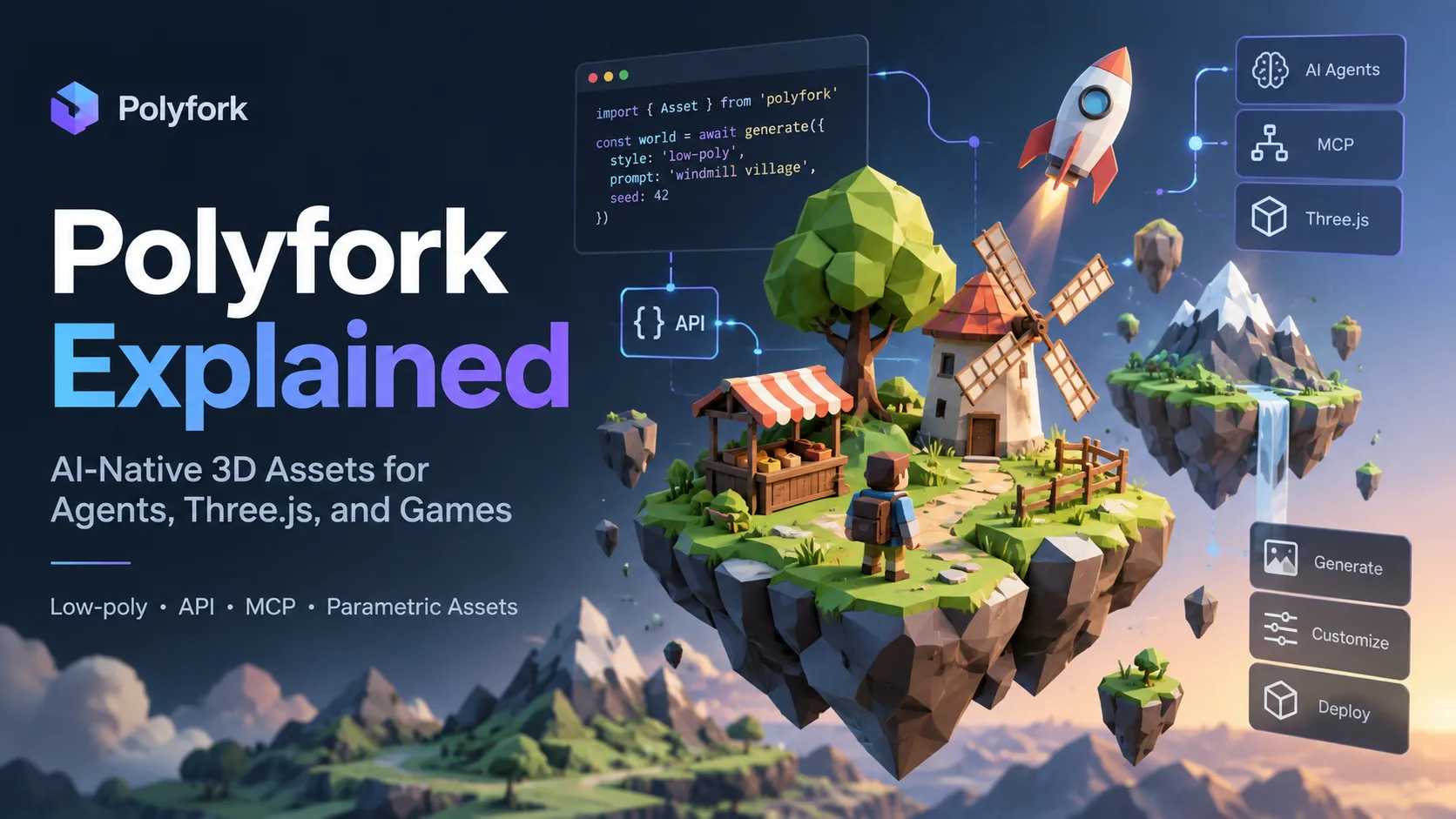
- Polyfork is an AI-native low-poly 3D asset library built around reusable, parameterized assets rather than frozen meshes. Many assets expose typed controls for properties such as color, dimensions, proportions, and part counts.
- The platform is designed for both humans and AI agents. Developers can browse visually, while agents can query the catalog through REST APIs, MCP,
llms.txt, andprompt.txt. - Its strongest differentiator is predictability. Assets publish real-world scale, origin conventions, triangle counts, palettes, rig information, and kit-level compatibility rules, making automated scene assembly more reliable.
- Polyfork is not primarily a text-to-3D generator. It is closer to a structured, programmable parts library, making it complementary to generative systems such as Meshy rather than a direct replacement.
- The free tier is unusually practical for developers. Lightweight assets can be used commercially, with GLB and ES module access, API/MCP browsing, and CDN delivery available for supported free assets.
What Is Polyfork?
Polyfork is a low-poly 3D asset platform built around a simple idea: a 3D asset should behave more like a reusable software component than a static file.
Traditional asset libraries typically give developers a finished GLB, FBX, OBJ, or similar file. That works well when the exact model already fits the project, but customization often means reopening the model in Blender or another 3D editor.
Polyfork takes a different approach. Its assets are described as small programs made with code. Many expose typed parameters that can change characteristics such as dimensions, colors, proportions, or repeated parts.
The result is a catalog in which a single asset can represent a family of useful variants rather than one frozen mesh.
The platform targets workflows involving Three.js, Unity, Godot, Unreal, Blender, Babylon.js, PlayCanvas, A-Frame, WebXR, and other glTF-compatible environments.
The important distinction is not simply format support. Polyfork tries to make assets machine-readable, spatially predictable, and controllable from code.
Why Polyfork Is Different From a Normal 3D Asset Library
A conventional 3D marketplace is usually optimized around a familiar sequence:
- Search for a model.
- Preview it.
- Download it.
- Import it into a project.
- Correct scale, pivot, materials, naming, or style inconsistencies when necessary.
Polyfork attempts to eliminate many of those unknowns before the asset enters the scene.
Assets can expose structured information including:
- Real-world dimensions in meters
- Grounded origins
- Exact color palettes
- Triangle counts
- Rig and node information
- Render previews
- Kit membership
- Compatibility information
- Typed remix parameters
Kits can also define shared conventions such as palette and grid scale so multiple objects can be assembled without every placement becoming a manual correction task.
This becomes particularly important for AI-assisted development.
An AI coding agent can generate a Three.js scene very quickly, but arbitrary models downloaded from the web may have wildly different assumptions. A tree could be 2 meters tall or 200 meters tall. A vehicle could have its pivot at ground level or at its center. Two attractive models may use completely incompatible visual styles.
Polyfork is designed to make those properties explicit enough that software can reason about them.
Assets as Code: The Core Polyfork Concept
One of Polyfork's most distinctive workflows is its JavaScript module format.
A Three.js asset can be imported directly from the Polyfork CDN:
import { createAsset } from 'https://polyfork.dev/cdn/<asset-id>.mjs';

const asset = createAsset();
scene.add(asset);
This allows developers to work with an asset directly from JavaScript without always building a separate asset-loading pipeline around a downloaded file.
A remixable asset may expose parameters that can be passed when it is created:
const asset = createAsset({
  length: 1.4,
  colorway: 'dark',
  detail: 3
});

scene.add(asset);
The exact parameters vary by asset, but the underlying concept is important: customization becomes structured data passed to code instead of a manual mesh-editing operation.
That model is particularly useful for procedural environments, small games, generated scenes, configurable worlds, and rapidly built prototypes.
Polyfork's AI Agent and MCP Support
Polyfork is unusually explicit about treating AI agents as first-class users.
The platform provides an MCP endpoint:
https://polyfork.dev/mcpIts toolset includes capabilities for searching assets, retrieving individual assets, finding compatible objects, generating variants, working with kits, previewing scenes, and reporting unmet asset needs.
Representative tools include:
search_assets
get_asset
find_matching
get_variant
preview_scene
list_kits
get_kit
get_terrain
report_need
The catalog can therefore appear as a collection of callable tools inside MCP-compatible coding environments.
For agents without MCP support, Polyfork also exposes:
llms.txtprompt.txt- A REST API
- Human-readable agent documentation
This is more significant than simply adding an AI-focused landing page.
Instead of asking an agent to search the web for a random low-poly tree, a developer can give the agent access to a catalog where the tree's dimensions, geometry complexity, palette, related objects, import method, and available variations can be inspected programmatically.
How the Polyfork REST API Works
Polyfork exposes a structured REST API for catalog discovery and asset retrieval.
A search can look like:
GET /api/assets?q=windmill&free=1&max_triangles=2000An individual asset can be retrieved with:
GET /api/assets/{id}Compatible objects can be requested with:
GET /api/assets/{id}/matchingVariants can be queried with instructions such as:
GET /api/assets/{id}/variant?want=dark+basaltKits are available through:
GET /api/kitsPolyfork also exposes a mechanism for recording unmet demand.
That feature is strategically important because a failed search does not have to end with an empty results page. An AI agent can report what it needed, turning unsuccessful searches into structured product-demand data.
The workflow becomes:
Search
→ No suitable asset
→ Record demand
→ Identify recurring missing categories
→ Produce new asset
→ Add new catalog page
→ Future searches succeed
This is a more useful interpretation of zero-result searches than simply treating them as lost traffic.
Matching Assets Instead of Merely Searching
Another subtle Polyfork feature is its matching system.
Scene composition is not purely a keyword-search problem.
A developer who already has a market stall may not need another result matching the phrase market stall. The more valuable question may be: what objects belong around this stall and will look consistent with it?
Polyfork's structured kits, palettes, scales, and compatibility information make this type of recommendation easier for both humans and software.
As AI development tools evolve from generating isolated code snippets to assembling complete applications and virtual environments, this relationship data may become as valuable as the individual assets themselves.
Polyfork Kits: Building Worlds Instead of Collecting Random Models
Polyfork organizes many assets into themed kits.
A kit is designed to be more than a folder containing objects with similar names. Kits can coordinate palette, grid scale, proportions, and visual style across a group of assets.
This addresses a common problem in game development: individually good low-poly assets do not necessarily look good together.
A coherent kit can standardize:
- Color language
- Scale
- Geometric density
- Grid spacing
- Visual proportions
- Modular environmental pieces
For a developer building a game world quickly, visual consistency can be more valuable than maximum geometric detail.
Shared Materials and Draw-Call Efficiency
Polyfork also pays unusual attention to how assets behave at runtime.
Many low-poly assets rely on lightweight vertex-colored materials instead of large texture sets. Static objects can potentially be merged to reduce draw calls, while rigged or dynamic objects remain separate.
A typical optimization workflow can look like:
import { mergeAssets } from 'https://polyfork.dev/cdn/merge.mjs';

const { merged, dynamic } = mergeAssets([
  terrain,
  tree,
  rock,
  { object: character, rig }
]);

scene.add(merged);
dynamic.forEach((item) => scene.add(item));
For hundreds of copies of the same object, THREE.InstancedMesh is generally a better approach than creating hundreds of independent clones.
That distinction matters because an asset library can look excellent in screenshots while still producing inefficient real-time scenes.
Polyfork is clearly designed around assets that are expected to run inside applications, not just assets that look attractive on marketplace pages.
Rigged Characters and Named Movable Parts
Some Polyfork models include rigging or named movable components.
A named part can be controlled directly from Three.js:
const head = asset.getObjectByName('Head');
head.rotation.y = Math.PI / 4;
Equivalent nodes can also exist in the GLB scene after loading the model through a standard glTF workflow.
Rigged characters can be particularly valuable for lightweight games and prototypes where developers want usable characters without first creating an entire modeling and rigging pipeline.
Polyfork vs. Poly Pizza
Polyfork and Poly Pizza can initially look similar because both focus heavily on low-poly 3D assets, but their product models are substantially different.
Poly Pizza primarily operates as a large discovery and download library, with thousands of free models covering games, animation, VR, AR, and general 3D projects.
Polyfork's catalog focuses much more heavily on programmatic behavior and structured metadata.
| Feature | Polyfork | Poly Pizza |
|---|---|---|
| Primary model | Programmable asset library | Large model discovery library |
| Parametric remixing | Core feature | Not the primary model |
| Agent-facing API | Core product surface | Not the primary focus |
| MCP integration | Yes | Not the primary focus |
| Structured dimensions | Central to agent workflow | Depends on individual assets |
| Matching assets | Dedicated workflow | Primarily search and browsing |
| Direct Three.js ES modules | Core workflow | Download-oriented |
| Free inventory | Rule-based subset | Large free catalog |
The better choice depends on the problem being solved.
If the goal is maximum free-model variety, a large traditional library can be attractive.
If the goal is programmatic control, agent access, predictable dimensions, remixing, and automated scene construction, Polyfork addresses a different class of workflow.
Polyfork vs. AI 3D Generators Such as Meshy
Polyfork should also not be confused with prompt-to-3D generation platforms.
Services such as Meshy can generate new 3D models from text or images. Polyfork starts with a catalog of known components instead.
A simplified comparison looks like this:
Generative 3D:
Prompt
→ Generation task
→ New mesh
→ Inspect result
→ Repair or regenerate if necessary
Polyfork:
Intent
→ Search structured catalog
→ Select known asset
→ Apply parameters
→ Place into scene
Generative 3D is useful when a project needs something unique.
A structured asset library is useful when a project needs repeatability, predictable topology, stable dimensions, consistent visual style, known performance characteristics, and instant reuse.
The two approaches can also be combined. A game might use catalog components for ordinary environment props and a generative system for rare hero objects that require unique visual designs.
Polyfork's Free Tier
Polyfork uses a permanent free tier rather than relying only on a time-limited trial.
A notable part of its model is that lightweight assets can automatically qualify for free access based on geometry complexity rather than being manually selected as promotional samples.
Free access can include features such as:
- Commercial use for eligible assets
- GLB files
- JavaScript ES modules
- API catalog browsing
- MCP access
- CDN delivery for supported assets
This rule-based model has an interesting side effect: as the overall catalog grows, the free catalog can grow automatically as well whenever newly published assets meet the free-tier criteria.
For developers experimenting with browser-based 3D, that provides a practical way to test the workflow before paying for broader catalog access.
Polyfork Pro
Polyfork also offers a paid Pro tier for developers who need broader catalog access and additional production features.
Paid functionality can include:
- Access to the wider catalog
- Newly released assets
- User-specific CDN access
- Server-side remix baking
- Individual and kit downloads
- Continued usage rights for eligible assets already downloaded under the applicable license
Because pricing and promotional lifetime offers can change, developers considering a paid subscription should verify the latest terms directly before purchasing.
What Is Remix Baking?
The ES module version of an asset can keep its parameters live at runtime, but not every engine wants to execute a JavaScript asset generator.
Server-side remix baking solves that problem.
A selected parameter combination can be converted into a finished GLB and cached, letting engines consume a conventional model file while developers still benefit from the parameterized source asset.
Conceptually:
Parametric asset
+
Selected options
↓
Server builds variant
↓
Cached GLB
↓
Unity / Godot / Blender / other glTF software
This bridges the gap between assets-as-code and conventional file-based 3D pipelines.
Platform Licensing for Products That Serve Assets to Their Own Users
Normal commercial use and redistribution are different licensing scenarios.
A standard asset license may allow developers to include models inside games, websites, apps, videos, and client work.
A product that exposes Polyfork assets directly to its own users is different. This can require a dedicated platform or redistribution license.
That distinction is especially relevant to:
- AI world builders
- Game creation platforms
- Browser-based scene editors
- No-code 3D tools
- Virtual-world platforms
- AI agents that deliver editable scenes to end users
Embedding a tree inside a shipped game is fundamentally different from operating a product in which users can access that tree as reusable catalog inventory.
Polyfork Licensing: Important Restrictions
Polyfork's standard licensing is designed for using assets inside finished products rather than republishing the catalog itself.
Depending on the applicable license, assets can generally be used in personal and commercial projects, modified, recolored, combined, and animated.
Important restrictions can include:
- Raw assets cannot simply be resold as standalone files.
- Files cannot be republished as a competing asset pack or download library.
- Products redistributing reusable assets directly to users may require platform licensing.
- Training or building a directly competing commercial asset-generation product can be restricted.
Teams with unusual distribution models should review the latest license before integrating the catalog deeply into production infrastructure.
Where Polyfork Is Especially Useful
Polyfork is strongest when speed, consistency, automation, and real-time performance matter more than photorealism.
Three.js Prototypes
The ES module workflow can reduce the setup required to put working 3D objects into a browser scene.
AI Coding Agents
Structured metadata and MCP tools allow agents to search a known asset catalog rather than inventing filenames or scraping arbitrary model websites.
Low-Poly Games
Kits can provide consistent characters, buildings, props, vehicles, and environmental parts without forcing developers to reconcile unrelated asset packs.
Procedural Worlds
Parameterized assets work naturally in scenes where code determines dimensions, colors, counts, layouts, or other variations.
WebXR and Browser 3D
Low geometry complexity and direct web delivery make the catalog relevant to interactive browser environments where rendering budgets matter.
Game Jams and MVPs
Ready-made formats, known dimensions, reusable kits, and direct imports can reduce setup work when developers need to ship quickly.
AI-Generated Game Prototypes
An AI agent can potentially select terrain, buildings, vegetation, props, and characters from the same structured catalog while maintaining more consistency than a workflow based on random web assets.
Where Polyfork May Not Be the Best Choice
Polyfork is intentionally opinionated, which creates both advantages and limitations.
Photorealistic Production
The platform emphasizes low-poly assets. Teams building cinematic or highly realistic scenes will generally need higher-detail geometry and more sophisticated materials.
Unique Hero Assets
A reusable catalog component is not always a substitute for a bespoke creature, branded product, signature vehicle, or main character that requires unique art direction.
Maximum Free-Model Breadth
Developers who simply want the largest possible pool of downloadable free assets may prefer a traditional 3D marketplace or model library.
Marketplace-Style Redistribution
The standard license is not intended to let another service expose Polyfork assets as a competing raw-download catalog. Products built around redistribution should examine the relevant platform licensing terms carefully.
The Most Interesting Polyfork Feature Is Not Actually 3D
Polyfork is interesting beyond 3D because of the way its product architecture treats the same database as infrastructure for multiple audiences.
A traditional asset website often looks like:
Database
↓
Website
↓
Search
↓
Download
Polyfork exposes the same underlying inventory through several surfaces:
Human browser
REST API
MCP server
llms.txt
prompt.txt
CDN
GLB files
ES modules
Kit metadata
Matching recommendations
Demand reporting
Humans can browse visually.
Applications can consume JSON.
Developers can import modules.
Game engines can use GLB files.
AI agents can call MCP tools.
Agents without MCP can read structured instructions.
Failed searches can become demand signals.
That is a much more powerful model than simply creating thousands of SEO pages around downloadable files.
Why the Agent-Native Model Matters
AI coding agents are increasingly capable of building complete prototypes rather than merely suggesting individual lines of code.
That changes what developer infrastructure needs to provide.
An agent does not benefit much from a visually impressive marketplace page if it cannot reliably determine:
- Which asset is suitable
- How large the object is
- Where its origin sits
- Whether it matches another object
- How complex its geometry is
- Which parts are movable
- Which parameters are adjustable
- How it should be imported
- Whether it is licensed for the requested use
Polyfork's architecture attempts to make many of those decisions queryable.
The broader lesson is that future asset libraries may need both a human interface and an agent interface.
Common Mistakes When Evaluating Polyfork
Mistake 1: Treating It as Another AI 3D Generator
Polyfork's primary advantage is not arbitrary mesh generation from prompts. Its key value is a structured catalog of known, reusable, remixable components.
Mistake 2: Comparing Only Catalog Size
A larger catalog is not automatically more useful for automated workflows. Metadata quality, dimensional consistency, material compatibility, and parameterization can matter more than raw item count.
Mistake 3: Ignoring the License Boundary
Using an asset inside a finished product is different from serving the asset itself to users.
Mistake 4: Assuming Every Asset Has Identical Controls
Polyfork supports typed parameters, but available controls vary by asset. Applications should inspect metadata instead of assuming every model supports the same configuration fields.
Mistake 5: Cloning Hundreds of Identical Meshes
For repeated copies of the same Three.js model, THREE.InstancedMesh is generally more efficient than producing hundreds of separate clones.
Mistake 6: Treating MCP as the Entire Product
MCP is useful because the underlying catalog is already structured. Adding an MCP wrapper to poorly normalized data would not create the same result.
The real foundation is the data model: scale, triangles, palettes, kits, parameters, relationships, and licensing information.
Is Polyfork Worth Using?
Polyfork is most compelling when a project sits at the intersection of 3D, code, and automation.
Developers who need one downloadable model already have many established alternatives.
Developers building procedural scenes, browser games, AI-generated prototypes, world-building agents, or applications that repeatedly assemble environments have a more difficult problem: assets need to be understandable by software before a human manually inspects every one of them.
Polyfork is specifically designed around that problem.
Its combination of structured metadata, parameterized assets, consistent kits, REST access, MCP integration, direct Three.js modules, matching recommendations, and a low-friction free tier creates a workflow that is meaningfully different from both conventional model marketplaces and prompt-to-3D generators.
Conclusion
Polyfork represents a broader shift in how 3D asset libraries can be designed.
Instead of treating a model as a file that developers download and repair later, Polyfork treats it as a programmable component with known geometry, predictable scale, structured metadata, remixable parameters, and interfaces that AI agents can query directly.
For Three.js developers, indie game creators, AI coding-agent users, procedural world builders, and teams experimenting with automated game creation, that architecture is worth evaluating even if the final production stack also includes traditional model libraries or generative 3D services.
The most useful way to evaluate Polyfork is practical: browse its catalog, inspect an asset's metadata and remix controls, connect its MCP endpoint to a compatible agent, and compare that workflow with manually searching, downloading, normalizing, and integrating unrelated 3D models.
Continue Reading
More articles connected to the same themes, protocols, and tools.


Referenced Tools
Browse entries that are adjacent to the topics covered in this article.