On This Page8 sections
Quick answer: Peter Steinberger is Agent builder at OpenAI and OpenClaw, best known for creating OpenClaw and joining OpenAI to work on personal agents. This profile focuses on verified professional work, public product decisions, and why that work matters to AI-assisted software development.

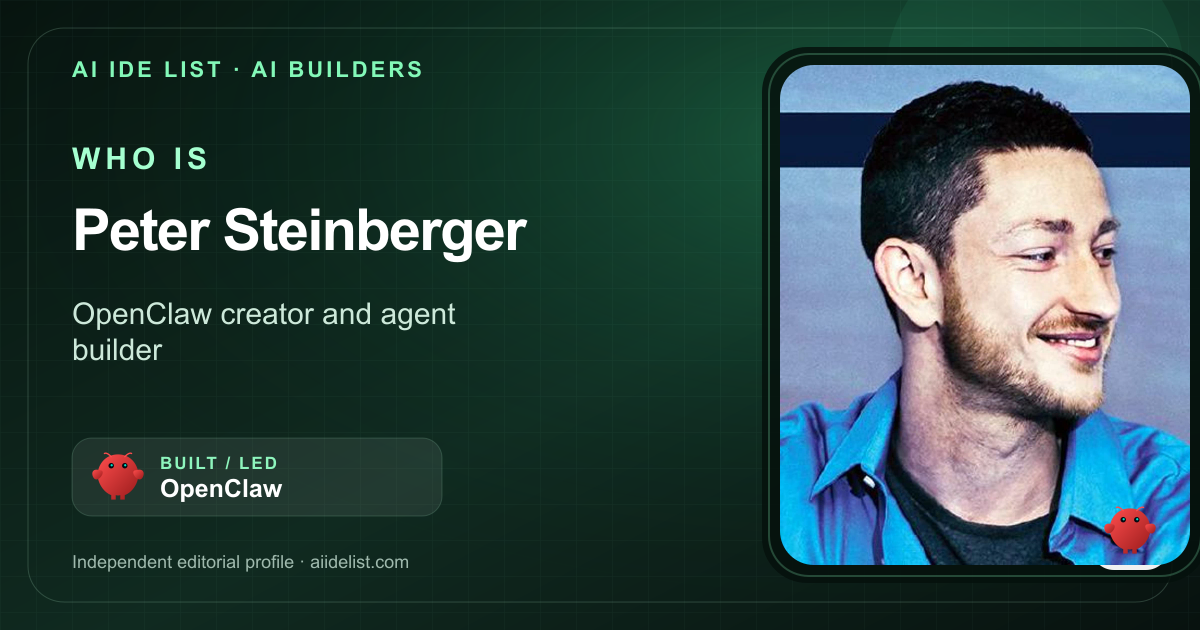
Peter Steinberger. Public speaker or profile photograph used for editorial identification. Photo source.
Peter Steinberger at a glance
| Current role | Agent builder |
| Company / project | OpenAI and OpenClaw |
| Known for | creating OpenClaw and joining OpenAI to work on personal agents |
| Field | AI coding agents and developer tools |
| Profile checked | August 31, 2026 |
Who is Peter Steinberger?
Peter Steinberger is a veteran developer and founder best known in the current AI cycle as the creator of OpenClaw, an open-source personal-agent project. Before agents became his primary focus, he spent years building developer-focused software and a company around document technology, giving him unusually deep experience with both product craft and complex native systems.
This page deliberately avoids unverified claims about private life, age, family, wealth, or education. The useful reason to follow Peter Steinberger is the work: creating OpenClaw and joining OpenAI to work on personal agents, the decisions behind that work, and the way those decisions affect developers.
Career context
Steinberger previously founded PSPDFKit and became a well-known independent software builder before creating OpenClaw. In February 2026, he joined OpenAI to work on next-generation personal agents while OpenClaw moved into a foundation and remained open source.
What is Peter Steinberger's role in OpenClaw?
OpenClaw drew attention because it treated an agent as something that could live close to a user's actual tools and routines rather than as a chat demo. In February 2026, Steinberger joined OpenAI to work on next-generation personal agents while OpenClaw moved toward an independent foundation model. The arrangement preserved the project's open-source identity while connecting its creator to a larger agent platform.
The product itself is part of a wider market shift. A coding assistant once meant autocomplete inside an editor. The current generation can inspect repositories, run commands, use browsers and external tools, create isolated worktrees, work in the cloud, and return changes for review. Read our OpenClaw profile for the product-level view, or browse the complete AI coding tool directory.
Built, led, and related products
- OpenClaw — the open-source personal-agent project that drove his latest wave of attention.
- PSPDFKit — the document-technology company he founded before returning to hands-on software building.
- OpenAI personal agents — his current area of work after joining OpenAI in 2026.
Explore more profiles in the AI Builders Hall of Fame, then compare the products themselves in the AI coding tool directory.
What does Peter Steinberger's work say about AI development?
His trajectory captures an important trend: small open-source projects can discover interaction patterns before large platforms formalize them. Personal agents require permissions, local context, tool integrations, persistence, and trust. Those concerns overlap strongly with coding agents, which is why OpenClaw belongs in the same broader agent-infrastructure conversation as Codex and Claude Code.
That distinction matters because frontier models are increasingly available through several products. Durable advantages often come from the harness around the model: context selection, permissions, memory, environments, verification, interaction design, and the product judgment that decides how much autonomy to expose.
Why Peter Steinberger matters
Peter Steinberger belongs in the AI Builders Hall of Fame because creating OpenClaw and joining OpenAI to work on personal agents connects a recognizable product with a specific builder. Understanding the people behind these tools makes the market easier to read: model announcements explain capability, while builders explain why that capability becomes one workflow instead of another.
For teams choosing a coding agent, the builder's philosophy can be as revealing as a feature table. It influences whether a product is open or closed, terminal- or editor-first, session- or task-centered, local or cloud-oriented, and optimized for close collaboration or high-throughput delegation. Those trade-offs are also why direct AI tool comparisons remain more useful than a single universal ranking.
Career and product timeline
- Earlier: Founds and grows PSPDFKit into a major document-software company.
- Later: Returns to independent building and open-source experimentation.
- 2025–2026: Creates OpenClaw and attracts a large developer community around personal agents.
- February 2026: Joins OpenAI; OpenClaw moves to a foundation and remains open source.
What to watch next
The next useful signals will be concrete launches, technical writing, interviews, and changes to OpenClaw. We will update this profile when Peter Steinberger's public responsibilities change or when new first-party material adds meaningful detail. A changing job title alone is less important than evidence of what the person is actually building.
Related AI builders
- Alexander Embiricos — Codex product lead
- Jason Liu — Developer Experience engineer on the Codex team
- Nick Turley — VP and Head of ChatGPT
You can also explore Tibo Sottiaux's Codex and ChatGPT profile, our Codex CLI guide, and our Claude Code guide to move between people, products, and competing development philosophies.
Frequently asked questions
What is Peter Steinberger known for?
Peter Steinberger is best known for creating OpenClaw and joining OpenAI to work on personal agents. The claim is based on the first-party and reliable sources listed below, not on private biographical databases.
What is Peter Steinberger's current role?
As of August 31, 2026, Peter Steinberger is Agent builder at OpenAI and OpenClaw. AI-company roles change quickly, so the checked date is part of the answer.
Is this an official biography?
No. This is an independent editorial profile from AI IDE List. It summarizes publicly documented professional information and links readers to original sources for verification.
Sources
Last verified: August 31, 2026. AI IDE List may update this page as roles, products, and public information change.
Continue Reading
More articles connected to the same themes, protocols, and tools.
Who Founded TierMaker? How a Simple Tier List Website Became a 17 Million-Visit Internet Phenomenon

15 Best Gemini 4 Argon Prompts: Viral 3D Games, Blender Demos & AI Agent Examples
OpenCode 2.0 Is Here: Code Mode, Background Agents, and a Major Rebuild of the Open-Source Coding Agent
Referenced Tools
Browse entries that are adjacent to the topics covered in this article.