
On This Page8 sections
Key Takeaways

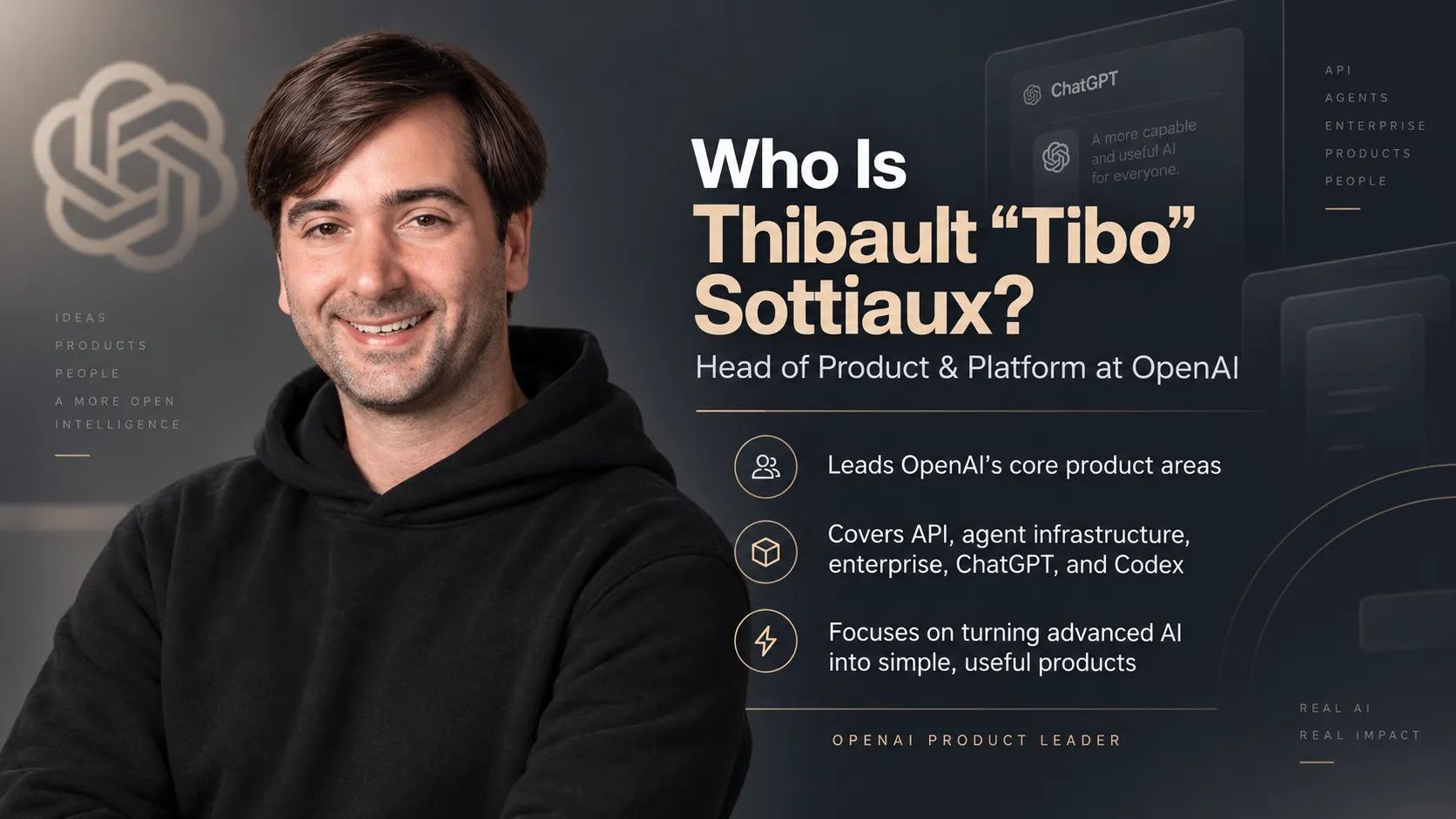
Thibault “Tibo” Sottiaux. Public speaker or profile photograph used for editorial identification. Photo source.
Thibault “Tibo” Sottiaux is OpenAI’s Head of Core Products. In a 2026 interview, he described a remit spanning the API, agent infrastructure, enterprise, ChatGPT, ChatGPT Work, and Codex—making his role substantially broader than a Codex-only product lead.
His significance goes far beyond posting usage-limit updates, reset announcements, or incident reports on social media. Tibo is helping OpenAI evolve from a company that provides conversational models into one that delivers general-purpose agents capable of executing real work.
Key facts include:
- Full name: Thibault Sottiaux, commonly known as Tibo
- Professional role: Engineering-driven AI product and platform leader
- Previous employers: Google Maps, Google DeepMind, and OpenAI
- Notable work: Gemini human-data systems, Reverb, Codex, and ChatGPT agent products
- Core expertise: Machine learning infrastructure, agent architecture, product engineering, training data, and developer tools
- Current influence: Bringing Codex-style execution capabilities into ChatGPT and OpenAI’s broader product ecosystem
Who Is Tibo Sottiaux?
Tibo Sottiaux is a Belgian software engineer and AI product leader who works on core products and platform initiatives at OpenAI.
His career path differs significantly from that of a conventional consumer technology product manager. Tibo did not enter product leadership through marketing, operations, or interface design. He progressed from applied mathematics, computer science, distributed systems, and machine learning infrastructure into increasingly broad product responsibilities.
This background allows him to understand three areas that are often managed separately:
- What an AI model can do
- How engineering systems can reliably deliver those capabilities
- How users apply those capabilities in real workflows
That combination helps explain why his responsibilities expanded from leading Codex to overseeing a broader portion of OpenAI’s core product platform.
Career context
Sottiaux joined OpenAI in 2024 after working at Google and Google DeepMind on research infrastructure, human-data systems, and tools connected to advanced model development. By August 2026, his public remit had expanded beyond Codex to OpenAI’s core product organization, spanning the API, agent infrastructure, enterprise, ChatGPT, ChatGPT Work, and Codex.
Built, led, and related products
- Codex CLI — the developer-facing coding-agent system most closely associated with his rise as a public product leader.
- ChatGPT and ChatGPT Work — part of the broader core-product portfolio he publicly described in 2026.
- OpenAI agent infrastructure and API — the execution and platform layers connecting models to real work.
Explore more profiles in the AI Builders Hall of Fame, then compare the products themselves in the AI coding tool directory.
Career and product timeline
- Before 2024: Works at Google and Google DeepMind on research infrastructure, human-data workflows, and machine-learning systems.
- 2024: Joins OpenAI and works close to research tooling and agent development.
- 2024–2025: Helps build and lead the new generation of Codex, including local and CLI workflows.
- 2026: Expands into Head of Core Products, with responsibilities spanning ChatGPT, Codex, the API, enterprise, and agent infrastructure.
What Is Distinctive About Tibo’s Education?
Tibo studied computer science, computational mathematics, and applied mathematics at UCLouvain, the French-speaking Catholic University of Louvain in Belgium, primarily between 2009 and 2014.
His academic work included subjects such as:
- Linear and nonlinear optimization
- Operations research
- Discrete mathematics
- Stochastic modeling
- Database systems
- Network security
- Decision systems
- Predictive modeling
These subjects are directly relevant to modern AI agent systems.
An agent is not simply a large language model responding to a single prompt. A capable agent must repeatedly break down tasks, observe its environment, choose tools, recover from errors, allocate resources, and verify results. These are fundamentally optimization, decision-making, and systems-engineering problems.
Tibo’s mathematical and engineering background therefore helps him reason not only about models, but also about the execution systems surrounding them.
What Did Tibo Do at Google and DeepMind?
Tibo began his career at Google’s London office, initially working on Google Maps before moving to Google DeepMind.
At DeepMind, his work focused on machine learning research infrastructure, human-data workflows, and internal tools used by researchers. His responsibilities and contributions included:
- Building infrastructure for AI research teams
- Supporting distributed machine learning workflows
- Contributing to reinforcement learning data systems
- Participating in work related to the Gemini model family
- Leading or supporting human-data processes for Gemini
- Improving the productivity of researchers working with advanced models
Tibo also contributed to Reverb, a framework designed for experience replay in reinforcement learning. Reverb addresses data storage, sampling, and transfer problems in large-scale distributed training systems.
Infrastructure projects like Reverb receive less public attention than consumer-facing chat interfaces, but they are essential for making large AI systems train reliably and improve quickly.
Why Does Human-Data Experience Matter?
Tibo’s experience with human data at DeepMind is central to understanding his later work at OpenAI.
Large language model performance does not depend only on pretraining data and computing power. A model’s ability to follow instructions, understand user intent, complete complex tasks, and avoid obvious mistakes also depends on post-training data, feedback systems, and evaluation design.
Human-data work commonly involves:
- Designing representative tasks for models
- Collecting high-quality demonstrations
- Comparing alternative model outputs
- Labeling errors and unsafe behavior
- Building automated and human evaluation criteria
- Translating real user requirements into training signals
This experience helps answer a critical product question: Should a weakness be fixed through additional model training or through changes to the surrounding product system?
OpenAI must repeatedly make this decision while developing Codex and more general-purpose agents.
Why Did Tibo Leave DeepMind for OpenAI?
After the release of ChatGPT, Tibo gradually shifted his professional focus toward San Francisco and joined OpenAI in 2024.
His initial work remained close to research tooling, helping OpenAI researchers improve model development and experimentation. Over time, some of these internal tools evolved into developer-facing agent products and contributed to the creation of the newer generation of Codex.
This development followed a common OpenAI product pattern:
- Solve a real internal workflow problem
- Encourage heavy use by researchers and engineers
- Collect failures, edge cases, and operational data
- Improve model reliability and task-execution capabilities
- Turn the internal system into a public product
Codex was therefore not designed solely through market research. It emerged from OpenAI’s own experience using AI to automate programming and knowledge work.
How Did Tibo Shape the Development of Codex?
After joining OpenAI, Tibo helped create and lead the new generation of the Codex software engineering agent.
Early versions of Codex operated more like cloud-based programming agents. A user could submit a task, after which the system would inspect a repository, understand the project structure, modify files, run tests, and potentially create a pull request.
Although powerful in theory, this model introduced practical problems:
- Cloud environments differed from local development environments
- Dependencies and permissions were difficult to reproduce
- Long-running tasks could fail before completion
- Users had limited visibility into agent activity
- Error recovery was inconsistent
- Code changes could be difficult to verify quickly
The Codex team subsequently strengthened local execution, command-line interaction, and integration with existing development environments.
This shift demonstrates a central feature of Tibo’s product approach: he is willing to revise the product model when real-world friction shows that the original design is not sufficiently reliable.
Why Was Codex CLI Open-Sourced?
Open-sourcing Codex CLI was an important part of Tibo’s product strategy.
Agent products are usually composed of several layers, including the model, prompts, tool interfaces, execution loops, permission systems, and result-verification mechanisms. When all of these components remain hidden, developers have difficulty understanding why an agent succeeds or fails.
An open-source Codex CLI offers several benefits:
- Developers can inspect how the agent reads and modifies code
- The community can extend tools and workflows
- Agent architecture becomes less mysterious
- Enterprises can review security and permission behavior
- OpenAI can gather feedback from real production environments
- Codex can spread across a wider range of developer workflows
Tibo’s broader position is that effective agents do not always require extremely complicated orchestration frameworks. As model capabilities improve, fragile handcrafted rules should be reduced, allowing the model to perform more reasoning and decision-making directly.
How Does Tibo Think About Agent Architecture?
Tibo’s agent-design philosophy can be summarized as: prioritize model capability and keep the surrounding scaffolding simple.
Many agent systems depend on complicated workflows such as:
User request
  ↓
Intent classifier
  ↓
Task planner
  ↓
Tool selector
  ↓
Multiple sub-agents
  ↓
Rule-based validator
  ↓
Final response composer
This architecture can improve consistency when models are weak, but it can also become restrictive. As model capabilities improve, old rules may prevent the model from discovering more efficient strategies.
Tibo appears to favor a smaller set of durable primitives, such as:
- Reading and editing files
- Running terminal commands
- Searching and browsing
- Executing tests
- Managing task state
- Isolating environments and permissions
The model then handles as much of the planning and decision-making as possible.
The advantage is that the system can improve naturally as the underlying model becomes stronger. The disadvantage is that reliability, permissions, and result verification become even more important.
Why Is Codex No Longer Just a Coding Tool?
Codex became known as a software engineering agent, but its underlying capabilities are expanding into broader computer-based work.
Software development is a highly structured environment. An agent can inspect files, use tools, observe errors, change its output, and run the process again. Other forms of knowledge work can also be handled when they are converted into similarly executable workflows.
Examples include:
- Organizing and analyzing documents
- Processing spreadsheets and structured data
- Summarizing email and calendar information
- Checking project-release status
- Creating presentations
- Searching internal knowledge bases
- Automating repetitive operational tasks
- Conducting research and information synthesis
Codex’s long-term role may therefore be less about helping programmers write code and more about using code, tools, and computing environments to complete knowledge work.
How Did Tibo’s Responsibilities Expand at OpenAI?
As Codex adoption and use cases grew, Tibo’s responsibilities expanded from a single product to OpenAI’s broader core product and platform organization.
Public titles associated with him have included:
- Codex Lead
- Core Products Lead
- Head of Product and Platform
Although the exact title has changed, the direction is clear: his role has moved beyond Codex toward integrating Codex capabilities with ChatGPT.
That broader responsibility likely includes:
- Combining ChatGPT’s conversational capabilities with Codex execution
- Making agent functionality accessible to non-developers
- Creating consistent experiences across web, desktop, and mobile
- Unifying models, tools, files, and account permissions
- Expanding enterprise security and audit capabilities
- Improving task-execution speed and success rates
ChatGPT provides access to a large mainstream audience, while Codex has validated the agent-execution model among developers. Combining the two is a major step in OpenAI’s transition from a chatbot company to an agent platform.
What Defines Tibo’s Product-Management Style?
Tibo’s product style reflects his engineering background.
Direct Engagement With Users
He frequently responds publicly to reports about usage limits, failures, task errors, and product friction. Compared with many senior executives, he operates as a more direct interface between users and the product organization.
Rapid Acknowledgment and Adjustment
When Codex has experienced capacity problems, unexpected usage consumption, or launch issues, Tibo has often acknowledged the situation publicly and provided updates after fixes or compensation measures were introduced.
Data-Driven Iteration
The Codex team appears to use real task execution, failure patterns, environment configurations, and user feedback to guide product changes rather than relying only on a predefined roadmap.
Heavy Internal Usage
Tibo is also a frequent Codex user. He has described assigning the system tasks related to project tracking, file organization, information synthesis, and release checks. This kind of internal adoption helps the team identify practical problems before they become widespread.
Why Does Tibo Frequently Announce Usage Limits and Resets?
Tibo’s public posts about limits, reset credits, and service compensation do not mean he is merely responsible for community operations.
These announcements indicate involvement in several important product areas:
- Model capacity allocation
- Subscription usage policies
- Credit and quota design
- Cross-platform feature launches
- Incident compensation
- Large-scale user communication
The economics of AI agents are more complicated than those of conventional software. A single task may run for several minutes or longer, requiring repeated model calls, file access, code execution, and result validation.
Usage policies therefore affect more than pricing. They also determine:
- Whether sufficient compute is available to complete tasks
- Whether resources are distributed fairly across users
- Whether long-running jobs consume excessive capacity
- Whether automated reviews and sub-agents count toward usage
- Whether the service can maintain acceptable response times
Tibo’s direct participation in these discussions suggests that his role connects product experience with infrastructure and resource constraints.
What Product Controversies Has Tibo Faced?
Public criticism associated with Tibo has primarily focused on Codex product operations rather than personal misconduct.
Unexpected Usage Consumption
Some Codex users reported that weekly limits were being consumed faster than expected. Possible causes included automated code reviews, background tasks, frequent sub-agent activity, and inaccurate usage reporting.
These incidents highlight a general problem with agent products: users often cannot easily understand how many model calls a task requires or which background operations consume credits.
Model-Capacity Problems
Codex users have also encountered capacity warnings, increased error rates, and tasks that failed to start. Agent tasks often run longer than standard chat requests, increasing pressure on compute infrastructure and concurrency scheduling.
ChatGPT Work Launch Friction
Following the introduction of ChatGPT Work and related functionality, users criticized usage limits, task costs, and elements of the interaction model. OpenAI subsequently adjusted limits, resets, and efficiency measures.
These problems show that OpenAI’s challenge is no longer limited to improving model intelligence. The company must also make cost, permissions, task status, and failure modes understandable to users.
What Are Tibo’s Main Technical Strengths?
Tibo’s strengths are not limited to a particular model or programming language. They are most visible in his ability to integrate multiple layers of the AI product stack.
Machine Learning Infrastructure
He understands large-scale training systems, distributed data processing, and research workflows. This helps him identify when a product requirement must be supported by deeper infrastructure changes.
Human Data and Model Evaluation
He has experience translating user requirements, expert feedback, and failure cases into training data and evaluation criteria.
Agent Execution Systems
His work extends beyond model output to permissions, tools, environments, execution loops, and verification mechanisms.
Developer Product Experience
Codex users demand speed, transparency, control, and code quality. Building for developers imposes a high standard that can strengthen broader consumer products.
Product and Research Coordination
Because OpenAI controls both models and applications, Tibo can help coordinate model researchers and product teams. This makes it possible to decide whether a limitation should be fixed in the model, the application layer, or both.
How Is Tibo Different From a Traditional Product Manager?
Traditional product managers often focus on market demand, feature planning, user research, and team coordination. Tibo’s role is closer to that of a product-engineering leader.
| Dimension | Traditional Product Manager | Tibo-Style Engineering Product Leader |
|---|---|---|
| Primary background | Market, operations, or design | Mathematics, engineering, and machine learning |
| Main product focus | Features and user flows | Integration of models, systems, and workflows |
| Technical involvement | Defines requirements | Influences architecture and execution systems |
| Primary data sources | Research and business metrics | Real tasks, failures, and model evaluations |
| Iteration model | Planned product releases | Continuous model and product co-evolution |
| Main challenge | Balancing user needs and business goals | Balancing capability, cost, safety, and reliability |
This type of role is becoming more important in AI companies because model capabilities can change rapidly. Product leaders must understand how each model upgrade may alter the design of the product itself.
Why Is Tibo Important to OpenAI’s Future?
The next phase of AI competition may not be determined by which chatbot gives the best isolated answer. It may be determined by which agent can reliably complete meaningful work.
This competition includes:
- Long-running task execution
- Multi-agent collaboration
- Browser and computer control
- File and project management
- Long-term memory
- Enterprise permission systems
- Code and result verification
- Email, calendar, and third-party integrations
- Payments and commercial transactions
Tibo’s responsibilities sit at the intersection of these capabilities.
If the integration of ChatGPT and Codex succeeds, users may no longer need separate chat applications, code editors, automation platforms, and search tools for many tasks. They could describe a goal and allow an agent to plan and execute the required operations.
If the integration fails, OpenAI may face products that are too complex, expensive, unreliable, or difficult for users to trust.
How Should Tibo’s Influence Be Understood?
Tibo is highly influential, but his role should not be exaggerated into sole control over OpenAI’s decisions.
He is not:
- A founder of OpenAI
- The CEO of OpenAI
- The sole creator of ChatGPT
- The sole architect of Gemini
- The only inventor of Codex
- The individual decision-maker for every model price or usage policy
A more accurate description is:
Tibo is one of the central OpenAI leaders responsible for connecting model capabilities, engineering systems, and user-facing products.
His work requires coordination with model research, infrastructure, security, finance, design, operations, and executive leadership. Public product changes are therefore typically organizational decisions rather than the work of one individual.
Why Are Tibo’s Public Posts Worth Following?
Tibo’s public account has become an important signal for understanding OpenAI’s product direction.
His posts frequently cover:
- New Codex features
- ChatGPT agent capabilities
- Usage-limit and quota changes
- Incidents and service restoration
- Requests for user feedback
- Product-design ideas
- Hiring and team priorities
These posts can reveal product changes earlier and more directly than formal corporate announcements. However, they may also describe temporary tests, phased rollouts, or short-term policies.
Readers should distinguish between:
- Fully launched long-term features
- Experimental or phased releases
- Temporary incident compensation
- Personal product opinions
- Formal OpenAI policy
Sources and further reading
- TechCrunch interview with OpenAI Head of Product Thibault Sottiaux
- OpenAI Codex
- DeepMind Reverb repository
Conclusion
Tibo Sottiaux represents a new type of AI industry leader: someone who understands models and infrastructure while also taking responsibility for products used by millions of people.
His career progressed from Google Maps and DeepMind research infrastructure to Gemini human-data work, then to OpenAI, where he helped build and lead Codex before expanding into broader responsibility for ChatGPT and the core product platform.
The most important reason to watch Tibo is not the frequency of his quota-reset announcements. It is the larger transformation he is helping drive: turning OpenAI from a provider of conversational models into a platform for general-purpose agents that can understand goals, use tools, and complete real work.
Anyone tracking AI coding tools, autonomous agents, or OpenAI’s product strategy should follow the development of Codex, the integration of agent capabilities into ChatGPT, and Tibo’s public product updates to better understand where the next generation of AI software is heading.
Continue Reading
More articles connected to the same themes, protocols, and tools.
Meitu's Global AI Empire in 2026: 26 Tools, Revenue Numbers, and the Startup Strategy Behind Its Expansion
CCBaga Explained: The Open-Source Claude Code Cleaner, Fingerprint Browser, and Network Toolkit
OpenCreator AI Review (2026): The Complete Guide to the Open-Source Codex Creative Workspace
Referenced Tools
Browse entries that are adjacent to the topics covered in this article.