

pi-jev
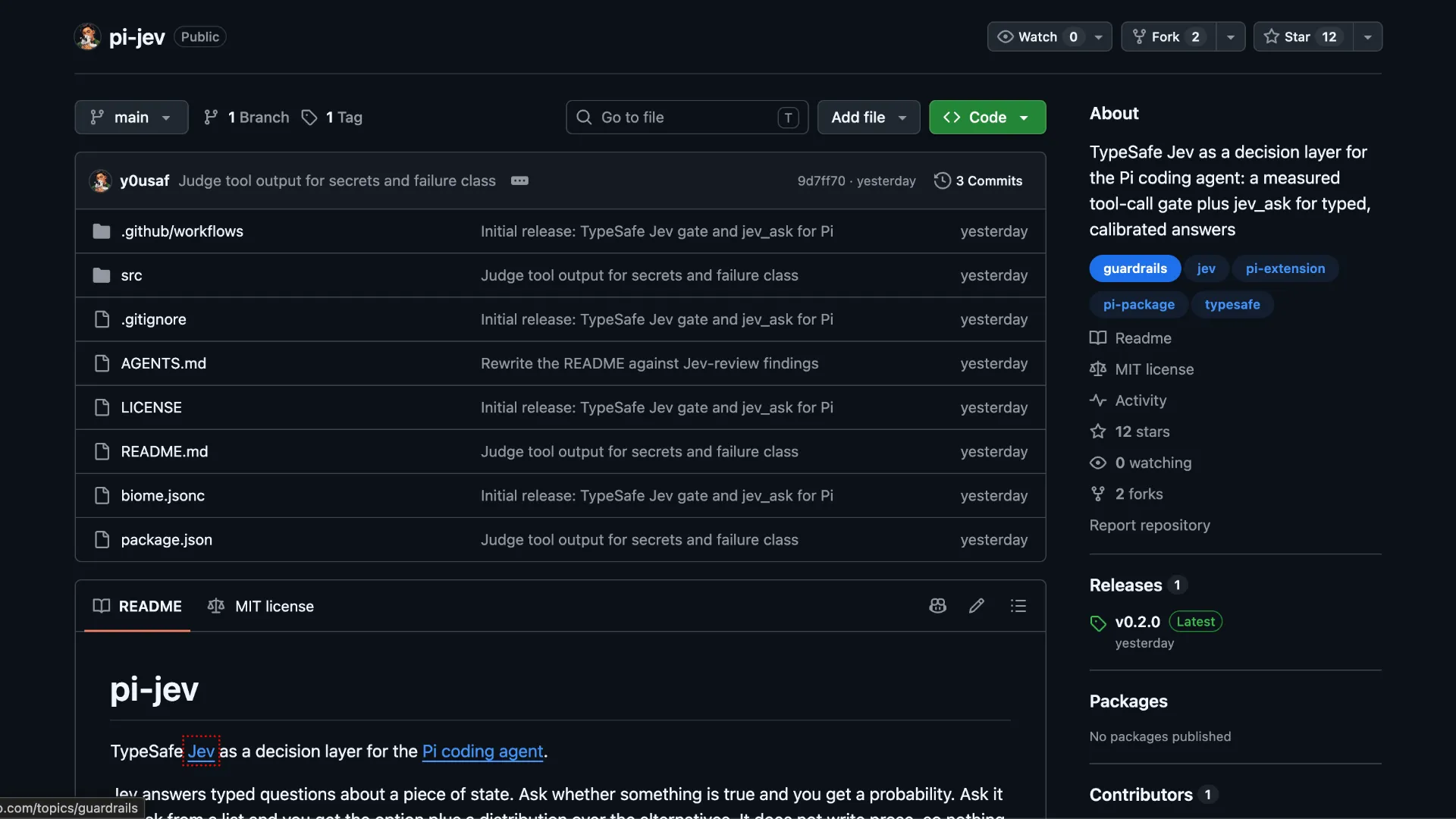
An open-source Pi Coding Agent extension that uses TypeSafe Jev as a semantic decision layer for tool-call guardrails, command-output classification, and typed agent judgments.
Information checked: Sep 17, 2026 ·View sources
Tool details
- Type
- Developer workflows
- Platforms
- macOS, Linux, Windows
- Free plan
- Yes
- Open source
- Yes
- Bring your own key
- Yes
- Local models
- No
Overview
Best for
- Pi Coding Agent users who want semantic checks before risky tool execution
- Developers experimenting with probabilistic guardrails and confidence thresholds
- Pi workflows that need narrow typed judgments instead of prose responses
- Interactive agent sessions where shadow-mode observations can be reviewed before enforcement
Strengths
- Adds semantic risk checks that can evaluate intent and scope, not only command patterns.
- Shadow mode makes it practical to observe false positives before enabling confirmations.
- Covers both pre-execution tool calls and post-execution command output.
- Typed Jev answers can be consumed by code without parsing generated prose.
- MIT-licensed and implemented as a small Pi extension.
Limitations & trade-offs
- Fully offline or local-only development environments
- Security-sensitive workflows that require a true sandbox or guaranteed fail-closed enforcement
- Users of coding agents other than Pi without plans to adapt the extension
- Teams that cannot send selected tool context to an external API
- Requires network access to TypeSafe Jev and a TypeSafe API key.
- The default gate fails open when the API key, endpoint, timeout, rate limit, or response is unavailable.
- Headless enforcement does not become a hard block unless blockWithoutUI is explicitly enabled.
- Judged requests can send project context and truncated tool arguments to TypeSafe; write/edit arguments may contain file content.
- The author's pre-call threshold work is described as smoke calibration rather than a labeled evaluation set.
Get started
pi install npm:@y0usaf/pi-jevPricing & usage limits
Official pricingFree tier available
MIT-licensed open-source extension; a TypeSafe API key is required for Jev judgments.
Underlying Jev usage cost; TypeSafe currently lists output tokens as free.
Pricing checked: Sep 17, 2026 · Subscription, usage limits, and model costs may be billed separately.
Features & details
Semantic Risk Gate
- Judges bash, write, and edit calls before execution
- Shadow and enforce modes
- Configurable risk thresholds and short-term caching
Command Output Judgment
- Detects likely secret or credential exposure
- Classifies common failure types with confidence gating
- Maps failure classes to deterministic recovery guidance
Typed Jev Decisions
- Exposes jev_ask inside Pi
- Supports noul, choice, and score questions
- User-level and project-level JSON configuration
Pi Integration
- Session commands for status, mode, and recent verdicts
- Uses a user-supplied TypeSafe API key
- No bundled runtime dependencies
Why Choose pi-jev?
pi-jev is useful when the missing layer in a Pi workflow is not another coding model, but a lightweight semantic judge. Traditional safety hooks are good at recognizing known command patterns such as destructive Git operations or obvious filesystem deletion. pi-jev instead asks Jev narrow questions about the meaning and scope of an action, then lets ordinary code decide what to do with the returned probabilities.
That distinction matters for operations that are syntactically ordinary but contextually suspicious. A write to a system configuration file may be perfectly valid in one task and clearly outside scope in another. The extension is designed to make that kind of judgment explicit rather than forcing the main coding model to reason about its own action and then trust its own conclusion.
It is also important to treat pi-jev as a guardrail layer, not a sandbox. Pi itself runs with the permissions of the local user, and its documentation recommends containers, VMs, micro-VMs, or other OS-level isolation for untrusted repositories or unattended execution. pi-jev can add an additional decision point, but it does not create a privilege boundary.
Core Workflow
The practical workflow is a two-stage review around selected Pi tool activity. Before a mutating action executes, pi-jev builds a compact state from the current task context and asks Jev separate questions about risk dimensions. The answers remain independent numeric signals, while the extension owns the threshold logic. This separation is useful because the policy can be changed without asking the model to invent a new explanation or action.
After a shell command finishes, a second judgment can examine the returned text. This is where the extension can reason about information that did not exist before execution, such as whether output appears to contain a credential or whether a failure looks transient, environmental, permission-related, invocation-related, or code-related.
The jev_ask path is broader than safety. It gives the active Pi agent a way to delegate narrow semantic decisions to Jev when the desired result is a probability, category, or score rather than a generated paragraph. In practice, that is most useful when downstream code needs to branch on the answer.
Use Cases
The strongest fit is a Pi setup where deterministic rules catch obvious hazards but there is still a gap around intent and task scope. Examples include deciding whether an otherwise normal command sends local data away from the machine, whether a proposed edit reaches beyond the user's request, or whether a tool result should change the next recovery step.
Another useful pattern is agent-side classification. A Pi extension or project workflow can use jev_ask to label an error, judge whether evidence is relevant, or score a result against a small rubric. This avoids spending a general coding model turn on a decision that ultimately needs to become an if statement.
The approach is less compelling for deterministic policies. If a command must never run, a direct rule or sandbox policy is easier to audit than a probabilistic threshold. Semantic judgment is most valuable where the boundary depends on context that a string matcher cannot reliably encode.
Comparison to Alternatives
Compared with rule-based Pi guardrails such as Pi Safety, CC Safety Net, or AST-oriented command filters, pi-jev trades deterministic matching for semantic interpretation. That can cover context-dependent cases that do not have a stable command signature, but it also introduces network latency, external API dependence, and threshold tuning.
Pi Permission Gate is a closer comparison because it also uses model-assisted risk classification before execution. The main difference is the decision interface: pi-jev is built around TypeSafe Jev's typed probability-oriented outputs and fixed decision dimensions, whereas a general LLM-based gate can be more expressive but may require more prompt and output handling.
Neither approach should be confused with containment. For repositories or automation that may be hostile, an OS-level sandbox remains the stronger control because it limits what the process can actually access even when the model or guardrail makes a bad decision.
Best Configuration
A sensible rollout is to keep the gate in shadow mode while collecting examples from the actual repositories and commands that matter to the user. The bundled thresholds were smoke-tested by the author, but the README explicitly does not present the pre-call calibration as a labeled production evaluation set. Real projects can have very different definitions of destructive, out-of-scope, or acceptable data egress.
For privacy-sensitive projects, reducing the set of judged tools can be more important than changing model thresholds. Restricting the gate to bash avoids sending write and edit file bodies through that pre-call path. Lowering argument and output character limits further reduces the amount of context sent externally, at the cost of giving Jev less evidence.
For unattended or RPC-driven sessions, review the headless behavior before relying on enforcement. Interactive confirmation cannot appear in headless mode, so a deployment that expects a hard stop needs to explicitly configure the non-UI blocking behavior and test it under the same execution mode used in production.
Migration Notes
When replacing a deterministic guardrail, do not immediately remove the old policy layer. Run pi-jev in shadow mode first and compare which actions each system flags. Deterministic rules are usually better for non-negotiable bans, while semantic judgments are better for ambiguous intent and scope.
If another extension already hooks the same Pi tool calls, test the combined behavior for duplicate prompts, conflicting decisions, and ordering effects. The cleanest setup is usually to assign each layer a distinct responsibility: hard rules for absolute prohibitions, pi-jev for contextual judgment, and a sandbox for privilege isolation.
Because pi-jev depends on an external Jev endpoint, migration planning should also cover API availability. Its documented default behavior is fail-open on request errors, so workflows that require guaranteed blocking should not assume the remote judgment service is itself the security boundary.
Model support & data privacy
Supported models
- TypeSafe Jev
Privacy & data handling
pi-jev sends selected judgment state to api.typesafe.ai. Its README states that pre-call judgments include the working directory, a truncated portion of the latest user message, and tool arguments; write/edit arguments can include file content, while output judgments can include a truncated portion of bash output. Truncation limits are configurable. TypeSafe's customer agreement states that customer data is not used to train model weights without prior consent, while telemetry may be processed to improve the service.
Guides, reviews & fixes
View allNo published guides yet. Start with the official documentation above.
Product updates
No verified product updates listed yet. Follow this tool to see new relevant content in Saved.
See the content timelineSources & verification
Verification dates record when this directory checked the information. Product release dates appear separately above.
Directory revision history
Directory entry verified against the current pi-jev README, Pi documentation, and TypeSafe Jev pricing and data terms.