
On This Page8 sections
Key Takeaways
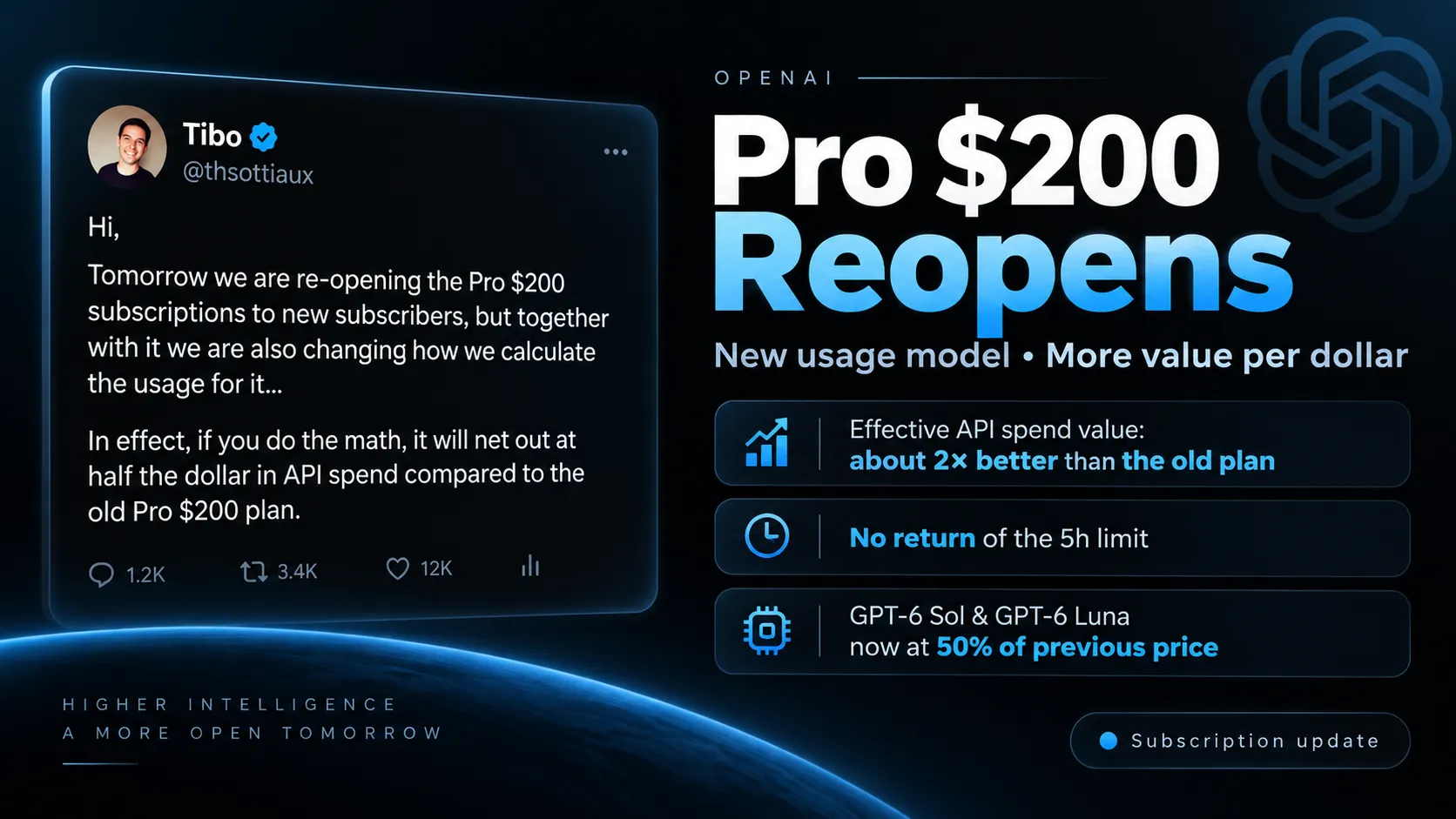
- OpenAI plans to reopen the $200 Pro subscription to new subscribers on September 30, 2026, according to Tibo Sottiaux's announcement.
- The biggest change is a new way of calculating included usage. Tibo says the reworked plan will amount to roughly half the API-dollar-equivalent spend of the old $200 Pro plan.
- That does not automatically mean subscribers get 50% fewer completed tasks. GPT-6 Sol and GPT-6 Luna were introduced at substantially lower API prices, so similar model usage can carry a much smaller dollar value.
- OpenAI is also committing to not reintroducing the five-hour limit, allowing subscribers to use their weekly allowance when they need it instead of being constrained by a shorter rolling window.
- Some new subscription features scheduled to be announced on September 30 will reportedly not draw from the main usage allowance.
- The exact new weekly allowance, model multipliers, and list of zero-usage features have not yet been published. Those details matter more than the headline API-dollar comparison.
What OpenAI Is Changing With the $200 Pro Plan
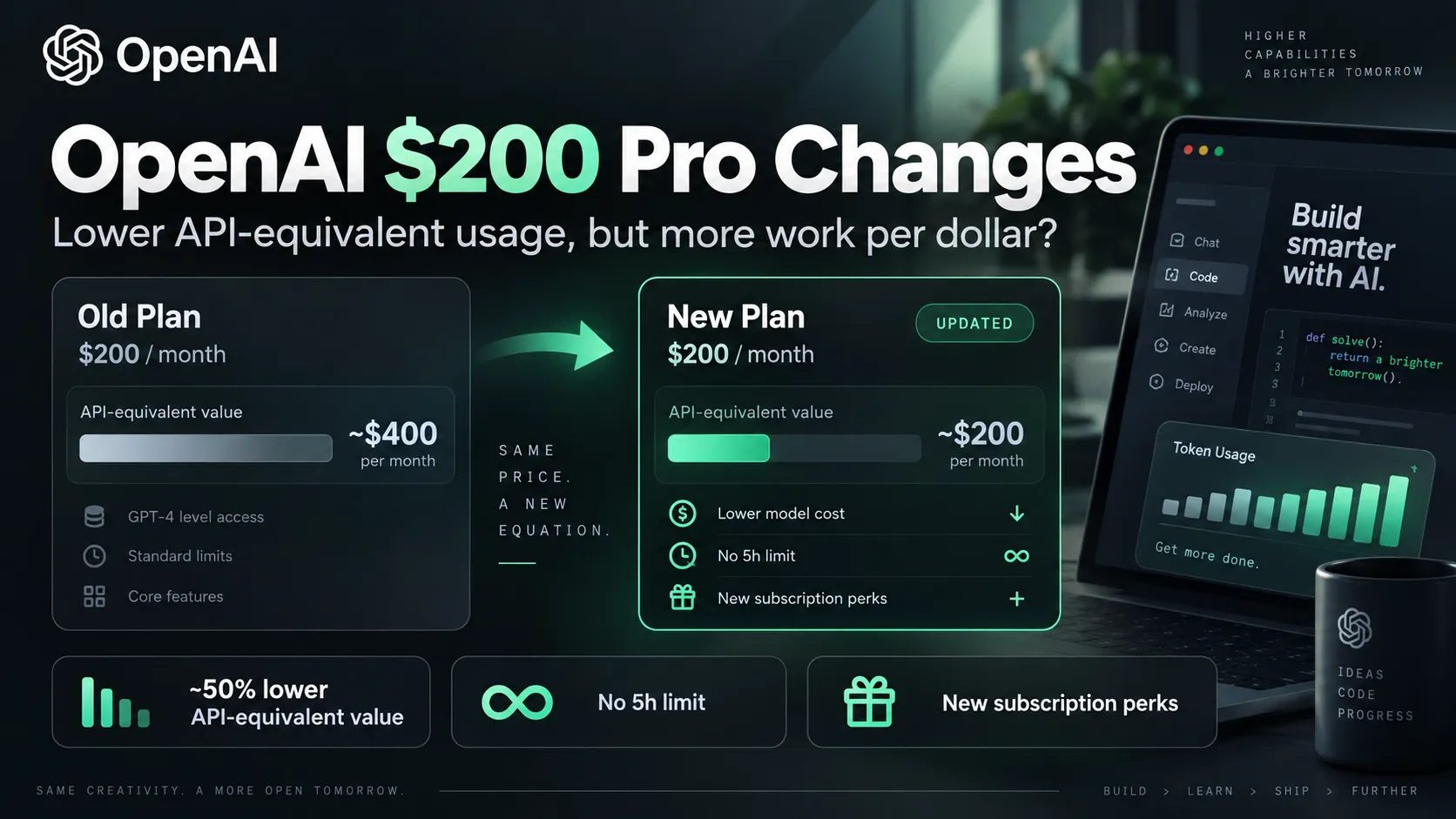
OpenAI is reopening its $200 Pro subscription to new subscribers, but the plan will use a different calculation for included usage.
The most important statement from Tibo Sottiaux is that, after the new calculation is applied, the plan will effectively provide half the dollar amount of API spend compared with the old $200 Pro plan.
That wording is easy to misinterpret.
It does not necessarily mean:
- the subscription price falls to $100;
- users receive literal API credits;
- every model gets half as many messages;
- every coding task gets half as much compute; or
- the weekly allowance is simply reduced by 50% in real task terms.
ChatGPT subscription usage is not the same thing as an API credit balance. Usage can depend on the model, task size, reasoning level, caching, Fast mode, and the number of steps an agent performs.
The more accurate interpretation is that the API-dollar-equivalent value assigned to the included usage is being recalibrated downward.
Why Half the API-Dollar Value Can Still Mean Similar Real Usage
The key variable is API price.
Imagine an older Pro plan allowed enough model usage that the same workload would have cost $400 through the API.
Suppose the relevant model's API price then falls by 50%.
The same workload could now be worth only $200 at the new API rate:
- Old allowance: $400 of API-equivalent work
- Old cost per representative task: $4
- Approximate tasks: 100
After a 50% price reduction:
- New allowance: $200 of API-equivalent work
- New cost per representative task: $2
- Approximate tasks: 100
The nominal dollar value falls by half, while the amount of model work can remain similar.
This example is illustrative. Tibo did not disclose a specific new dollar allowance in the post.
That distinction is critical when evaluating whether the new subscription is actually worse for users.
GPT-6 Sol and Luna Changed the Economics
Tibo specifically points to GPT-6 Sol and GPT-6 Luna becoming much cheaper than their predecessors.
If a subscription's included usage is compared against API list prices, falling API prices automatically make an unchanged workload look less valuable in dollar terms.
That means a metric such as $500 of API-equivalent usage is not stable over time. It can shrink even when the number of useful tasks does not.
This is the foundation of OpenAI's argument for changing the Pro calculation.
The Better Metric Is Work Completed per Dollar
For an AI coding subscription, raw token quantity is increasingly a weak measure of value.
A more useful metric is:
successful work completed per subscription dollar
A newer model can improve that metric in several ways:
- fewer tokens needed to solve the same problem;
- fewer failed attempts;
- fewer corrective prompts;
- better tool selection;
- better code edits on the first pass;
- less unnecessary reasoning;
- more efficient reuse of repository context; and
- cheaper inference.
For Codex-style workflows, this matters because long-running coding tasks often reuse substantial repository context. Better caching and more efficient models can reduce the economic cost of completing the same task.
Why Removing the Five-Hour Limit Matters
The second major part of the announcement may matter more to heavy Codex users than the API-dollar headline.
Tibo says OpenAI is committing to not reintroducing the five-hour limit for the reopened $200 Pro subscription.
A short-window limit can create a situation where a subscriber still has weekly capacity available but cannot continue working because the smaller rolling window has been exhausted.
Removing that restriction makes the weekly allowance more flexible.
A developer could potentially use a much larger portion of the weekly pool during one intensive coding session rather than spreading the same amount of work across multiple time windows.
This is particularly valuable for workloads such as:
- large repository refactors;
- framework migrations;
- long debugging sessions;
- multi-file feature implementations;
- autonomous coding tasks;
- weekend development sprints; and
- repository-wide reviews.
For these users, when compute can be consumed can be almost as important as how much compute is included.
Pro Usage Is Not Necessarily One Single Limit
Another important distinction is that ChatGPT conversations and coding-agent usage may not share one universal quota.
Different models, surfaces, and features can have different limits or usage calculations.
Therefore, users should not assume Tibo's statement means every Pro limit across ChatGPT will simply be divided by two.
The September 30 announcement needs to clarify several separate questions:
- What is the new Work or Codex weekly allowance?
- Do normal ChatGPT message allowances change?
- How are GPT-6 Astra, Sol, and Luna weighted?
- Does reasoning level change usage consumption?
- Does Fast mode use a different multiplier?
- Which new subscription features consume zero usage?
Until those figures are published, the statement Pro usage was cut exactly 50% is too broad.
What Half the Dollar in API Spend Really Means
The phrase is best understood as an accounting comparison.
Suppose a subscription includes a quantity of model compute represented by C, while the API price per unit of that compute is P_old.
The API-equivalent value is approximately:
C × P_old
If the relevant model price falls by 50%, the same quantity of compute could have a new API-equivalent value of:
C × 0.5 × P_old
The reported dollar value falls by half even if C remains unchanged.
Real workloads are more complicated because:
- input and output tokens have different prices;
- cached tokens may be substantially cheaper;
- models have different rates;
- reasoning settings can affect consumption;
- agentic tasks may execute many steps; and
- tool calls can change the overall task cost.
But the underlying economic principle remains the same.
Why OpenAI Says It Is Making This Change
Tibo's explanation points to a broader pricing philosophy.
If a subscription is marketed primarily by saying it contains a certain dollar amount of API-equivalent usage, OpenAI has a strange incentive to keep API list prices high.
For example:
- $500 of included usage sounds more generous than $250;
- but if API prices are reduced by 50%, both figures could represent similar compute;
- therefore, maintaining a high nominal subscription value could discourage API price reductions.
Tibo says OpenAI wants the opposite incentive.
The company wants to continue reducing API prices as models become more efficient while allowing the subscription's nominal API-equivalent value to adjust accordingly.
Over time, this could narrow the difference between two ways of buying OpenAI compute:
- paying a fixed subscription for bundled usage and product features; and
- buying additional model usage directly as needed.
That represents a meaningful shift away from viewing Pro simply as an oversized discounted compute bundle.
Why Model Efficiency Matters More Than Token Quantity
Suppose an older model needs three attempts to fix a difficult bug:
- inspect the repository;
- propose an incorrect change;
- analyze the failure;
- produce another patch;
- run tests;
- correct a second issue; and
- finally complete the task.
A better model might solve the same problem in one pass.
Even if both models have access to the same nominal token allowance, the newer model produces substantially more useful work from it.
That is why raw token counts can become misleading as models improve.
The practical value of a coding subscription depends on:
useful output = available compute × model efficiency × task success rate
Reducing the cost of compute while simultaneously increasing model capability can therefore offset a smaller nominal allowance.
The Old Usage Multiplier Labels May Become Less Useful
Simple labels such as 5x or 20x usage are only useful if the underlying usage unit remains stable.
Once OpenAI changes:
- model pricing;
- model efficiency;
- model-specific weighting;
- reasoning multipliers;
- short-window restrictions;
- weekly limits; and
- which features count against usage,
a single multiplier can hide more than it explains.
For power users, the better comparison is:
| Metric | What to Measure |
|---|---|
| Weekly throughput | Number of useful coding tasks completed |
| Burst capacity | Whether a long session can continue uninterrupted |
| Model mix | How expensive Astra is relative to Sol or Luna |
| Reasoning cost | How much higher reasoning levels consume |
| Fast mode cost | Whether lower latency consumes additional allowance |
| Context efficiency | How repository size affects usage |
| Included features | Which tools do not consume the shared pool |
| Overage economics | Cost of continuing after included usage is exhausted |
These metrics reveal the practical value of Pro much better than a nominal API-dollar figure.
Who Could Benefit From the New $200 Pro Structure?
The change could be favorable for several types of users.
Burst-heavy Codex users: Removing the five-hour restriction makes a weekly allowance more flexible for long coding sessions.
Users who route tasks across models: Routine jobs can potentially use Luna or Sol while the most expensive model is reserved for difficult problems.
Large-context workflows: Better caching and more efficient context handling can lower the cost of repeated repository analysis.
Users of zero-usage features: If important new capabilities are excluded from the main usage pool, their effective subscription value increases without increasing the nominal quota.
Developers focused on task throughput: A stronger model that completes tasks in fewer attempts can produce more useful work from the same amount of compute.
Who Should Be More Cautious?
The new structure is not automatically better for every subscriber.
Several factors could reduce its value for certain workloads.
A lower real weekly ceiling could still matter. A lower API price does not guarantee a perfect one-to-one offset for every usage pattern.
Output-heavy tasks may behave differently. Input and output tokens often have different prices, so workloads generating large amounts of code or text can have different economics from workloads dominated by cached input.
Premium-model usage could consume the pool quickly. If GPT-6 Astra has a significantly higher multiplier than Sol or Luna, users who rely on it for almost every task may see their weekly allowance disappear much faster.
Efficiency gains vary by workload. Better benchmarks do not guarantee that every repository, framework, programming language, or debugging scenario will require fewer attempts.
The zero-usage features remain unknown. Their value cannot be incorporated into a serious comparison until OpenAI reveals exactly what they are.
How Pro Users Should Evaluate the New Plan
Once the new subscription rules are live, the best evaluation method is to track a representative week of real work.
For every major task, record:
- model used;
- reasoning level;
- Fast mode status;
- approximate task complexity;
- starting usage percentage;
- ending usage percentage;
- whether the task completed successfully;
- number of retries; and
- whether the final result was actually usable.
Then calculate:
successful tasks ÷ percentage of weekly allowance consumed
This gives a practical measure of subscription efficiency.
A second useful metric for autonomous agents is:
productive agent minutes ÷ percentage of weekly allowance consumed
Tracking these metrics for one or two weeks will reveal far more than comparing nominal API-dollar values.
A Practical Model-Routing Strategy
If different models consume allowance according to their relative cost, using the strongest model for every task is unlikely to be the most efficient strategy.
A reasonable routing approach is:
- GPT-6 Luna: repetitive edits, extraction, formatting, lightweight transformations, and straightforward fixes;
- GPT-6 Sol: feature development, normal debugging, code review, research, and most repository work;
- GPT-6 Astra: difficult architecture decisions, stubborn bugs, complex migrations, and high-complexity multi-step tasks.
The core principle is simple:
Use the cheapest model that can reliably complete the task.
Higher reasoning levels should also be reserved for situations where they materially improve results rather than being enabled by default.
The Most Important Unknown: Zero-Usage Features
Tibo also revealed that OpenAI plans to add more things to the subscription that will not draw on usage.
This could materially change the economics of the plan.
For example, if a frequently used coding or automation feature becomes zero-usage, its effective value could compensate for a smaller metered allowance.
However, OpenAI has not yet revealed what those features are.
Possible examples should not be treated as confirmed until the September 30 announcement specifies them.
This is arguably the biggest unknown remaining in the new Pro structure.
What Is Still Unknown Before September 30
Several critical details remain unannounced:
- the exact new weekly usage amount;
- whether existing $200 subscribers move to the new calculation immediately;
- GPT-6 Astra, Sol, and Luna usage multipliers;
- how reasoning levels affect consumption;
- whether Fast mode has a separate multiplier;
- whether purchased additional usage changes price;
- whether normal ChatGPT message limits change;
- the exact list of features that consume zero usage; and
- whether any regional differences apply.
These details can materially change whether the new Pro plan is better or worse for a particular user.
FAQ
Is OpenAI cutting the $200 Pro plan by 50%?
Tibo says the new calculation results in roughly half the API-dollar-equivalent spend of the previous $200 plan. That is not necessarily equivalent to reducing actual completed tasks by 50%, because model prices and efficiency have changed.
Does the $200 Pro plan include actual API credits?
No. ChatGPT subscription usage and API billing are separate products. The API-dollar comparison is a way of describing the economic value of model usage rather than a cash API balance.
Will the new $200 Pro plan have a five-hour limit?
According to Tibo's announcement, OpenAI is committing to not reintroducing the five-hour limit for the reopened subscription.
Why can a smaller dollar allowance perform the same amount of work?
Because a dollar buys more model inference after API prices fall. If the cost of completing a representative workload decreases by roughly the same proportion as the nominal allowance, real task capacity can remain similar.
Does this mean all ChatGPT Pro limits are being cut in half?
No such conclusion can be drawn from the announcement alone. Different ChatGPT surfaces, models, and coding tools can use different limits and calculation methods.
Is the new $200 plan better than the old one?
That cannot be determined from the API-dollar figure alone. The answer depends on the final weekly allowance, model multipliers, absence of the five-hour limit, model efficiency, and which new features do not consume usage.
Conclusion
The headline sounds straightforward: OpenAI's reopened $200 Pro plan will represent roughly half as much API-dollar-equivalent usage as the previous version.
But API-dollar value is not the same thing as productive capacity.
If GPT-6 models cost substantially less to run, perform tasks more efficiently, and can be used without a five-hour rolling restriction, a smaller nominal dollar allowance can still support a similar or greater amount of real work.
OpenAI is also adding subscription features that reportedly will not consume the main usage allowance, potentially increasing the plan's effective value further.
The real test is therefore not how many API dollars the plan appears to include.
The useful questions are:
- How many successful tasks can be completed each week?
- Which models consume the allowance fastest?
- Can users spend the weekly pool whenever they need it?
- Which new features cost zero usage?
- How much additional usage costs after the included allowance is exhausted?
For developers using Pro primarily for Codex, those numbers will determine whether the September 30 plan is genuinely better, worse, or simply a new pricing model for roughly the same productive capacity.
Continue Reading
More articles connected to the same themes, protocols, and tools.

Referenced Tools
Browse entries that are adjacent to the topics covered in this article.