On This Page8 sections
Key Takeaways
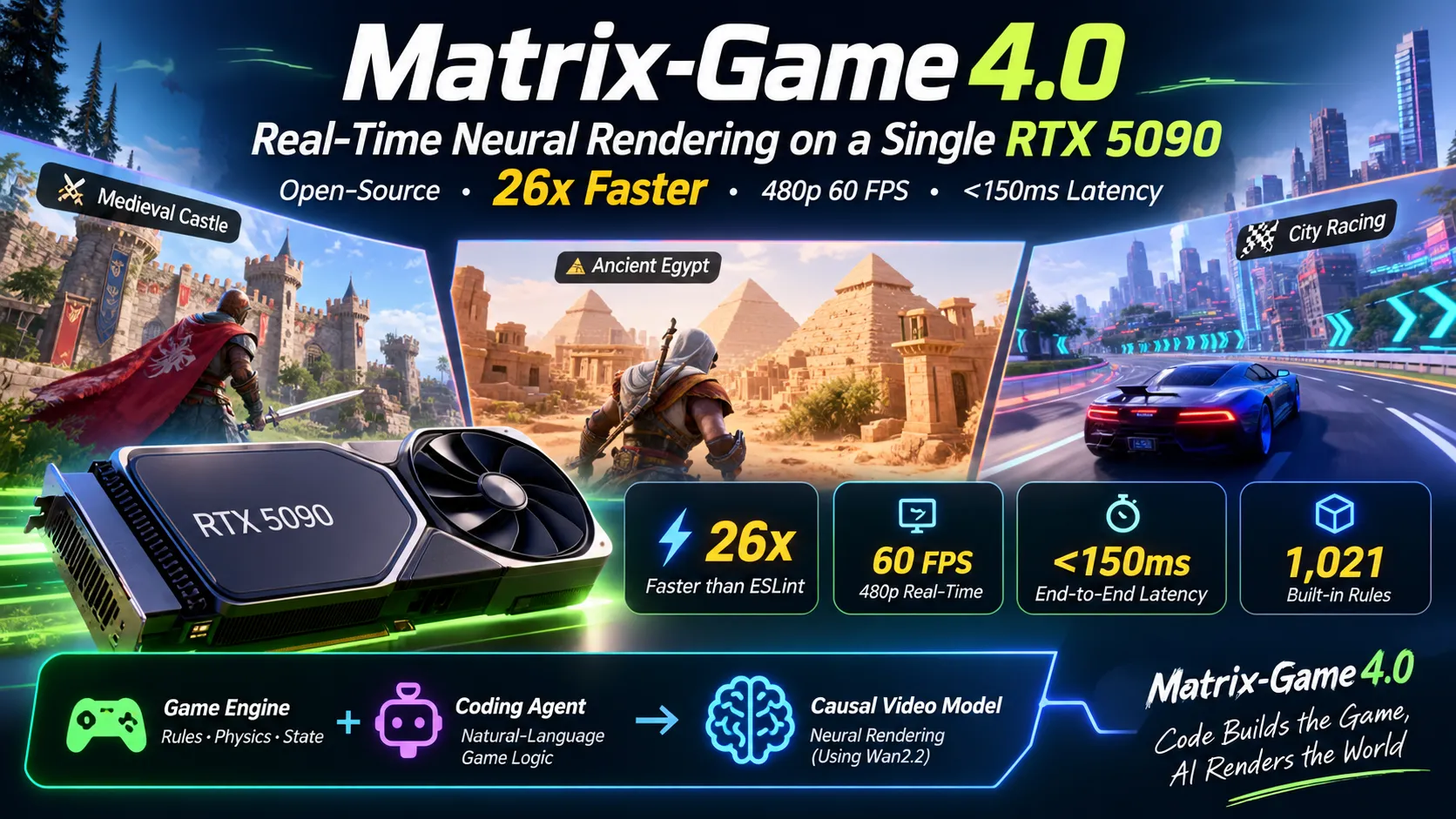
- Matrix-Game 4.0 (Skywork AI / Kunlun Tech, released 15 October 2026) is an open-source interactive world model that splits responsibilities: a conventional game engine owns rules, physics, and state while a causal video model performs streaming neural rendering.
- Company and independent reports indicate 480p at 60 FPS on a single RTX 5090 with end-to-end key-to-frame latency under 150 ms (measured ~112 ms in some tests) and peak VRAM around 18.5 GiB.
- The “Harness” design keeps world state explicit in code so visual generation errors cannot corrupt health, inventory, or mission progress; a coding agent can rewrite rules from natural-language requests.
- Three playable scenes ship with weights: Medieval Castle and Ancient Egypt (third-person shooters) plus City Racing. License is Apache-2.0.
- Compared with contemporaneous research systems (StreamRender-H3, Code World Model, AgentGarten), Matrix-Game 4.0 reports substantially lower latency while running on consumer rather than multi-GPU datacenter hardware.
What Is Matrix-Game 4.0?
Matrix-Game 4.0 is the fourth release in Skywork AI’s open interactive world-model series. Unlike pure pixel-rollout world models that must simultaneously remember state, enforce rules, and generate frames, version 4.0 externalizes the first two duties.
A lightweight game engine maintains authoritative state (health, collisions, inventory, checkpoints, AI behavior) and renders a cheap low-poly RGB proxy. A distilled causal video diffusion model (based on Wan2.2 5B architecture) then turns successive chunks of that proxy, plus a dynamic caption and reference frames, into detailed output. HUD elements and audio stay outside the neural path and are composited in frame alignment.
The project site describes the split as “code builds the game, AI renders the world in real time.” Because the engine is ordinary executable code, a coding agent can accept natural-language instructions and rewrite rules (for example, raising weapon fire rate or converting a time-trial race into a pursuit mode).
The Harness Architecture in Detail
Analysis of the released documentation and project materials shows three cooperating components:
- Game engine: Evolves all rule-governed state and outputs a structural low-poly proxy plus camera pose. Spatial memory is retrieved by pose so off-screen objects continue to exist.
- Coding agent: Translates user intent into new engine rules and refined prompts that carry current state. This layer handles requests that pure pixel models cannot reliably satisfy.
- Causal video model: Conditioned on the per-frame proxy, a dynamic caption, and a small set of reference frames. It generates one latent (four frames) per step after distillation to one or two denoising steps. Text encoder, DiT, and VAE all reside on the same GPU.
This design directly addresses long-standing failure modes of pure generative world models: state vanishing when objects leave the camera frustum, rule drift, and irreversible corruption of game logic by visual artifacts. Because state lives in code, a mismatched frame cannot change a player’s health or item ownership.
Performance Numbers and Hardware Requirements
Reported figures (company claims via QbitAI and repository measurements) include:
- RTX 5090 (consumer, 32 GB): steady-state generation ~83 FPS with one denoising step and ~57 FPS with two steps; games run at 60 FPS; end-to-end latency <150 ms; peak VRAM ~18.5 GiB. Text encoder, DiT, and VAE stay resident.
- A100 80 GB (repository measurements, 864×480, one denoising step, TAEHV codec, CUDA graphs): Castle / Ancient Egypt fixed-prompt ~38–39 FPS model processing; Racing fixed ~38.5 FPS; Racing dynamic ~28.9 FPS (server-side online pipeline).
Optimizations cited for the single-GPU path include CUDA Graph capture of the DiT backbone, fused custom kernels for RoPE / normalization / FP8 quantization, recomputation of text-condition KV only on caption changes, and a ring-buffer for video-history KV.
The release notes state that optimized inference code for RTX 50-series cards was planned shortly after the initial drop. The system currently targets Linux, Python 3.12, and NVIDIA GPUs; the tested stack uses PyTorch 2.12.0 / CUDA 13.2.
Comparison with Peer Approaches
Public comparisons position Matrix-Game 4.0 against several contemporaneous systems:
| Approach | End-to-End Latency | Compute Requirement | Open-Source Status |
|---|---|---|---|
| Code World Model | ~10.2 s | 1× H200 141 GB | Released |
| StreamRender-H3 | ~545 ms | 8× GB200 | Released |
| AgentGarten | ~878 ms | 1× H100 | Partially released |
| Matrix-Game 4.0 | ~112 ms | 1× RTX 5090 | Code, weights, assets released |
The latency gap is roughly one-ninetieth of Code World Model and one-fifth to one-eighth of the other two systems while using a single consumer card instead of multi-GPU datacenter hardware. The architectural difference is material: Matrix-Game 4.0 keeps an explicit, inspectable, and editable game state outside the generative model, whereas several alternatives rely more heavily on implicit model memory.
Available Scenes and Assets
Three scenes ship with model weights on Hugging Face (Skywork/Matrix-Game-4.0) under Apache-2.0:
- Medieval Castle (fps-castle) — third-person shooter
- Ancient Egypt (fps-egypt) — third-person shooter
- City Racing (driving_game) — free driving, time trials, and pursuit modes with fixed or dynamic prompts
Game source (C++), assets, sink images, and inference configuration are included. A single-user WebRTC browser demo is provided. Offline rendering paths and native desktop / headless recorders also exist. Long continuous play sessions of 54–99 seconds are reported while maintaining scene and identity consistency via spatial memory and dynamic captions.
Setup and Practical Usage
Basic installation from the repository README:
git clone https://github.com/SkyworkAI/Matrix-Game.git
cd Matrix-Game/Matrix-Game-4
python3.12 -m venv .venv
source .venv/bin/activate
python -m pip install --upgrade pip
python -m pip install torch==2.12.0 torchvision==0.27.0 --index-url https://download.pytorch.org/whl/cu132
python -m pip install -e '.[inference,server,download,test]'
Native games can be built and launched independently of the neural renderer (for example bash scripts/build_game.sh followed by bash scripts/play.sh --scene castle). Online sessions stream the low-poly proxy to the model and composite the returned detailed frames.
Edge cases and tips:
- Dynamic prompts lower measured throughput versus fixed prompts; measure both for a target scene.
- Type-aware or multi-step denoising trades speed for quality; the one-step path is the real-time baseline.
- Because the engine is authoritative, visual glitches do not affect gameplay logic, but severe proxy-to-render mismatches can still degrade perceived quality until the model is reconditioned.
- Single-user WebRTC demo is currently the interactive path; multi-player consistency is listed as future work.
- Resolution is 480p in the published real-time path; a refiner for higher resolution is planned.
Why the Harness Matters
Pure generative world models must compress physics, object permanence, and game rules into latent video dynamics. Small errors accumulate, and objects that leave the frame often disappear. By keeping an executable engine as the source of truth and using the video model strictly as a neural renderer conditioned on a structural proxy, Matrix-Game 4.0 converts those hard consistency problems into ordinary software problems. The coding-agent layer further turns rule changes into a natural-language interface rather than a retraining or prompt-engineering exercise.
The result is a practical path for hobbyist and research experimentation on consumer hardware rather than requiring multi-GPU clusters for interactive rates.
Limitations and Future Directions
Current constraints include 480p output, single-user focus, and the need for careful prompt and reference-frame management to avoid visual drift. The team has indicated plans for a resolution refiner, multi-player perspective consistency, finer image controls, and support for additional game genres. RTX 50-series optimized kernels were scheduled for near-term release after the initial open-source drop.
Community feedback and independent replication will be required to confirm the exact latency and FPS numbers across different system configurations; repository A100 measurements already show lower absolute FPS than the RTX 5090 marketing figures, which is expected given the different measurement methodology and hardware.
Conclusion
Matrix-Game 4.0 demonstrates that an explicit game-engine harness around a distilled causal video model can deliver playable, state-consistent interactive experiences on a single consumer GPU. The open-source release of code, weights, and three complete scenes lowers the barrier for experimentation with neural rendering pipelines.
Clone the repository, download the scene weights from Hugging Face, and measure the one-step versus two-step paths on available hardware to evaluate whether the Harness approach fits a given research or prototyping goal.
Continue Reading
More articles connected to the same themes, protocols, and tools.



Referenced Tools
Browse entries that are adjacent to the topics covered in this article.