On This Page8 sections
Quick answer: Mario Zechner is Independent creator at Pi, best known for creating the Pi Coding Agent. This profile focuses on verified professional work, public product decisions, and why that work matters to AI-assisted software development.

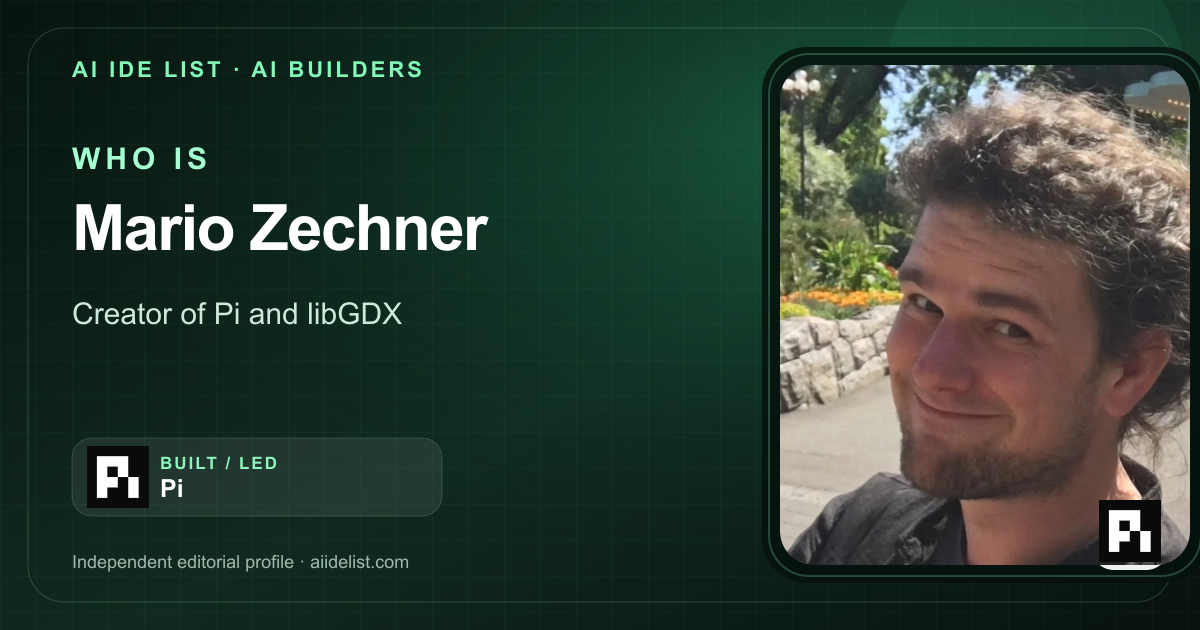
Mario Zechner. Public speaker or profile photograph used for editorial identification. Photo source.
Mario Zechner at a glance
| Current role | Independent creator |
| Company / project | Pi |
| Known for | creating the Pi Coding Agent |
| Field | AI coding agents and developer tools |
| Profile checked | August 31, 2026 |
Who is Mario Zechner?
Mario Zechner is an independent software developer and prolific open-source creator. In the AI coding ecosystem he is best known for Pi, a compact terminal coding agent and library designed to be understandable, extensible, and easy to embed instead of becoming an all-encompassing platform.
This page deliberately avoids unverified claims about private life, age, family, wealth, or education. The useful reason to follow Mario Zechner is the work: creating the Pi Coding Agent, the decisions behind that work, and the way those decisions affect developers.
Career context
Zechner was already well known in open-source development as the creator of libGDX before building Pi. That long experience with small, composable developer tools is visible in Pi’s deliberately minimal harness and extension-first design.
What is Mario Zechner's role in Pi Coding Agent?
Pi exposes the pieces that agent builders often need: a terminal interface, programmatic APIs, RPC mode, extension hooks, model providers, tools, sessions, and compaction. Its deliberately small harness makes it useful both as a daily coding agent and as a foundation for custom interfaces or experiments. Frequent changelog updates show a project optimized for practitioners who care about terminal behavior and host integration.
The product itself is part of a wider market shift. A coding assistant once meant autocomplete inside an editor. The current generation can inspect repositories, run commands, use browsers and external tools, create isolated worktrees, work in the cloud, and return changes for review. Read our Pi Coding Agent profile for the product-level view, or browse the complete AI coding tool directory.
Built, led, and related products
- Pi — a minimal, extensible terminal coding-agent harness.
- libGDX — the cross-platform open-source game-development framework he created.
- Pi extensions and RPC — the surfaces that let developers adapt the agent instead of waiting for a monolithic roadmap.
Explore more profiles in the AI Builders Hall of Fame, then compare the products themselves in the AI coding tool directory.
What does Mario Zechner's work say about AI development?
Zechner's approach is a counterweight to increasingly large agent platforms. Pi asks how little machinery is required to create a capable, controllable coding loop. That minimalism improves inspectability and makes architectural choices visible to developers who want to learn from or modify the harness.
That distinction matters because frontier models are increasingly available through several products. Durable advantages often come from the harness around the model: context selection, permissions, memory, environments, verification, interaction design, and the product judgment that decides how much autonomy to expose.
Why Mario Zechner matters
Mario Zechner belongs in the AI Builders Hall of Fame because creating the Pi Coding Agent connects a recognizable product with a specific builder. Understanding the people behind these tools makes the market easier to read: model announcements explain capability, while builders explain why that capability becomes one workflow instead of another.
For teams choosing a coding agent, the builder's philosophy can be as revealing as a feature table. It influences whether a product is open or closed, terminal- or editor-first, session- or task-centered, local or cloud-oriented, and optimized for close collaboration or high-throughput delegation. Those trade-offs are also why direct AI tool comparisons remain more useful than a single universal ranking.
Career and product timeline
- Earlier: Creates libGDX and becomes a long-running open-source game-tools maintainer.
- Later: Builds small developer and AI experiments under the badlogic identity.
- 2025–2026: Develops Pi as a compact terminal agent with read, write, edit, and bash primitives.
- 2026: Expands Pi through RPC, extensions, model support, and terminal integrations.
What to watch next
The next useful signals will be concrete launches, technical writing, interviews, and changes to Pi Coding Agent. We will update this profile when Mario Zechner's public responsibilities change or when new first-party material adds meaningful detail. A changing job title alone is less important than evidence of what the person is actually building.
Related AI builders
- Explore every AI Builder in the AI IDE List Hall of Fame.
You can also explore Tibo Sottiaux's Codex and ChatGPT profile, our Codex CLI guide, and our Claude Code guide to move between people, products, and competing development philosophies.
Frequently asked questions
What is Mario Zechner known for?
Mario Zechner is best known for creating the Pi Coding Agent. The claim is based on the first-party and reliable sources listed below, not on private biographical databases.
What is Mario Zechner's current role?
As of August 31, 2026, Mario Zechner is Independent creator at Pi. AI-company roles change quickly, so the checked date is part of the answer.
Is this an official biography?
No. This is an independent editorial profile from AI IDE List. It summarizes publicly documented professional information and links readers to original sources for verification.
Sources
Last verified: August 31, 2026. AI IDE List may update this page as roles, products, and public information change.
Continue Reading
More articles connected to the same themes, protocols, and tools.
OpenCode 2.0 Is Here: Code Mode, Background Agents, and a Major Rebuild of the Open-Source Coding Agent
OpenCreator AI Review (2026): The Complete Guide to the Open-Source Codex Creative Workspace
Herdr GUI Is Now Roamgate: The Complete Guide to Managing AI Coding Agents from Your Browser
Referenced Tools
Browse entries that are adjacent to the topics covered in this article.