
On This Page8 sections
A face shape detector answers a deceptively simple question: which broad contour profile does this face most closely resemble in this photo? That distinction matters. A responsible detector does not discover a permanent identity, judge attractiveness, or diagnose anatomy. It estimates visible proportions and returns a useful starting point.
People usually search for a face shape detector because advice about hairstyles, glasses, makeup placement, facial hair, or portrait framing often begins with labels such as oval, round, square, heart, diamond, oblong, and triangle. The problem is that manual measurement is awkward. Hair can hide the forehead, a phone camera can widen the center of the face, and small changes in head angle can make the jaw look narrower or broader.
Modern browser-based detectors can make that first step faster, but the result is most helpful when the tool shows its measurements, confidence, and limitations instead of presenting one label as unquestionable fact.
What is a face shape detector?
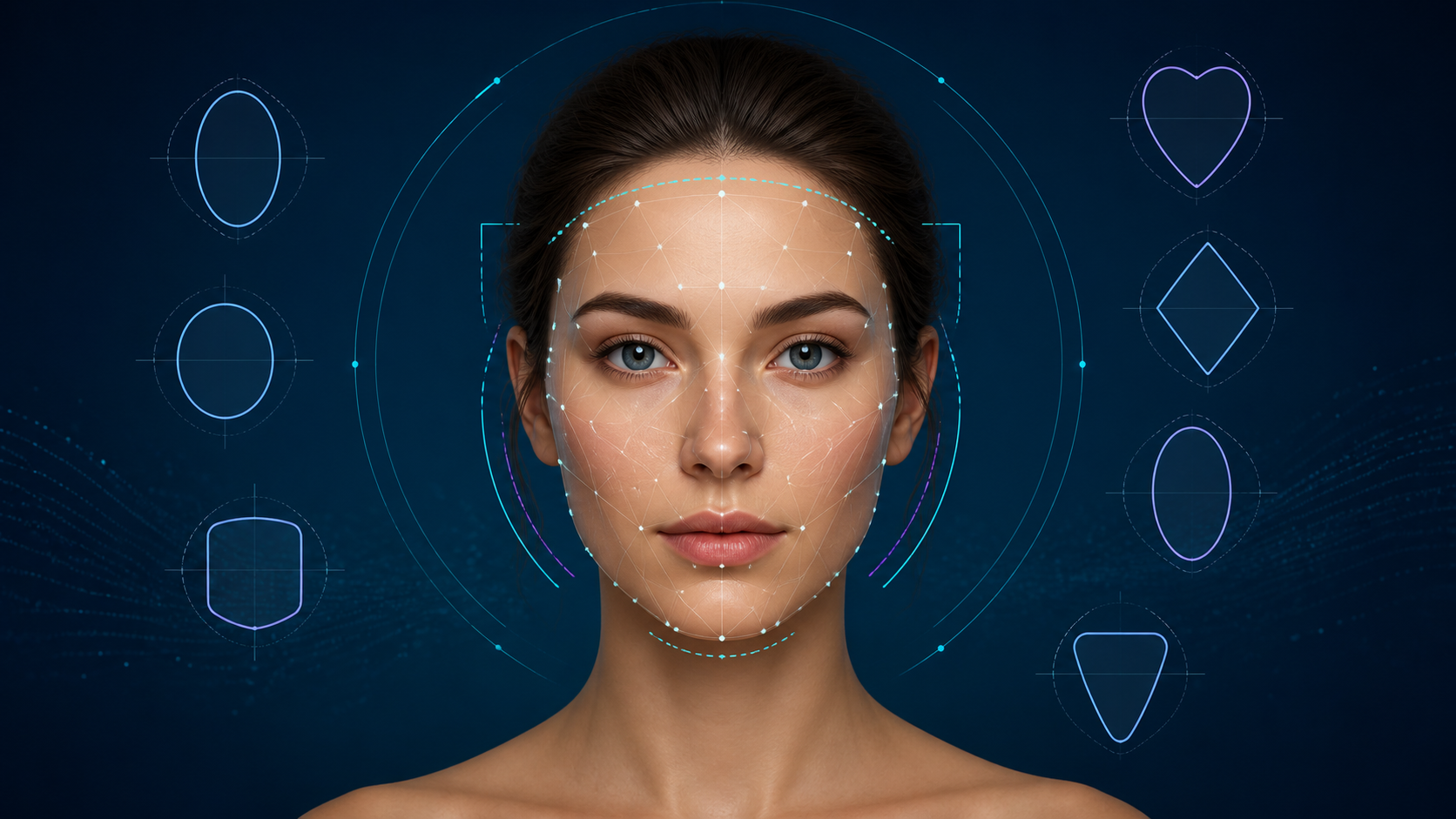
A face shape detector is a photo-analysis tool that compares visible facial contour relationships with broad reference profiles. Depending on the implementation, it may use a facial landmark model, a dedicated image classifier, or a combination of both.
A landmark-based system typically follows this pipeline:
- Detect one face in the image.
- Locate points around the face oval and visible features.
- Estimate measurements such as face length, cheek-level width, forehead width, and jaw width.
- Convert the measurements into ratios so the result does not depend on image resolution.
- Compare those ratios with several reference profiles.
- Return the closest match, ideally with an alternate match and a photo-quality signal.
The Google MediaPipe Face Landmarker can estimate 478 three-dimensional face landmarks from an image or video frame. Those landmarks are not a ready-made face shape answer. A detector still needs its own rules for choosing contour points, correcting visible pose, calculating ratios, defining profile ranges, and handling uncertain results.
Why people use face shape analysis
The practical demand is less about collecting a label and more about narrowing choices.
Hairstyle research
Face shape is often used as one input when discussing where a haircut creates width, height, softness, or diagonal movement. It should not override hair texture, density, growth pattern, maintenance needs, or personal taste. A detector can give someone vocabulary for a conversation with a stylist, not a rule that limits what they can wear.
Eyewear shortlisting
Frame guides frequently compare frame geometry with face contours. A broad face shape estimate can help create a shortlist, but bridge fit, lens position, temple width, prescription requirements, and comfort are more important than a style chart.
Makeup and facial-hair planning
Some users want a neutral outline reference before experimenting with blush placement, contour direction, eyebrow balance, or beard lines. These are creative choices. A photo-based label should never be treated as a correction that a person needs.
Consistent portrait preparation
The analysis can reveal a more immediate problem: the photo itself. If two similar photos return different results, the cause may be head rotation, focal length, lighting, expression, or cropping. That feedback is useful for anyone trying to take consistent profile photos or compare styling ideas under similar conditions.
The seven common face shape profiles
These labels are shorthand rather than rigid biological categories. Different tools may define their boundaries differently, and many faces fall between two profiles.
| Profile | Common visible relationship in a front-facing photo |
|---|---|
| Oval | Face length is greater than cheek-level width, with a gently tapered jaw |
| Round | Length and width are relatively close, with a softer continuous contour |
| Square | Forehead, cheek, and jaw widths are relatively similar, with a broader jaw contour |
| Heart | Forehead or upper face appears broader than the jaw, tapering toward the chin |
| Diamond | Cheek-level width is prominent relative to the forehead and jaw |
| Oblong | Face length is noticeably greater than width, with less taper than a typical oval profile |
| Triangle | Jaw width is more prominent relative to the upper face |
No single ratio is sufficient. For example, two faces can have a similar length-to-width ratio while differing at the forehead or jaw. A useful detector therefore compares several relationships and preserves a runner-up when the evidence is close.
A practical example: private, on-device analysis
One example worth examining is AI Rate Face. Its free Face Shape Detector runs in the browser and keeps the selected photo on the device. The tool uses visible face landmarks to compare face length with cheek-level width and to examine forehead, cheek, and jaw width relationships. It returns a primary and alternate match rather than forcing false certainty.
That design addresses two important user needs. First, the result remains explainable because the relevant ratios and photo confidence stay visible. Second, local processing reduces the privacy cost of trying the tool: the free photo and detected landmarks are held in the browser rather than sent to an analysis server.
The service is intended for adults, and users must own the photo or have permission from the adult shown. Those boundaries are especially important for any product that processes faces.
How to take a better photo for face shape detection
The input photo often matters as much as the classification logic. Use these conditions for a more repeatable result:
- Face the camera directly with the head level.
- Use a relaxed, neutral expression.
- Choose soft, even light from the front.
- Keep the hairline, both cheeks, the full jaw, and the chin visible.
- Pull long hair away from the face if comfortable.
- Remove hats, large glasses, and anything that hides the contour.
- Hold the camera near eye level and avoid an extreme close-up.
- Prefer a normal portrait distance over a wide-angle selfie.
- Use one adult face in the frame.
- Avoid beauty filters, strong retouching, and heavy perspective correction.
For comparison over time, use the same camera distance, lens, lighting, crop, and expression. Even then, treat small differences cautiously.
What can make the result change?
Camera distance and lens perspective
A close phone selfie can exaggerate central features and change the apparent relationship between the middle and sides of the face. Moving the camera farther away and cropping afterward usually produces a more neutral portrait perspective.
Head rotation and tilt
Yaw hides part of one cheek and jaw, while roll changes the visible horizontal reference. Software can estimate pose, but a two-dimensional photo cannot fully reconstruct an obscured contour.
Hair and facial hair
Bangs can hide the forehead boundary. Long hair may blend into the cheek contour, and a full beard can change the visible jaw outline. The detector measures what the photo shows, not what is hidden beneath it.
Expression
Smiling can lift the cheeks and change the lower-face contour. A tense jaw or raised eyebrows can also shift visible landmarks. A neutral expression improves repeatability.
Category overlap
Face shape is continuous. A face can reasonably sit between oval and oblong, round and oval, or heart and diamond. An alternate match is often more honest than a high-confidence single label.
Privacy and safety checklist
Before uploading a portrait to any face-analysis service, check:
- Does the analysis run locally or upload the image?
- If uploaded, how long is the photo retained?
- Is the photo used for model training?
- Can the user delete stored data and results?
- Does the product require consent from the person shown?
- Does it restrict use involving minors?
- Does it avoid medical, identity, ethnicity, personality, and attractiveness claims?
- Are the measurements and important limitations explained?
On-device processing is a strong default for a lightweight geometry task, but local execution alone does not guarantee quality. The product should still explain what it measures and avoid claims that the measurements cannot support.
What a face shape detector cannot tell you
A face shape detector cannot determine health, personality, ethnicity, gender, age, identity, or personal value. It cannot prove which haircut or glasses will look best. It also cannot turn a two-dimensional image into a complete account of three-dimensional anatomy.
The familiar shape categories are styling conventions, not universal scientific truths. Training data, reference ranges, landmark performance, and product design choices can introduce bias. A responsible result should therefore be phrased as a match for one visible photo, not an objective definition of a person.
How to evaluate a face shape detector
When comparing tools, look beyond speed and the number of labels. A stronger product should provide:
- Input guidance so users know how to take a suitable photo.
- Photo-quality checks for pose, framing, clarity, and obstruction.
- Multiple contour measurements instead of one unexplained score.
- An alternate match when categories overlap.
- Visible uncertainty rather than unsupported precision.
- Clear privacy behavior before the user selects a photo.
- Responsible limits that reject medical or identity conclusions.
- Repeatable output under the same photo and model version.
Frequently asked questions
Can AI accurately detect face shape?
AI can estimate the closest broad shape profile from a suitable photo. Accuracy depends on the landmark or classification model, the tool-specific rules, and photo conditions. Because the categories overlap and the input is two-dimensional, the result should be treated as an estimate.
Can a person have more than one face shape?
Yes. Many people sit between categories. A primary and alternate match can describe the visible contour more honestly than a single rigid label.
Is a face shape detector the same as a beauty score?
No. Face shape describes broad contour geometry. It is not a measure of attractiveness, health, symmetry, or worth.
Does face shape change?
The underlying structure is relatively stable in adulthood, but the visible contour can vary with hairstyle, facial hair, expression, body composition, age, camera perspective, and lighting. A photo detector reports what is visible in that image.
Should I use the result as a styling rule?
Use it as a starting point. Comfort, fit, texture, maintenance, individual features, and personal preference matter more than matching a category chart.
Final perspective
The best face shape detector is not the one that sounds most certain. It is the one that turns a photo into understandable contour evidence, protects the image, and clearly separates a useful styling estimate from claims about identity or beauty.
With a clear front-facing portrait and realistic expectations, face shape analysis can reduce guesswork and provide helpful vocabulary for exploring hairstyles, eyewear, makeup, facial hair, and portrait presentation. The label is only the beginning; the measurements, uncertainty, privacy design, and personal context are what make the result useful.
Continue Reading
More articles connected to the same themes, protocols, and tools.


Referenced Tools
Browse entries that are adjacent to the topics covered in this article.