On This Page8 sections
Key Takeaways
- WigglyPaint is a free, open-source browser drawing tool created by Internet Janitor in December 2023 and published primarily on itch.io. It automatically adds a live line-boil (wiggle) effect to every stroke.
- The effect is produced by three simultaneous image buffers that receive slight tool-specific randomization (position offsets, brush variations). The buffers cycle at roughly 12 frames per second.
- Only three official distribution points exist: the itch.io page, the author’s personal site, and Newgrounds. There are no official iOS or Android apps.
- Most top search results for “WigglyPaint” are unofficial clones based on older versions, often generated or enhanced with LLMs, and sometimes monetized with ads or paid wrappers.
- The design intentionally limits options (few colors at a time, single-level undo, discrete tools) to encourage fast, loose drawing and reduce decision fatigue.
- Users seeking the latest features and correct attribution should use the official itch.io version (v1.6 as of April 2026) rather than domain-name lookalikes.
What WigglyPaint Actually Is
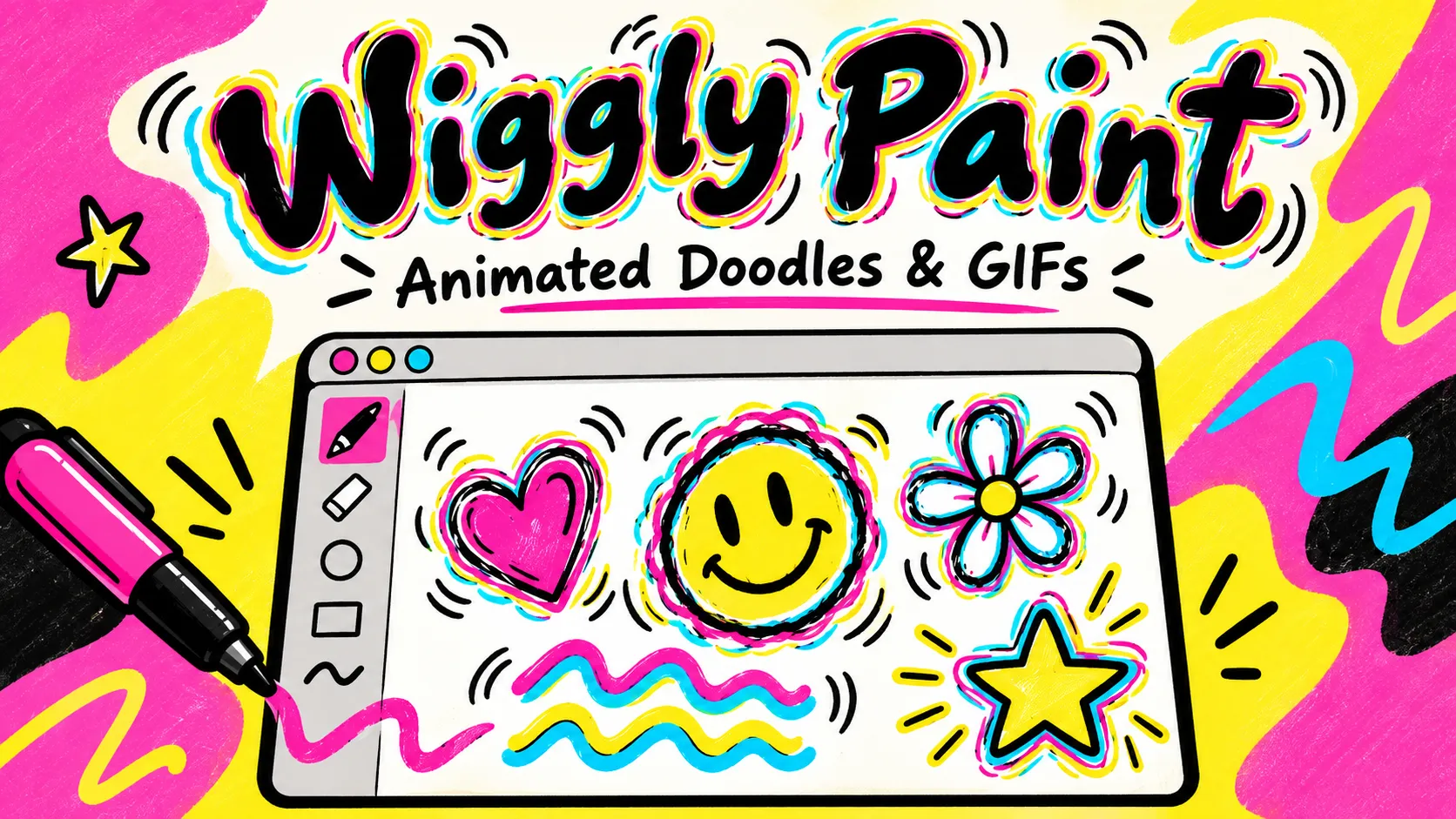
WigglyPaint is a lightweight HTML5 drawing program built on the Decker platform. Its defining behavior is automatic line boil: every stroke begins to jitter and shift the moment it is drawn, turning a static doodle into a continuously moving sketch without any keyframes or timeline.
The program was first released in early December 2023. It shares conceptual DNA with earlier tools such as Shake Art Deluxe (2022) and the playful spirit of KidPix, but its implementation and constraints are distinct. The author has repeatedly stated that no generative AI was used in the tool itself.
Core user flow is deliberately short: choose a tool, draw, optionally crop or adjust, then export a GIF. Average session length reported on the official page is a few minutes, reflecting its design as a quick, low-friction creative outlet rather than a full illustration suite.
How the Line Boil Effect Works
Analysis of the author’s technical notes shows the mechanism is raster-based rather than vector.
WigglyPaint maintains three image buffers and writes to them simultaneously. Different tools apply different forms of controlled randomization:
- Random positional offsets between stroke segments
- Selection among multiple brush shapes or sizes
- Other per-tool variations that create the characteristic wobble
The display cycles through the three buffers at approximately 12 frames per second—a familiar rate for limited animation. Drawing itself remains responsive; the animation is a display-time effect. Three frames is described as the practical sweet spot: two frames produce an unpleasant hard jitter, while additional frames yield diminishing returns in perceived fluidity.
Because the tool is built in Decker, the source remains editable. Users who run it locally or inspect the deck file can introduce new brush shapes or other modifications using Decker’s own tools—an openness that many commercial wrappers deliberately remove.
Design Philosophy and Intentional Constraints
Benchmarks of user behavior and the author’s own documentation indicate several deliberate design choices:
- Strongly discretized options. Rather than exposing continuous parameters for every variable, each tool has a distinct personality and a small set of good defaults. This avoids the “infinite combinatoric landscape” of general-purpose drawing software.
- Limited color model. Only five colors are typically active at once (lineart, background, and three markers), paired with opinionated preset palettes. The goal is visual coherence and faster decisions.
- Single “Oops” undo. Multiple undo levels are technically straightforward, yet the single-level design encourages forward momentum and works more cleanly on touch devices.
- Simplified layering. Markers always draw underneath lineart, removing the need for a full layer stack while still supporting common sketch-to-color workflows.
Community feedback on the official itch.io page frequently highlights the low friction and the way the automatic motion reduces the pressure to produce “finished” art. The constraints appear to function as creative guardrails rather than limitations for the intended short-session use case.
Official Distribution, Versions, and Licensing
The author has published WigglyPaint only on:
- itch.io (primary and most up-to-date location)
- Personal website
- Newgrounds
Code is released under the MIT License; assets are Creative Commons Zero. Offline use is supported by saving the page as a standalone HTML file, or by running the deck inside Decker for improved performance.
Version history (official):
- v1.1–v1.3 (late 2023–early 2024): Core tools and early brush size controls
- v1.4 (October 2025): Additional brush shapes, configurable eraser, more default palettes
- v1.5 (February 2026): New shapes, redesigned Alter panel (crop, flip, invert), stroke mirroring, slider-based color picker
- v1.6 (April 2026): Alter panel refinements, canvas shift controls, simplified scripts for customization, miscellaneous audiovisual and usability improvements
The official page carries an explicit warning that no official mobile apps exist. Any product charging money, inserting ads, or promoting generative AI under the WigglyPaint name is not from the original author.
The Unofficial Clone Landscape
Search results for the term are dominated by domains such as wigglypaint.com, wigglypaint.org, wigglypaint.net, wigglypaint.art, and similar variants. Analysis of these sites and the author’s public statements shows a consistent pattern:
- Many host older builds (commonly v1.3) without updates
- Content is frequently low-quality or LLM-assisted “slop” containing vague claims, incorrect technical details, and unattributed artwork
- Some wrap the tool in WebView shells and sell it as paid iOS or Android apps
- Attribution is often removed or replaced; a few claim official or fan status while adding donation buttons or subscriptions
These clones create several practical problems. Users receive outdated features, cannot easily reach the latest version, and may encounter monetization or data practices absent from the original. The author has described the situation as both a technical and attribution issue, noting that the open-source release was intended for free sharing and modification, not for sealed commercial repackaging under the original name.
Some forks (for example those rebranded as JigglyPaint after communication with the author) have added features such as unlimited colors or community galleries while retaining credit. These remain distinct from the large number of unacknowledged domain-name clones.
Practical Usage and Export
On the official version the workflow is:
- Open the tool in a modern browser (mouse or touch input).
- Select a drawing tool from the available set.
- Draw on the canvas; the line-boil animation appears immediately.
- Use Alter controls if cropping, flipping, or shifting is needed.
- Export the result as a GIF.
For repeated offline use, the “Save As” HTML option produces a self-contained file. Running inside Decker unlocks additional editing of the tool itself.
Common pitfalls reported in community discussion include:
- Accidentally using an outdated clone and missing newer Alter, mirroring, or brush options
- Expecting continuous color pickers or multi-level undo that the original deliberately omits
- Assuming mobile app store versions are official
- Treating the automatic wiggle as a full frame-by-frame animation system (manual frames are not the core mechanism)
Comparisons and Related Tools
| Aspect | WigglyPaint (official) | Shake Art Deluxe | Typical clone sites |
|---|---|---|---|
| Approach | Raster, 3-buffer randomization | Vector control-point offset | Usually older raster copy |
| Color model | 5 colors + presets | Full HSV | Varies, often expanded |
| Official mobile app | None | N/A | Frequently claimed |
| Source availability | MIT + editable in Decker | Proprietary | Usually sealed |
| Update channel | itch.io | Original developer | Stale or absent |
The closest conceptual relative remains Shake Art, yet the two tools optimize for different trade-offs: continuous parameter control versus discrete, personality-driven tools and extreme simplicity.
Risks, Limitations, and Edge Cases
- Clone risk: Domain-name similarity is high; verifying the URL against the official itch.io page is the most reliable check.
- Feature expectations: Users coming from Photoshop or Procreate may find the single undo and limited simultaneous colors restrictive. These are intentional.
- Performance: Browser performance is adequate for typical doodles; heavier local editing benefits from running inside Decker.
- Attribution and licensing: Commercial wrappers that remove credit or lock the Decker editing layer violate both the spirit of the MIT release and the author’s stated wishes.
- AI claims: The original tool contains no generative AI. Any site advertising AI image generation or photo-to-cartoon features under the same name is operating outside the official project.
Conclusion
WigglyPaint remains one of the clearest examples of a small, open creative tool whose primary value lies in a single well-executed idea—automatic line boil—combined with strong constraints that keep the experience fast and approachable. Technical analysis of its three-buffer system, combined with the author’s documented design decisions, explains both its appeal and its limitations.
The dominant practical issue in 2026 is not the tool itself but the surrounding ecosystem of unofficial clones that capture search traffic, ship outdated builds, and sometimes monetize the work without clear attribution. Users who want the current feature set, correct licensing, and ongoing updates obtain the best results by going directly to the official itch.io release.
Explore the current version on the official itch.io page, export a few GIFs, and compare the experience with any domain-name variant to see the difference in currency and fidelity. Continued use and sharing of the original distribution channel remains the most direct way to support the open-source project as it was intended.
Continue Reading
More articles connected to the same themes, protocols, and tools.

Referenced Tools
Browse entries that are adjacent to the topics covered in this article.