On This Page8 sections
Key Takeaways
- Destroy Any Website is a free browser game from Sprite Fusion that turns a website URL into a destructible 2D stickman level.
- The game was released in September 2026 and is developed by Hugo Duprez.
- Players can use seven weapons, grenades, and a jetpack, with multiplayer supporting a host plus up to five friends.
- The original website is not actually modified or attacked. The page is transformed into a temporary game environment inside the browser.
- The game's strongest idea is its URL-to-level mechanic: instead of manually creating maps, it uses existing websites as constantly changing levels.
- Some websites may fail to load because of Cloudflare protection, authentication, browser security policies, or other technical restrictions.
- The game currently focuses on desktop browsers and requires keyboard and mouse controls.
- Beyond entertainment, the project works as a highly effective viral marketing vehicle for Sprite Fusion's broader game-development tools.
What Is Destroy Any Website?
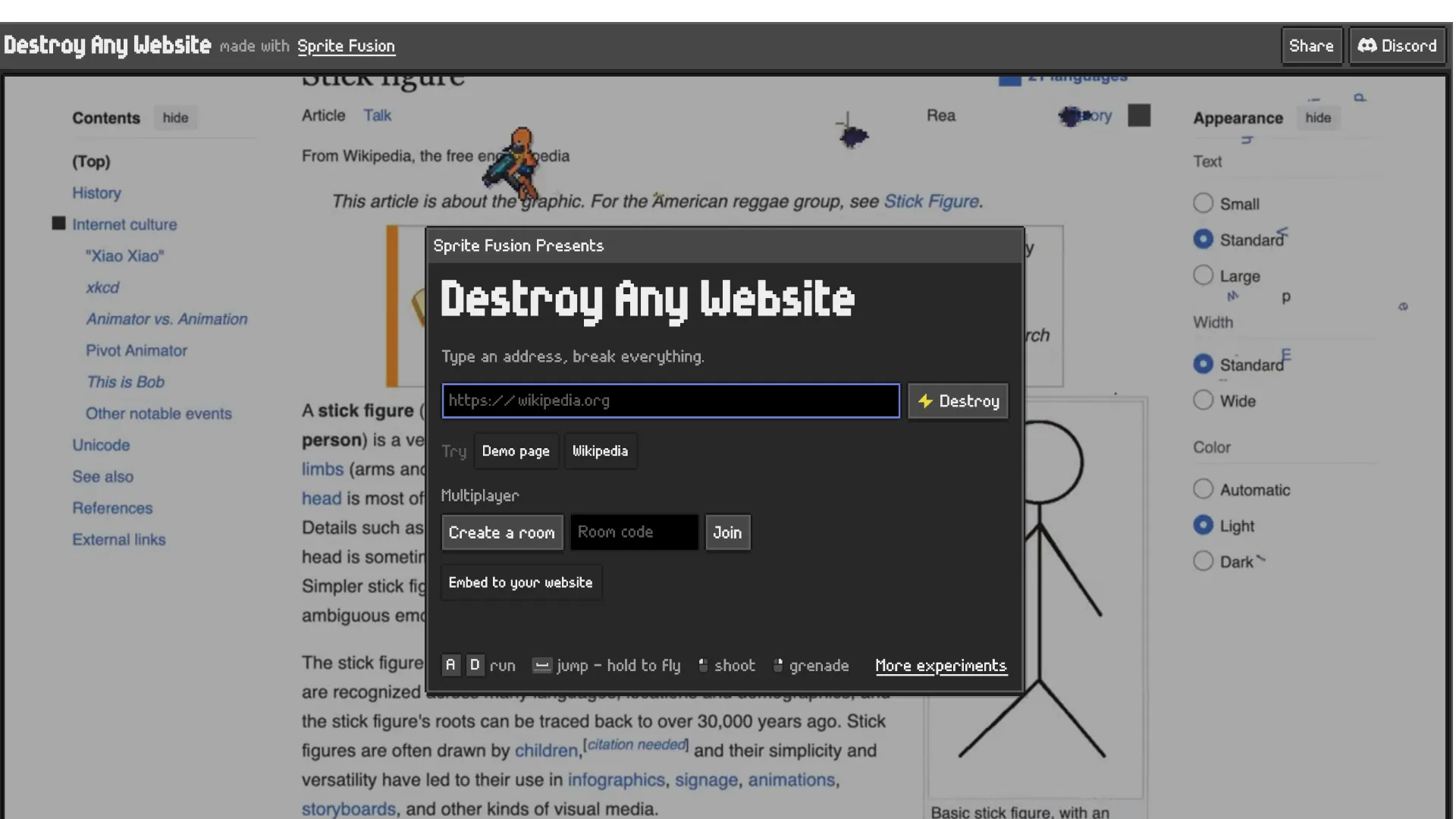
Destroy Any Website is a browser-based stickman shooter created by Sprite Fusion. Instead of placing players inside a traditional handcrafted map, the game asks for a website address.
Enter a URL, click Destroy, and the selected webpage becomes the level.
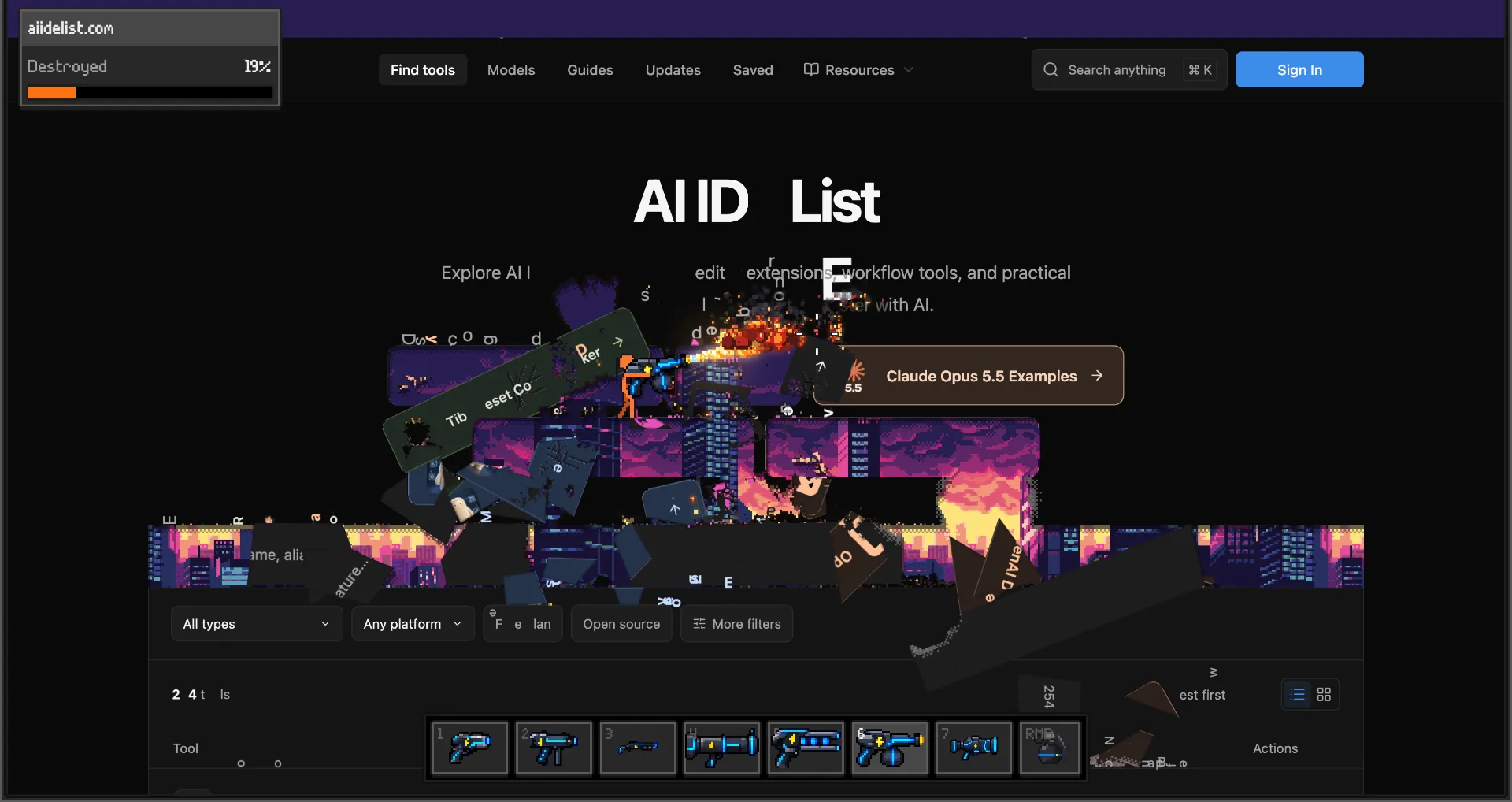
Text, images, navigation areas, cards, buttons, and other page elements become part of a destructible environment. A small armed stickman can move across the page, jump between sections, use a jetpack, and fire different weapons until the destruction meter approaches 100%.
Sprite Fusion officially describes the project as an Action, Shooter, Sandbox, and Multiplayer game. Its core concept is simple enough to understand immediately: turn a website into a level and destroy it.
The game combines several familiar ideas:
- 2D platform shooting
- Physics-based destruction
- Stickman animation
- Browser experimentation
- Old-school desktop destruction toys
- Multiplayer sandbox gameplay
What makes it unusual is that the internet itself effectively becomes the game's map library.
How Destroy Any Website Works
The basic player flow is extremely short:
Enter a URL
↓
Load the website as a playable environment
↓
Control the stickman
↓
Shoot page elements
↓
Increase the destruction percentage
↓
Reach 100% or choose another website
The important distinction is that Destroy Any Website does not delete or modify the actual remote site.
If a player shoots a headline, image, or button, the original website remains unchanged. No content is removed from the publisher's server and no database records are altered.
The better mental model is:
Website → temporary browser game level
rather than:
Website → actual attack target
This distinction is essential because the name is intentionally dramatic, while the underlying product is a visual sandbox game.
How to Play Destroy Any Website
The controls follow familiar PC platform-shooter conventions, making the game easy to learn.
- A / D or arrow keys: move left and right
- Space or W: jump
- Hold Space: use the jetpack
- S: drop downward through supported surfaces
- Mouse: aim
- Left click: shoot
- Right click: throw a grenade
- 1–7 or mouse wheel: switch weapons
- Esc: pause
- Tab: view multiplayer or score information
The short learning curve is important to the game's success.
There is no account creation, progression tree, tutorial campaign, or lengthy onboarding process between discovering the site and experiencing its main mechanic.
A visitor can understand the product within seconds.
Weapons and Destruction
Sprite Fusion advertises seven weapons, together with grenades and a jetpack.
Launch coverage identified weapons including:
- Pistol
- SMG
- Shotgun
- RPG
- Railgun
- Flamethrower
- Missiles
- Grenades
The weapon variety matters because the objective itself is intentionally simple.
Rapid-fire weapons can quickly damage smaller elements, while explosives are useful for clearing larger parts of a page. The railgun creates a more precise destructive line, while the flamethrower emphasizes persistent visual effects.
The jetpack adds another layer by allowing players to reach sections of tall pages without relying entirely on the original webpage layout as platforms.
Without this weapon variety, the novelty of destroying a website could become repetitive very quickly. Different attack styles help turn a visual joke into a more complete sandbox experience.
Multiplayer: Destroy Websites With Friends
Destroy Any Website also includes online multiplayer.
A player can create a room, share the room information with friends, and load the same website as a shared arena.
Sprite Fusion states that multiplayer supports the host plus up to five friends, allowing six players in one session.
The multiplayer interface includes features such as:
- Player names
- Health
- Kills
- Scores
- Rematches
- New website selection
This substantially improves the game's viral potential.
Single-player creates the question:
Which website should be destroyed next?
Multiplayer adds another question:
Which website should the group destroy together?
That naturally encourages users to send links to friends instead of treating the experience as a one-time solo novelty.
Developer comments on Reddit indicate that multiplayer uses Cloudflare Durable Objects for real-time room state and coordination.
The Most Important Idea: Every Website Can Become a Level
The real innovation is not the stickman character or the guns.
It is the URL-to-level mechanic.
Traditional games face a constant content-production problem:
Developer creates level
↓
Player finishes level
↓
Developer must create another level
Destroy Any Website changes the model:
User selects URL
↓
Existing website provides layout
↓
Game transforms layout into a playable environment
This gives the game potentially enormous content variety without requiring the developer to manually design thousands of maps.
A Wikipedia article, ecommerce homepage, portfolio, blog, documentation page, and news website all contain different layouts.
Those differences automatically produce different gameplay spaces.
In product-design terms, this is close to user-selected procedural content.
Instead of generating an entirely new world, the game transforms structures that already exist on the web.
That is one of the most transferable ideas behind the project.
How the Technology Likely Works
Sprite Fusion has not publicly released a complete technical architecture for the game, so detailed implementation claims should be treated as conceptual rather than confirmed source-code documentation.
However, developer comments provide useful clues.
Hugo Duprez explained that pixel-art effects are rendered on a separate layer, allowing the original webpage graphics to stay sharp while game sprites and effects maintain proper pixel-art scaling.
A simplified conceptual architecture could look like this:
Website content and layout
        ↓
Element positions and playable geometry
        ↓
Collision and destruction system
        ↓
Player movement + weapons + explosions
        ↓
Separate pixel-art effects layer
        ↓
Final browser composition
The difficult engineering problem is likely not simply drawing a stickman.
The challenge is making arbitrary webpage structures behave consistently enough to function as game environments.
A browser page contains elements with different positions, sizes, stacking contexts, responsive rules, images, scripts, animations, and dynamically loaded content.
Turning that unpredictable structure into usable game geometry requires normalization and fallbacks.
Why Some Websites Do Not Work
Despite its name, Destroy Any Website does not guarantee perfect compatibility with literally every website.
The developer acknowledged in launch discussions that some pages fail because of Cloudflare protection and similar restrictions.
Modern sites may depend on:
- Cloudflare or other anti-bot protection
- Authentication
- Content Security Policy rules
- Frame restrictions
- Cross-origin resource restrictions
- Session cookies
- JavaScript-heavy rendering
- Protected images or video
- Dynamic API requests
- Region-specific content
As a result, some websites may show:
- Blank areas
- Missing images
- Incomplete CSS
- Broken positioning
- Slow loading
- Failed loading entirely
Simple public webpages are therefore likely to provide more predictable results than complex authenticated applications.
This is currently the biggest limitation of the game's core promise.
Desktop Support and Mobile Limitations
The current version is primarily designed for desktop browsers.
Sprite Fusion lists modern browsers including Chrome, Firefox, Safari, and Edge, while gameplay depends heavily on keyboard and mouse input.
Mobile visitors are currently directed toward using a laptop instead.
This creates an interesting growth limitation.
A large percentage of social-media discovery happens on phones, especially through X, Reddit, TikTok, Discord, and messaging apps. A user may discover a viral video on mobile but be unable to immediately reproduce the experience.
Potential future improvements could include:
- Touch controls
- Landscape mobile mode
- Controller support
- Browser extensions
- One-click destruction of the current tab
Community discussions have already shown interest in several of these directions.
Why Destroy Any Website Went Viral
Destroy Any Website contains several characteristics associated with strong organic sharing.
1. The Concept Fits in One Sentence
Destroy any website with a stickman.
That sentence explains almost the entire product.
Products with low explanation requirements generally perform better in short-form social feeds because users can understand the value before clicking.
2. Every Player Immediately Has an Idea
Most games require players to learn what they should do.
Destroy Any Website asks a much easier question:
Which website should be destroyed?
Players immediately begin thinking about:
- Wikipedia
- Their own website
- A friend's portfolio
- A familiar news site
- A product they use
The product therefore generates its own prompts.
3. The Results Are Highly Visual
A familiar website that has been burned, exploded, shot apart, or reduced to fragments is easy to understand in a screenshot or short video.
No long explanation is necessary.
That makes the game well suited to:
- X
- TikTok
- YouTube Shorts
- Discord
- Instagram Reels
4. It Uses Nostalgia
Community reactions frequently compare the project with old desktop destruction applications, Flash stickman games, and early internet animation culture.
The concept therefore combines two forms of appeal:
- A modern browser experiment
- A familiar early-2000s destruction-game feeling
This combination gives the game a broader emotional hook than the technical implementation alone.
5. Every URL Creates Another Content Opportunity
A traditional game clip may become repetitive once viewers have seen the main level.
Destroy Any Website can continually generate new social content simply by changing the website.
Same game mechanic
+
Different recognizable website
=
New shareable clip
That is a powerful viral-content loop.
Early Community Attention
The project received substantial attention shortly after its September 2026 release.
A September 28 Hacker News snapshot recorded the Show HN submission at approximately 100 points and 27 comments at that point in time.
The launch thread on Reddit's r/aigamedev also received more than 1,000 upvotes in available snapshots, with users discussing the technical implementation, nostalgia, weapons, browser-extension ideas, multiplayer, and mobile support.
Gaming publication Dexerto also covered the project shortly after launch.
These early signals are more useful than monthly traffic-estimation platforms during the first days of a viral launch because Similarweb-style datasets generally need more time before a sudden traffic spike becomes visible in their estimates.
Was Destroy Any Website Built With AI?
Developer Hugo Duprez said in the Reddit launch discussion that Claude Opus 5.5 helped with implementation during the project's rapid development process.
However, his comments also highlighted an important limitation of AI-assisted game development: visual polish still required substantial iteration.
The practical workflow was closer to:
- AI accelerates implementation
- The developer evaluates the result
- Visual effects are refined repeatedly
- Game feel is adjusted manually
- Weak outputs are rewritten or regenerated
- Final polish remains human-directed
That distinction makes the project more interesting than simply describing it as an "AI-generated game."
AI can reduce implementation time, but a polished viral product still depends on strong product taste, iteration, technical judgment, and visual feedback.
The Sprite Fusion Connection
Destroy Any Website is part of the broader Sprite Fusion ecosystem.
Sprite Fusion develops tools for creating 2D games and pixel-art assets, including:
- Browser-based tilemap editing
- AI pixel-art generation
- Sprite animation tools
- Pixel-art editing
- Pixel Snapper
Its tilemap tools support workflows involving engines and formats such as:
- Unity
- Godot
- Phaser
- Cocos
- Bevy
- Love2D
- Defold
- GB Studio
- JSON
- TMX
- PNG
Sprite Fusion also offers paid AI pixel-art plans, giving the company a commercial product behind the free viral game.
This makes Destroy Any Website strategically important.
It is not only a browser game.
It can also function as a playable marketing funnel.
Why the Marketing Strategy Is Clever
The growth loop can be summarized as:
Free entertaining browser game
↓
Player destroys recognizable website
↓
Player shares screenshot or video
↓
New users try different websites
↓
Developers discover Sprite Fusion
↓
Some explore Sprite Fusion's paid tools
This is significantly more engaging than traditional software marketing.
Instead of publishing another article titled "Best Pixel Art Generator," Sprite Fusion created something people voluntarily share.
The game itself demonstrates the company's ability to build polished 2D experiences.
That produces a powerful form of demo marketing.
The user does not need to be told that Sprite Fusion understands games. The game demonstrates that capability directly.
The Embed Feature Creates Another Viral Loop
Destroy Any Website also offers an Embed to your website option.
The concept allows website owners to expose a destruction experience directly from their own site.
This creates another distribution loop:
Website owner adds destruction feature
↓
Visitors discover the game
↓
Visitors interact and share results
↓
More users discover Sprite Fusion
Each participating site can effectively become a new distribution channel.
This is much more scalable than relying entirely on paid advertising or search traffic.
What Could Improve Long-Term Retention?
The current core loop is excellent for first-time discovery:
Choose website
→ destroy it
→ choose another website
However, the same simplicity may limit long-term retention.
Potential additions that could deepen the experience include:
- Daily Website Challenge: every player receives the same target level
- Speedrun Mode: reach 100% destruction as quickly as possible
- Limited Ammo Mode: maximize destruction with restricted ammunition
- Website Difficulty Scores: compare how difficult different layouts are
- Achievements: reward unusual weapon or movement combinations
- Global Statistics: track popular playable domains without implying actual damage
- Shareable Result Cards: generate screenshots automatically after each run
- Replay Clips: save short destruction highlights
- Browser Extension: activate the game directly on the current tab
- Mobile Mode: introduce simplified touch controls
These are logical product opportunities rather than confirmed upcoming Sprite Fusion features.
Is Destroy Any Website Safe for the Original Website?
Destroy Any Website should not be confused with a hacking or website-deletion service.
Using the game does not normally:
- Delete the actual website
- Modify remote database records
- Remove published content
- Obtain administrator access
- Change the target site's server files
- Give the player control of the website
The destruction happens inside the playable representation of the webpage.
This makes the project closer to an interactive visual simulation than a security tool.
Who Should Try Destroy Any Website?
The game is particularly suitable for:
- Fans of experimental browser games
- Players who enjoy sandbox destruction
- Stickman-game fans
- Developers interested in unusual browser interactions
- Indie developers studying viral game mechanics
- Users nostalgic for desktop destruction toys
- Creators looking for short, highly shareable gameplay clips
It is less suitable for players expecting:
- A long campaign
- Deep character progression
- Mobile-first gameplay
- Persistent inventory systems
- Perfect support for every website
The primary appeal remains the novelty of turning a recognizable webpage into a physical, destructible environment.
Frequently Asked Questions
Is Destroy Any Website free?
Yes. The browser game is currently presented by Sprite Fusion as a free experience.
Do you need to download anything?
No. The official game runs directly in a supported desktop browser.
Does it really destroy websites?
No. It creates a destructible representation of the page inside the game. The original site remains intact.
Can it load every website?
No guarantee exists that every site will work perfectly. Cloudflare protection, authentication, browser security policies, dynamic rendering, and cross-origin restrictions can interfere with loading.
Does Destroy Any Website have multiplayer?
Yes. Sprite Fusion states that a host can play with up to five friends.
Does it work on mobile?
The current version is primarily desktop-focused and the game recommends using a laptop rather than a phone.
Who created Destroy Any Website?
The game was developed by Hugo Duprez and published under Sprite Fusion.
Was AI used during development?
Yes. The developer has said Claude Opus 5.5 assisted with implementation, although visual effects and polish still required extensive iteration.
Conclusion
Destroy Any Website succeeds because its entire concept can be communicated in a few words: choose a website and smash it.
Underneath that simple idea is a smart product architecture.
The internet provides the levels. Familiar websites provide immediate context. Weapons provide visual satisfaction. Multiplayer provides social interaction. Embedding creates distribution. Sprite Fusion gains exposure for its broader game-development ecosystem.
The project still has clear limitations. Some protected websites do not load correctly, mobile gameplay is missing, and the current progression system is relatively shallow.
However, its strongest lesson extends far beyond one stickman shooter.
Existing internet content can become game content when a simple transformation mechanic is strong enough.
Instead of building hundreds of handcrafted levels, Destroy Any Website allows players to bring their own level simply by entering a URL.
That combination of recognizable content, instant interaction, user-selected variety, and shareable results explains why the project stands out among browser-game experiments released in 2026.
Continue Reading
More articles connected to the same themes, protocols, and tools.


Referenced Tools
Browse entries that are adjacent to the topics covered in this article.